

The Bayern Ticket is one of the simplest ways to cut your train costs when exploring Bavaria by regional rail. In 2026 it remains popular with both locals and visitors, despite competition from the nationwide Deutschlandticket. This guide explains the current prices, where and when the Bayern Ticket is valid, and how to use it step by step, with concrete route examples you can copy for your own trip.
What the Bayern Ticket Is – and How It Compares to the Deutschlandticket
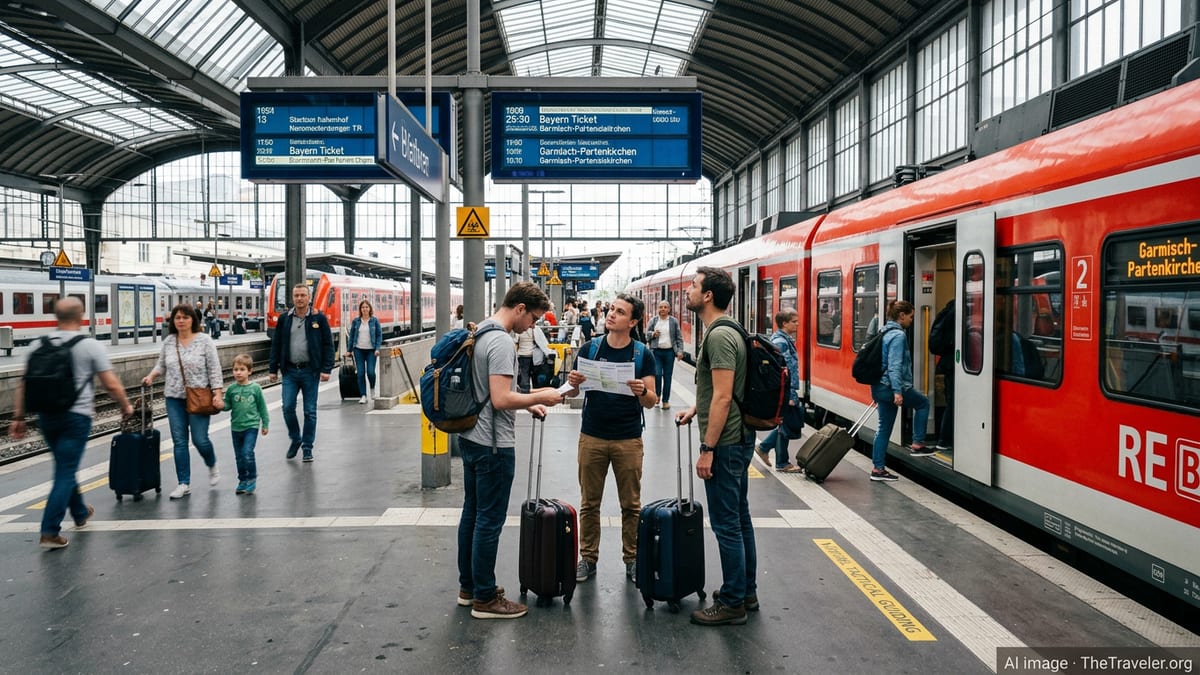
The Bayern Ticket is a regional day ticket offered by Deutsche Bahn and several partner rail companies. It allows unlimited travel on most local and regional public transport in Bavaria for a single calendar day, including almost all regional trains (RE, RB, and S-Bahn), plus many local buses and trams. You pay one fixed price and can ride as much as you like within its validity window.
The key point is that the Bayern Ticket is valid only in Bavaria and on a few cross-border regional routes, for example from Munich to Salzburg on Bayerische Regiobahn (BRB) regional trains or from Nürnberg toward the Czech border on regional services. By contrast, the Deutschlandticket is a subscription valid on local and regional transport all over Germany for a monthly fee of about 63 euros in 2026. The Bayern Ticket is a one-day product that you buy for specific travel days, not a subscription.
For a short trip focused on Bavaria, such as three days based in Munich with day trips to Füssen for Neuschwanstein Castle and to Regensburg or Nürnberg, the Bayern Ticket can work out cheaper and more flexible than starting a monthly Deutschlandticket subscription. For longer itineraries, for instance a two-week rail journey that includes Berlin, Hamburg, and the Rhine, the nationwide Deutschlandticket may be more economical despite its higher total cost.
Think of the Bayern Ticket as a classic regional day pass: buy it on the day, hop on almost any regional train in Bavaria, and stop worrying about individual fares. If you are not ready to commit to a monthly subscription or you only need one or two days of regional travel, it stays very attractive in 2026.
Current Bayern Ticket Prices in 2026
In 2026 the Bayern Ticket is still structured as a group-friendly ticket, with one base fare for a solo traveler and modest surcharges for each extra person up to a maximum of five people in total. Prices are slightly higher than in previous years, broadly in line with other regional day passes in Germany, but they remain good value when you cover longer distances.
As a rough guide, a standard second class Bayern Ticket bought online or at a ticket machine in 2026 typically costs a little over 30 euros for one traveler. Each additional person you add up to five people raises the price but reduces the average cost per person. Families and small groups often end up paying under 20 euros per person for a full day of travel if they plan at least one longer train ride.
First class versions and the Bayern Ticket Nacht, which is valid in the evening and overnight, are more expensive than the daytime second class ticket but follow the same pattern: the first traveler pays the most and each extra person costs somewhat less. You do not receive extra discounts for having a BahnCard; the Bayern Ticket is already considered a special offer, and its price is fixed regardless of railcards.
To judge value, compare the Bayern Ticket with point-to-point fares. For example, a regular one-way second class regional fare in 2026 from Munich to Nürnberg can easily exceed 25 euros. A day return could cost more than the price of a solo Bayern Ticket. If you add a second route, for instance an evening hop on the S-Bahn back from a restaurant in Fürth to Nürnberg, the Bayern Ticket usually comes out ahead on price while also giving you flexibility to change departure times.
Where the Bayern Ticket Is Valid: Trains, Transport Modes, and Borders
The Bayern Ticket is accepted on almost all local and regional trains within Bavaria in both first and second class, depending on which version you buy. That includes DB Regio Regional-Express (RE) and Regionalbahn (RB) services, S-Bahn networks such as the S-Bahn München or S-Bahn Nürnberg, and a wide range of private and regional operators that run under contract in Bavaria. Examples include Bayerische Regiobahn (BRB) trains from Munich to Füssen or Salzburg, agilis services in eastern Bavaria, Berchtesgadener Land Bahn around Berchtesgaden, and Bayerische Oberlandbahn trains to Tegernsee and the alpine foothills.
In practical terms, if the train type is labeled RE, RB, or S (for S-Bahn) in journey planners and the entire route is in Bavaria, the Bayern Ticket is usually valid regardless of whether the operator is Deutsche Bahn or a private company. The ticket is not valid on long-distance categories such as ICE, IC, EC, ECE, Railjet, or Nightjet, even if those trains pass through Bavaria or happen to stop at the same stations. If you see an ICE from Munich to Nuremberg that is much faster than the regional trains, you cannot use the Bayern Ticket on it; you must instead choose an RE or RB option for that route.
Beyond Bavaria’s borders, the Bayern Ticket is recognized on several cross-border regional routes that are popular with tourists. For instance, you can use it on most BRB regional services from Munich to Salzburg, which is in Austria, as long as you take the regional train labeled RE or RB that is covered by Bavarian regional tariffs rather than an Austrian long-distance service. Similarly, some regional lines toward the Czech Republic accept the Bayern Ticket to the first major station after the border. If you are heading to Salzburg in 2026, a typical day might involve taking a morning RE from München Hbf to Salzburg Hbf on a BRB-operated service, using the same ticket all day on local Salzburg buses that accept the Bayern Ticket, then returning on any eligible regional train in the evening.
Within Bavarian cities, the Bayern Ticket generally covers local public transport networks, including S-Bahn, U-Bahn, trams, and city buses, when these systems are part of the regional tariff area. For example, in Munich the Bayern Ticket is accepted on S-Bahn trains throughout the MVV area and on most city trams and buses. This means you can arrive in Munich on a regional train from Regensburg and then continue directly on the S-Bahn to Marienplatz or on a tram to the Deutsches Museum without buying a separate city ticket, as long as you are still within the Bayern Ticket’s time validity.
Time Validity and Off-Peak Rules
The Bayern Ticket is a day ticket, but its exact times of validity depend on the day of the week. On weekdays, from Monday to Friday, the standard Bayern Ticket typically becomes valid in the morning off-peak period, shortly after 9:00, and runs until 03:00 the following day. This means you cannot use it for early commuter trains before around 9:00 on working days. A traveler staying near Munich Hauptbahnhof who wants to take an 08:15 regional train to Garmisch-Partenkirchen on a Tuesday would need a different ticket; the Bayern Ticket would only start to be valid from the first off-peak departure after the designated time.
On weekends and public holidays, the restrictions are relaxed. The Bayern Ticket generally becomes valid from the very early morning, around midnight, and remains valid until 03:00 the next calendar day. In practice this gives you almost a full 24 hours of unlimited regional travel. For example, on a Saturday you could take a 07:00 RE from Munich to Regensburg, spend the day exploring the historic old town, then ride a late evening RB back to Munich around 22:30, all under the same Bayern Ticket.
The Bayern Ticket Nacht is a separate product designed for evening and overnight travel. In 2026 it typically starts at 18:00 and lasts until 06:00 the next morning on weekdays, with extended validity to about 07:00 on Saturday, Sunday, and holiday mornings. This can be useful for attending concerts, festivals, or Christmas markets. A typical use would be catching an early evening S-Bahn from a suburb into central Nuremberg, taking a late regional train home after midnight, and using trams in between, all covered by one night ticket for a small group.
Because these off-peak times and early morning cutoffs may shift slightly with timetable changes and regional agreements, it is wise to reconfirm them when you purchase the ticket in 2026. Ticket machines and the DB Navigator app generally show the current rules, and station staff can point out whether a specific early train is already within the Bayern Ticket’s validity window.
How to Buy and Use the Bayern Ticket Step by Step
Buying a Bayern Ticket is straightforward and can usually be done just a few minutes before travel. The most flexible option in 2026 is the DB Navigator app, where you select the Bayern Ticket under regional offers, choose the date, class, and number of travelers, and pay by card or digital wallet. The ticket is stored in the app with a QR code. At smaller stations in the Bavarian countryside where ticket counters have closed, this can be the easiest method.
If you prefer a paper ticket, almost all ticket machines in Bavarian stations sell the Bayern Ticket. On the main menu, you normally select offers for Bavaria or regional day tickets, then choose Bayern Ticket, specify first or second class, travel date, and number of people. The machine prints a ticket with the travel date and sometimes a field to write the names of all travelers. At major hubs like München Hauptbahnhof, Nürnberg Hbf, and Augsburg Hbf you can also buy the ticket at staffed counters, though a small service surcharge may apply compared with online or machine prices.
Using the ticket on the train is simple. Before boarding your first train, write the full names of all travelers in the spaces provided if required. Everyone named must travel together; the Bayern Ticket cannot be split between separate groups on different trains. When a conductor comes through the carriage, you present either the paper ticket and matching ID or the digital ticket on your phone. If you are using it on city trams or buses in Munich, Nuremberg, or Regensburg, you simply board and show the ticket when asked during random inspections.
For a concrete example, imagine four friends based in Munich planning a day trip to Rothenburg ob der Tauber via Augsburg and Ansbach. On the day of travel, one person buys a second class Bayern Ticket for four travelers on the DB Navigator app. They all board the morning RE from München Hbf to Augsburg using that ticket, change to another RE toward Treuchtlingen, and then an RB into Rothenburg. After sightseeing, they reverse the route in the evening. Even if they end up taking a later return train than planned, their Bayern Ticket remains valid all day, and they do not need to rebook anything as long as they stick to regional categories.
Common Routes and Real-World Savings Examples
The Bayern Ticket offers the best value when you use it for longer regional journeys and when more than one person travels. One classic example is Munich to Füssen and back in a day to visit Neuschwanstein Castle. A regular second class one-way regional ticket in 2026 from Munich to Füssen can come close to the cost of a Bayern Ticket, especially in peak tourist periods. A couple traveling together can often save a noticeable amount by buying one Bayern Ticket, taking the morning regional express to Füssen, the bus to Hohenschwangau that is included within the regional network, and then the evening train back to Munich on the same ticket.
Another popular route is Munich to Salzburg. If you choose the BRB-operated regional express rather than long-distance trains, the Bayern Ticket covers both directions within one day and can also be valid on certain Salzburg city buses. A group of three friends could, for example, leave Munich mid-morning, arrive in Salzburg in time for lunch, take a trolleybus to the old town, visit the fortress, then catch a late afternoon or evening regional train home. If they compared the cost of individual return tickets for each person to the group price of a Bayern Ticket, they would typically find the Bayern Ticket cheaper and simpler.
For those exploring Franconia in northern Bavaria, routes like Nuremberg to Bamberg and on to Würzburg are prime use cases. A traveler might start with an S-Bahn from Nuremberg’s suburbs into the city, continue by RE to Bamberg for a brewery tour, then move on by RB to Würzburg in the afternoon and take an evening RE back to Nuremberg. All these segments are covered by a single Bayern Ticket, eliminating the risk of accidentally boarding a wrong fare zone or buying the wrong local ticket at each city.
The Bayern Ticket can even help with airport transfers when combined with city transport. For instance, if you land at Munich Airport and plan a day trip that ends in Regensburg, you could use the ticket on the S-Bahn from the airport to the city center, then continue on an RE to Regensburg. On another day, you might start in Augsburg, take a regional train to Garmisch-Partenkirchen for hiking, ride local buses to nearby villages, and then return to Augsburg in the evening, all on a single Bayern Ticket that you bought moments before boarding.
Key Restrictions, Pitfalls, and How to Avoid Fines
Despite its flexibility, the Bayern Ticket comes with clear restrictions that you need to respect. The most important is that it is not valid on long-distance rail categories like ICE, IC, EC, or Nightjet. These trains often appear first in journey planners because they are faster, so it is easy for visitors to accidentally select them. If a conductor finds you on an ICE between Munich and Nuremberg with only a Bayern Ticket, you will be treated as traveling without a valid ticket and may face a hefty surcharge.
Another frequent misunderstanding involves the start time on weekdays. Travelers arriving in Munich on an early morning flight sometimes buy a Bayern Ticket at the airport ticket machine and then board an S-Bahn or regional train before the ticket’s weekday start time. If inspected, they can be fined because the ticket is not yet valid. To avoid this, check the printed validity times on the ticket or confirm in the DB Navigator app which trains you are allowed to board. If you must travel before the Bayern Ticket becomes valid, buy a short extra ticket just for the early segment.
Names and group rules also matter. On most versions you must write the full names of all travelers on the ticket before departure and the group must travel together for the ticket to be valid. You cannot, for example, buy a Bayern Ticket for four people and then let two people use it for a morning trip to Regensburg while the other two use a photograph of the same ticket on their phones for a different train. Conductors will check names and may ask for ID, especially when large groups are traveling.
Finally, be careful when traveling near borders or on mixed-traffic lines where regional and long-distance trains run along the same route. On the Munich to Salzburg line, for instance, both BRB regional trains and faster Railjet or EuroCity services operate. The Bayern Ticket is valid only on the regional services. If journey planners offer options labeled IC, EC, or Railjet, you need to deselect those categories and choose RE or RB alternatives, even if they are slower. Watching the train category letters on the departure boards at stations is a simple but effective habit.
When the Bayern Ticket Makes Sense – and When to Choose Other Options
In 2026 travelers in Germany face a choice between regional day tickets like the Bayern Ticket and national offers like the Deutschlandticket or long-distance saver fares. The Bayern Ticket is strongest in several scenarios. The first is the classic day trip from a Bavarian city: a couple based in Munich who want to visit Neuschwanstein or a family in Nuremberg heading to the Franconian wine region. In these cases, the Bayern Ticket usually undercuts the price of two separate regional returns while also covering city transport at each end.
The second sweet spot is for small groups of up to five people traveling together. Because the per-person price drops as you add more passengers, groups of three to five often achieve particularly low average costs when they plan one or two substantial journeys plus some local buses or trams. A group of four students could, for example, plan a Saturday circuit from Regensburg to the Bavarian Forest and back, using regional trains and local buses, and end up paying significantly less per person than if each bought individual day tickets or a separate Deutschlandticket subscription for a short visit.
On the other hand, the Bayern Ticket is less attractive if you need to travel outside Bavaria on most of your days, if you mainly ride long-distance trains, or if you will be in Germany long enough that a Deutschlandticket subscription pays off. Someone staying three weeks in Berlin with only a weekend trip to Munich planned would not benefit from a Bayern Ticket for their everyday commuting in Berlin. Likewise, if you are chasing speed on corridors like Munich to Berlin or Munich to Cologne, discounted long-distance fares on ICE services will be much faster and more comfortable, even though the Bayern Ticket would in theory cover the regional alternative.
It is also worth comparing the Bayern Ticket to other regional day passes such as the Quer-durchs-Land-Ticket, which covers all of Germany on regional trains only, or city-specific day tickets in Munich, Nuremberg, and other large cities. For travelers who plan several medium-length regional journeys across multiple federal states in a single day, a national regional day ticket might be a better fit. When your plans stay squarely within Bavaria, though, the Bayern Ticket’s simplicity and group pricing usually make it the most convenient choice.
FAQ
Q1: Can I use the Bayern Ticket on ICE or IC trains?
No. The Bayern Ticket is valid only on local and regional services such as RE, RB, and S-Bahn, plus eligible city transport. It is not accepted on long-distance categories like ICE, IC, EC, or Nightjet, even if those trains run entirely within Bavaria.
Q2: Is the Bayern Ticket valid from Munich to Salzburg?
Yes, if you take eligible regional trains operated under the Bavarian regional tariff, typically labeled RE or RB and often run by Bayerische Regiobahn. It is not valid on faster long-distance trains such as Railjet or EuroCity on the same route.
Q3: How many people can travel on one Bayern Ticket?
Up to five people can travel together on a single Bayern Ticket. The first traveler pays the base price and each additional traveler pays a smaller supplement. All named passengers must travel together for the ticket to be valid.
Q4: Do children need their own Bayern Ticket?
Small children usually travel for free when accompanied by an adult, while older children may count as one of the people included on the ticket. The exact age rules and family arrangements can change, so it is best to confirm the current policy during purchase in 2026.
Q5: Can I buy the Bayern Ticket on the day of travel?
Yes. You can buy it at any time on the day of travel using ticket machines, the DB Navigator app, or staffed ticket counters in Bavaria. There is no need to book days in advance unless you simply want the peace of mind of having your ticket ready.
Q6: Is the Bayern Ticket valid on city buses and trams?
In many Bavarian cities the Bayern Ticket is accepted on integrated local transport such as S-Bahn, trams, U-Bahn, and buses. For example, you can typically use it on Munich’s S-Bahn and most MVV trams and buses. Always check local notices, as some special services or tourist buses may be excluded.
Q7: What is the difference between the Bayern Ticket and the Bayern Ticket Nacht?
The standard Bayern Ticket is a daytime offer valid from the morning off-peak period until the early hours of the next day, while the Bayern Ticket Nacht is an evening and night ticket valid from around 18:00 until early the next morning. The night version suits late events, concerts, or nightlife-focused trips.
Q8: Do I need to reserve seats with a Bayern Ticket?
Seat reservations are not included and are generally not required on regional trains. Most RE and RB services operate without compulsory reservations, and you simply find any free seat. On busy holiday weekends or popular tourist routes, however, trains can be crowded, so arriving a little early improves your chances of sitting together.
Q9: What happens if my train is delayed when I travel on a Bayern Ticket?
Passenger rights for delays apply to Bayern Ticket holders just as they do for other regional tickets. If you arrive significantly late at your destination, you may be entitled to partial compensation. In practice, for modest delays the compensation amounts are small, but for missed last connections or very long disruptions, staff at major stations can advise on your options.
Q10: Should I buy a Bayern Ticket or a Deutschlandticket for a week in Bavaria?
For a short visit focused on one or two intensive day trips within Bavaria, the Bayern Ticket often works out cheaper and more flexible. If you plan to use local and regional transport every day for several weeks, or if your itinerary spans several German states, a monthly Deutschlandticket subscription may offer better overall value despite its higher upfront cost.