

More news on this day
For decades, air combat was defined by turning performance, pilot eyesight and radar scopes. With the arrival of the F‑35 Lightning II, the focus has shifted toward information advantage, stealthy first strikes and tightly networked formations that fight as a system rather than as individual jets.
Get the latest news straight to your inbox!
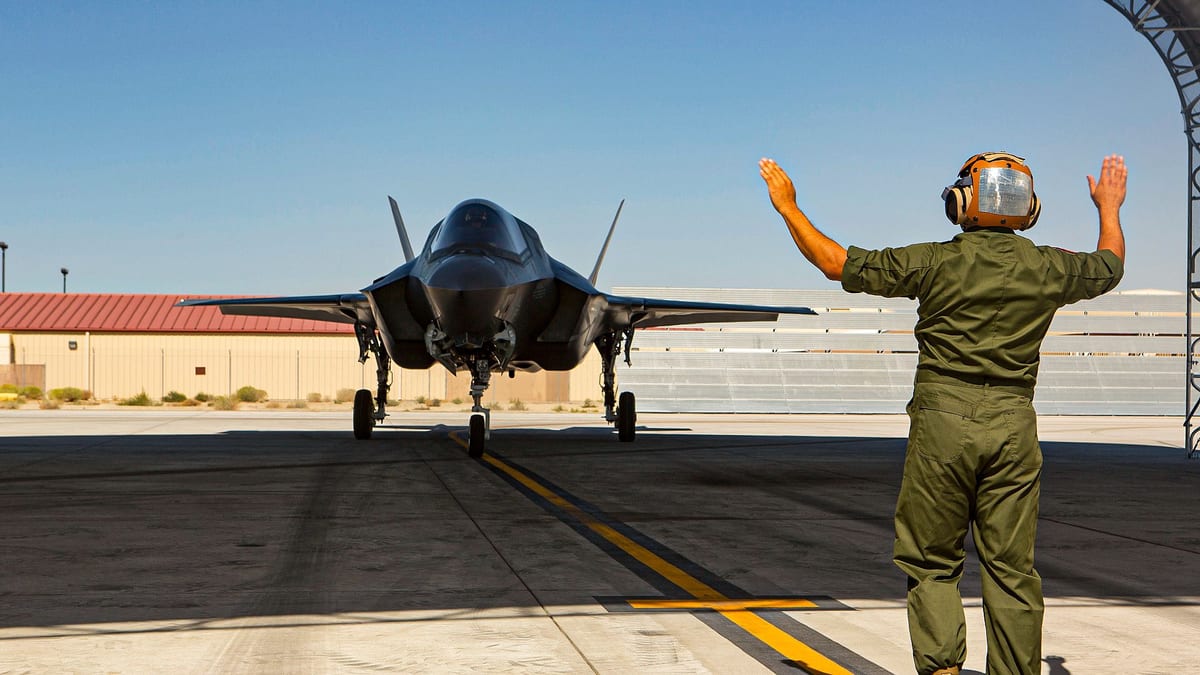
Image by Simple Flying
From Dogfights to Beyond Visual Range Duels
Cold War era fighters such as the F‑4, F‑14 and later F‑15 and F‑16 were built around the idea that air combat would likely end in a maneuvering engagement within visual range. Pilots trained to out-turn and out-climb opponents, using short-range infrared missiles and guns as their decisive weapons. Long-range missiles existed, but limitations in radar, identification and guidance meant visual confirmation often remained essential.
Over time, incremental improvements in radar performance, identification systems and missiles like the AIM‑120 began to push engagements farther out. However, fourth-generation aircraft still relied heavily on pilot workload to manage separate sensors and displays. Situational awareness depended on how quickly a crew could interpret fragmented radar returns, radio calls and offboard information.
The F‑35 consolidated and accelerated this long-running shift toward beyond visual range engagements. Its combination of low radar observability, advanced active electronically scanned array radar, distributed infrared sensors and data fusion is designed to detect and track opponents well before those opponents can return the favor. Reports indicate that training exercises routinely pit F‑35 formations against larger numbers of legacy aircraft to develop tactics that capitalize on striking first from long range.
As a result, contemporary air combat concepts emphasize denying the enemy a chance to reach a traditional turning fight at all. The defining contest is now who can field the better mix of sensors, missiles and networks to locate and target the other side from distance, while remaining hard to find or engage in return.
Sensor Fusion and the Rise of the “Quarterback” Fighter
One of the most profound changes associated with the F‑35 is not a single sensor or weapon, but the way information is combined. Publicly available information describes how multiple onboard systems, including radar, infrared cameras and electronic support measures, feed into a unified picture for the pilot. Instead of managing separate displays, the crew sees an integrated view of friendly, neutral and hostile tracks rendered across the cockpit screens and helmet visor.
This fusion allows the F‑35 to act as a kind of airborne coordinator. Coverage in defense and military journals often refers to the jet as a “quarterback,” indicating its role in orchestrating other aircraft, surface ships and ground-based systems. By sharing a curated tactical picture through secure data links, an F‑35 can guide less advanced fighters or direct long-range missiles fired from other platforms at targets the launching unit cannot itself see.
The implications reach beyond individual engagements. In exercises linked to emerging concepts such as the Advanced Battle Management System and multi-domain operations, F‑35s have been used to collect targeting information and relay it to air defense networks or long-range artillery units. This turns the aircraft into a forward sensor and targeting node for an entire joint force, supporting naval and ground elements in addition to other aircraft.
In earlier eras, fighters were largely consumers of information, relying on ground-based radar or airborne warning and control aircraft to provide cues. With the F‑35, fighters have become both high-value consumers and producers of intelligence and targeting data, blurring the lines between traditional roles in the battlespace.
Networked Formations and Distributed Airpower
The F‑35 was conceived as part of a connected ecosystem rather than a stand-alone asset. Its secure data links are intended to let multiple F‑35s silently share tracks, threat information and weapons assignments, allowing a four-ship formation to operate more like a single distributed sensor and shooter array than four independent jets. This approach builds on wider trends in network-centric warfare, where the quality of connectivity can be as decisive as speed or payload.
In practical terms, this means an F‑35 that detects a threat can support weapons launched by another aircraft, or even by a ship equipped with compatible missiles. The missile can receive midcourse updates from whichever platform has the best view of the target. Training and concept development material shows a growing emphasis on cooperative engagements, where responsibility for sensing, deciding and shooting is shared across the formation.
The networking concept extends to logistics and sustainment. The transition from earlier maintenance information systems to newer cloud-linked tools aims to improve aircraft availability by predicting parts failures and streamlining resupply. While this side of the program has faced setbacks and criticism, it reflects an overarching idea that the fighter is one node in a larger digital infrastructure supporting operations before, during and after combat sorties.
This networking ambition has also influenced basing strategies. Analyses of Pacific scenarios, for example, highlight how short-takeoff variants of the F‑35 could disperse across austere airstrips while remaining connected to higher headquarters and other assets. In contrast with the earlier generation reliance on a few large, vulnerable air bases, distributed operations seek to complicate enemy targeting while still keeping forces synchronized through resilient communications.
Training, Autonomy and the Next Phase of Air Combat
The F‑35’s focus on information advantage has reshaped how pilots train. Instead of centering primarily on close-in maneuvering, contemporary syllabi place greater weight on managing complex sensor suites, interpreting fused data and coordinating with offboard assets. Exercises and simulation environments emphasize large force engagements where F‑35s, legacy fighters, tankers and surface units all share a live data picture.
Recent demonstrations in synthetic environments have combined F‑35 crews with virtual collaborative combat aircraft, sometimes described as loyal wingman drones. According to publicly available program updates, these trials are intended to refine tactics in which a single crewed jet can control or coordinate several uncrewed aircraft, using them to extend sensor coverage, carry additional weapons or probe air defenses.
Researchers are also using advanced simulators and artificial intelligence to explore new beyond visual range tactics. Academic work on reinforcement learning for air combat highlights how algorithms can uncover non-intuitive maneuvers or formation strategies in simulated environments. These insights are then evaluated by human tacticians to see which concepts could translate into real-world doctrine once safety, rules of engagement and technological limits are taken into account.
Historically, pilots relied on experience and manually updated playbooks of tactics. The combination of highly networked aircraft like the F‑35, powerful simulation tools and early autonomy is gradually moving air combat toward a model where new techniques can be iterated and tested more rapidly, potentially shortening the time between concept and frontline use.
Counter-Stealth Advances and the Contested Future
While the F‑35 helped define the current benchmark for stealth and sensor integration, air defenses and rival air forces have been adapting. Open-source analyses describe how integrated air defense systems are incorporating more passive sensors, including infrared search and track, multi-band radars and networked nodes sharing data across large areas. These developments aim to erode the advantages of low observable designs by relying less on any single detection method.
Debate continues among defense commentators over how sustainable stealth dominance will be in the face of denser sensor networks and improved data processing. Some argue that large constellations of infrared and radar sensors, including on uncrewed platforms, will make it harder for any aircraft to remain undetected during extended operations. Others point to the F‑35’s emphasis on electronic warfare, mission data files and software upgrades as a way to adapt its survivability over time.
The aircraft’s own modernization path reflects this tension. Block upgrades focus heavily on computing power, electronic warfare enhancements, expanded weapons options and improved data fusion rather than dramatic external redesigns. At the same time, news and analysis coverage notes that software delays and integration challenges have slowed the pace at which some of these capabilities reach operational units, highlighting how central software has become to modern air combat effectiveness.
As sixth-generation fighter concepts and more advanced uncrewed systems emerge, the environment the F‑35 helped shape is already evolving. Yet the fundamental shift it accelerated remains clear: airpower is now measured less by raw aerodynamic performance and more by how effectively a force can sense, decide and act as a cohesive, data-driven whole on a contested, information-rich battlefield.