

More news on this day
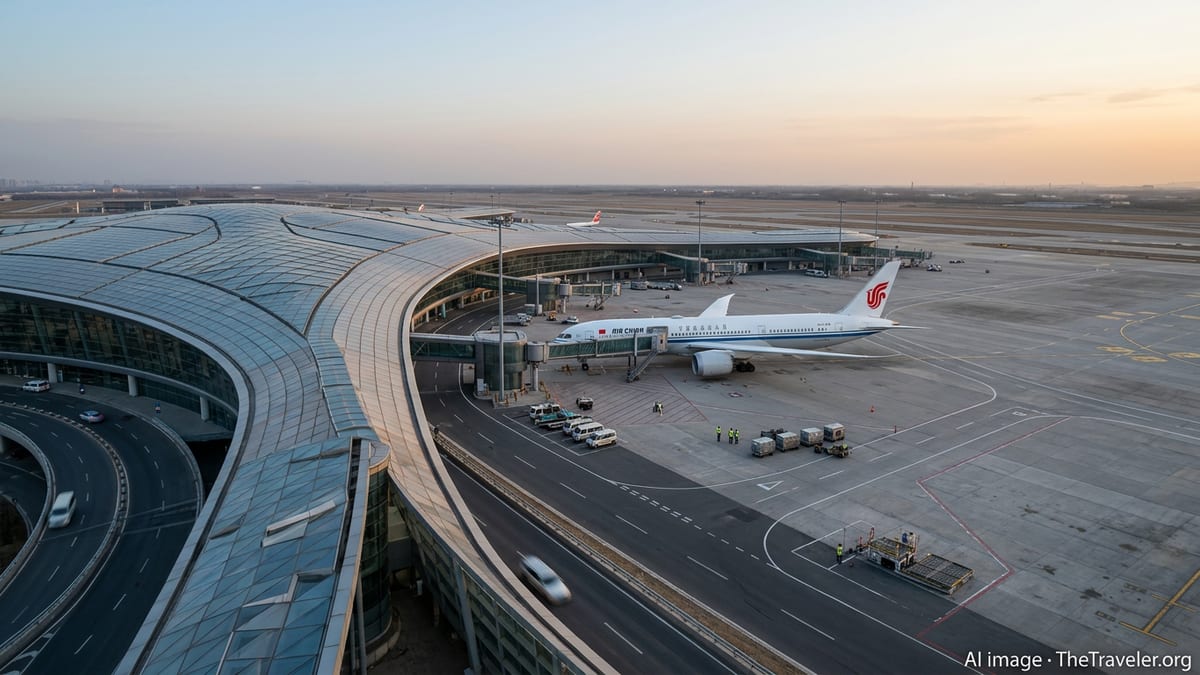
Beijing Daxing International Airport is set to take on a more prominent role in Air China’s long-haul strategy, as new services to Frankfurt and Milan position the capital’s newer airport as a growing competitor to Beijing Capital in Europe–China travel.
Get the latest news straight to your inbox!
New Frankfurt Link Signals Strategic Shift
Publicly available scheduling data and industry reports indicate that Air China is preparing to introduce nonstop flights from Beijing Daxing to Frankfurt, one of Europe’s busiest intercontinental hubs. While Air China has historically concentrated its intercontinental operations at Beijing Capital, a move into Frankfurt from Daxing would give the carrier a second Beijing gateway on a cornerstone Europe route frequently used by business travelers, connecting passengers and cargo shippers.
Frankfurt’s role as a leading Star Alliance hub adds further weight to the planned link. Air China is a Star Alliance member, and an eventual Daxing–Frankfurt service would be expected to feed a wide network of European and transatlantic connections via Germany, while simultaneously channeling passengers into Air China’s domestic and regional network from the Beijing side. Aviation analysts note that this type of hub to hub pairing is central to the recovery of long haul traffic between Europe and China after the severe disruption of the early 2020s.
For Beijing Daxing, the Frankfurt route would mark another step up from predominantly domestic and regional operations toward a more balanced long haul portfolio. Reports tracking capacity at the airport show that long haul frequencies have been steadily increasing as Chinese carriers redeploy widebody aircraft to European, North American and Australasian markets, aided by a gradual easing of traffic and airspace constraints.
Milan Service Builds on Deepening Italy–China Links
In parallel with the expected Frankfurt launch, industry coverage points to Milan as another focus of Air China’s expansion from Beijing Daxing. The airline already has a notable presence at Milan Malpensa through routes from Beijing Capital, Shanghai and Chengdu, and reports on network planning suggest that adding Daxing into the mix is under active consideration as part of a broader Italy strategy.
Over the last several years, Milan Malpensa has become one of Air China’s most important European gateways, with Chinese and Italian demand supported by both tourism and trade. Previous additions from secondary Chinese cities such as Chengdu have been framed in industry analysis as a response to resilient demand in fashion, manufacturing and e commerce sectors. A Beijing Daxing connection to Milan would further diversify routings for passengers traveling between northern Italy and northern China and would give Daxing another high profile European destination.
Published route analyses also highlight that Milan is increasingly functioning as a multi carrier bridge between Europe and China, with several Chinese airlines operating or planning services into Lombardy. In that context, an Air China operated Daxing–Milan route would not only strengthen the airline’s own network but also reinforce Beijing Daxing’s status as a player in the wider Europe–China market alongside Beijing Capital, Shanghai Pudong and Guangzhou.
Beijing Daxing’s Evolving Role in Long-Haul Connectivity
Since opening in 2019, Beijing Daxing has gradually moved from being seen largely as a domestic reliever airport to a more rounded hub with growing long haul relevance. Initially, China Southern and China Eastern dominated operations at the airport, while Air China continued to anchor most of its international flying at Beijing Capital. However, network updates published for the 2023 to 2026 seasons show a progressive build up of intercontinental services at Daxing as Chinese carriers adjust to new demand patterns and long term shifts in airspace and fleet deployment.
Specialist aviation reports charting Daxing’s development describe a steady rise in long haul routes, including services to Europe and North America. These developments align with broader strategic objectives that position Daxing as a key node in what Chinese planning documents describe as an air corridor linking major cities in Europe and Asia. Additional Air China operated flights to Frankfurt and Milan would represent a logical next phase of that evolution, creating more non stop options for travelers who previously relied on Beijing Capital or other Chinese hubs.
Passenger experience feedback shared in travel forums and consumer reporting has generally characterized Daxing as efficient for transfers, with relatively fast baggage delivery and modern facilities. As more long haul flights are introduced, this operational reputation could become a competitive advantage, especially for time sensitive business travelers seeking smooth connections between Europe and interior Chinese cities accessible from Beijing by high speed rail and feeder flights.
Implications for Europe–China Traffic and Competition
The planned Frankfurt and Milan routes from Beijing Daxing come at a time when the balance of Europe–China flying is still recalibrating. Multiple industry outlets note that while European carriers have restored some capacity to mainland China, their growth has been constrained by routing limitations and fleet availability, particularly on paths that once relied heavily on now restricted airspace. In contrast, Chinese airlines have been steadily rebuilding and in some cases expanding their long haul portfolios.
Adding Frankfurt and Milan from Daxing would give Air China additional options to capture flows between Europe and a wide swath of Chinese destinations using a hub and spoke model. For travelers, this translates into more choice of departure times, routings and fare combinations, potentially improving connectivity not just between the Chinese and German or Italian markets, but also for onward journeys across Europe through partner networks.
For rival Chinese carriers based at Daxing, such as China Southern and China Eastern, a strengthened Air China presence in the long haul space could spur further adjustments in route planning. Analysts observing recent capacity shifts have pointed out that Daxing’s competitive landscape is fluid, with airlines testing new long haul routes and adjusting frequencies in response to demand, yields and policy decisions affecting international flying rights.
What Travelers Can Expect from the Emerging Hub
For passengers, Air China’s choice to grow long haul services from Beijing Daxing rather than relying solely on Beijing Capital suggests that Daxing will feature more prominently in itinerary planning tools and corporate travel policies in the coming seasons. Travelers booking between Europe and China are likely to see additional options via Daxing appear alongside established routings, especially on journeys to and from Germany and Italy.
Industry documentation on Air China’s product and service standards for intercontinental flights indicates that the airline aims to provide a consistent long haul offering across its major hubs, including lie flat business class seating on key routes, full service economy cabins and standard intercontinental baggage and in flight entertainment provisions. If the new Frankfurt and Milan services are operated with the carrier’s latest generation widebody aircraft, experience levels from Daxing could match or closely mirror those offered from Beijing Capital.
With these developments, Beijing Daxing is moving beyond its initial identity as Beijing’s secondary airport and toward a more distinct role as a modern, transfer friendly long haul gateway. As Air China’s planned services to Frankfurt and Milan take shape, the airport’s profile on Europe–China corridors is likely to rise, offering travelers another option for crossing between the two regions while reshaping competitive dynamics among Chinese and European carriers.