

More news on this day
Hundreds of passengers were left stranded at Beirut’s Rafic Hariri International Airport on Friday as a fresh wave of flight delays and cancellations rippled through carriers serving Beirut, Cairo, Dubai and Paris, compounding wider regional airspace disruptions linked to the escalating conflict in the Middle East.
Beirut Ground Stop Hits Regional and European Routes
Operations at Beirut’s Rafic Hariri International Airport were severely disrupted as at least 24 flights were delayed and eight cancelled, according to airport and industry tracking data. The knock-on effects were felt across a web of regional hubs, snarling connections through Cairo, Dubai and European gateways including Paris.
Flights operated by or codesharing with Royal Jordanian, EgyptAir, Transavia, Qatar Airways, Fly Dubai, TAROM and Air France were among those affected, alongside services by Beirut-based Middle East Airlines and other regional carriers. Routes to Amman, Cairo, Doha, Dubai, Amsterdam and Paris saw particularly heavy disruption as airlines struggled to adapt schedules to shifting airspace restrictions and security assessments.
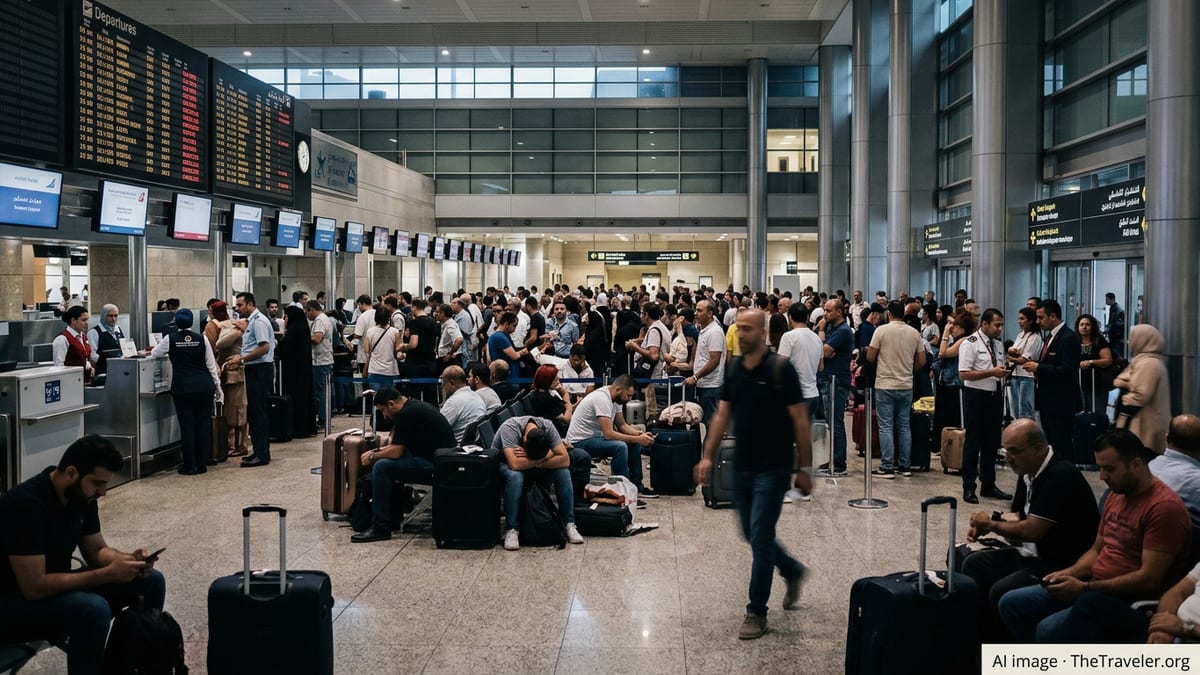
Passengers described crowded departure halls, long queues at check-in counters and information desks, and departure boards filled with red notices for delayed or cancelled flights. Airport ground staff and airline agents fielded a surge of rebooking and refund requests as travelers scrambled to salvage itineraries that relied on tight regional connections.
The latest disruption at Beirut’s only commercial airport comes on top of a week of mounting cancellations across the Middle East, where airspace closures and security concerns have forced airlines to repeatedly redraw their networks, sometimes on just a few hours’ notice.
Major Carriers Scramble as Royal Jordanian, EgyptAir and Others Cut Beirut Services
Royal Jordanian and EgyptAir were among the hardest-hit carriers serving Lebanon, with multiple Beirut-bound and departing flights scrubbed from Friday’s schedule. Royal Jordanian’s Beirut–Amman shuttle, a vital link for passengers connecting onward to Europe, the Gulf and North America, saw repeated cancellations and rolling delays that rippled through its wider network.
EgyptAir’s operations between Beirut and Cairo were also disrupted, complicating travel plans for passengers using Cairo as a major transfer point to Africa, Europe and Asia. With limited spare capacity on alternative routes and a broader regional squeeze on available seats, many stranded travelers reported being offered rebookings several days out rather than same-day solutions.
Low-cost and leisure-focused European carrier Transavia, which operates seasonal and year-round links between Beirut and cities such as Paris and Amsterdam, faced renewed uncertainty over its schedule. While some flights remained scheduled, others were pulled or placed under review as the airline weighed operational and security considerations on a rolling basis.
Romanian carrier TAROM, which maintains links between Lebanon and Eastern Europe, was also caught in the turbulence, with passengers reporting last-minute changes and limited rebooking options via alternative European hubs already strained by diversions and cancellations elsewhere in the region.
Gulf and European Networks Disrupted as Qatar Airways, Fly Dubai and Air France Adjust
In the Gulf, Qatar Airways and Fly Dubai were forced to further adjust already fragile schedules. Qatar Airways, which has been operating a mix of reduced and relief services across the region, saw Beirut-linked flights delayed or pulled as it balanced safety considerations with an urgent need to move stranded passengers through its Doha hub.
Fly Dubai operations connecting Beirut with Dubai International Airport were similarly affected, with some services cancelled outright and others experiencing extended delays. These interruptions added to congestion in Dubai, where earlier airspace closures and conflict-related disruptions had already led to hundreds of cancellations and diversions in recent days.
In Europe, Air France, which had previously suspended or limited services to Beirut and Dubai during the height of the regional security crisis, continued to adjust its operations. Paris-bound passengers from Beirut faced a patchwork of options as some flights were cancelled, others delayed, and a minority operated as planned, often with revised routings to avoid sensitive airspace corridors.
Across the network, airline planners raced to reroute aircraft around closed or restricted airspace over parts of Iran, Iraq and neighboring countries, adding flight time, fuel costs and crew scheduling complications. The result was a fragile timetable in which any additional disruption at a key node such as Beirut could quickly cascade into further delays across multiple continents.
Travelers Face Long Waits, Uncertain Rebookings and Confusing Information
For passengers at Beirut’s Rafic Hariri International Airport, the operational complexity translated into long waits and considerable uncertainty. Many reported conflicting information between airport departure boards, airline mobile apps and third-party booking platforms, complicating decisions on whether to remain at the airport or seek alternative arrangements.
Families returning from holidays, migrant workers heading back to Gulf jobs, and students traveling to European universities were among those stranded, some forced to sleep on terminal floors or in packed seating areas as nearby hotels quickly filled. Volunteers and airport staff tried to assist vulnerable travelers, including elderly passengers and families with young children, with access to food, water and seating.
Airline policies on rebooking, refunds and accommodation varied widely. Some carriers offered meal vouchers and hotel stays for passengers facing overnight delays, while others provided only the option to rebook on a later flight or accept a travel credit. With many alternative services also constrained or sold out, even generous policies did not always translate into immediate relief.
Consumer advocates urged travelers to document their disruption, keep receipts for any out-of-pocket expenses and closely review their ticket conditions and travel insurance coverage. They also advised passengers to remain proactive by regularly checking airline channels rather than relying solely on airport displays that could lag behind fast-moving operational decisions.
Broader Regional Crisis Keeps Middle East Aviation on Edge
The Beirut disruption formed part of a broader aviation crisis across the Middle East, where ongoing conflict and shifting airspace restrictions have led to thousands of cancellations, diversions and extended flight times since the start of March. Hubs in Dubai, Doha, Jeddah and other cities have all experienced surges in stranded passengers as carriers recalibrate daily.
Industry analysts noted that while airlines and air navigation authorities are working to maintain a minimum level of connectivity, the situation remains volatile, with schedules subject to rapid change as security assessments evolve. Smaller markets such as Lebanon, which rely heavily on a limited number of foreign carriers and a single national airline, are particularly vulnerable to such shocks.
Lebanese tourism operators, already grappling with economic headwinds and geopolitical instability, warned that recurring disruptions at Beirut’s airport could deter visitors and complicate outbound travel for residents. Travel agencies in Beirut and across the region reported a spike in customer calls and walk-ins from passengers seeking alternative routes via less affected hubs.
With no clear timeline for a full normalization of air traffic, airlines have urged passengers traveling to or from Beirut and neighboring hubs to build additional flexibility into their plans, monitor flight status frequently and be prepared for last-minute changes. For now, the scenes at Beirut’s terminal, with exhausted travelers clustered around charging stations and information screens, capture the human face of a regional aviation crisis that shows little sign of easing.