

More news on this day
Hundreds of passengers were stranded at Beirut–Rafic Hariri International Airport on Sunday after at least 28 flights were cancelled and 15 delayed, as regional airspace closures rippled across airline networks serving Cairo, Doha, Athens, Paris, Amman, Riyadh and other key destinations.
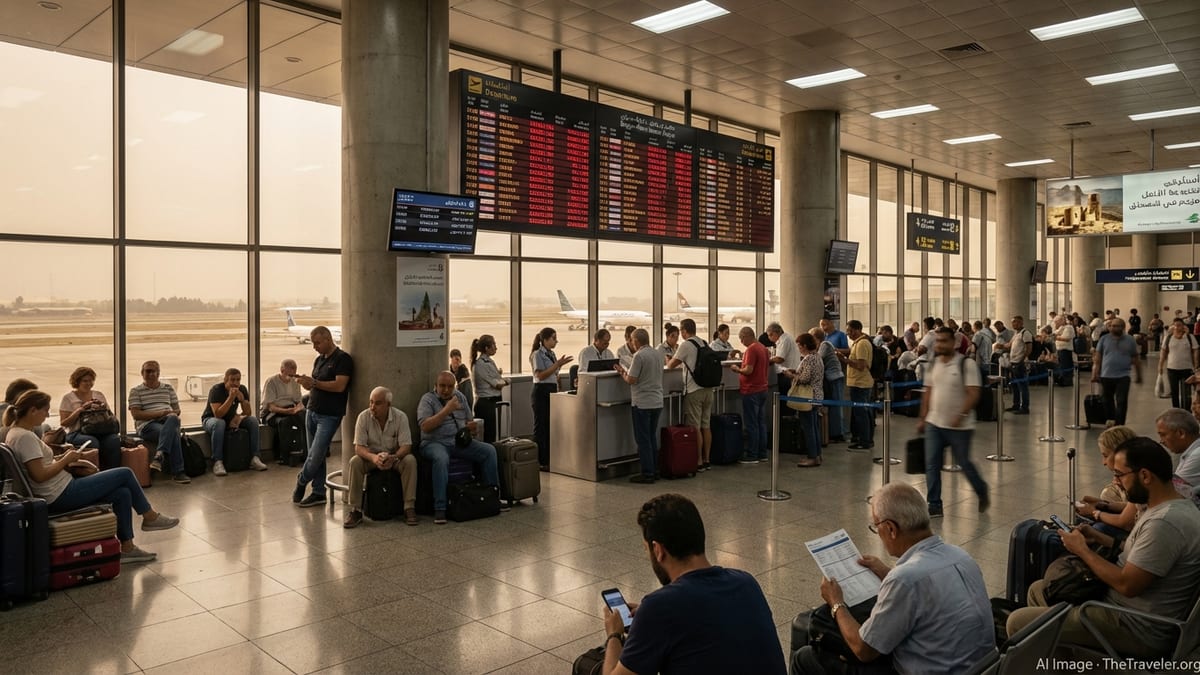
Beirut Operations Squeezed by Regional Airspace Closures
While Lebanese airspace formally remained open on March 1, the country’s main gateway functioned at a fraction of normal capacity as airlines struggled to route around closed skies in much of the Middle East. The cascading effect left departure boards at Beirut–Rafic Hariri International Airport filled with red cancellation notices and extended delays through the day.
Carriers including Pegasus Airlines, Qatar Airways, Middle East Airlines, Air France, Aegean and several other regional and European operators scrubbed rotations to and from Lebanon, citing safety concerns and the practical impossibility of navigating shuttered or restricted corridors over Iran, Iraq, Kuwait, Qatar, Israel and parts of the Gulf. Many of the affected flights were bound for or arriving from major connection points such as Cairo, Doha, Athens, Paris, Amman and Riyadh, cutting Beirut off from some of its most important regional links.
Airport staff reported unusually crowded check in halls and boarding areas as travelers attempted to rebook or reroute, often with limited information about when services might resume. Electronic displays showed long strings of cancellations into the evening, alongside flights placed in indefinite delay as airlines assessed alternative routings and crew availability.
The disruptions in Beirut form part of a much wider aviation fallout across the region after fresh military strikes and retaliatory attacks prompted sweeping airspace shutdowns. With key hubs such as Dubai, Abu Dhabi and Doha either closed or operating under tight restrictions, the knock on effect on secondary airports like Beirut has been immediate and severe.
Key Airlines Pull Back From Beirut and the Wider Region
Several prominent carriers moved quickly to reduce or halt operations to Beirut, adding to the scale of disruption for passengers in Lebanon and those transiting through the city. Low cost Turkish carrier Pegasus announced that flights to Lebanon, as well as to Iran, Iraq and Jordan, would be cancelled through at least March 2, immediately wiping out multiple daily options between Beirut and Istanbul and onward connections to Europe and Asia.
Qatar Airways, which normally provides a vital bridge between Beirut and its Doha hub, continued a temporary suspension of flights as Qatari airspace remained closed. The pause effectively severed one of Lebanon’s most important long haul connection points, limiting access to routes towards Asia, Africa and Oceania that typically rely on Doha as a transfer gateway.
Lebanon’s flag carrier, Middle East Airlines, also sharply trimmed its schedule, cancelling numerous flights to Gulf states and Iraq after surrounding countries closed their skies or imposed strict restrictions. The airline has attempted to preserve a skeleton network where possible, while adding occasional extra services to nearby alternative gateways such as Larnaca when operationally feasible.
European operators have followed suit. Air France extended its suspension of flights to and from Beirut, as well as to Tel Aviv and Dubai, while Aegean and other regional carriers pruned services amid fast changing security assessments. German group Lufthansa has halted Beirut operations for several days and is avoiding multiple national airspaces across the region, a move that further reduces European capacity into Lebanon.
Passengers Face Long Waits, Patchy Information and Limited Options
For travelers caught in the middle of Sunday’s disruption, the most immediate challenge was simply finding a way out of Lebanon or into their intended destination. With 28 cancellations and 15 recorded delays at Beirut alone, many itineraries evaporated overnight, leaving passengers scrambling for scarce seats on the few flights still operating or hoping for last minute reinstatements.
Scenes inside the terminal reflected growing frustration. Long queues formed at airline service desks as passengers sought rebooking, refunds or written confirmation of cancellations to support insurance claims. Some travelers reported waiting hours for updates, as local airport announcements often lagged behind airline system changes and global reservation platforms struggled to keep pace with rolling schedule adjustments.
Rebooking options were constrained by the broader regional picture. With neighboring hubs either shut down or heavily curtailed, rerouting via familiar waypoints such as Doha, Dubai or Abu Dhabi was largely off the table. Travelers attempting to reach destinations like Cairo, Athens, Paris or Riyadh frequently had to consider circuitous alternatives via European or Mediterranean airports not affected by the closures, adding significant time and cost to their journeys.
Airlines have generally offered flexible policies, including date changes and in some cases full refunds or credit vouchers, but the immediate lack of available seats has proven a bigger obstacle than ticket rules. For many passengers at Beirut airport, the only realistic option on Sunday was to wait in hotels or with family until carriers could safely restore portions of their schedules.
Global Context: Beirut as a Snapshot of Wider Middle East Travel Turmoil
The chaos unfolding in Beirut mirrors a much larger disruption to global aviation as conflict related airspace closures spread across the Middle East. From Saturday into Sunday, thousands of flights were cancelled or delayed worldwide as airlines diverted away from affected corridors and temporarily suspended services to key cities.
Major hubs in the Gulf, including Dubai and Abu Dhabi, along with Doha and several airports in Iran, Iraq and Israel, have seen large parts of their operations halted. These airports typically serve as critical bridges between Europe, Africa and the Americas on one side and Asia and Oceania on the other. When they fall offline, the ripple effects can reach airports as far afield as London, Frankfurt, Mumbai and Sydney, with Beirut among the many intermediate cities feeling the secondary shock.
Aviation analysts note that the Middle East’s role as a central crossroad for global travel means any prolonged closure of its airspace can quickly upend airline timetables worldwide. Carriers are forced to fly longer detours around restricted zones, burning more fuel and facing crew duty limitations, or to cancel flights outright when no safe and efficient path is available.
For Lebanon, whose economy and tourism sector are already under strain, the current wave of cancellations is another setback at the start of what would normally be a busy planning period for spring and summer travel. Hoteliers and tour operators rely heavily on reliable air links to regional capitals and European gateways, links that are now in flux as airlines reassess their exposure to the evolving security situation.
What Travelers Through Beirut Should Expect Next
Looking ahead, the situation at Beirut–Rafic Hariri International Airport will depend heavily on how quickly neighboring states reopen their airspace and how airlines recalibrate their networks in response. Some carriers have signaled that they will review conditions daily, issuing rolling updates on whether flights can resume, while others have already extended suspensions several days into March.
Passengers planning to travel to or from Beirut in the coming days should be prepared for continued short notice changes, including day of departure cancellations and significant schedule reshuffles. Industry experts advise monitoring bookings closely through airline apps and notifications, and, where possible, opting for routings that avoid currently closed hubs in favor of more northerly or western connections.
Travel agents in Lebanon report a spike in inquiries from residents and expatriates seeking to leave the country while commercial options remain, and from visitors worried about being unable to return home. Some are exploring alternative exit points such as Larnaca, Athens or European capitals reachable by the limited services still in operation, though demand is quickly filling available seats on those routes.
For now, Beirut’s airport remains technically open but functionally constrained, a visible symbol of how swiftly geopolitical tensions can sever air links and leave passengers marooned. Until regional skies begin to reopen and carriers can safely restore their timetables, hundreds of travelers in Lebanon and thousands more across the Middle East will remain in limbo, their plans reshaped by events far beyond the airport perimeter.