

More news on this day
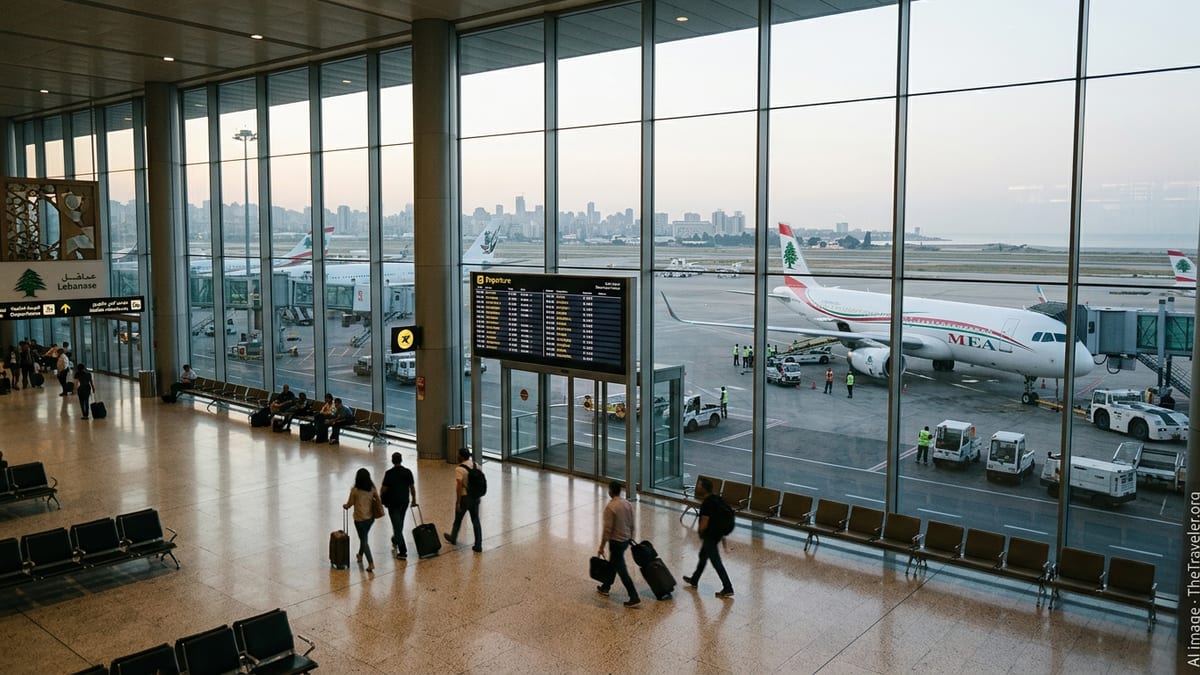
Lebanon’s Middle East Airlines is keeping a thin but vital air bridge open from Beirut to key hubs in Riyadh, Paris, London and Istanbul, even as sweeping airspace closures and security fears force global carriers to slash Middle East schedules.
Get the latest news straight to your inbox!
Beirut Stays Open as Neighbors Scale Back
While large parts of the region’s skies remain restricted following recent US and Israeli strikes on Iran, Beirut–Rafic Hariri International Airport has so far remained operational, allowing Middle East Airlines to preserve a skeletal schedule on select routes. Lebanese authorities have opted to keep the country’s airspace open, even as neighboring states impose tighter controls or shut corridors entirely in response to missile and drone threats.
Regional and European carriers have extended suspensions to Lebanon, sharply narrowing options for travelers trying to leave or reach the country. Several foreign airlines that once connected Beirut with Gulf and European hubs have halted operations through at least mid‑March, citing security assessments and airspace constraints. That has placed outsized importance on MEA’s ability to keep even a reduced program running.
The national carrier has responded with frequently updated schedules, last‑minute aircraft swaps and selective extra services, particularly to Istanbul, to absorb demand created by cancellations elsewhere. The result is an irregular but continuing flow of passengers through Beirut, in stark contrast to the grounded fleets at many airports across the Gulf and Levant.
For now, Beirut’s role is less that of a regional hub and more of a narrowly maintained lifeline, with MEA balancing operational risk, regulatory guidance and the urgent need for outbound capacity for residents, expatriates and transit passengers.
Limited Flights Anchor Links to Riyadh and Europe
Within this constrained network, MEA’s services to Riyadh, Paris and London have emerged as symbolic and practical anchors. Flights to the Saudi capital connect Lebanese travelers with one of the few major Gulf gateways still operating at reduced capacity, even as Saudi authorities warn of potential delays and short‑notice schedule changes at King Khalid International Airport.
Operations to Paris and London are equally critical, providing rare direct links from Beirut to western Europe while many long‑haul routings via Gulf hubs remain compromised. Travel industry trackers report that several European airlines have suspended or sharply curtailed Beirut operations, making MEA’s departures to Paris–Charles de Gaulle and London–Heathrow some of the only nonstop options for passengers seeking onward connections.
To maintain these links, MEA planners have been rerouting flight paths to avoid the most sensitive airspace and accepting longer block times and higher fuel burn. Aviation analysts say this reflects a wider pattern across the industry, with carriers flying circuitous tracks around Iran, Iraq, Syria and Israel to reach Europe and the Gulf, further squeezing capacity on the few routes that remain open.
Seat availability on Beirut’s surviving long‑haul departures is tight, with many flights reported close to full as foreign nationals, dual citizens and Lebanese residents compete for limited inventory. Fares have risen in step with demand and reduced supply, although MEA and foreign governments have also been coordinating on capped‑fare contingents and, in some cases, chartered flights to support organized departures.
Istanbul Emerges as a Pressure Valve
Istanbul, long a favored transit point for Lebanese travelers, has taken on renewed importance during the current disruption. MEA has recently added extra Beirut–Istanbul rotations on peak days to help clear backlogs, turning the Turkish metropolis into a critical pressure valve for those trying to reach Europe, North America or Asia.
With multiple international airlines maintaining at least partial operations at Istanbul’s main airport, passengers able to secure a seat on MEA’s Beirut services can often rebook onward legs that would be impossible via shuttered Gulf hubs. Travel agents in Beirut report that Istanbul‑bound flights are among the first to sell out whenever new seats are released, particularly on days following waves of cancellations elsewhere in the region.
The surge in demand has also shifted passenger behavior. Rather than waiting for direct flights that may or may not operate, many Lebanese and expatriates now book Beirut–Istanbul segments first and worry about final destinations later, relying on the relative resilience of Turkish and European networks once they are out of Lebanon.
This strategy is not without risk. Airlines at Istanbul are also wrestling with reroutes, crew‑duty constraints and volatile airspace advisories, which can turn guaranteed connections into overnight layovers with little notice. Still, for many, the combination of MEA’s flights and Istanbul’s connectivity represents the most realistic path out.
Travelers Face Constantly Shifting Schedules
For passengers, the reality behind Beirut’s fragile aviation lifeline is a level of uncertainty rarely seen in peacetime commercial travel. Schedules are treated as provisional, with airlines warning that departures can be retimed, rerouted or canceled outright within hours of departure if regional risk assessments change.
Travel advisories from multiple governments urge citizens to avoid nonessential travel through the region and to maintain maximum flexibility when itineraries involve Beirut or nearby hubs. Travelers are instructed to monitor airline apps and airport boards repeatedly on the day of departure, and to expect lengthy security screening, intermittent road closures and heavy congestion at terminal entrances.
Within Lebanon, tour operators and corporate travel managers have shifted from long‑range planning to crisis‑mode logistics, often holding blocks of seats on MEA’s Riyadh, Paris, London and Istanbul flights for high‑priority passengers such as medical cases or staff on emergency rotation. Some multinational companies have activated contingency plans to move expatriate workers out of Lebanon while commercial options still exist.
Despite the turmoil, there are no indications yet of an imminent closure of Beirut’s airport to civilian traffic. Industry observers note, however, that the situation can evolve quickly, and that the thin network currently maintained by MEA could contract further if risk thresholds are exceeded or additional airspace corridors are lost.
What MEA’s Lifeline Means for Lebanon
Beyond the immediate imperative of getting people in and out, MEA’s limited schedule carries outsized symbolic weight for a country accustomed to seeing its primary gateway disrupted during periods of conflict. The continuation of flights to Riyadh, Paris, London and Istanbul signals that Lebanon remains physically connected to major political and economic centers despite escalating tensions on its doorstep.
Economically, the preserved routes offer a narrow breathing space for trade, investment visits and diaspora travel that underpin key sectors such as banking, healthcare and higher education. While cargo operations face their own set of restrictions and rerouting challenges, passenger flights still bring in business travelers and expatriates whose spending helps sustain Beirut’s struggling service economy.
There is also a psychological dimension. For many Lebanese, the sight and sound of aircraft continuing to depart over the capital stands in contrast to memories of complete isolation in earlier crises. Travel experts caution against complacency, but acknowledge that even a handful of daily departures can temper a sense of being cut off from the wider world.
How long this fragile connectivity can be maintained will depend on security developments, diplomatic efforts to reopen airspace corridors and the operational resilience of MEA itself. For now, each departure to Riyadh, Paris, London or Istanbul represents not only a flight number on a departures board, but a measure of normality preserved against the odds.