

More news on this day
Belgium’s railways are heading into one of their most disruptive episodes in years, with unions calling a 72-hour nationwide strike in early March to protest contested pension reforms and what they describe as a growing climate of job insecurity across the rail sector.
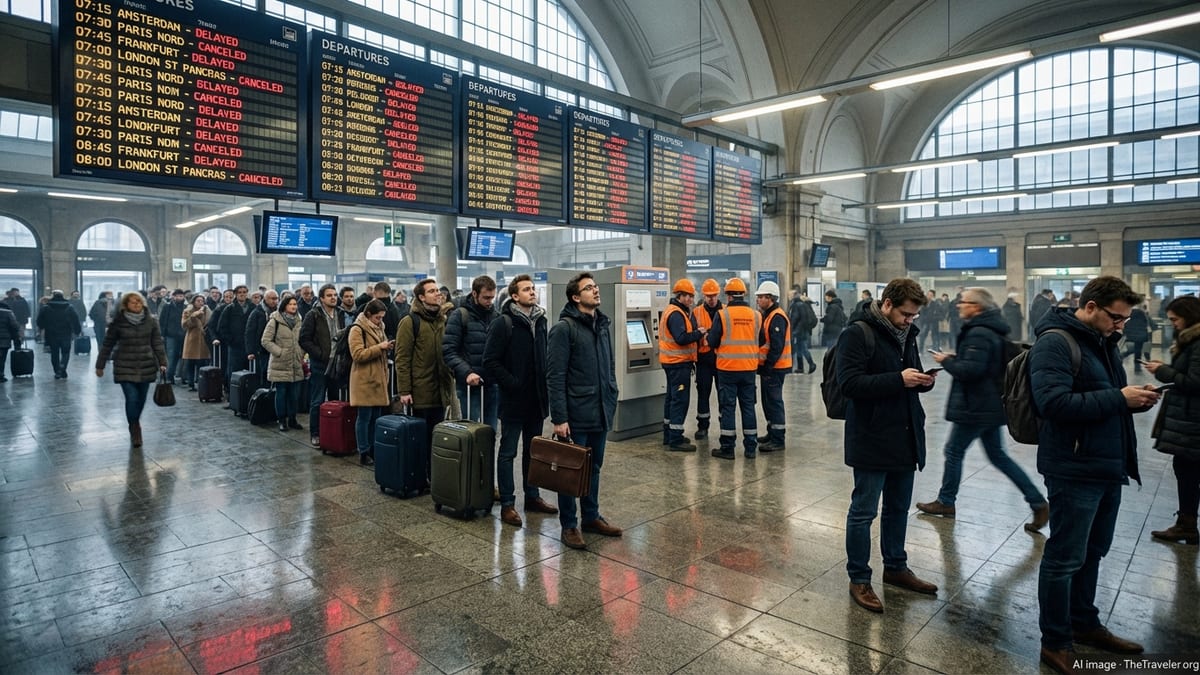
Three-Day Walkout Set to Cripple National Rail Network
The latest strike notice, filed by socialist rail union ACOD Spoor, confirms that Belgian rail workers will walk out from Sunday 8 March at 22:00 until Wednesday 11 March at 22:00. The action will affect the entire network of state operator SNCB, infrastructure manager Infrabel and human resources company HR Rail, effectively paralyzing domestic and international train traffic for three full days.
Rail managers warn that only a minimal number of trains required by Belgian law are likely to operate, and that even these services may be patchy, particularly during peak commuter hours. The strike window covers two full working days and part of a third, raising the prospect of days of residual disruption as rolling stock and staff return to normal rotations.
The escalation comes on the heels of what rail unions describe as a relentless cycle of stoppages. Since the beginning of last year, SNCB has already faced dozens of strike days, including a five-day walkout at the end of the previous month. Passenger groups fear that the new 72-hour shutdown could further erode confidence in the network just as Belgium seeks to shift more travelers from road to rail.
Authorities are urging travelers to avoid non essential journeys by train during the strike period and to anticipate congestion on roads and in urban public transport networks as commuters seek alternatives.
Pension Reform at the Heart of the Dispute
At the core of the looming confrontation is the federal government’s pension reform agenda, which unions argue will make it harder for rail workers to retire with full benefits and will penalize those in physically and psychologically demanding roles. Proposed changes include tightening access to early retirement schemes and altering calculation rules in ways that unions say will cut lifetime payouts for many public sector employees.
Union officials contend that the reforms ignore the specific realities of rail work, from irregular hours and night shifts to safety critical responsibilities in all weather conditions. They insist that any overhaul of Belgium’s pension system must provide enhanced protection for drivers, conductors, signallers and maintenance teams whose jobs carry high stress and health risks.
The pension dispute is not confined to the railways. Belgium has already seen mass demonstrations and wider national strikes in recent months, as public sector unions mobilize against broader social security changes and austerity driven spending cuts. For rail staff, the 72-hour walkout is both a sector specific protest and part of a wider national pushback against what unions describe as a systematic weakening of the welfare state.
Government representatives maintain that reforms are necessary to keep the pension system financially sustainable as Belgium’s population ages. They argue that gradual increases in effective retirement ages and adjustments to benefits are unavoidable if the country is to comply with European budget rules while preserving the core of its social model.
Mounting Fears Over Job Security and Working Conditions
Beyond pensions, rail workers point to growing anxieties over job security and the long term future of the public rail system. Unions accuse management of using attrition and internal restructuring to phase out permanent appointments for new hires, replacing them with more flexible contracts that they say leave younger employees exposed to uncertainty.
Staff representatives warn that successive savings plans and headcount reductions are stretching remaining teams thin, with knock on effects for safety, punctuality and customer service. They argue that a rail network that moves hundreds of thousands of passengers daily cannot be run on what they describe as a permanent crisis footing.
Management at SNCB counters that modernization is essential to keep the company competitive and to fund investments in new trains, station upgrades and digital ticketing systems. While executives express frustration at the frequency of strikes, they stress that dialogue with unions is ongoing and that efforts are being made to protect frontline jobs while meeting budget constraints set by the federal government.
The stand off has left many workers skeptical. Union leaders say that without binding guarantees on staffing levels, training and career prospects, they fear a slow erosion of the public service mission in favor of a lean workforce model more typical of commercial operators.
Severe Travel Disruption Expected for Commuters and Tourists
For domestic commuters, the 72-hour rail stoppage will land at a delicate moment, sandwiched between other announced actions across Belgium’s wider transport network. In major cities, local bus and tram operators have already faced or announced their own strike days in response to budget cuts and staffing disputes, raising the specter of overlapping disruptions.
International travelers are also bracing for knock on effects. Services linking Brussels with Paris, Amsterdam, London and Luxembourg are expected to be heavily curtailed or canceled outright during the strike, either because Belgian crews are unavailable or because trains cannot circulate on Infrabel’s infrastructure. Neighboring rail operators are advising passengers with flexible plans to reroute via alternative hubs or shift travel dates where possible.
Travel agencies and consular services are issuing advisories urging visitors to Belgium in early March to closely monitor local news and operator announcements. Hotels in Brussels, Antwerp, Ghent and Bruges anticipate a rise in last minute cancellations and rebookings, particularly from business travelers scheduled to attend meetings and conferences during the strike period.
Airports are preparing for increased pressure as some passengers move journeys from rail to air, especially on short haul routes to nearby European capitals. However, aviation planners caution that a separate 24 hour national strike targeting airport operations later in March could limit the extent to which air travel can absorb displaced rail demand.
What Rail Passengers Should Do Now
With the dates and scope of the strike now confirmed, rail operators are urging passengers to plan around the disruption rather than hoping for a last minute reprieve. SNCB has announced that it will publish adapted timetables closer to the start of the strike, but warns that frequencies will be sharply reduced and that no reliability guarantees can be offered.
Travelers with non essential journeys during the affected period are being encouraged to postpone trips or bring them forward to before Sunday evening. Those with advance purchase tickets for long distance services are advised to check refund and rebooking options, which many operators are relaxing in recognition of the exceptional circumstances.
Commuters who have no choice but to travel are being told to allow significantly more time for their journeys, expect crowded replacement services and consider combining modes, such as park and ride schemes, cycling to out of town stations or car sharing with colleagues. Employers in major Belgian cities are also being asked to expand remote working arrangements to ease pressure on what remains of the transport network.
As the strike deadline approaches, all eyes will be on last ditch talks between unions, management and federal mediators. While negotiations may still narrow the scope of disruption, union leaders insist that without clear concessions on pensions and job security, rail workers are prepared to press ahead with what could become one of the most consequential stoppages in the recent history of Belgian public transport.