

More news on this day
Thousands of passengers across Europe were left scrambling for alternatives on Thursday as Brussels South Charleroi Airport cancelled 98 flights amid a nationwide strike in Belgium, disrupting dense low cost networks operated by Ryanair, Wizz Air, Buzz and other carriers just as the spring travel season gathers pace.
Get the latest news straight to your inbox!
Charleroi Grounded As Nationwide Walkout Bites
Brussels South Charleroi Airport, Belgium’s second largest passenger hub, confirmed that all outbound operations for Thursday, 12 March have been halted after unions representing security, ground handling and baggage staff joined a 24 hour general strike over pay, pensions and working conditions. Airport management said the decision to cancel 98 departures and a similar number of arrivals was taken to avoid unmanageable queues and safety risks if only skeleton services attempted to run.
The shutdown at Charleroi comes on top of a suspension of all departures from Brussels Airport in Zaventem, creating an unprecedented clampdown on Belgian air traffic for the duration of the industrial action. Travel data providers estimate that well over 60,000 passengers are affected nationwide, with Charleroi alone handling around 8 million travellers a year, mostly on short haul leisure and visiting friends and relatives routes.
Airlines were formally notified earlier in the week that the airport would be unable to guarantee minimum staffing levels for screening and ramp operations. As the strike went ahead on Thursday, only a handful of positioning and technical movements were allowed, with commercial passenger flights to and from Charleroi effectively frozen and passengers urged not to travel to the terminal.
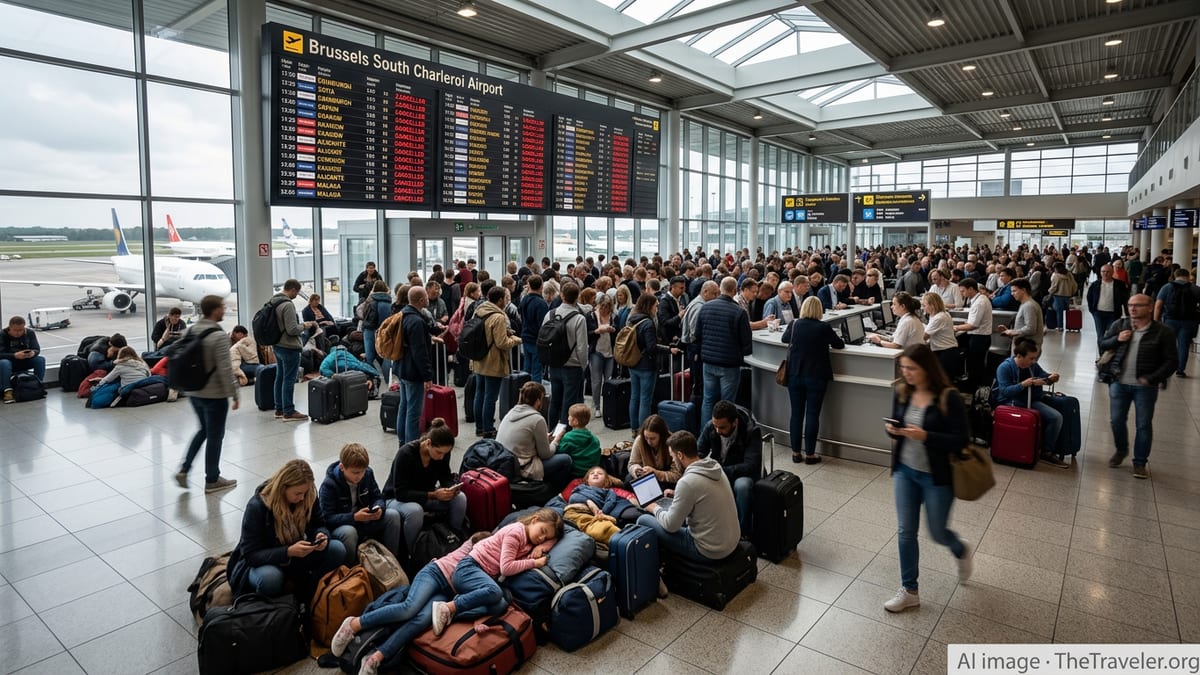
Inside the departures hall, information screens were dominated by red “cancelled” notices, while police and limited airport staff attempted to redirect confused travellers back out of the building. Many passengers reported receiving confirmation of cancellations overnight or early Thursday morning, leaving little time to secure replacement flights or accommodation.
Ryanair, Wizz Air And Buzz Scramble To Reroute Passengers
The disruption is hitting low cost carriers hardest, as Charleroi is a key base for Ryanair and an important outpost for Wizz Air and Polish operator Buzz. Together, these budget airlines account for the majority of daily movements at the airport under normal conditions. On Thursday their schedules were gutted, with early morning departures to the United Kingdom, Spain, Poland and the Balkans among the first to be axed.
Ryanair has pre emptively cancelled dozens of rotations and is offering affected customers the option to rebook on alternative dates free of charge or receive a refund. However, with parallel disruption at Brussels Airport and high demand ahead of Easter and various school holidays across Europe, there are limited spare seats in the coming days. Some travellers report being offered rerouting via distant airports, or only finding alternative flights several days after their original travel dates.
Wizz Air, which runs dense networks from Charleroi into Central and Eastern Europe, has also pulled flights throughout the day and is working through backlogs of customer service requests. Buzz, which operates on behalf of Ryanair in several Central European markets, has seen its own Charleroi rotations scrapped, adding to the wave of schedule changes rippling across the continent’s low cost sector.
Airlines stress that the cancellations are driven by circumstances beyond their control, as the strike targets airport and public sector operations rather than individual carriers. Under European passenger protection rules, however, travellers are still entitled to a choice of rerouting or reimbursement, even if fixed cash compensation may not apply when the disruption is linked to external industrial action.
Popular Routes To Edinburgh, Sofia, Krakow, Alicante And Malaga Affected
The impact is being felt far beyond Belgium as feeder flights linking Charleroi with secondary European cities are unpicked for the day. Services to and from Edinburgh have been cancelled, leaving UK city break tourists and workers commuting between Scotland and mainland Europe hunting for last minute alternatives from other airports such as Brussels, Lille or Amsterdam.
On the eastern flank of the continent, flights connecting Charleroi with Sofia and Krakow, two core destinations in the low cost network for Bulgarian and Polish travellers, have also been suspended. These routes typically carry a mix of migrant workers, students and leisure passengers, many of whom booked far in advance to secure low fares and now face expensive walk up tickets from other gateways.
Southbound leisure traffic has been similarly hit, with multiple rotations to Spanish sun destinations Alicante and Malaga cancelled as the strike took hold. These flights are popular with Belgian and northern European holidaymakers heading to the Costa Blanca and Costa del Sol, as well as with expatriates based in Spain returning home. Travel agents in both countries reported a spike in emergency rebookings and new rail and long distance bus sales on Wednesday night and Thursday morning as news of the shutdown spread.
The cancellation of 98 flights at Charleroi alone removes thousands of seats from the European network on a single day, putting pressure on already busy services during a period when airlines are ramping up capacity for the late winter and early spring getaway. Knock on effects are expected to linger into Friday and the weekend as aircraft and crews reposition and passengers are re accommodated.
Nationwide Strike Highlights Belgium’s Tense Labour Climate
Thursday’s industrial action is part of a broader nationwide strike called by Belgium’s main trade union confederations to protest against unpaid overtime, pension reforms and wider austerity measures. Public transport, schools, some public services and parts of the private sector have also been affected, but the decision by aviation unions to halt operations at both Brussels and Charleroi has made air travel the most visible symbol of the stoppage.
Charleroi, which relies heavily on outsourced security and ground handling firms, has been at the centre of previous disputes over working conditions, pay scales and staffing pressure. Union representatives argue that chronic understaffing and cost cutting at low cost hubs have eroded safety margins and left workers bearing the brunt of intense schedules and passenger growth, making a strong collective response necessary.
Airport management and regional authorities have urged both sides to return to the negotiating table while insisting that the priority is to restore passenger confidence in the reliability of Belgium’s air transport system. Officials acknowledged that repeated strikes and labour disputes risk damaging the country’s reputation as a convenient and affordable gateway for intra European travel.
For now, travellers are bearing the brunt of the showdown, with consumer advocates warning that complicated multi leg itineraries involving Belgian airports should be approached with caution until the industrial situation stabilises. They also advise passengers to document expenses, keep records of airline communications and be aware of their rights when flights are cancelled or significantly delayed.
What Travellers Can Do If Their Flight Is Cancelled
Passenger rights experts say the first step for anyone booked to fly via Charleroi on Thursday is to avoid heading to the airport and instead contact their airline or travel agent through digital channels. Most carriers have activated disruption plans that prioritise self service rebooking tools via their apps and websites, which can be faster than reaching call centres.
Where possible, travellers are being encouraged to consider alternative Belgian or nearby regional airports on dates outside the strike window. Brussels Airport, once operations resume, along with hubs in Lille, Paris, Amsterdam and Düsseldorf, may offer substitute routes, though availability is tight. Some passengers are opting to continue their journeys by high speed rail or long distance coach, particularly on shorter cross border routes.
Travel industry bodies also stress the importance of checking travel insurance policies, which may offer some coverage for additional accommodation and transport costs when strikes cause major disruption. However, policy terms vary widely and usually require documentation such as cancellation notices from airlines and receipts for extra expenses.
While the immediate focus is on helping thousands of stranded passengers reach their destinations, the wider debate over how to balance cost efficient air travel with fair working conditions at Europe’s low cost airports is likely to intensify. For many travellers caught up in Thursday’s cancellations at Charleroi, the day has become an unwelcome reminder of just how vulnerable modern flight schedules can be to industrial unrest.