

More news on this day
In a race against closing airspace and fast-shifting front lines in the Gulf, Belgium has mounted a complex evacuation operation that is now airlifting 198 Belgian nationals and 39 other European citizens out of the United Arab Emirates via emergency corridors through Muscat in Oman and Hurghada on Egypt’s Red Sea coast.
War in the Gulf Triggers Sudden Scramble to Exit
The latest escalation of the conflict involving the United States, Israel and Iran has turned the Gulf’s usually busy skyways into a patchwork of no-go zones, grounding or diverting hundreds of commercial flights. For thousands of European holidaymakers, business travelers and expatriates, the UAE’s glittering hubs suddenly became holding pens as airlines suspended routes and avoided key air corridors over Iran, Iraq and parts of the wider Middle East.
Among the hardest hit are Belgians and other Europeans transiting through Dubai and Abu Dhabi when the security situation deteriorated. Belgium’s Foreign Affairs Ministry confirmed on Saturday that around 900 Belgians across the wider Gulf region have requested repatriation, prompting an emergency plan built around a limited number of safe air corridors and a patchwork of overland routes to nearby airports.
With neighboring states partially closing their airspace and commercial carriers wary of flying near potential conflict zones, European governments have shifted into crisis mode. Military aircraft and specially chartered civilian jets are now handling missions normally left to scheduled airlines, with Muscat and Hurghada emerging as crucial stepping stones for evacuation flights out of the region.
Bus Convoys to Muscat, Then a Night Flight to Safety
For the first group of 198 Belgian nationals and 39 citizens from other European Union countries, the journey out began not at an airport check-in desk but at bus pick-up points in the UAE. Under Belgian consular supervision, travelers were moved by road from Dubai and other emirates to Muscat, the Omani capital, where Belgian personnel and local authorities had cleared space and security slots for an overnight military-operated flight to Europe.
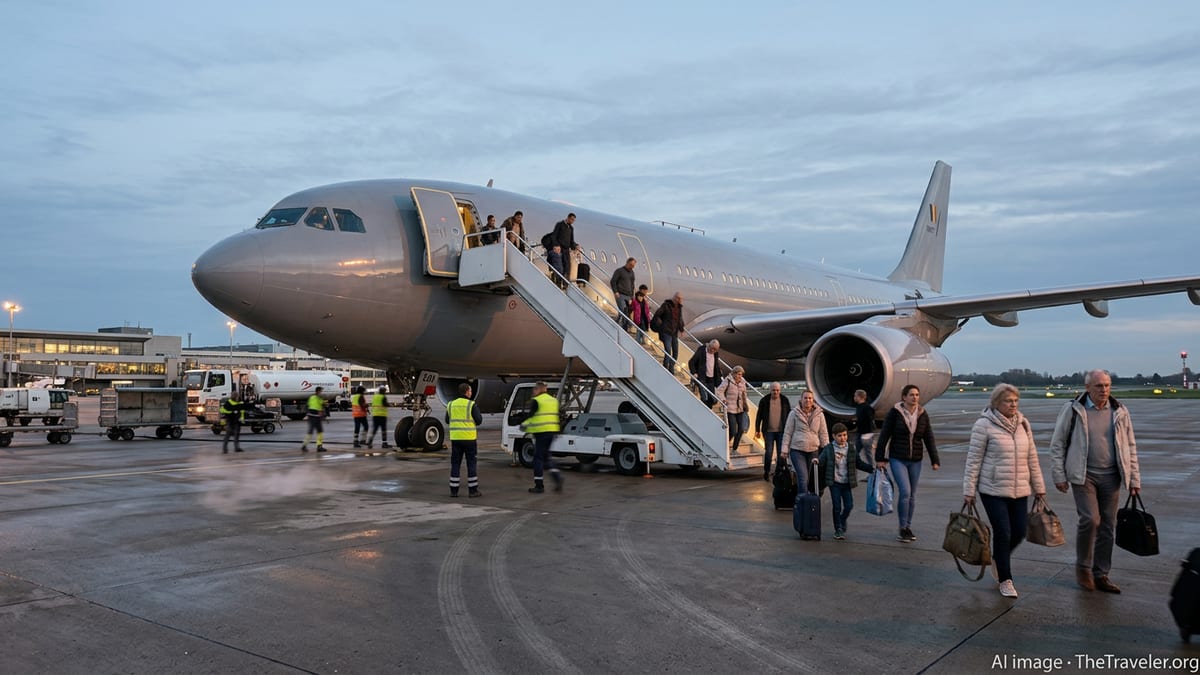
The route, chosen to skirt conflict-affected airspace, sends passengers from Muscat west to the Egyptian resort city of Hurghada for refuelling before continuing on to Brussels. Belgian officials say the flight, operated with an air force MRTT tanker-transport normally used for refuelling missions, is configured with standard seating and basic amenities to handle the mixed group of families with children, tourists and business travelers seeking a way out.
Diplomats describe the road leg from the UAE to Oman as one of the most delicate parts of the operation. While the UAE itself remains stable, the risk calculus changes quickly once travelers leave major urban centers and approach borders in a region on high alert. Belgian and Omani authorities have coordinated checkpoints, escorts and border procedures to minimize delays and keep convoys moving through the night toward Muscat’s airport.
Hurghada Emerges as an Unexpected Lifeline
If Muscat is the staging ground, Hurghada has become the unlikely lifeline for Europe. The Red Sea resort town, better known for dive boats and beach hotels than emergency operations, is now handling multiple refuelling and transfer stops for evacuation flights coming out of the Gulf. Aircraft carrying evacuees have been routed through Hurghada to avoid overflying sensitive zones and to take advantage of Egypt’s relatively uncongested airspace and long runway infrastructure.
In the Belgian operation, the Muscat to Hurghada leg is carefully timed to slot into corridors cleared by regional air traffic control, with pilots following routes designed to steer clear of military activity. After a ground stop in Hurghada, the same jet continues on a northerly track to Brussels, effectively stitching together a safe passage around the conflict while keeping passengers on a single aircraft for the bulk of their journey.
Hurghada’s sudden prominence is part of a broader regional pattern. As direct flights from the Gulf to major European hubs are curtailed, a growing number of evacuation missions are using secondary airports in Egypt and Jordan as waypoints. For travelers, that often means longer journeys and unfamiliar stops, but it also provides a rare exit in a fast-closing map of available routes.
A Broader European Effort Amid Mounting Uncertainty
Belgium’s airlift is one element of a wider scramble by European governments to retrieve citizens from the conflict-affected Gulf and Middle East. The Netherlands has been running repatriation flights out of Muscat to Amsterdam, while other EU states, including Luxembourg and Austria, have partnered on shared operations that route passengers through Hurghada and other regional hubs before onward travel to their home countries.
At Brussels Airport, officials are preparing to receive the mixed group of evacuees, who include Belgians and at least three other nationalities from within the European Union. Medical teams, crisis counselors and consular staff will be on hand to provide support, particularly for families who endured days of uncertainty as commercial flights were cancelled or rerouted.
For many of those now finally heading home, the evacuation caps a nerve-racking week spent watching departures screens fill with red cancellations and listening for updates from embassies and travel agents. Some travelers have reported sleeping in airport terminals, while others were stranded in hotels unsure if their booking would be extended or if they would be asked to move as airlines reshuffled their operations.
What Travelers Need to Know as Routes Keep Shifting
While the dramatic scenes of night-time bus convoys and military jets on evacuation duty capture global attention, officials stress that the situation remains fluid and subject to sudden change. Airspace notices can be updated at short notice, altering flight paths or grounding aircraft, and governments are urging citizens in the region to register with consular services so they can be contacted quickly if new evacuation options open.
For travelers still in the UAE and neighboring states, the key advice is to stay in close contact with airlines and embassies and to be prepared for unconventional itineraries that may involve overland transfers and staging points like Muscat or Hurghada. Travel insurance providers are also updating guidance, and some are treating the conflict as a known event, limiting coverage for new bookings while continuing to support those already abroad when the crisis erupted.
As Belgium presses ahead with additional flights through the weekend to bring home more of the 900 nationals who have requested help, the first Muscat and Hurghada evacuees are offering a glimpse of what emergency travel now looks like in a suddenly volatile Gulf. Long lines, late-night departures and unfamiliar routes have become part of the journey, but for the 198 Belgians and 39 other Europeans now heading toward Brussels, the only detail that really matters is that they are finally on their way home.