

More news on this day
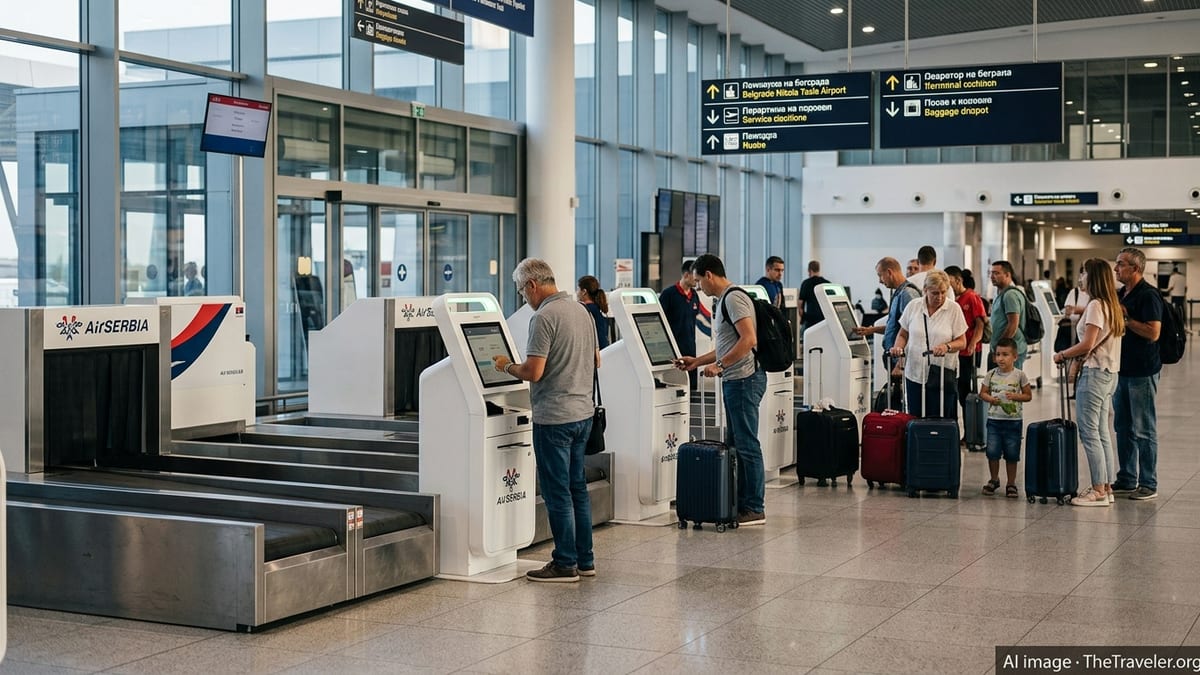
Serbia is entering a new phase of digitally driven air travel as Belgrade’s Nikola Tesla Airport rolls out self-service check-in kiosks and automated baggage drop-off stations for Air Serbia passengers, marking a significant upgrade in how travelers move through the country’s busiest aviation hub.
Get the latest news straight to your inbox!
New Technology Reshapes the Passenger Journey
Recent reports from Belgrade’s Nikola Tesla Airport indicate that a new generation of self-service check-in kiosks and automated baggage drop-off points is being introduced in partnership with national carrier Air Serbia. The technology is designed to streamline the departure process, enabling passengers to print boarding passes and luggage tags themselves before depositing bags at dedicated automated stations. The move brings Serbia in line with a growing number of European hubs that have adopted similar systems to cope with rising passenger volumes.
Industry-focused coverage notes that an initial cluster of kiosks is being installed in the departure hall, positioned close to Air Serbia’s premium check-in area and conventional counters. The layout is intended to give travelers a choice between traditional staffed desks and faster self-service options, particularly at peak times. Once fully operational, the kiosks are expected to support most Air Serbia destinations from Belgrade, aligning with the airline’s existing digital check-in tools on web and mobile platforms.
The automated baggage drop-off units complement the kiosks by allowing passengers who have already checked in online or at a kiosk to move directly to a self-service bag drop belt. Publicly available documentation from airport stakeholders describes the new infrastructure as part of a broader centralized system that supports common-use terminal equipment, signaling that the facilities are being designed for wider use beyond a single carrier over time.
For Air Serbia, which has been gradually enhancing its airport and ground services, the arrival of automated kiosks and bag drop points at its main base is viewed in regional aviation reports as a natural next step. It follows earlier technology investments, including digital baggage tracking initiatives and an expanded portfolio of online services.
Belgrade Airport Modernization Gathers Pace
The deployment of self-service kiosks and automated bag drops comes against the backdrop of a multi-year modernization and expansion program at Belgrade Nikola Tesla Airport led by concessionaire Belgrade Airport, a company within the VINCI Airports network. Official project outlines show that work started in early 2020, focusing on expanding terminal capacity, upgrading runways, and improving landside and airside infrastructure to accommodate sustained traffic growth.
Over the past few years, the airport has opened new terminal sections, increased gate and boarding capacity, and introduced enhanced passenger processing facilities such as electronic passport control gates. Activity reports from the operator highlight continuous investment in new technology and reconfigured terminal flows, aimed at boosting both throughput and overall passenger comfort.
Recent modernization milestones were underscored by high-level recognition of the completed works, with public communications emphasizing that Belgrade is positioning itself as a regional gateway ahead of major upcoming events, including EXPO 2027 in Belgrade. Within this broader strategy, the introduction of self-service check-in and baggage drop-off is presented in local aviation and business media as a key element of improving efficiency in the departure area.
Airport development documents also reference plans for additional terminal expansion phases and upgraded landside facilities, suggesting that the new kiosks and automated bag drops form part of a long-term reconfiguration of check-in zones. Analysts following the region’s aviation market note that as terminal capacity grows, the importance of automation at critical processing points such as check-in, baggage handling, and border control typically increases.
Responding to Rising Passenger Numbers and Operational Pressure
Belgrade Nikola Tesla Airport has reported record traffic in recent years, with 2024 figures cited in local media coverage showing more than eight million passengers handled and tens of thousands of aircraft movements. Forecasts associated with the concession project point to the possibility of reaching around 15 million passengers annually over the course of the concession period, assuming continued growth in Air Serbia’s network and additional airline partnerships.
At the same time, the airport has faced occasional operational challenges, including periods of congestion at check-in and passport control, as well as IT system disruptions that slowed processing. Local news reports and traveler accounts have described long queues during peak travel days, highlighting the pressure placed on traditional staffed counters and manual processes.
In this context, the new self-service infrastructure is being framed in industry commentary as a practical response to growing demand. By enabling passengers to complete routine steps independently, the kiosks and automated bag drop systems are expected to help distribute passenger flows more evenly between manned and automated positions, reducing bottlenecks at busy times. This approach mirrors strategies already in place at other medium and large European airports where automation has become a central element of terminal planning.
For Air Serbia, which has expanded both its short-haul and long-haul networks in recent seasons, smoother ground operations at its Belgrade hub are essential to maintaining reliable schedules and competitive connection times. Publicly available information on the airline’s operations shows continued emphasis on hub-and-spoke connectivity, particularly for travelers transferring between Western Europe, the Balkans, and long-haul destinations such as North America and China.
What Travelers Can Expect From the New Systems
According to check-in guidelines published by Air Serbia, airport kiosks at Belgrade will generally open 24 hours before departure, aligning with the carrier’s existing practice for kiosk-based check-in. Travelers will be able to scan their passports or enter booking references, confirm flight details, and print boarding passes and baggage tags before proceeding directly to either staffed counters or automated bag drop belts.
The automated bag drop process itself is expected to follow a familiar pattern already seen at many European hubs. Passengers place their tagged baggage on a conveyor at the self-service unit, where the system verifies weight and dimensions before sending the luggage into the baggage handling system. If a bag does not meet the permitted criteria or requires special handling, travelers are redirected to a staffed counter.
Air Serbia’s broader digital offering, which already includes online and mobile check-in, means that many passengers arriving at the airport may only need to use the kiosks for luggage tags or proceed straight to bag drop if they have already obtained mobile boarding passes. For those traveling with only cabin baggage, carrier information indicates that passengers can go directly to security and passport control once they have checked in electronically, reducing the need to interact with check-in facilities at all.
Travel specialists observing the rollout suggest that the success of the new systems will depend on clear signage, on-site assistance during the initial transition period, and continued reliability of the airport’s underlying IT infrastructure. As more passengers become familiar with the technology, the self-service area is expected to take on a larger share of total check-in volume, particularly during busy summer travel periods.
Part of a Broader Digital Shift in Serbian Air Travel
The introduction of self-service kiosks and automated baggage drop at Belgrade is widely seen as part of a broader digital transformation in Serbia’s air travel ecosystem. In recent years, the country’s main airport has implemented automated passport e-gates, expanded its use of centralized terminal systems, and invested in modern baggage handling and airside equipment, including increasing numbers of electric ground-support vehicles.
For passengers, the cumulative impact of these changes is expected to be a more predictable and standardized travel experience, closer to what is already common at larger European hubs. Aviation analysts point out that as Serbia pursues its ambition to position Belgrade as a key transfer point in Southeast Europe, such upgrades are not only about convenience but also about competitiveness in attracting airlines and travelers.
Regional observers also note that Serbia’s secondary airports are beginning to follow similar trends, with development plans at Niš and other locations referencing modern check-in systems and expanded terminal facilities. While Belgrade remains the primary testing ground for large-scale automation, the rollout of new technology at the capital’s airport is likely to influence how other Serbian airports design their own passenger journeys in the coming years.
As the new Air Serbia self-service kiosks and automated baggage drop stations come into use, stakeholders across the Serbian aviation sector will be watching performance indicators such as queue times, punctuality, and passenger feedback. If the systems deliver the expected improvements, they may become a defining feature of how Serbia presents itself to international travelers arriving at or departing from Belgrade.