

More news on this day
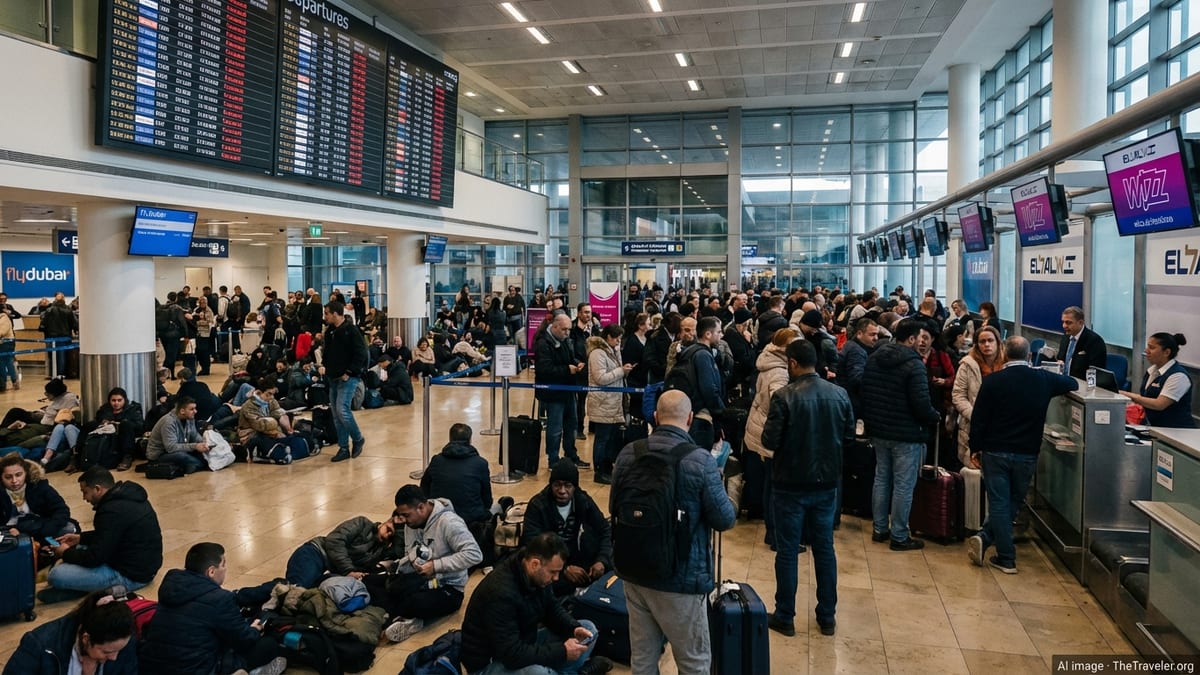
Hundreds of travelers were stranded at Israel’s Ben Gurion International Airport on February 28, as at least 90 flights were canceled and several more delayed after rapid-fire airspace closures across the Middle East crippled routes to Dubai, Athens, Zurich, New York and other major hubs.
Rapid Escalation Leaves Passengers Grounded
The disruption at Ben Gurion unfolded within hours on Saturday, after a wave of regional airspace restrictions followed U.S. and Israeli strikes on Iran and subsequent retaliatory attacks, prompting multiple Gulf and neighboring states to shut their skies to civilian traffic. Airlines operating in and out of Tel Aviv were forced to cancel or reroute services, triggering a cascade of schedule changes that rippled through one of the region’s busiest gateways.
Airport officials and airline staff spent the day juggling rolling updates as carriers adjusted plans in real time. Flight boards at Ben Gurion’s Terminal 3 showed swathes of red annotations, with departures to Dubai, Athens, Zurich and New York among the hardest hit. By evening, aviation data and carrier statements indicated around 90 cancellations and several additional delays linked directly to the closures, with authorities warning that figures could climb if restrictions persist.
Travelers who had already checked in or passed security suddenly found their journeys on hold. Some watched as their flights moved from “on time” to “delayed” and then “canceled” within minutes, while others learned of the changes only when boarding gates failed to open. With no clear timeline for normal operations to resume, the atmosphere in the departures hall ranged from tense to resigned.
Flydubai, Wizz Air and El Al Hit on Key International Routes
Flydubai was among the first to confirm a wave of cancellations, announcing it had temporarily suspended operations on February 28 due to regional airspace closures and security developments. Its regular link between Tel Aviv and Dubai, a popular corridor for both business and leisure travel, was scrubbed from the schedule, joining other services in and out of the United Arab Emirates that were unable to operate while Dubai International and Al Maktoum airports remain shut.
Low-cost carrier Wizz Air, which has expanded aggressively in the Israeli market over recent years, also faced significant disruption. Flights connecting Tel Aviv with European cities, including Zurich and networks further west, were canceled or heavily delayed as the airline navigated restricted flight paths and uncertainty over overflight permissions. For many budget-conscious travelers, Wizz Air services had been a lifeline for affordable access to Europe; on Saturday, those links were abruptly severed.
Flag carrier El Al confronted its own operational challenges. Earlier this week, an El Al flight to Newark was forced to return to Israel due to extreme winter weather in the United States, compounding the frustration for passengers on transatlantic routes. With Saturday’s regional crisis layered on top of existing weather-related disruptions, El Al’s long-haul network from Ben Gurion to New York and other North American destinations came under renewed pressure, with cancellations and knock-on delays leaving travelers scrambling for alternatives or overnight accommodation.
Other regional and European airlines serving Tel Aviv, including smaller carriers operating to Athens and onward connections into Europe, announced their own suspensions to and from Israel through at least March 2. Together, the overlapping cancellations choked connectivity from Ben Gurion to major transfer hubs, shrinking options for onward travel even for those whose flights had not yet officially been cut.
Airspace Closures Across the Gulf Reshape Flight Paths
The turbulence at Ben Gurion is part of a wider shockwave hitting air travel across the region. In the wake of the latest strikes, Iran, Iraq, Kuwait, Bahrain and Qatar all either closed or severely restricted their airspace, forcing airlines to abandon established corridors that link Europe with Asia and Africa. Aviation analytics indicated that hundreds of flights across the Middle East were canceled or diverted on Saturday, with thousands of passengers stranded at airports from Tel Aviv and Dubai to Muscat and Doha.
Dubai International Airport, one of the world’s busiest hubs for international traffic, suspended all operations after the United Arab Emirates temporarily closed portions of its airspace. Home carrier Emirates halted all flights to and from Dubai, while Flydubai followed suit. Airlines warned that the knock-on impact on global schedules would be felt far beyond the Gulf, as long-haul flights were rerouted or forced to return to origin points after hours in the air.
For Ben Gurion, the closures removed several of its most important connecting hubs in one stroke. Routes to Dubai not only serve as a direct link to the Gulf but also as a gateway to Asia and Australia; connections through Zurich, Athens and other European cities provide access to North America and the rest of Europe. With those hubs constrained or temporarily unavailable, travelers in Tel Aviv suddenly found themselves with limited detour options and significantly longer journey times on any remaining routes.
Industry experts note that while airlines can, in some cases, navigate around restricted airspace, doing so adds hours to flight times and substantial fuel costs, often making certain services uneconomical or operationally impossible at short notice. As a result, carriers have opted for widespread cancellations until there is greater clarity on the security environment.
Scenes of Confusion as Passengers Seek Answers
Inside Ben Gurion’s terminals, the human cost of the disruption was evident. Lines quickly formed at airline service desks, where overworked staff tried to rebook passengers, arrange hotel vouchers or explain that no immediate alternatives existed. Families bound for vacations in Dubai, business travelers heading to Zurich and New York, and students returning to universities abroad all waited with their luggage, phones in hand, refreshing airline apps for any sign of movement.
Some passengers described spending hours in the airport without clear information on when they might be able to leave. While airlines pushed notifications about cancellations and schedule changes, many travelers complained that they only received updates after arriving at the airport or when their flight status abruptly changed. The language of airline advisories was cautious, emphasizing safety and urging travelers to check digital channels, but offered little certainty over when flights might resume.
Local transport around the airport also felt the strain as some stranded passengers gave up on flying altogether and attempted to rebook onto buses or rail services to neighboring countries, only to find those options limited by the same regional tensions. Taxi queues lengthened as others sought to return home or to hotels for an indefinite wait until carriers publish revised timetables.
Airport staff and volunteers circulated with water and basic refreshments in the busiest areas, while security teams kept a visible presence amid the frustration. Despite the scale of the disruption, no major security incidents were reported in the terminal, though tempers occasionally flared as travelers confronted the prospect of missed events, lost hotel nights and complex visa and ticket-change issues.
Uncertain Timeline for Recovery
Aviation authorities in Israel and across the Middle East have so far refrained from giving firm dates for the full reopening of affected airspace, stressing that decisions will depend on evolving security assessments. Airlines have adopted a similarly cautious stance, extending cancellations in rolling increments and advising passengers with travel booked over the coming days to monitor official channels and refrain from going to airports unless their flight is confirmed as operating.
For Ben Gurion, the near-term outlook is one of continued disruption. Even if some airspace corridors reopen quickly, carriers will need time to realign aircraft rotations, reposition crews and clear backlogs of stranded passengers. Industry analysts warn that irregular operations could persist well into next week, particularly on heavily affected routes to Dubai and other Gulf hubs, while certain frequencies to Europe and North America may be trimmed as airlines prioritize core services.
Travel agents in Israel reported a surge in calls from customers seeking to reroute journeys via alternative hubs that remain open or to postpone trips entirely. Some airlines and tour operators began offering flexible rebooking and waiver policies, allowing passengers to change dates or destinations without additional fees. However, with demand for the remaining seats outstripping supply, many travelers face the prospect of waiting days before they can secure a new itinerary.
As passengers bed down in airport lounges, nearby hotels and their own homes, the scene at Ben Gurion has become a stark illustration of how quickly geopolitical shocks can ground even the most carefully planned journeys. Until airspace corridors reopen and carriers can restore predictable schedules, Israel’s main international gateway is likely to remain a symbol of the broader uncertainty now gripping regional air travel.