

More news on this day
Ben Gurion Airport is facing one of its most serious disruptions in years, with sharply reduced operations and widespread cancellations on routes to the United States, Europe and Asia as the regional conflict involving Israel, Iran and the United States continues to roil global aviation.
Get the latest news straight to your inbox!
Flights Slashed as Security Concerns and Damage Mount
Publicly available information shows that Ben Gurion Airport is operating on a highly restricted basis in late March 2026, with a focus on limited inbound and repatriation services rather than normal commercial schedules. Travel security advisories describe the airport as functioning at a significantly reduced level, with routine passenger operations heavily curtailed following weeks of missile threats and intermittent strikes linked to the 2026 Iran war.
Reports indicate that a missile impact on March 18 damaged three private aircraft parked at Ben Gurion, triggering a further tightening of passenger flows and renewed scrutiny of ramp safety. While there were no injuries in that incident, the visible damage to aircraft and the proximity to passenger infrastructure reinforced concerns among airlines and insurers about the risks of maintaining regular service into central Israel at this stage of the conflict.
According to recent coverage, Israeli regulators have responded by imposing strict caps on passenger loads from Ben Gurion, especially on long haul departures. These constraints, combined with ongoing security assessments and insurer requirements, have translated into a cascade of cancellations across some of the airport’s most important intercontinental routes.
The result for travelers is an airport that remains physically open but is no longer functioning as the busy regional hub familiar to many visitors. Instead, schedules are sparse, last minute changes are common and many flights that appear in booking systems are later pulled or rerouted as security conditions are reassessed.
Long Haul Routes to the United States Severely Curtailed
Traffic between Israel and the United States has been hit particularly hard. According to recent reporting on aviation operations out of Tel Aviv, authorities have cut by roughly half the number of passengers allowed on outbound flights to the United States, limiting most departures to about 130 travelers. Capacity caps of this scale effectively erase the economic viability of many long haul services, prompting airlines to cancel frequencies, consolidate departures or pull back altogether.
Airlines already balancing crew safety concerns, elevated insurance premiums and complex overflight restrictions are finding it difficult to sustain regular operations to North American gateways under these constraints. Public schedules have shown repeated cancellations on transatlantic services, with some departures disappearing from departure boards only hours before planned pushback.
For US bound passengers in Israel, this has translated into days of uncertainty and frequent rebooking. Many travelers are being advised to route via alternative hubs in Europe, where flights are still operating around the conflict zone, or to postpone nonessential trips. Travel industry advisories are urging passengers with itineraries touching Tel Aviv and US destinations in March to treat all plans as fluid and to reconfirm repeatedly with carriers.
Industry analysts note that these disruptions are unfolding at a time when global demand for transatlantic travel remains strong, amplifying the shock for both leisure and business travelers who would typically rely on Ben Gurion as a primary gateway to North America.
European Networks Reshaped by Airspace Closures
Links between Israel and Europe, a core component of Ben Gurion’s traffic base, have also been dramatically reshaped. In the early days of the conflict, Israel’s airspace was completely closed as missile exchanges intensified across the region, forcing airlines to divert or cancel flights and leaving thousands of passengers stranded in third country hubs from the Mediterranean to the Gulf.
Even as limited operations resumed, European carriers confronted a patchwork of regional airspace closures and risk advisories affecting Iran, Iraq, Jordan, Kuwait, Qatar, Bahrain and others. Travel advisories from early March describe widespread cancellations on routes that normally connect Europe with the Middle East and onward to Asia, with Israel listed among the countries where passenger flights were suspended or heavily disrupted.
Several major European and Gulf based airlines have scaled back or temporarily suspended services touching Israeli airspace, either cutting Tel Aviv from their networks or rerouting traffic along longer southern corridors that bypass active conflict zones. These changes have reduced seat availability into Ben Gurion from key European hubs and have undermined its role as a convenient transfer point between Europe and Asia.
Passengers attempting to travel between Israel and European cities are increasingly funneled through a small number of still operating routes or are being advised to consider surface segments to neighboring countries whose airports retain more stable operations. This has added time, cost and complexity to journeys that were previously straightforward short haul flights.
Asia Connections Disrupted Across the Wider Region
The impact on flights between Israel and Asia is being magnified by the wider regional aviation crisis. Analysis of the broader Middle East and North Africa network shows that major hubs such as Dubai, Abu Dhabi and Doha have been affected by airspace closures and missile incidents, with thousands of flights cancelled across the region in early March. These airports normally serve as critical waypoints for travelers moving between Asia, the Middle East, Europe and the Americas.
With Israel’s own airspace previously shuttered and still subject to heightened risk assessments, many carriers have suspended Tel Aviv services while they reconfigure long haul routes around the Gulf and over alternative corridors. For travelers starting or ending journeys in Israel, this means that familiar one stop connections to Asian cities via Gulf hubs are either unavailable or subject to abrupt last minute changes.
Travel discussion forums and industry advisories describe passengers in Asia struggling to find viable itineraries back to Europe and the Middle East as successive cancellations accumulate. In this environment, Ben Gurion’s ability to function as an origin or destination for Asia bound traffic is significantly constrained, with only a handful of services operating and little reliability from one week to the next.
Some travelers are turning to more circuitous options, including routings via southern Africa or transpacific detours, but these come with higher costs, longer travel times and the persistent risk of further disruption as the conflict evolves.
Stranded Passengers and Industry Bracing for Prolonged Turbulence
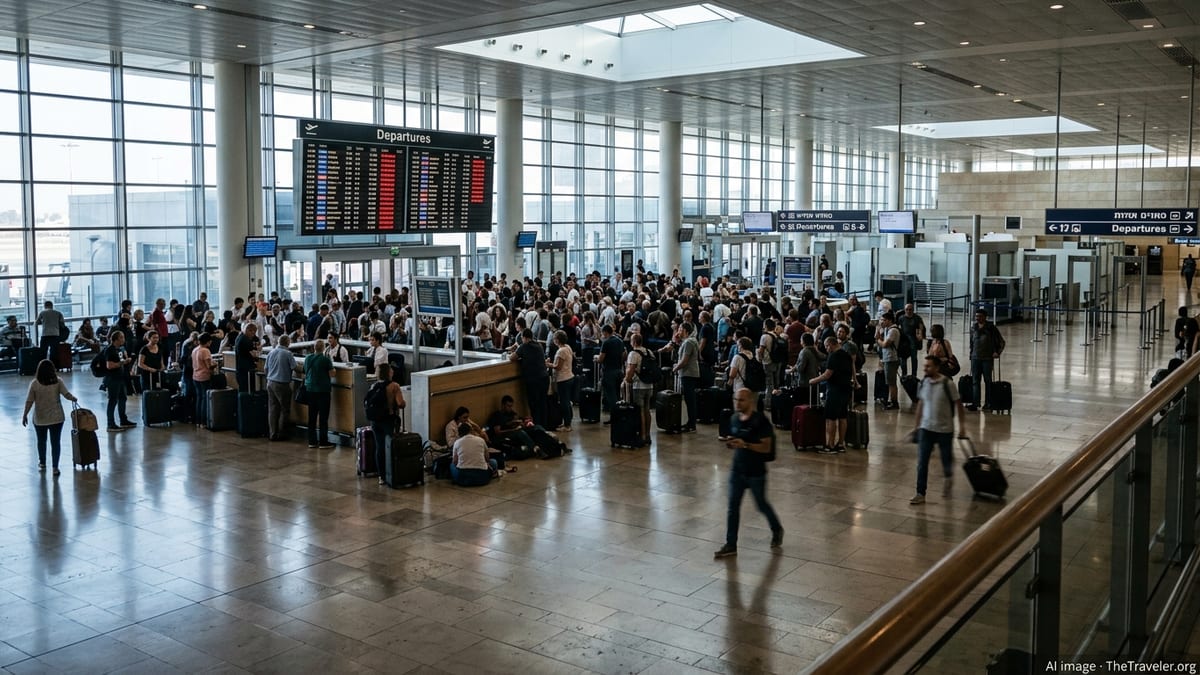
For passengers on the ground in Israel, the crisis at Ben Gurion has a very human face. Images and eyewitness accounts from regional airports depict crowded terminals, long queues at airline service desks and travelers sleeping on terminal floors after overnight cancellations. Similar scenes have been reported at other hubs affected by the war, reflecting a network wide breakdown that extends well beyond any single airport.
Travel industry advisories emphasize that the situation remains highly dynamic. Analysts point out that routing options and operating permissions can change on a daily basis as missile activity fluctuates, new security guidance is issued and airlines reassess their exposure. This volatility makes it difficult for carriers to publish stable schedules and encourages many to err on the side of cancellation rather than risk unplanned diversions or mid route airspace closures.
Economic assessments of the 2026 Iran war already highlight aviation as one of the sectors most severely affected, alongside energy and shipping. The loss of key corridors between Europe, Asia and Africa has forced carriers into longer routings that increase fuel burn and operating costs at a time of heightened uncertainty, pressuring already thin margins.
For Ben Gurion Airport, the coming weeks will be decisive in determining whether the current crisis stabilizes into a predictable reduced schedule or deepens into a more prolonged shutdown of regular commercial links. For now, travelers with upcoming itineraries touching Tel Aviv are being urged by airlines and travel advisors alike to build in maximum flexibility, monitor conditions closely and prepare for significant last minute changes on flights to the United States, Europe and Asia.