

More news on this day
Thousands of travellers were left stranded or scrambling for alternatives on Sunday as Tel Aviv’s Ben Gurion Airport recorded more than 230 flight cancellations, after the rapidly escalating US–Israel conflict with Iran prompted sweeping airspace closures across the Middle East.
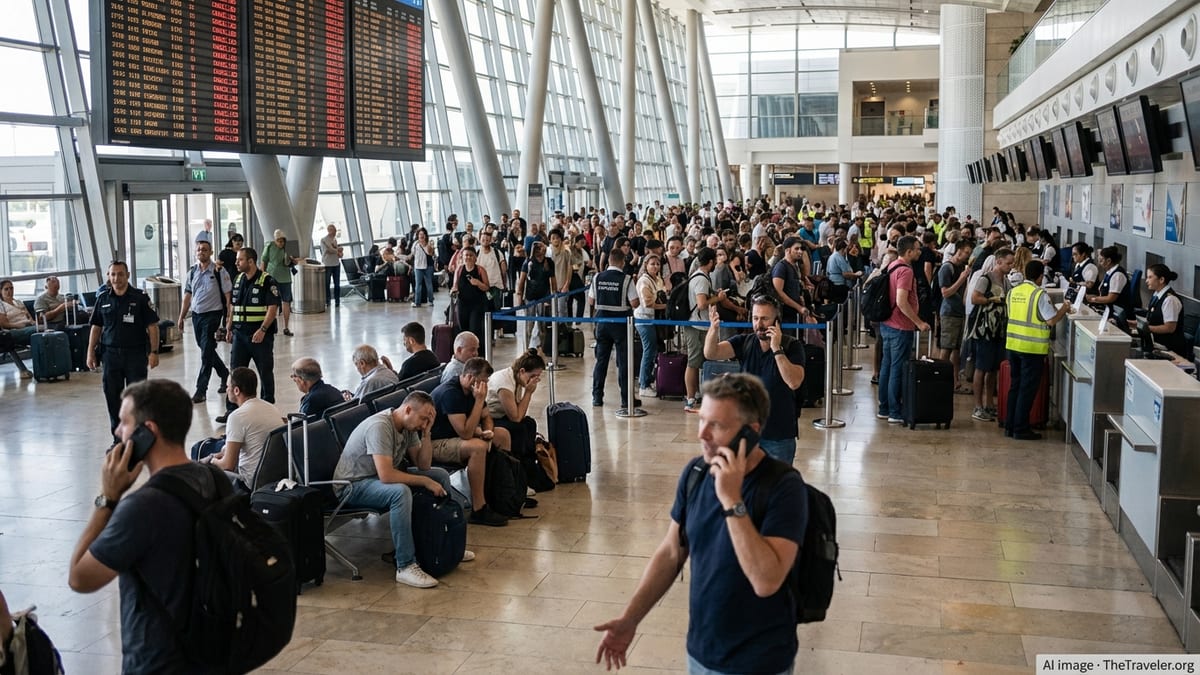
Ben Gurion Gridlocked as Israel Locks Down Its Skies
Israel’s aviation authorities effectively shut Ben Gurion Airport to most commercial traffic through at least Monday evening local time, following a joint US–Israeli strike on Iran and subsequent missile salvos that have transformed the region’s airspace into an active conflict zone. Airlines operating into Tel Aviv were ordered to cancel services en masse, leaving departure boards dominated by red “canceled” notices and terminals filled with confused passengers clutching rebooking slips.
Industry data providers and Israeli media reports on Sunday pointed to at least 231 cancellations at Ben Gurion within a roughly 36-hour window, encompassing both arrivals and departures and representing nearly half of the airport’s scheduled traffic. With runways available only for limited military and emergency movements, the country’s main international gateway has been reduced to a skeleton operation, severing air links for tourists, business travellers and diaspora families trying to reach or leave Israel.
The abrupt clampdown comes less than two years after previous wartime disruptions at Ben Gurion, underscoring how the airport has once again become a frontline asset. Security officials say the decision to freeze most civil aviation was driven by the need to keep air corridors clear for military aircraft and to reduce the risk posed by potential incoming missiles or drones to packed passenger jets.
Flag Carrier El Al Hit as Foreign Airlines Pull Back
El Al, Israel’s flag carrier and the dominant operator at Ben Gurion, has been forced to trim or cancel a large share of its schedule, even as the airline coordinates closely with defence authorities and keeps a small number of repatriation and strategic routes on standby. While El Al is accustomed to operating in high-risk environments and has one of the world’s most robust aviation security systems, outright airspace closures leave it with limited room to manoeuvre.
Foreign airlines have responded even more aggressively. Major European and North American carriers had already been scaling back Tel Aviv services amid mounting tensions, but the latest attack and counterstrikes triggered fresh waves of cancellations extending well beyond the immediate closure window. Several big groups have suspended Israel flights until at least early or mid March, warning customers that further extensions are possible if the conflict continues or expands.
The retrenchment leaves El Al shouldering a disproportionate role in any eventual restart of commercial links, but the carrier itself faces higher insurance costs, rerouting burdens, and crew safety concerns. Analysts say the airline’s ability to ramp back up swiftly will depend on how long Israel’s skies remain effectively off limits to routine traffic and whether international regulators keep classifying the region as a high-risk conflict zone.
Regional Carriers From Dubai to Abu Dhabi Feel the Shockwaves
The disruption radiating from Ben Gurion is rippling across the wider Middle East, where airspace closures over Israel, Iran, Iraq, Kuwait and parts of the Gulf have turned some of the world’s busiest hubs into bottlenecks. FlyDubai, which normally serves Tel Aviv and numerous regional destinations from Dubai International, has seen more than half of its flights scrapped according to recent operational tallies, stranding transit passengers en route between Europe, Asia and Africa.
Etihad Airways, based at Abu Dhabi’s Zayed International Airport, temporarily halted all departures for several hours on Sunday and later extended a full suspension of flights to and from the UAE’s capital into Monday. With key east–west corridors now blocked or heavily restricted, Etihad is among several Gulf carriers forced to reroute long-haul services around closed skies, adding hours to flight times, burning extra fuel and compressing already tight crew rosters.
Low-cost operator Wizz Air Malta, which has built an extensive network linking Europe with Tel Aviv as well as Gulf cities, has cancelled all services to Israel and suspended flights to Dubai, Abu Dhabi and Amman for at least a week. Charter and business specialists such as KlasJet, which often operate ad hoc missions into Israel and the region, have also been compelled to stand down, leaving gaps in corporate and VIP travel as well as in sports and tour operations that rely on customized lift.
Global Connectivity Frays as Reroutings Pile Up
What began as a targeted regional airspace lockdown is rapidly becoming a global connectivity crisis. Data from aviation analytics firms indicate that roughly a quarter of all flights to the broader Middle East were cancelled over the weekend, with some hubs such as Dubai, Doha and Abu Dhabi briefly seeing more than a third of their operations wiped from schedules. Given that these airports function as major transfer points linking Europe and the Americas with Asia and Oceania, disruptions at Ben Gurion reverberate far beyond Israel’s borders.
Many airlines are now avoiding entire swathes of Middle Eastern airspace, adding substantial detours to routes between Europe and South Asia, or between North America and the Indian Ocean region. Travellers on flights that do operate are reporting significantly longer journey times, unexpected fuel stops and missed onward connections, while crews confront maximum duty hour limits and aircraft rotations slip off schedule.
For global carriers already grappling with aircraft shortages and high demand, the sudden loss of reliable corridors over Israel and its neighbours risks undermining carefully calibrated summer schedules. Some operators have started proactively capping bookings on long-haul services that would normally traverse the region, anticipating further operational turbulence and seeking to preserve a margin of flexibility for stranded passengers.
Stranded Travellers Face Uncertainty and Limited Options
Inside Ben Gurion’s terminal buildings, scenes on Sunday ranged from resigned patience to visible anger as travellers learned that rebooking options were scarce and constantly changing. With many airlines suspending Israel services for days or weeks rather than hours, traditional same-day or next-day re-accommodation has often proved impossible, particularly for those holding tickets on low-cost or inbound foreign carriers that have no near-term plans to return.
Airport staff and airline agents have encouraged passengers to stay in close contact with their carriers’ digital channels, warning that call centres are overwhelmed and that information at check-in counters can lag behind fast-moving operational decisions. Governments, including those of the United States and several European states, have advised citizens to avoid non-essential travel to Israel and the wider conflict zone, while signalling that organised evacuation flights would be considered only if commercial options fail to resume within a reasonable period.
For now, thousands of holidaymakers, migrant workers, business travellers and visiting relatives remain caught in limbo, their journeys interrupted by a conflict far beyond their control. As military operations and diplomatic efforts unfold, the question for travellers and the industry alike is not just when Ben Gurion will physically reopen, but how quickly confidence in flying across the region can be restored.