

More news on this day
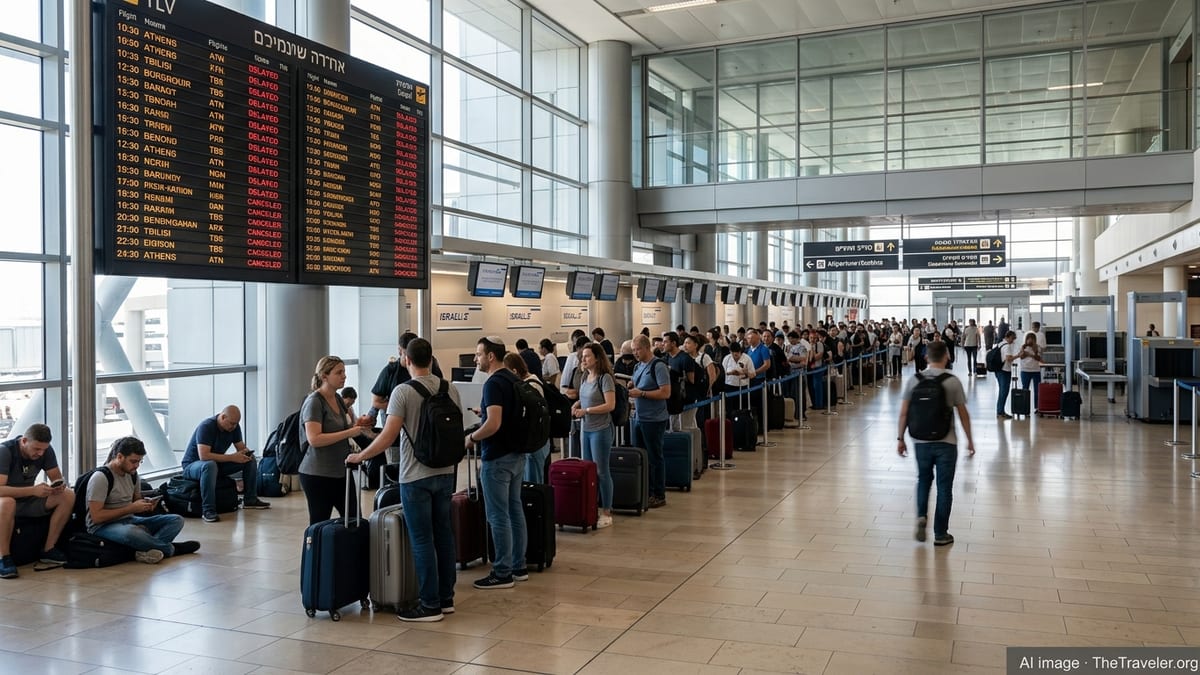
Ben Gurion International Airport is again experiencing heavy disruption, with a new wave of cancellations and delays on flights operated by El Al, Arkia Israel Airlines, Israir and other carriers, affecting passengers traveling between Israel and destinations including Greece, Georgia and other regional hubs.
Get the latest news straight to your inbox!
Limited Operations At Israel’s Main Gateway
Ben Gurion International Airport has been operating under constrained conditions for weeks as regional airspace restrictions linked to the ongoing Iran conflict continue to reshape flight schedules. Publicly available travel advisories describe the airport as functioning on a very limited basis, with priority given to inbound repatriation services rather than regular commercial frequency.
Against this backdrop, the latest airport operations data show at least three short-haul services canceled and multiple additional departures and arrivals delayed, including routes typically served by Israeli carriers El Al, Arkia Israel Airlines and Israir. While the absolute numbers are modest compared with pre-crisis volumes, the impact on individual passengers is significant given the already reduced baseline of flights in and out of Tel Aviv.
Passengers report that even when flights are still listed as operating, departure times are frequently pushed back as airlines wait for updated airspace clearances or adjust routings to avoid sensitive areas. These cascading delays create knock-on effects for connections onward to Europe, the Caucasus and North America, further complicating travel plans.
Regional Airspace Closures Ripple Through Schedules
The disruptions at Ben Gurion are closely tied to a wider pattern of airspace measures across the Middle East since late February 2026, when the conflict between Israel, the United States and Iran escalated sharply. Airspace over multiple countries, including Israel, Iran, Iraq, Jordan and parts of the Gulf, has been subject to full or partial closures, creating a patchwork of narrow operational corridors for civilian aviation.
Travel risk bulletins published in March highlight that selected Middle Eastern airports remain partially closed or are operating under tight restrictions, with Ben Gurion singled out for its focus on limited, primarily inbound traffic. Airlines operating from Israel have been forced to reconfigure their networks in response, thinning schedules, cutting frequencies and, in some cases, suspending certain routes entirely.
The result is a fragile timetable at Tel Aviv, in which even a small number of operational issues can translate into a visible spike in cancellations and delays. When three regional departures are scrubbed and around eight more flights are significantly delayed in a single operating window, as recent monitoring indicates, the effect on stranded travelers and airport congestion is acute.
El Al, Arkia And Israir Struggle To Maintain Connectivity
El Al, Israel’s flag carrier, has been at the center of efforts to sustain a minimum level of international connectivity during the crisis, adding special services on key routes such as Tel Aviv to New York to help return foreign nationals and residents. At the same time, its regular schedule has been repeatedly reshuffled, with individual flights subjected to last-minute timing changes or operational holds, contributing to the latest cluster of delays at Ben Gurion.
Arkia Israel Airlines and Israir, which normally provide dense short- and medium-haul coverage to nearby leisure and city destinations, have also been compelled to trim or reorient their offerings. Public updates and traveler accounts describe periods in which services to popular regional points such as Cyprus and Egypt have been suspended or converted into ad hoc recovery flights, underscoring how little slack remains in their reduced timetables.
When weather, airspace or technical constraints intersect with this already tight operational picture, flights can quickly be removed from the day’s schedule. The three most recent cancellations out of Ben Gurion involve short- and medium-haul sectors that would ordinarily connect Israel with nearby markets, illustrating how even limited adjustments can erase key links for business and leisure travelers alike.
Greece, Georgia And Neighboring Markets Feel The Strain
Greece and Georgia, both important outbound destinations for Israeli holidaymakers and entry points for travelers heading onward into Europe and the Caucasus, have been among the routes affected by the latest disruptions. Historical schedule data and legal filings show that Arkia and Israir have long used Ben Gurion as a base for charter and scheduled services to Greek islands and Georgian cities, and those patterns continue to shape current travel demand.
Under current constraints, however, flights that would typically connect Tel Aviv with Greek and Georgian airports are more vulnerable to cancellation or extended delay. Publicly available flight boards in recent days have listed Greek-bound and Caucasus-bound departures among those experiencing prolonged ground holds, while some services no longer appear at all on near-term schedules.
Passengers attempting to reach or depart from these destinations face a combination of longer connection times, re-routing through third countries such as Cyprus, Egypt or Jordan, and uncertainty over whether return legs will operate as planned. For many travelers, this means accepting overnight layovers or last-minute changes in order to complete trips that, in more stable times, would be routine point-to-point journeys.
Travelers Confront Uncertainty And Seek Workarounds
For individual passengers, the cumulative effect of three cancellations and numerous delays in a compressed time frame is less about headline statistics and more about personal disruption. Accounts shared on public forums describe travelers waking up to find their flights from Ben Gurion to regional destinations scrubbed, or discovering at the airport that departure boards have shifted repeatedly as airlines wait for clearance to depart.
Some travelers with urgent needs to reach Israel are piecing together multi-leg journeys via neighboring states. Public discussions reference itineraries that route passengers through airports in Egypt or Jordan, followed by overland crossings and, when possible, onward short-haul flights on Israeli carriers once they secure slots and permissions. Others are postponing trips entirely, citing the difficulty of securing reliable return segments.
Travel experts recommend that passengers booked on El Al, Arkia, Israir or other airlines serving Ben Gurion closely monitor flight status tools and remain prepared for rapid changes, including same-day cancellations. Many airlines are temporarily relaxing change and refund policies in recognition of the volatile situation, but rebooking options can be limited due to the sharply reduced number of available seats.
With the broader regional conflict still unresolved, there is little indication that Ben Gurion International Airport will return to normal operations in the immediate future. For now, travelers to and from Israel, Greece, Georgia and other nearby destinations must navigate an unpredictable environment in which even a small cluster of cancellations and delays can cascade into days of disruption.