

More news on this day
Severe capacity limits and new security rules at Israel’s Ben Gurion Airport have forced flag carrier EL AL to cancel and reshape large parts of its schedule, leaving thousands of travelers scrambling to rebook or change plans as the country’s airspace operates in an “extremely limited” mode.
Get the latest news straight to your inbox!
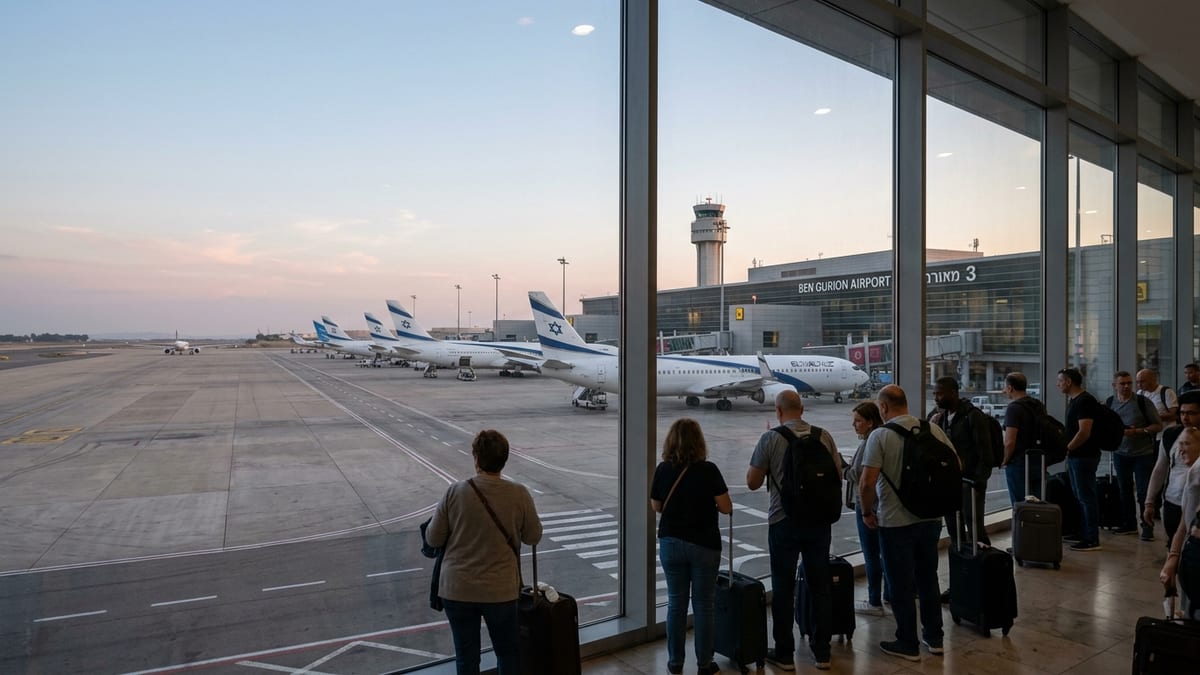
Why Ben Gurion Airport Is Operating Under Tight Restrictions
Ben Gurion Airport, Israel’s main international gateway near Tel Aviv, is currently functioning with sharply reduced capacity following weeks of heightened regional tensions and Iranian missile strikes that damaged private aircraft on the ground. Publicly available information shows that Israeli regulators have chosen to reopen the airport only partially, placing strict limits on the number of passengers allowed on each outbound flight while prioritizing essential and repatriation travel.
Reports indicate that in mid March the number of passengers permitted to depart on long haul flights, including those to the United States, was cut roughly in half, with outbound loads to North America and Europe held well below normal levels. These measures are described in local coverage as a way to manage security risk while maintaining a minimal air bridge for citizens and foreign nationals.
Travel advisories circulated by risk consultancies describe Ben Gurion as operating on a very limited basis, with schedules prone to sudden changes, rolling delays and last minute cancellations. While the runway and terminal infrastructure are technically open, airspace restrictions and operational caps have turned what is normally a busy hub into a tightly controlled, low throughput facility.
The net result is that there are far fewer seats leaving Israel than there are passengers who want to fly, placing intense pressure on EL AL’s network and triggering widespread disruption for leisure travelers, expatriates and business passengers alike.
How EL AL’s Schedule Has Been Reshaped
EL AL, which had continued flying when many foreign carriers suspended Israel service earlier in the conflict, has now been forced to substantially redraw its schedule to comply with the new restrictions at Ben Gurion. According to Reuters-based summaries shared on public channels, the airline temporarily halted new ticket sales until at least March 21 so that limited seats could first be allocated to customers whose flights were previously canceled when Israeli airspace was closed.
Travel forums and passenger accounts indicate that entire rotations on some routes have disappeared from the timetable, with EL AL consolidating demand into a smaller number of departures that operate with capped passenger loads. In practice, this means that many previously confirmed itineraries have been canceled outright, while others have been shifted to different days or times with little advance notice.
EL AL has also organized special recovery flights on select routes, particularly to major North American gateways, to help clear the backlog of stranded passengers whose original flights were scrapped in the early days of the airspace shutdown. These flights are often reserved first for travelers who already held EL AL tickets, leaving limited availability for new bookings.
Despite these efforts, discussions on traveler message boards suggest that tens of thousands of passengers have already experienced cancellations or involuntary changes, and that schedules for late March remain fluid as authorities review security conditions and capacity limits at Ben Gurion.
What the Restrictions Mean for Departing Passengers
For passengers trying to leave Israel in the coming days, the most immediate impact of the Ben Gurion restrictions is a sharp reduction in choice. With outbound flights capped at relatively low passenger numbers, seats are scarce, and many departures sell out quickly once they are released for booking. Some travelers report being rebooked multiple times as flights are cancelled, merged or retimed to fit within the new constraints.
Travelers also face longer processing times at the airport itself. Public reports describe crowded check in areas when new flights open, followed by periods of relative quiet as airlines stagger departures to align with the tighter security environment. Check in cut off times may be brought forward, and passengers are being advised across multiple channels to arrive well ahead of schedule and to remain flexible about potential delays.
Another complication is that inbound and outbound traffic are not being treated equally. Since Ben Gurion’s partial reopening, priority has often been given to repatriation arrivals and departures for foreign nationals, which can push back regular commercial services or force further cancellations on secondary routes. As a result, passengers on non essential trips or discretionary journeys are more likely to find their flights axed or moved.
Travelers with connections beyond EL AL’s network must take particular care. With many regional routes disrupted and other Middle Eastern hubs also dealing with airspace issues, missed onward connections are more likely if a Tel Aviv departure is delayed or rescheduled at short notice.
EL AL’s Policies on Rebooking, Vouchers and Refunds
To manage the disruption, EL AL has introduced temporary commercial policies for customers whose flights are affected by the Ben Gurion restrictions. According to information shared on the airline’s public channels and summarized in travel forums, passengers who purchased tickets by late February for travel through at least March 31 are generally being allowed to cancel or change their plans without standard change fees.
In many cases, travelers whose flights have been canceled are offered a choice between rebooking on the next available EL AL service on the same route, accepting a credit voucher for future travel, or requesting a refund of the unused ticket value and certain taxes. The exact options can vary by fare type, route and point of purchase, and processing times may be longer than usual due to call center congestion.
Reports from passengers suggest that EL AL is prioritizing rebooking for those stranded abroad or needing to leave Israel urgently, with less flexibility for new reservations or discretionary travel. Some travelers note that finding replacement dates in March has been challenging, and are instead opting for credit vouchers to use once Ben Gurion returns to more normal operations.
Because policies continue to evolve as the situation develops, travelers are being encouraged in public advisories and online discussions to monitor EL AL’s official channels and to work closely with their travel advisors, especially if they face tight deadlines for visas, employment start dates or other time sensitive commitments.
Planning Travel To and From Israel in the Coming Weeks
With the regional security situation still unsettled and Ben Gurion Airport operating under stringent caps, prospective visitors to Israel are being urged by travel risk consultants and government advisories to approach any upcoming trip with caution. Non essential travel into the country in late March is widely described as “challenging,” in large part because outbound options may be limited or subject to sudden change.
For travelers who must fly, experts quoted in mainstream coverage recommend building extra time into itineraries, avoiding tight same day connections and ensuring that accommodation and ground transport arrangements are flexible. It is also advisable to hold fully refundable or changeable tickets where possible, given the elevated risk of further cancellations if airspace restrictions tighten again.
Some passengers are exploring alternative exit routes via neighboring countries, traveling overland to Jordan or Egypt and then flying onward from Amman or Cairo. Public discussion threads highlight that these routes can offer more predictable capacity on certain dates, but they also introduce additional border crossing procedures and security checks that may not be suitable for everyone.
For now, the situation at Ben Gurion remains highly dynamic. The combination of airport level restrictions, airspace considerations and EL AL’s reduced schedule means that travel plans involving Israel in the coming weeks require close monitoring, a high tolerance for last minute changes and a willingness to adjust dates or routes as conditions evolve.