

More news on this day
Hundreds of travelers were left scrambling on Wednesday as a new wave of cancellations and rolling delays at Tel Aviv’s Ben Gurion International Airport prompted El Al, United Airlines, Aegean Airlines, Georgian Airways, Air France and other carriers to suspend at least 37 flights, disrupting connections to Newark, Athens, Larnaca, Tbilisi and other major hubs.
Get the latest news straight to your inbox!
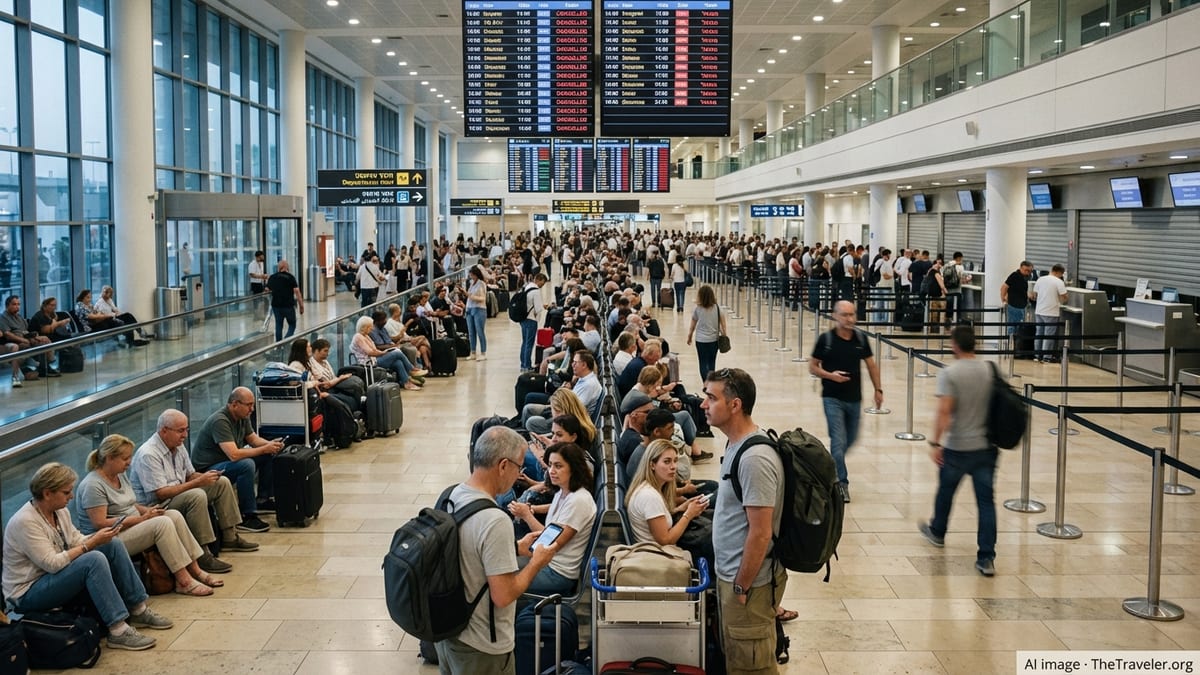
Wave of Cancellations Hits Tel Aviv Departures
Ben Gurion International Airport continued to operate under acute strain on March 11, with departure boards showing clusters of canceled and heavily delayed services as airlines adjusted schedules in response to heightened regional tensions and operational constraints. Airport data indicated scrapped or suspended services affecting at least 37 flights within a 24-hour window, with routes to and from Europe and North America among the hardest hit.
El Al, Israel’s national carrier, has shifted almost entirely to an emergency timetable, canceling most regularly scheduled flights through March 14 while operating a pared-back network of rescue and essential services. The carrier is also working under a strict cap on the number of passengers permitted per flight, significantly limiting its ability to rebook stranded travelers and contributing to scenes of crowding at Ben Gurion’s terminals.
United Airlines, which links Ben Gurion with Newark Liberty International Airport and other US hubs, has been adjusting its Israel schedule under a broad “Middle East unrest” travel waiver that spans late February through the end of March. While some Newark services continued to appear on departure boards, the carrier has proactively suspended or consolidated select rotations, leaving many passengers facing last-minute changes and overnight stays.
Regional and European operators, including Aegean Airlines, Georgian Airways and Air France, have also trimmed flying to Tel Aviv, either canceling individual services or extending earlier suspensions. The result for passengers at Ben Gurion on Wednesday was a patchwork of active flights, long delays and abrupt cancellations that shifted hour by hour.
Spillover Disruption in Newark, Athens, Larnaca and Tbilisi
The disruption in Tel Aviv is rippling outward across multiple airports that serve as key gateways to Israel. At Newark Liberty, where United and El Al both operate high-demand transatlantic services to Ben Gurion, travelers reported gate changes, rolling departure times and sudden scrubbing of rotations as aircraft and crews fell out of position.
In Athens, Aegean Airlines has been steadily extending its suspension of Tel Aviv flights, as well as services to several other Middle East destinations. The carrier’s latest advisories cover cancellations stretching at least into late March, forcing passengers on the Athens–Tel Aviv corridor to seek alternative routings through third countries or accept travel vouchers and future credits instead of immediate journeys.
Larnaca in Cyprus, a popular alternative gateway for travelers heading to and from Israel, has also been hit hard. Airport figures show dozens of recent cancellations tied to Middle East routes, with Monday alone seeing nearly 40 flights scrapped as carriers reassessed the viability of operating near conflict-affected airspace. This has constrained one of the main fallback options for Israelis and visitors trying to bypass Tel Aviv’s disruption by flying via Cyprus.
Further east in Tbilisi, services linking Georgia and Israel have experienced delays and selective cancellations, including flights that would normally feed Ben Gurion with connecting passengers from the Caucasus and Central Asia. Georgian Airways has limited its operations as demand softens and routing options grow more complex, adding yet another choke point for regional mobility.
Airlines Activate Waivers and Emergency Schedules
Airlines affected by the turbulence have responded with a mix of emergency schedules, flexible rebooking policies and, in some cases, temporary network cuts. El Al has concentrated on a skeleton operation that prioritizes routes deemed essential, while leveraging wide-body aircraft where possible to maximize capacity within the passenger caps imposed on each flight.
United has expanded and then fine-tuned a region-wide travel waiver that allows passengers ticketed to or from Tel Aviv and other affected destinations to change their plans without standard penalties. In some cases, the carrier has organized special “rescue” services, rerouting or consolidating flights through alternative hubs when direct operations to Ben Gurion were no longer feasible.
Aegean Airlines, confronted with prolonged uncertainty over airspace and security conditions, has gone beyond short-term cancellations and is now offering extended flexibility windows. Passengers booked on suspended Tel Aviv, Dubai, Baghdad, Erbil and Beirut services are being allowed to shift their trips to later dates well into the spring or opt for credit vouchers, an approach mirrored in how the airline is handling Israel-bound itineraries from Athens and Larnaca.
Legacy European carriers such as Air France have layered these route-specific steps on top of broader operational disruptions at their home hubs. Paris Charles de Gaulle, one of the main connection points between Europe and the Middle East, has recorded dozens of delays and a double-digit tally of cancellations in a single day, as airlines from El Al to Gulf carriers reshuffle their schedules.
Passengers Face Crowding, Confusion and Limited Alternatives
For travelers, the operational complexity has translated into long queues at ticket counters, extended waits for information and limited same-day alternatives. At Ben Gurion, the combination of flight caps, security procedures and rolling schedule changes has generated dense crowds around departure boards and check-in islands, with passengers often learning of cancellations only after arriving at the airport.
Reports from the terminals in recent days have described frayed tempers and tense exchanges between passengers and staff, particularly among those holding tickets on now-suspended flights who cannot be rebooked promptly due to the reduced capacity. In some instances, spontaneous protests have broken out when groups of travelers realized they might be stranded for several days.
Downline cities such as Newark, Athens, Larnaca and Tbilisi are experiencing similar pressure, as stranded passengers accumulate and hotel availability tightens. Many travelers are turning to indirect routings using secondary hubs, yet these options are increasingly constrained by other carriers’ own schedule cuts and detours around closed or restricted airspace.
Consumer advocates are urging passengers to meticulously document delays and cancellations, save receipts for out-of-pocket expenses and familiarize themselves with their rights under European and US regulations. Depending on the route, some travelers may be entitled to meals, accommodation, rebooking on other carriers or even financial compensation, though the applicability of such rules can be complex in the context of security-related disruptions.
What Travelers Should Expect in the Coming Days
Operational planners at major airlines and airports caution that the situation around Ben Gurion is likely to remain fluid through at least mid-March. Continued airspace restrictions, evolving security assessments and the sheer logistics of repositioning aircraft and crews mean that schedules will be updated frequently, often with limited advance warning.
Industry analysts note that carriers are increasingly treating Tel Aviv and nearby gateways like Larnaca as volatile nodes within a wider network, adjusting capacity and timings on a rolling basis rather than adhering to fixed seasonal timetables. This shift allows airlines to respond quickly to new developments but leaves passengers facing an unusually high risk of last-minute changes.
Travelers planning routes through Tel Aviv, Newark, Athens, Larnaca or Tbilisi in the coming days are being advised to monitor flight status continuously, keep airline apps and contact details handy, and build generous buffers into itineraries that rely on tight connections. Those with flexible plans may find it prudent to postpone nonessential trips until schedules stabilize.
For now, Ben Gurion remains open but fragile, operating under a patchwork of emergency measures as airlines balance safety, regulatory constraints and passenger demand. The suspension of 37 flights in a single burst illustrates how quickly that balance can tip, sending shockwaves across a network of airports from the Eastern Mediterranean to the US East Coast.