

More news on this day
Rail travel between Bengaluru and Goa is poised for a major upgrade as Indian Railways advances plans for a new Vande Bharat Express on the coastal corridor, promising faster journeys, modern amenities and a significant boost to business and tourism across Karnataka and Goa.
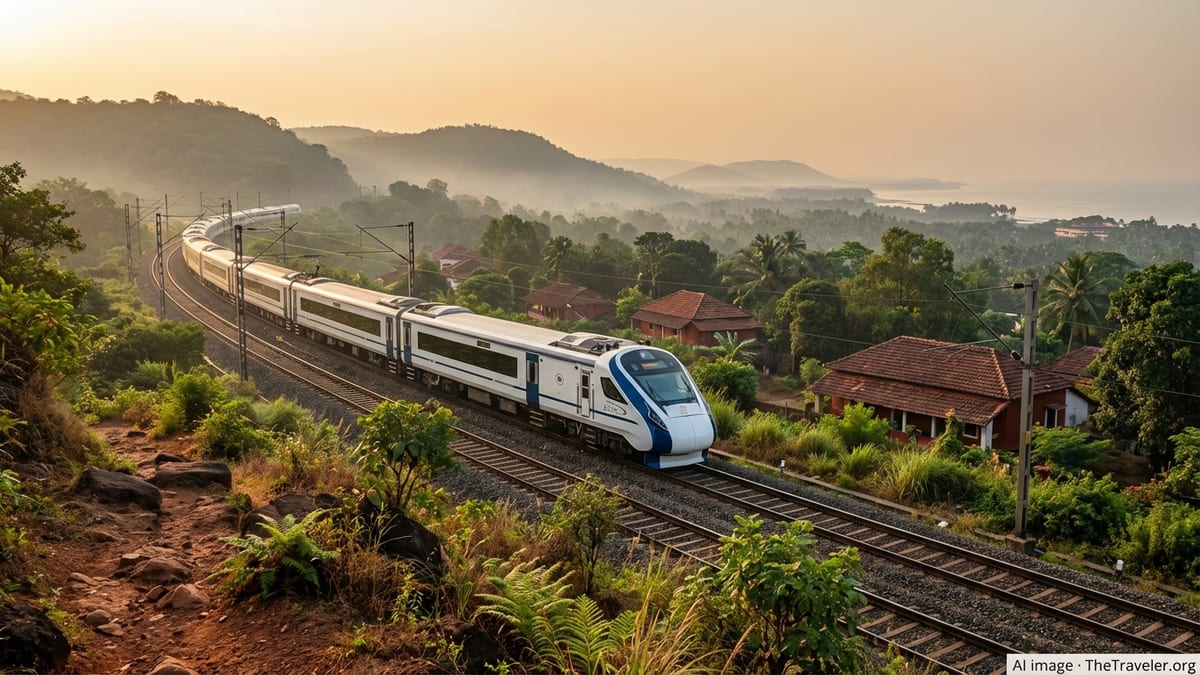
New Semi-High-Speed Link Between Tech Hub and Beach Belt
The proposed Vande Bharat Express will connect Yesvantpur in Bengaluru with Madgaon in Goa, creating a dedicated semi-high-speed rail corridor between India’s technology capital and one of its most popular coastal tourism hubs. South Western Railway and Railway Ministry proposals outline a service that combines improved journey times with the comfort and reliability associated with the Vande Bharat brand.
According to recent planning details, the train is expected to take about 13 hours and 10 minutes to cover the full distance between Yesvantpur and Madgaon. While this does not yet match headline speeds seen on some northern and western routes, officials stress that the service represents a major qualitative leap for one of southern India’s most scenic but operationally challenging corridors.
The initiative builds on a broader expansion of Vande Bharat services across India, including new links in Gujarat and Rajasthan and additional coaches on high-demand routes. For Karnataka and Goa, however, this is the first time the premium service is being specifically tailored to tie together the state capital, major coastal towns and an international tourism gateway.
Route, Timings and Journey Experience
Under the current proposal, the Bengaluru–Goa Vande Bharat will start from Yesvantpur early in the morning, allowing passengers to leave the city before peak-hour congestion and arrive in Goa by evening. In the Yesvantpur–Madgaon direction, the service is planned to depart at 6.05 am and reach Madgaon at around 7.15 pm. The return train would leave Madgaon at 5.30 am and arrive back in Yesvantpur at approximately 6.40 pm, offering same-day connectivity in both directions.
The route will run via Hassan, Sakleshpur, Subrahmanya Road, Padil, Thokur and Udupi before entering Goa. This alignment means the train will traverse the Western Ghats and coastal Karnataka, but is expected to bypass some of the central Mangaluru stations to save time while still serving key regional hubs. Railway planners note that average speeds for significant stretches of the journey will remain below 50 kmph because of gradient, curvature and signalling constraints, particularly in the ghat sections.
Despite these limitations, the scheduled timings represent a structured, time-bound option compared to many existing services on the corridor, which often face delays linked to freight traffic and weather-related disruptions. Regular departure and arrival windows are being designed to suit both leisure travellers heading to Goa’s beaches and business passengers commuting between the tech and industrial belts of Karnataka and the port and tourism economy of Goa.
State-of-the-Art Features on Board Vande Bharat
The Bengaluru–Goa service will draw on the standard Vande Bharat design, which has become synonymous across India with faster intercity travel and upgraded passenger amenities. Trains in this series feature air-conditioned Chair Car and Executive Chair Car coaches, with ergonomically designed reclining seats, large tinted windows, reading lights and individual mobile and laptop charging points. Wide automatic doors and vestibules allow smoother movement across coaches.
Onboard systems include GPS-based passenger information displays, announcement systems and continuous CCTV surveillance throughout the train for enhanced security. Bio-vacuum toilets with touch-free fittings, sensor-based taps and improved ventilation systems are intended to improve hygiene, while sealed-gangway construction and better suspension reduce noise and vibration in the passenger cabins.
The Bengaluru–Goa rake is expected to benefit from recent upgrades seen on other Vande Bharat routes, including more robust luggage racks, improved lighting and refined braking systems for better performance on challenging gradients. Although the route’s top permissible speeds are constrained by infrastructure, the robust acceleration and braking characteristics of the train are likely to help improve punctuality and reduce time lost at frequent stops.
Railway designers emphasize that Vande Bharat’s semi-high-speed platform is as much about reliability and comfort as it is about raw speed. Consistent air-conditioning, smoother ride quality and quick station dwell times are expected to be significant differentiators for passengers used to older rolling stock on the coastal route.
Political Push and Long-Standing Public Demand
The new corridor is the result of sustained political and public pressure to upgrade rail connectivity between Bengaluru and the coastal belt. In late 2025, Union Minister H D Kumaraswamy wrote to Railway Minister Ashwini Vaishnaw, formally urging the introduction of a Vande Bharat Express from Bengaluru to Madgaon via coastal Karnataka. He highlighted both the long-pending public demand and the completion of crucial electrification works in the ghat section.
The minister argued that a semi-high-speed service would substantially reduce travel time while improving comfort and reliability for a wide mix of passengers, including tourists, pilgrims, students and daily commuters. His intervention came as part of a broader push from Karnataka leaders to secure more premium rail services for the state after a series of Vande Bharat launches in northern and western India.
Railway officials have since moved from conceptual discussions to more concrete proposals, examining rake availability, route capacity and potential station halts along the coastal line. While a final date for inauguration has yet to be formally announced, the publication of proposed timings and station lists indicates that the project is now firmly on the ministry’s near-term agenda.
Boost for Tourism, Trade and Regional Mobility
Travel planners and tourism operators in both Karnataka and Goa expect the Bengaluru–Goa Vande Bharat to become a flagship service for the region. The corridor will link Bengaluru’s dense cluster of technology parks, start-ups and multinational offices with coastal destinations such as Udupi and the beaches and nightlife of Goa, creating a direct, premium option for weekend and holiday travel.
For Goa’s hospitality sector, the service is expected to complement existing air connectivity by offering a mid-priced, high-comfort alternative for domestic tourists, particularly families and groups who prefer to avoid airport transfers and baggage restrictions. Hoteliers expect that predictable, early-evening arrivals from Bengaluru will better align with check-in schedules, improving occupancy planning during peak seasons and long weekends.
Beyond leisure travel, the train will also serve as an important conduit for students and professionals who shuttle between educational institutions in coastal Karnataka and Bengaluru’s universities and corporate campuses. Port-linked industries and logistics firms are tracking the project closely, viewing it as part of a wider upgrades push that may eventually help free up capacity on mixed-traffic routes and support time-sensitive cargo by decongesting certain sections.
Regional planners note that improved rail options along the western coast can also ease pressure on congested highways, particularly during the monsoon, when landslides and flooding routinely slow road traffic between the Ghats and the coast. A reliable, modern train can offer a safer and more sustainable alternative for medium-distance travel.
How the New Service Fits into India’s Wider Rail Modernisation
The Bengaluru–Goa proposal comes at a time when Indian Railways is aggressively scaling up its Vande Bharat portfolio and broader modernisation programme. New Vande Bharat services have recently been launched or announced in states including Gujarat and Rajasthan, while authorities are adding extra coaches on selected busy routes to cope with rising demand.
Parallel to rolling-stock upgrades, the national transporter is investing heavily in track renewal, signalling upgrades and automatic train protection technologies such as the latest version of Kavach. These measures have allowed higher permissible speeds on multiple corridors and contributed to a reduction in consequential train accidents, according to recent government data.
In Karnataka itself, a Vande Bharat Express already links Belagavi with KSR Bengaluru, inaugurated alongside the city’s Yellow Line metro extension and demonstrating how premium rail and urban transit projects can reinforce one another. The planned coastal service from Yesvantpur to Madgaon is seen as a logical extension of this strategy, targeting tourism-rich and trade-linked regions that have so far relied largely on conventional mail and express trains.
Officials involved in planning stress that while travel times on the Bengaluru–Goa corridor will initially be constrained by legacy infrastructure, the use of modern trains is part of a phased approach. Future upgrades to tracks, signalling and crossing removal could gradually translate into faster schedules, mirroring improvements seen on other parts of the national network.
Challenges on the Ghats and the Path to Higher Speeds
Despite the buzz around the new service, railway engineers caution that the corridor poses significant operational challenges. The stretch across the Western Ghats is one of the most technically demanding in southern India, with steep gradients, sharp curves and heavy rainfall during the monsoon. These factors limit permissible speeds and require careful management of braking, traction and safety systems.
The recent electrification of the ghat section has removed a major barrier to introducing a semi-high-speed service, allowing electric traction and regenerative braking throughout the route. However, average speeds will still be modest in comparison with flatter trunk corridors in northern and western India. Planners acknowledge that even with Vande Bharat rolling stock, the train will operate below 50 kmph across long segments, particularly in the hills.
Infrastructure upgrades will be crucial if authorities are to gradually raise speeds and cut journey times. These include improved track geometry, bridge strengthening, upgraded signalling to reduce headway between trains and enhanced protection against landslides and washouts. Environmental and social considerations in the sensitive Western Ghats region mean that such works must balance safety, speed and sustainability.
In the meantime, officials argue that reliability, comfort and predictable scheduling will be the main selling points. For many passengers, the ability to work on board, enjoy cleaner facilities and arrive on time may matter more than headline speed claims, especially on a scenic route where the landscape is part of the experience.
What Passengers Can Expect Next
As of late February 2026, the Bengaluru–Goa Vande Bharat remains in the proposal and planning phase, with operational details being refined by South Western Railway and the Railway Board. Key next steps include finalising rake allocation, confirming the full list of intermediate halts, setting fare structures and completing any residual technical checks on the electrified sections.
Once the Railway Ministry formally signs off on the schedule and resources, Indian Railways is likely to announce an inaugural date alongside trial runs and safety clearances. Ticketing details, including the days of operation and coach composition, will be published through regular reservation channels and passenger information systems.
For now, the emerging picture is of a premium, long-distance day train that will give both Karnataka and Goa a share in India’s most visible rail modernisation programme. If the service meets expectations and attracts strong patronage, it could pave the way for further enhancements, including additional frequencies, seasonal specials or, in the longer term, sleeper variants tailored to overnight coastal travel.
For travellers accustomed to overnight buses or lengthy conventional train journeys on this corridor, the new Vande Bharat Express promises a markedly different experience: an early morning departure from Bengaluru, a day spent watching the Western Ghats and Konkan coastline roll by, and an evening arrival in Goa with the comfort and predictability of India’s latest-generation intercity trains.