

More news on this day
Gulf-bound passengers at Bengaluru’s Kempegowda International Airport faced a turbulent weekend as airspace restrictions linked to escalating tensions in the Middle East prompted 19 flight cancellations and widespread schedule disruptions on key routes to Qatar, Dubai and Riyadh.
Airspace Curbs Ripple Into Bengaluru Operations
Airport officials in Bengaluru confirmed that a combination of arrival and departure services across core Gulf sectors were pulled from the schedule over February 28 and March 1 after airlines were instructed to avoid multiple Middle Eastern airspaces for safety reasons. The restrictions, introduced amid a sharp deterioration in the regional security environment, affected standard westbound corridors used by Indian carriers and foreign airlines alike.
The impacted flights included services to Doha in Qatar, Dubai in the United Arab Emirates and Riyadh in Saudi Arabia, alongside other heavily trafficked destinations such as Abu Dhabi, Jeddah and Dammam. With routings that normally overfly or skirt restricted zones suddenly unavailable or operationally complex, airlines opted to cancel a total of 19 movements over the two-day period.
While domestic schedules at Kempegowda International Airport remained largely intact, the disruption underscored how quickly geopolitical flashpoints far from southern India can upend connectivity for one of the country’s busiest technology and migrant-worker hubs.
Gulf Routes Bear the Brunt of Cancellations
The bulk of the cancellations involved services linking Bengaluru to major Gulf transit hubs that serve as stepping stones for both onward long-haul itineraries and labour traffic to the wider Middle East. Flights bound for and arriving from Dubai and Doha were among the first to be affected as operators responded to airspace closures and rapidly shifting risk assessments across West Asia.
Connections to Riyadh also saw disruption, with at least one Bengaluru service to the Saudi capital withdrawn from the weekend schedule as carriers recalibrated their networks. Industry sources indicated that some flights were initially delayed while alternative routings were evaluated, only to be scrubbed when it became clear that diversions would add significant time, fuel burn and operational complexity.
Airlines serving the Gulf from Bengaluru, including major Indian low-cost and full-service carriers as well as Middle Eastern network airlines, moved quickly to consolidate capacity. Operations teams faced the additional challenge of rebalancing aircraft and crew positioning, given that any cancellation on an outbound leg can cascade into further schedule changes on return sectors.
Stranded Passengers Confront Uncertainty and Long Queues
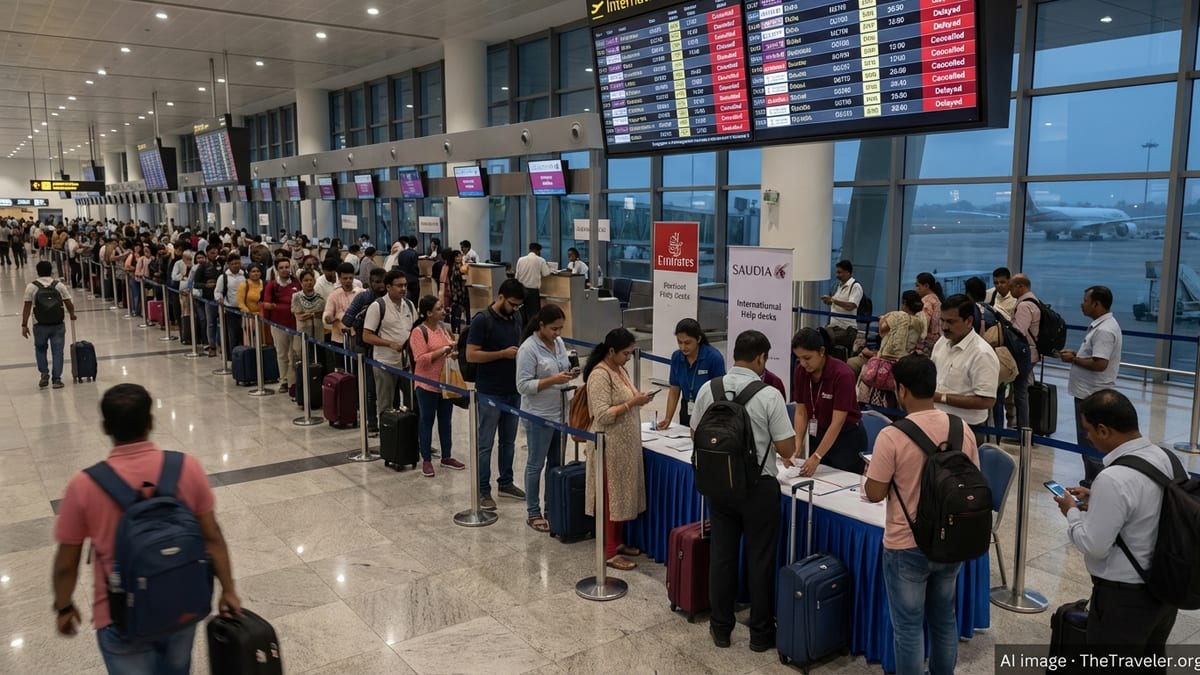
For passengers, the operational decisions translated into hours of uncertainty at check-in counters and departure halls. Many weekend travellers reported arriving at Kempegowda International Airport to discover their flights to Qatar, Dubai or Riyadh were listed as cancelled or indefinitely delayed, with some saying they had received no prior notification from their airlines.
Airport staff and airline ground teams established dedicated desks in the international terminal to manage rebooking and refund requests, but long queues formed as hundreds of travellers sought clarity on revised plans. Families heading to the Gulf for work rotations, medical visits or onward connections to Europe and North America were among the hardest hit, with some facing tight visa windows or immovable job start dates.
Several passengers were offered options to reroute via alternative Indian gateways with remaining capacity to West Asia or to postpone their journeys at no additional charge. Others opted for full refunds, wary that the situation in the Middle East and consequent airspace restrictions could extend beyond the immediate weekend.
Regulators and Airlines Navigate a Shifting Safety Landscape
The disruption at Bengaluru formed part of a broader realignment of Indian aviation in response to the regional crisis. The country’s civil aviation regulator has advised carriers to avoid multiple airspaces across West Asia through at least March 2, prompting wide-scale adjustments on westbound routes. Airlines have stressed that passenger and crew safety remains the primary driver of schedule changes, even as they work to minimise inconvenience.
Major Indian operators have temporarily suspended or curtailed flights to several Middle Eastern destinations, while Gulf-based carriers are also recalibrating operations to and from India. For Bengaluru, a key southern gateway with strong Gulf ties, that has translated into an unusually thin weekend departure board on routes that are typically popular with business travellers, tourists and expatriate workers.
Aviation analysts note that rerouting options around closed or high-risk airspace are limited and logistically complex for airlines working with tight turnaround times and narrow profit margins. Longer flight paths not only raise fuel costs but can also impact crew duty-time limits, aircraft availability and onward connections, making selective cancellations a pragmatic, if disruptive, short-term response.
Outlook for Travellers and the Wider South India Network
With advisories currently in place only through early March, airlines and regulators are closely monitoring developments in the Middle East to determine how quickly regular patterns of traffic can be restored. Industry observers caution, however, that even a rapid easing of airspace restrictions may not immediately translate into a full return to pre-crisis schedules, as carriers rebuild networks and clear passenger backlogs.
The cancellations and delays in Bengaluru follow similar disruptions at other South Indian airports, where Gulf-bound services have also been curtailed. Together, the changes highlight the dependence of cities across the region on stable Middle Eastern air corridors for employment-linked flows, tourism and long-haul connectivity.
For now, Kempegowda International Airport is advising passengers booked on flights to Qatar, the United Arab Emirates, Saudi Arabia and neighbouring destinations to closely monitor airline communications, arrive early for departures and be prepared for last-minute changes. Travel agents say flexible tickets and travel insurance that covers geopolitical disruption are once again moving up the priority list for frequent flyers out of Bengaluru.