

More news on this day
Premium leisure carrier Beond is preparing to link the Maldives with London, Paris and Moscow on itineraries routed via Dubai, in a move that would significantly broaden the young airline’s footprint in Europe and Russia while reinforcing Dubai’s role as a key stopover point for high-end Indian Ocean travel.
Get the latest news straight to your inbox!
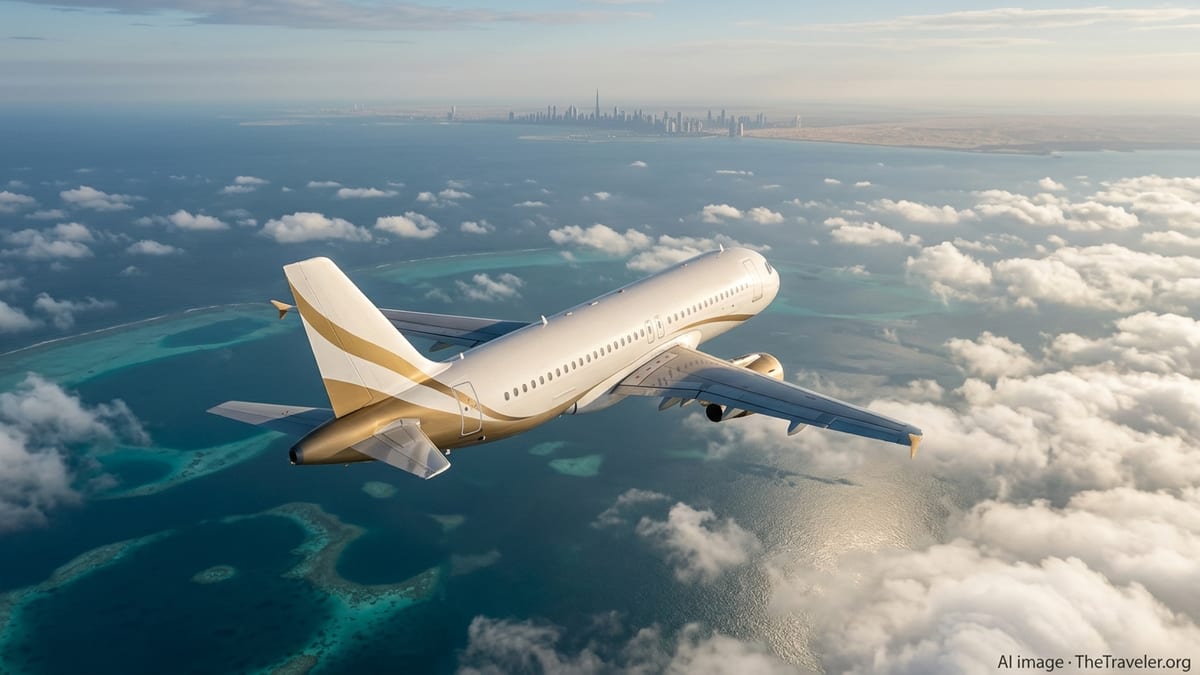
Premium Maldivian Carrier Eyes Major European Gateways
Beond, an all-business-class airline based in the Maldives and headquartered in Dubai, has been steadily positioning itself as a niche option for upscale travelers bound for the Indian Ocean. Publicly available company information shows that the carrier launched operations in late 2023 with flights from initial European gateways such as Munich and Zurich to Malé, often using Dubai Al Maktoum as a technical stop.
Industry schedule filings and route-mapping data now indicate that Beond is working on a broader network strategy that would place London and Paris among its key long-haul markets from the Maldives, with Moscow positioned as a primary origin point in Russia. These additions would build on the airline’s existing Europe–Maldives links and align with its stated ambition to make Malé more accessible to premium leisure customers worldwide.
While the carrier has not yet published a finalized start date or full timetable for the London, Paris and Moscow operations, analyst commentary suggests that Beond’s network choices tend to be closely tied to premium holiday demand cycles in Europe and the Gulf. The Maldives has long been a strong draw in the winter season for travelers from the United Kingdom, France and Russia, giving the proposed routes the potential to generate high-yield cabin loads if schedules and pricing align.
For Dubai, the development underscores the city’s enduring role as a staging point for traffic to the Maldives. Beond’s dual identity as a Maldivian airline with a Dubai headquarters means that its European and Russian expansion is likely to continue routing through the emirate, even as the airline experiments with alternative intermediate stops elsewhere in the region.
Routing Strategy: Maldives to Europe and Russia via Dubai
Operational data from existing Beond services shows that the airline has favored a one-stop model on long sectors, using Dubai Al Maktoum as a refueling and crew stop while selling seats on the intermediate segment where traffic rights allow. Reports on the airline’s Milan and Zurich services describe routings that initially passed through Dubai before being adjusted to include other regional points, reflecting a flexible approach to network design.
The planned Maldives to London, Paris and Moscow services appear set to follow a similar pattern, with Dubai positioned as the central waypoint. Under this model, passengers originating in Europe or Russia would board in their home cities, fly to Dubai, and then continue onward to Malé on the same carrier. Where bilateral agreements permit, Beond may also be able to sell individual sectors such as Dubai to London or Dubai to Moscow, effectively adding premium point-to-point capacity on those corridors.
Industry observers note that this strategy allows Beond to spread operational risk. Instead of launching multiple nonstop ultra-long-haul routes from Malé, the airline can operate a smaller fleet on a hub-and-spoke style pattern anchored by Dubai. This can simplify maintenance, crew planning and fuel management while also tapping demand in the Gulf itself, where travelers may board only for the final leg to the Maldives.
However, such a model depends heavily on punctual turnarounds at the intermediate stop. Any operational disruption in Dubai can cascade across the combined sectors, affecting travelers both to and from the Maldives. Previous schedule adjustments on European routes have illustrated how sensitive small premium airlines can be to aircraft utilization and seasonality, and similar factors are likely to shape the roll-out of new London, Paris and Moscow flights.
Competitive Landscape on Maldives Links From London, Paris and Moscow
Beond will enter crowded markets from all three cities. Aviation and tourism data highlight that the Maldives is already accessible from London, Paris and Moscow through a mix of nonstops and one-stop itineraries provided by large global carriers and regional specialists. Gulf mega-hub airlines, South Asian operators and European legacy carriers all compete aggressively for premium leisure traffic headed to Maldivian resorts.
On routes from London and Paris, Beond’s proposed via-Dubai itineraries will be competing not only with nonstops to Malé, where available, but also with established one-stop options via Doha, Abu Dhabi, Istanbul and other hubs. Many of these airlines operate widebody fleets with large premium cabins, strong loyalty programs and extensive feeder networks across Europe, allowing them to aggregate demand from secondary cities.
Moscow represents a different competitive environment, shaped by evolving airspace restrictions, sanctions and shifting travel patterns from Russia to Indian Ocean destinations. Available tourism statistics continue to list Moscow among the cities with direct or one-stop connectivity to the Maldives, often routed through regional hubs in the Gulf and Central Asia. In this context, Beond’s value proposition will likely hinge on its all-business-class offering and the appeal of a curated premium leisure product rather than simple price competition.
Analysts point out that Beond’s relatively small scale could be an advantage on routes prone to seasonal swings. With only a handful of aircraft in service, the airline can adjust frequencies or temporarily shift aircraft between markets more nimbly than some larger competitors, provided that customer communication and schedule reliability remain strong.
All-Business-Class Cabin Aims at Maldives Luxury Segment
Beond markets itself as a “premium leisure” airline, operating aircraft configured entirely with lie-flat business-class seats. Reviews of its early flights describe a boutique onboard experience with a strong emphasis on design, privacy and personalized service, pitched specifically at travelers heading to upscale Maldivian resorts rather than corporate road warriors.
The choice of London, Paris and Moscow aligns closely with that positioning. All three cities have sizable affluent traveler bases accustomed to premium cabins on long-haul routes, as well as strong existing links to the Indian Ocean resort market. Travel trade coverage has previously highlighted high-spend outbound tourism from the United Kingdom, France and Russia to the Maldives, particularly in peak northern winter months when resort occupancy and airfares typically rise.
By operating all-business-class cabins on relatively small aircraft, Beond is effectively pursuing a micro-niche within an already premium-heavy market. The strategy relies on selling high-yield seats to travelers who value exclusivity and a simplified end-to-end experience more than the perks of a large alliance loyalty program. The Dubai stopover component may further appeal to passengers interested in multi-destination itineraries, combining a city break in the Gulf with a beach stay in the Maldives.
At the same time, the model leaves little room for error. With no economy cabin to fill and limited ability to discount aggressively without undermining its brand, Beond must balance fares carefully against load factors. The proposed expansion into London, Paris and Moscow via Dubai will test whether the carrier’s boutique formula can sustain itself on some of the most competitive long-haul leisure corridors in the world.
Operational Headwinds and Growing Pains for a Young Airline
As a relatively new entrant, Beond has already encountered the typical growing pains faced by startup airlines, including schedule changes, seasonal frequency adjustments and occasional route reconfigurations. Industry reports document how some European services have been rerouted away from Dubai to alternative regional airports, or had frequencies reduced during the Maldives low season before being restored at busier times of the year.
Consumer forum posts and traveler reports also describe mixed experiences, ranging from praise for the onboard hard product to criticism of customer communication during cancellations and refunds. Such accounts, while anecdotal, underscore the importance of operational reliability and transparent information for an airline that depends on high-end leisure travelers planning complex, often expensive, resort holidays.
The planned introduction of services linking Malé with London, Paris and Moscow via Dubai will add another layer of complexity to Beond’s operations. Each new long-haul route increases demands on crew rosters, maintenance planning and spare aircraft availability. In a premium-only cabin, any significant disruption can be costly, both in immediate compensation and in longer-term reputational impact among a small but influential customer base.
Industry analysts will therefore be watching closely how Beond sequences the roll-out of these new routes, how it coordinates schedules with resort check-in and check-out patterns in the Maldives, and how it leverages its Dubai presence to manage disruption. The success or failure of the Maldives to London, Paris and Moscow services via Dubai is likely to shape not only the airline’s short-term fortunes, but also the broader viability of the premium-leisure, all-business-class model centered on a single high-end destination.