

More news on this day
Berlin Brandenburg Airport has lurched from black-ice shutdown to looming strike action in recent weeks, renewing scrutiny of how Germany’s capital gateway copes with shocks and what can be done to shield passengers from cascading travel chaos.
Get the latest news straight to your inbox!
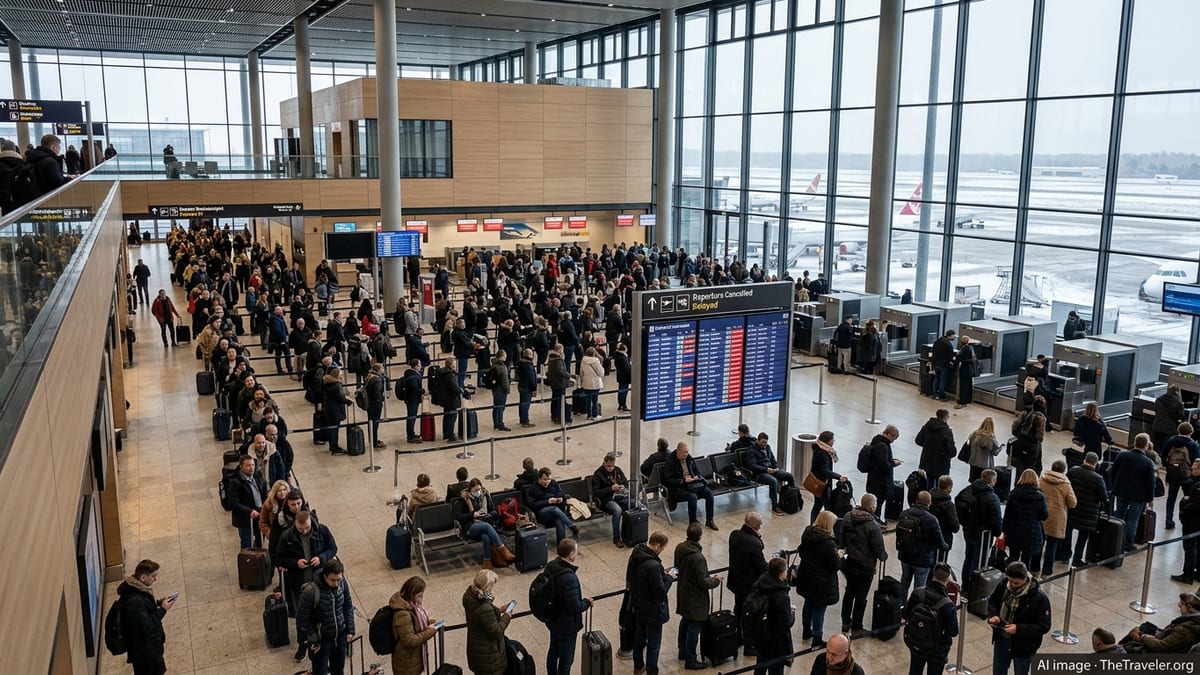
From Black Ice Shutdown to Ongoing Disruptions
The latest bout of turmoil began on the evening of 5 February 2026, when sudden freezing rain coated runways and taxiways at Berlin Brandenburg Airport (BER) with black ice. Publicly available reports describe a near-total suspension of departures and most arrivals for around 18 hours, with traffic only gradually resuming by early afternoon on 6 February.
Air travel data and independent passenger-rights trackers indicate that hundreds of flights were cancelled or diverted during the closure period, with knock-on delays rippling across German and wider European networks for days. The shutdown coincided with a period of persistent sub-zero temperatures and wintry precipitation across northern and eastern Germany, compounding problems for rail and road links into the capital.
Fresh traffic statistics for February released by the airport’s operator show how sharply the disruption hit overall performance. Preliminary figures point to 1.63 million passengers in February, a drop of 4.8 percent compared with the same month a year earlier. Without weather-related cancellations, the operator notes that planned volumes would likely have surpassed 2025 levels, underlining how a single extreme-weather episode can erase months of incremental growth.
The winter chaos comes on top of a wider pattern of strain. Separate coverage in recent days highlights the prospect of a warning strike halting virtually all passenger flights on a mid-March weekday, as fire and ground staff press for higher pay. Social media posts shared by unions and passenger-rights advocates suggest travellers should brace for cancellations rather than minor schedule tweaks if industrial action goes ahead.
Why Berlin’s Single-Hub Setup Magnifies Chaos
Analysts point to structural factors that make operational shocks at BER particularly painful for travellers. Since the closure of Tegel and Schönefeld to commercial traffic, Germany’s capital relies on a single large airport, meaning there is little redundancy when weather, labour disputes or technical failures hit.
Industry commentary notes that consolidation was meant to simplify operations and improve efficiency. Instead, it has concentrated risk. When black ice forced runways shut in February, there was no realistic alternative field nearby with spare capacity to absorb diverted Berlin-bound traffic. Wide regional disruption followed, as airlines juggled aircraft and crews already stretched by a busy winter schedule.
Persistent criticism of BER’s layout and passenger flows has also resurfaced. Regular travellers have long complained in public forums about security bottlenecks, long walks between check-in and gates, and limited flexibility in how passengers move through the terminal. These design constraints can turn any disturbance at security, check-in or baggage handling into long queues and missed connections, especially during peak morning and evening banks of flights.
The airport has sought to highlight improvements, pointing to international awards and gradually rising annual passenger numbers. Yet the February shutdown, the memory of a September cyber incident that affected check-in systems, and recurring staffing and infrastructure problems suggest that resilience remains a work in progress.
Operational Fixes: Weather, Technology and Staffing
In the wake of the black-ice crisis, operational measures are receiving renewed attention. Publicly available information on the February incident describes a staged reopening plan based on surface temperature thresholds and runway inspections, indicating that the airport is refining its playbook for extreme winter episodes.
Aviation experts commenting in trade publications argue that more investment in de-icing equipment, runway surface monitoring and real-time collaboration tools between airport, airlines and air-traffic control will be key. Enhanced forecasting and earlier trigger points for slowing traffic could prevent a sudden standstill and allow airlines to consolidate schedules in a more orderly way.
Technology is another focus. The cyber disruption that affected passenger and baggage handling systems last autumn underscored the vulnerability of interconnected airport IT. Reports indicate that operators across Europe, including BER, are accelerating back-up system deployments, data segregation and manual fallback procedures to avoid full check-in paralysis should a vendor system fail again.
Staffing remains a parallel challenge. Labour shortages and high turnover among ground handlers, security personnel and technical staff have been widely cited as underlying causes of delays across European hubs. In Berlin, union demands and management cost-cutting efforts are colliding just as traffic continues to climb back towards pre-pandemic levels. Any lasting solution will likely involve higher staffing buffers, clearer minimum service guarantees during disputes, and more predictable rosters to retain skilled workers.
Policy Debates and Long-Term Capacity Questions
Beyond day-to-day operations, the February shutdown has fed into a broader policy conversation about Germany’s airport infrastructure. Commentaries in business and transport media argue that relying on a single major airport for a metropolis of Berlin’s size makes the city especially vulnerable to climate-driven weather extremes and industrial unrest.
Some analysts are calling for a review of contingency capacity in the wider region, including limited reactivation of former airfields for diversions or emergency operations. Others suggest that improved high-speed rail connectivity could relieve pressure on short-haul flights, giving passengers realistic alternatives when the airport is constrained.
The discussion is unfolding against a backdrop of tighter environmental regulations, airspace constraints linked to geopolitical tensions, and rising expectations from travellers who have become less tolerant of opaque delays and poor communication. Berlin’s experience is often cited as emblematic of the balancing act facing European hubs: delivering growth and connectivity while hardening infrastructure against increasingly frequent shocks.
For now, there is no sign of a rapid expansion of runway or terminal capacity at BER. Instead, airport planners appear focused on incremental efficiency gains, digital tools to manage passenger flows, and targeted upgrades to airfield equipment. Whether these steps will be sufficient to avoid repeat scenes of stranded passengers during the next harsh winter or labour dispute remains an open question.
How Travellers Can Minimize Disruption at BER
For passengers with upcoming trips through Berlin, the recurring disruption has one clear implication: more proactive trip planning. Consumer advocates and travel-law specialists recommend checking flight status and terminal information repeatedly in the days and hours before departure, rather than relying on a single pre-trip confirmation.
Given the risk of sudden schedule changes, many experts advise building additional buffer time into connections, particularly when transferring from rail to air at Berlin’s main stations or changing from one airline to another at BER. Where possible, booking through itineraries on a single ticket can make it easier to be reprotected in the event of cancellations, compared with separate point-to-point bookings.
Understanding passenger rights is also critical. Under European air-passenger regulations, travellers are generally entitled to meals, refreshments, and hotel accommodation where necessary when flights are heavily delayed or cancelled, even in cases of bad weather. Compensation payments, by contrast, may not apply when disruptions are caused by extraordinary circumstances such as extreme meteorological events or certain strikes outside the airline’s direct control.
Travel insurers note that comprehensive policies can help bridge gaps, particularly for non-refundable accommodation or event tickets at the destination. However, coverage conditions vary widely, so passengers are encouraged to review policy wording carefully, especially clauses on weather and industrial action.
In practical terms, carrying essential medication, chargers, a change of clothes and basic toiletries in cabin baggage can significantly ease the strain of an unplanned overnight stay in the terminal or at an airport hotel. For travellers reliant on tight schedules or critical appointments, choosing earlier flights in the day, avoiding last departures, and considering rail alternatives on domestic German routes can further reduce the risk that a disruption at Berlin Brandenburg Airport derails an entire trip.