

Arizona is a state of vivid contrasts, where towering saguaros frame rosy sunsets in the low desert while cool pine forests, alpine lakes, and historic towns anchor the high country. Travelers can wander quiet Sonoran Desert trails in winter, seek shade in red rock canyons by spring, and be breathing crisp mountain air by afternoon. Choosing where to go can feel overwhelming, but focusing on a handful of standout areas helps reveal the best of both Arizona’s desert landscapes and its character-rich mountain towns.
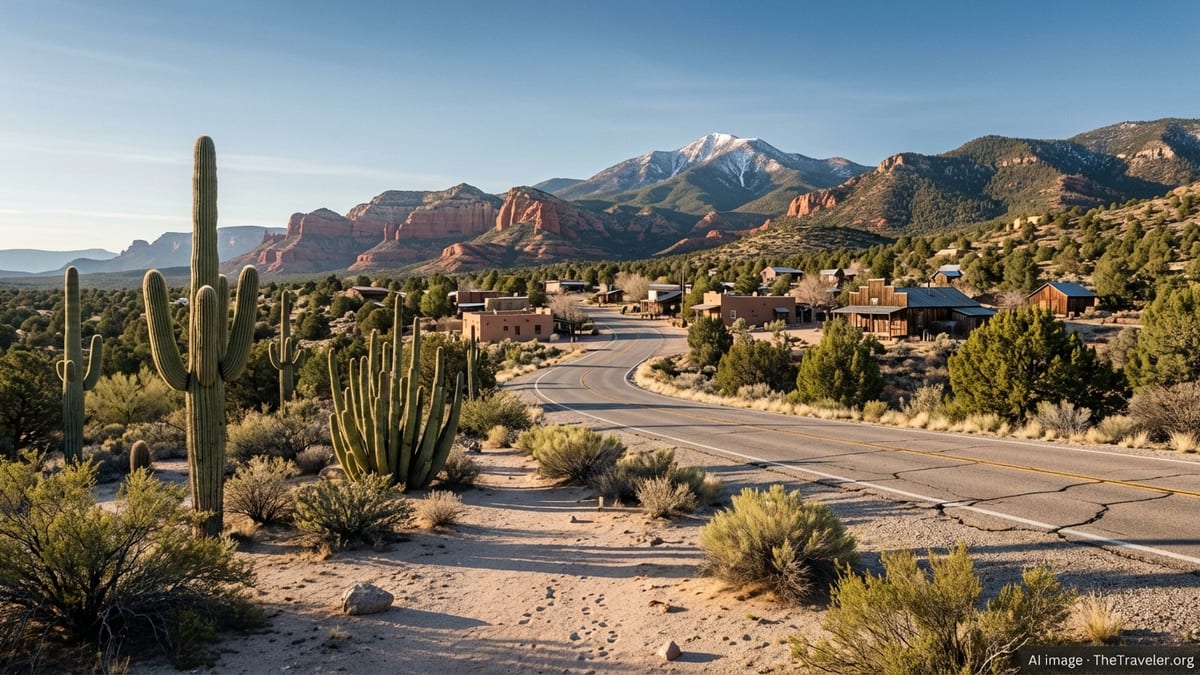
Sonoran Desert Gateways: Phoenix, Scottsdale and the Valley
The greater Phoenix area, including Scottsdale, Tempe and several neighboring cities, is many visitors’ first introduction to Arizona’s desert landscapes. Ringed by rugged mountain preserves and studded with iconic saguaro cacti, the Valley of the Sun pairs accessible hiking and biking with big-city comforts. Winter and early spring typically deliver mild days and cool nights, which makes this one of the most appealing times to explore desert trails before returning to poolside patios and lively restaurants.
For easy immersion in the Sonoran Desert without straying far from the city, travelers gravitate to preserves such as South Mountain, the McDowell Sonoran area and the Superstition-adjacent Usery region. Well-marked trails, sunrise overlooks and desert botanic gardens introduce visitors to native flora like palo verde, cholla and prickly pear. Golf courses and resort pools are ever-present, but it is the morning light on rocky ridgelines and the warm, dry air that tend to leave a lasting impression.
Scottsdale in particular has developed a reputation for blending luxurious desert resorts with a walkable old town full of galleries, tasting rooms and Southwestern architecture. In contrast, Tempe leans younger and more energetic, anchored by a major university and a compact waterfront district. Together these communities create a broad base for travelers who want to sample Arizona’s desert environment without sacrificing dining options, spas or nightlife.
The Valley’s central location also makes it a practical base for day trips. Within a few hours’ drive, visitors can reach the Superstition Mountains to the east, the red rock country around Sedona to the north, or the saguaro forests outside Tucson to the south. For many itineraries, it is the starting point for a wider circuit that links the state’s signature desert and mountain destinations.
Tucson and the Saguaro Country of Southern Arizona
South of Phoenix, Tucson sits in a broad basin surrounded by ranges such as the Tucson, Santa Catalina and Santa Rita Mountains. The city has become increasingly prominent as a desert destination, with travel editors highlighting it for its extensive trail networks, cultural depth and comparatively relaxed pace. Here, the Sonoran Desert feels closer and wilder, and the silhouettes of saguaros dominate nearly every horizon.
One of the defining features of the Tucson area is Saguaro National Park, which is split into two districts on either side of the city. The park has grown in recent years, with land acquisitions adding to its protected acreage and expanding foothill access. Scenic drives and loop trails pass through dense saguaro forests, where older specimens can reach heights comparable to small trees and support nesting birds in their arms. In spring, visitors may see the creamy blossoms that make the saguaro Arizona’s state flower, along with carpets of wildflowers in good rainfall years.
Beyond Saguaro National Park, the Tucson region offers varied desert and mountain experiences. Sabino Canyon and nearby Bear Canyon provide riparian corridors where seasonal streams flow, offering shady walks and, at times, shallow pools. To the south, Madera Canyon in the Santa Rita Mountains is a noted birding area, where desert slopes give way to oak and pine woodlands. In winter, Mount Lemmon in the Santa Catalina range can even host snow sports, underscoring how quickly the environment changes with elevation.
The city itself supports this outdoor appeal with a strong cultural and culinary scene. Tucson’s designation as a UNESCO City of Gastronomy reflects both Indigenous and Mexican influences and a longstanding focus on local ingredients. Neighborhoods such as Barrio Viejo showcase 19th-century adobe homes, colorful murals and a growing number of independent cafes and galleries. For travelers who value both wilderness access and urban character, Tucson offers one of the most balanced desert-based stays in Arizona.
Red Rock Country and Mountain Escapes: Sedona, Flagstaff and the Mogollon Rim
North of the Sonoran lowlands, the landscape rises toward the Colorado Plateau and the Mogollon Rim, creating some of Arizona’s most dramatic transitions between desert and mountain environments. Sedona, framed by sandstone spires and buttes, has long attracted hikers, photographers and travelers seeking both outdoor recreation and a sense of retreat. Its trail network winds through piñon and juniper woodlands, past slickrock benches and along creeks that run clear after winter snowmelt or summer storms.
Many visitors come to Sedona for its famed red rock vistas, but they often stay for the variety of experiences packed into a relatively compact area. Popular hikes around formations like Cathedral Rock, Bell Rock and Boynton Canyon deliver panoramic overlooks, while Oak Creek provides pockets of shade and water. The town itself mixes galleries, wellness retreats and small inns with larger resorts. Views are part of daily life here, visible from patios, roundabouts and even gas station forecourts.
Less than an hour’s drive north, Flagstaff offers a distinctly different atmosphere. At an elevation of roughly 7,000 feet, this mountain town is surrounded by ponderosa pine forests and peaks that reach above 12,000 feet. The nearby Kachina Peaks Wilderness includes Humphreys Peak, Arizona’s highest summit, and miles of alpine and subalpine trails. In summer, temperatures here can be dramatically cooler than in the desert, making Flagstaff a favored escape during the hottest months.
Flagstaff also serves as a gateway to the wider Colorado Plateau, with routes leading to the Grand Canyon, volcanic fields, and deep side canyons such as Sycamore Canyon. Its historic downtown centers on brick buildings, breweries and cafes clustered along old railroad corridors and Route 66. Combined with Sedona’s red rock scenery and the forested cliffs of the Mogollon Rim, this region illustrates Arizona’s vertical diversity, where travelers can drive from cactus to conifer forest in the span of an afternoon.
Historic High-Country Towns: Prescott, Payson and the Central Highlands
West and east of the main north-south highway that links Phoenix and Flagstaff, several smaller mountain towns anchor Arizona’s central highlands. Prescott, situated in a basin ringed by granite boulders and pine-covered hills, leans heavily into its historic identity. Once the territorial capital, it retains a courthouse square edged by saloons, brick buildings and Victorian homes. Nearby lakes, including those surrounded by otherworldly granite formations, reflect the sky and provide easy-access paddling and walking paths.
The climate in Prescott is generally milder than that of the low desert, with four distinct seasons but less snow than higher-elevation communities. This encourages a steady stream of visitors seeking moderate temperatures, small-town events and access to trails that fan out into surrounding national forest. Granite Mountain, Thumb Butte and other local landmarks offer half-day hikes and biking routes, often with broad views across the high-desert grasslands beyond town.
On the eastern side of the central highlands, Payson sits near the base of the Mogollon Rim, a dramatic escarpment that marks the southern edge of the Colorado Plateau. Forested mesas and canyons stretch beyond the rim, dotted with small lakes and traversed by creeks that draw anglers and campers. The area acts as a gateway to higher, cooler country for travelers coming from Phoenix, who often notice the shift from saguaro to pine within a short drive.
Both Prescott and Payson offer a quieter alternative to more famous destinations while still providing the amenities visitors expect, such as lodging ranges from rustic cabins to newer hotels, along with local diners, breweries and seasonal festivals. They work well as bases for road trippers exploring Arizona’s interior, linking desert floors, mid-elevation grasslands and pine forests in a single scenic loop.
Quirky Desert Towns and Remote Landscapes: Bisbee, Ajo and Organ Pipe Country
Not all of Arizona’s most memorable areas are large or heavily touristed. In the state’s southeastern and southwestern reaches, small desert towns and remote protected areas reward travelers who enjoy quieter roads and a slower pace. Bisbee, near the Mexican border, occupies steep hills once carved by copper mining. Colorful homes step up the slopes, and historic brick buildings line narrow streets below. After mining waned, artists and independent business owners helped reinvent Bisbee as a creative enclave, and its galleries, vintage shops and cafes now give the town a lively, idiosyncratic feel.
Visitors often explore Bisbee’s mining heritage through museum exhibits or guided tours that venture into former workings. Outside, staircases climb the hillsides, and an annual race challenges participants to tackle hundreds of steps across multiple routes. The elevation keeps summer temperatures a bit cooler than in many desert basins, and clear nights allow for good stargazing away from major city lights. Bisbee’s atmosphere tends to linger in the memory as much as any particular attraction.
On the opposite side of the state, the town of Ajo introduces travelers to one of Arizona’s most remote desert preserves: Organ Pipe Cactus National Monument. This region protects a particularly lush stretch of Sonoran Desert where towering organ pipe cacti grow alongside saguaros and other species. Scenic drives loop through broad valleys and over low mountain passes, revealing wide-open horizons and an impressive variety of desert vegetation. The remoteness means services are limited once inside the monument, so many visitors stock up in Ajo before venturing farther south.
These outlying areas emphasize solitude and the stark beauty of the desert. With fewer crowds, it becomes easier to appreciate subtle shifts in light, the rustle of desert birds among cholla branches, and the sharp contrast between green cacti and pale gravel washes. They appeal especially to repeat visitors who have already experienced Arizona’s marquee destinations and are ready to explore corners of the state where time seems to slow.
Cliff Dwellings, Canyons and Desert Rivers: Superstition Mountains and Central Arizona
East of Phoenix, the landscape rises into rugged volcanic peaks, hidden basins and canyons carved by intermittent streams. The Superstition Mountains, wrapped in local lore and stories of lost mines, offer some of central Arizona’s most dramatic hiking and backcountry scenery within a reasonable driving distance of the state’s largest city. Jagged ridgelines catch the light at sunrise and sunset, and long-distance trails weave past rock spires, seasonal wildflower displays and broad desert views.
Further east, the Salt River corridor introduces a different side of the desert, one shaped by flowing water. Along certain stretches, especially below major reservoirs, riverbanks support cottonwood and willow groves that contrast sharply with surrounding rocky slopes. Paddling, birdwatching and seasonal tubing give visitors more ways to experience the desert than hiking alone. The presence of water draws bands of wild horses in some areas, a sight that has become emblematic of central Arizona for many travelers.
Central Arizona is also home to well-preserved archaeological sites that highlight the ingenuity of early inhabitants. At Tonto National Monument, for example, Salado cliff dwellings occupy rock alcoves above a river valley, illustrating how communities took advantage of elevation and natural shelter in a challenging climate. Visiting such sites helps place modern recreation in a deeper context, reminding travelers that people have been navigating these landscapes for centuries.
Tying these elements together are small towns and lakeside communities that provide base camps for exploration. While they may lack the name recognition of Sedona or Tucson, they offer access to slot-like canyons, high-desert plateaus and starry night skies with comparatively little traffic. For road trippers willing to follow winding highways and unpaved side roads, central Arizona delivers a sense of discovery that complements the more familiar postcard views.
The Takeaway
Arizona’s appeal lies in its contrasts and its proximity of extremes. Within a day’s drive, travelers can move from low Sonoran Desert valleys, where saguaro forests bracket sunlit trails, to mountain towns smelling of pine and wood smoke. The urban energy of Phoenix, Scottsdale and Tucson coexists with the slower rhythms of Prescott, Flagstaff, Bisbee and Ajo. Red rock formations near Sedona and alpine summits near Flagstaff rise within easy reach of desert basins and historic canyons.
Choosing the best areas in Arizona ultimately depends on personal priorities. Those drawn to spa resorts and accessible desert hikes may favor the Valley of the Sun or Scottsdale’s foothills. Visitors seeking culture paired with trails and sky islands might gravitate toward Tucson. Travelers who long for cooler air and small-town charm often head for the central highlands and plateau rim, while explorers craving solitude and stark, expansive vistas find it in the state’s more remote desert corners.
Regardless of the route, a successful Arizona trip usually blends at least two environments: time among saguaros or organ pipe cacti at lower elevations, and time under pines or on red rock rims higher up. The shift in air, light and color between these zones can feel like traveling across entire regions rather than simply changing altitude. In that sense, Arizona functions less as a single destination and more as a compact collection of distinct worlds, all waiting within a day’s drive of one another.
FAQ
Q1. What is the best time of year to visit Arizona’s desert areas?
The most comfortable period for low-elevation deserts is typically from late fall through early spring, when daytime temperatures are mild and nights are cool.
Q2. When is the best season to explore Arizona’s mountain towns?
Late spring through early fall usually works well for mountain towns, with summer offering cooler temperatures than the desert and shoulder seasons bringing fewer crowds.
Q3. Can I visit both desert and mountain areas in a single Arizona trip?
Yes. Many itineraries pair a few days in Phoenix, Scottsdale or Tucson with time in Sedona, Flagstaff, Prescott or other high-country towns within a half-day’s drive.
Q4. Do I need a four-wheel-drive vehicle to reach Arizona’s scenic areas?
Most major desert and mountain destinations are accessible via paved or well-graded roads, though some remote trails and backcountry routes do require higher-clearance or four-wheel-drive vehicles.
Q5. How should I prepare for hiking in Arizona’s deserts?
Carry ample water, sun protection, sturdy footwear and a map or reliable navigation. Start early in the day, watch for changing weather and avoid overextending in heat.
Q6. Are Arizona’s mountain towns suitable for winter visits?
Many are, but conditions vary. Some high-elevation areas receive snow and can be icy, while others have cool, crisp days. Checking local forecasts and road reports is important before driving.
Q7. Which Arizona towns are best for a quieter, arts-focused desert escape?
Smaller communities such as Bisbee, Ajo and certain neighborhoods around Sedona offer art galleries, studios and a slower pace compared with larger cities.
Q8. Is it safe to visit remote desert areas near the border?
Many travelers visit these regions without incident, but it is wise to follow park guidance, stay on established routes, be aware of your surroundings and carry adequate supplies due to the remoteness.
Q9. Can families with children enjoy both desert and mountain destinations?
Yes. Short nature trails, visitor centers, lakes and scenic drives provide family-friendly options, though parents should plan activities and distances carefully based on age and heat tolerance.
Q10. How many days should I plan for a trip combining desert landscapes and mountain towns?
A week allows time for at least one desert base and one or two mountain areas, while ten days or more gives flexibility for slower travel and additional small-town stops.