

Arkansas rewards curious travelers with more variety than many expect, from mountain rivers and mineral springs to Delta blues towns and a modern capital city on the Arkansas River. If you are planning a first trip, deciding where to go can feel overwhelming. This guide breaks the state into its most compelling regions and highlights what each area does best, so you can choose the right Arkansas for your style of travel and time of year.
Little Rock and Central Arkansas: Urban Energy on the River
For many visitors, the best first stop in Arkansas is Little Rock, the state capital set along a broad curve of the Arkansas River. The compact downtown and River Market District offer an easy introduction to the state, with a walkable mix of museums, public art, and riverfront parks. Strolling the river trail at sunrise or dusk gives a sense of how closely the city lives with its landscape, with bridges, wetlands, and skyline views all sharing the same corridor.
Cultural travelers can spend a full day between the city’s major museums and historic sites before ever leaving downtown. The cluster of institutions near the riverfront and in adjacent neighborhoods, combined with a growing restaurant and craft beverage scene, makes Little Rock feel manageable but not sleepy. It works especially well as a long-weekend base for first-time visitors who want to sample Arkansas without committing to a fully rural trip.
Nature is never far away here. Within a short drive of the city center you will find lakes, hiking trails, and wildlife areas that speak to Arkansas’s “Natural State” nickname, including riverfront green spaces and urban nature centers that interpret the ecosystems of central Arkansas. This makes Little Rock a strategic starting point if you are flying in, picking up a rental car, and then branching out toward the mountains or the Delta after a day or two of city time.
Practical considerations also favor beginning in Little Rock. The region has the state’s most robust lodging options across a range of budgets, and it is a major crossroads for interstate highways and regional flights. For travelers who like to ease into a new destination with reliable infrastructure, good food, and clear signage before heading out on scenic byways, central Arkansas is a sensible and satisfying place to start.
Hot Springs and the Ouachita Mountains: Spa Town and Scenic Lakes
West of Little Rock, the Ouachita Mountains rise in long, forested ridges, sheltering thermal springs and deep, clear lakes. The standout gateway here is Hot Springs, a small city whose historic bathhouse row has drawn visitors for generations. Walking past the ornate early twentieth century bathhouses and the steamy vents along the sidewalk offers both a glimpse into American spa history and a signature Arkansas experience that is difficult to duplicate elsewhere.
Hot Springs National Park preserves these springs and the wooded hills around them, threading hiking trails and drives across the slopes. Scenic overlooks give broad views of the Ouachita range, while lower trails wander through mixed hardwood and pine forest that changes character dramatically with the seasons. Because much of the activity is close to town, this area suits travelers who want easy access to nature without sacrificing restaurants, galleries, and nightlife.
Water is a defining feature of this region beyond the hot springs themselves. To the north and west of town lie large man-made lakes known for boating, fishing, and paddling. Lake Ouachita and Lake Catherine, along with their surrounding state parks, provide opportunities for camping, cabin stays, and day hikes linked with swimming coves and marinas. The water tends to be clear, and shorelines range from gentle, sandy inlets to rocky points framed by dense forest.
Because Hot Springs is popular year-round, it can work as a first stop in almost any season. Cooler months are ideal for soaking in historic bathhouses and hiking in comfortable temperatures, while late spring and early fall bring colorful foliage around the lakes. Summer is busier and hotter, but pairing early-morning hikes with long afternoons on or in the water keeps the heat manageable. For first-time visitors who like a blend of history, small-city amenities, and accessible forests and lakes, this area often tops the list.
The Ozark Mountains and Buffalo National River: Wild Cliffs and Clear Water
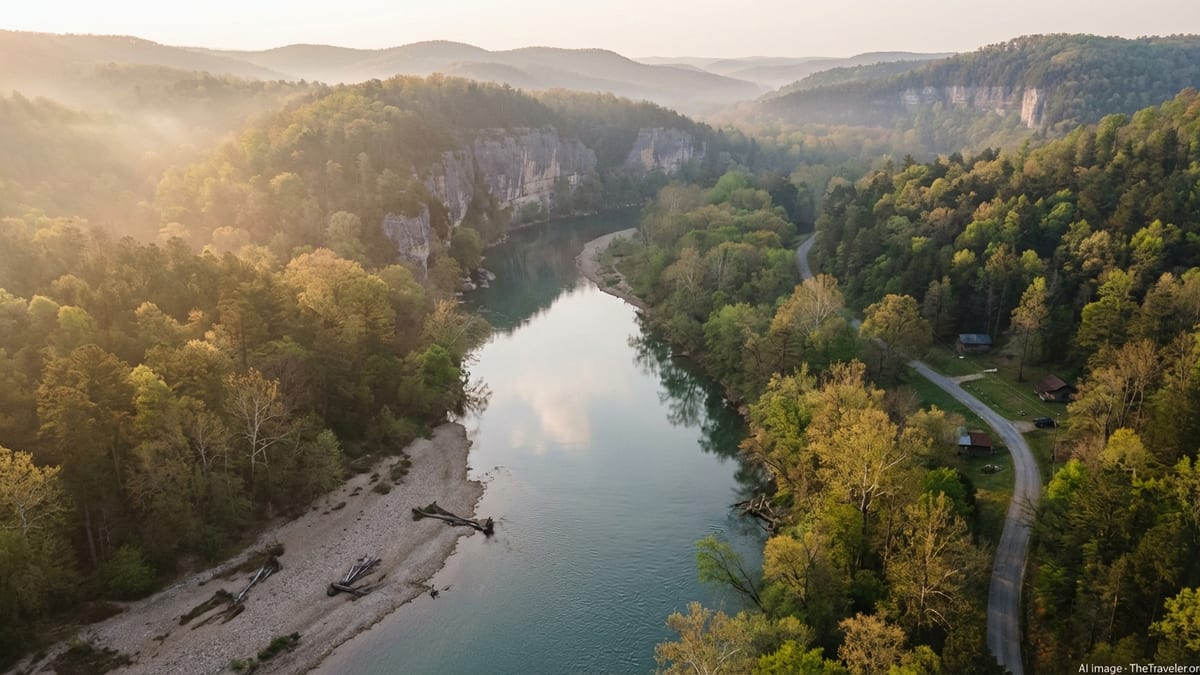
Northern Arkansas is defined by the Ozark Mountains, a maze of forested hills, limestone bluffs, and free-flowing rivers that has become a signature image of the state. The Buffalo National River, one of the country’s first designated national rivers, meanders for more than a hundred miles through this plateau, carving high cliffs and narrow valleys along the way. It is widely considered one of the best paddling and floating destinations in Arkansas, especially in spring when water levels typically support longer canoe and kayak trips.
For many outdoor-focused travelers, the upper Buffalo area near communities like Ponca and Jasper is the single most compelling place to begin an Arkansas itinerary. Here the river is fast and clear, winding below towering bluffs with frequent access points and established campgrounds. Outfitters in the region rent canoes, kayaks, and rafts, and can advise on current water levels, typical floating seasons, and safety considerations. Park information stresses the need for life jackets, careful route planning, and respect for rapidly changing river conditions, which can shift with seasonal rains.
The Ozarks here are not only about the river. Trail networks in and around the national river corridor link waterfalls, caves, and dramatic overlooks, offering day hikes that range from short scenic strolls to strenuous climbs over rocky terrain. Wildlife is another attraction; elk herds introduced decades ago now graze in some valleys, and early-morning or dusk drives often reward patient visitors with sightings. Mountain roads throughout this region are curvy and slow, but they deliver broad views and a sense of remoteness that many travelers seek.
Because the Buffalo’s float season is strongly tied to rainfall and time of year, this area works best as a first stop in late winter through early summer, or as a primarily hiking destination in drier months when paddling options shrink. Travelers should approach cliff edges, waterfalls, and rugged trails cautiously, as periodic accidents in the region underscore how quickly scenic overlooks can become hazardous. With proper planning, though, the Ozark and Buffalo corridor offers a concentrated introduction to Arkansas’s wild side that is difficult to match anywhere else in the state.
Northwest Arkansas: Arts, Trails, and Modern Mountain Towns
Northwest Arkansas has grown into one of the most dynamic corners of the state, combining mountain scenery with a surprisingly rich cultural scene. Anchored by cities such as Fayetteville, Bentonville, Springdale, and Rogers, the region mixes a university town’s creative energy with the resources of major corporate headquarters. That combination has produced museums, bike networks, and event calendars that feel far larger than the population alone might suggest.
For travelers who appreciate art and architecture as much as outdoor recreation, this is an ideal first area to explore. Major art institutions sit within or just beyond the wooded hills, often linked to surrounding neighborhoods and trails by bike and walking paths. Biking has become a defining local pastime, with extensive networks of paved greenways and purpose-built mountain bike trails winding through town centers and nearby forests. Many routes are designed to welcome beginners while still offering more technical options for experienced riders.
Beyond the cities, the surrounding Ozark countryside offers traditional small-town and rural experiences. Short drives reveal highland farms, roadside produce stands in season, and trailheads leading to waterfalls, bluff-top overlooks, and quiet valleys. Nearby state parks preserve caves, stone shelters, and CCC-era structures in heavily forested settings, and they function as easily accessible bases for day hiking or camping within about an hour of the region’s main cities.
Northwest Arkansas works well as a starting point for travelers driving in from the Midwest or arriving through its regional airport. Its compact geography allows visitors to sample several distinct experiences in one trip: an urban art day, a trail ride, an afternoon at a lake or state park, and an evening performance or ballgame. For first-time visitors who are curious about how Arkansas is evolving, yet still want ready access to forests and hills, this region is a compelling candidate for where to go first.
Historic Eureka Springs and the Upper Ozarks: Victorian Charm and Springs
On a steep hillside in the upper Ozarks, Eureka Springs offers a completely different feel from the larger cities of northwest Arkansas. The Victorian-era town wraps around ridges and hollows, with narrow streets, stairways, and stone walls creating an almost European sense of scale. Many buildings date from the late nineteenth century, when mineral springs in the area fueled a boom as a health resort. Today, the town remains a favorite escape for couples and travelers who appreciate historic architecture, independent shops, and a strong arts presence.
This area is particularly appealing for travelers who like to explore on foot. Walking through downtown reveals hidden gardens, steep alleys, and small spring-fed plazas, while nearby hills shelter cabins, bed-and-breakfasts, and forested hideaways. The surrounding countryside includes attractions that highlight both the natural and cultural heritage of the Ozarks, including scenic overlooks, heritage centers focused on local springs, and drives that thread through small farmsteads and wooded ravines.
The region around Eureka Springs is also rich in water-based recreation. Nearby lakes offer boating, paddling, and fishing, with wooded shorelines that stay green well into late spring and early summer. Scenic drives along ridges and across lake bridges provide wide-open views, making this a photogenic part of Arkansas in almost any season. In autumn, the mix of oaks, hickories, and other hardwoods can produce particularly vivid foliage that frames the town’s stone buildings and painted porches.
Because of its compact size and distinct character, Eureka Springs works best as a focused stop of a couple of days rather than a broad regional base. It is a good choice as either a first or second area on an itinerary that also includes more rural parts of the Ozarks or the Buffalo National River corridor. Travelers drawn to historic hotels, live music in intimate venues, and quirky small-town festivals will find this corner of the state especially rewarding.
The Arkansas Delta and Mississippi River Towns: Blues, Fields, and Big Skies
Eastern Arkansas presents a sharp contrast to the hills and hot springs of the west. Here the land flattens into the Mississippi Alluvial Plain, known locally as the Delta, where agriculture, blues music, and river history shape daily life. Towns along the Mississippi River and its backwaters tell stories of levees, floods, and trade, while smaller communities inland are tied to row crops and hunting culture. The landscape itself, with its broad fields, cypress-lined bayous, and long horizons, offers a distinctive sense of place.
This region is particularly appealing for travelers interested in Southern history and music. Blues heritage sites, small museums, and local festivals trace the evolution of the genre along both sides of the Mississippi. Driving here often means following two-lane highways past old country stores, churches, and juke-joint-era buildings, some preserved and some fading. The combination of history and ongoing community life gives the area a lived-in authenticity that rewards unhurried exploration.
Nature lovers discover a different side of Arkansas in the Delta. National wildlife refuges, state-managed wildlife management areas, and bottomland hardwood forests support migratory birds, waterfowl hunting in season, and year-round birdwatching. Boardwalks, observation towers, and low-traffic gravel roads provide access to wetlands where herons, egrets, and raptors are common sights. Seasonal flooding and changing river channels mean the landscape is continually reshaping itself, and visitors should be prepared for occasionally rough roads and weather-related detours.
Because services in some Delta communities are limited compared with larger cities, many travelers treat this area as a themed segment within a broader Arkansas trip rather than a sole destination. It can be a powerful place to start or end a journey, especially for visitors tracing the Mississippi River corridor from other states. Those who appreciate big skies, slow travel, and stories at the intersection of culture and landscape will find the Arkansas Delta a memorable counterpoint to the state’s mountain regions.
Southwest Arkansas and Scenic Lakes: Quiet Forests and Small-Town Escapes
Southwest Arkansas receives less attention than the Ozarks or the spa town of Hot Springs, but for travelers seeking quieter forests and uncrowded lakes, that relative obscurity can be a virtue. Here rolling hills, pine stands, and reservoir lakes define the landscape, with small communities acting as gateways to state parks and national forest lands. The pace is slower, traffic is lighter, and many outdoor experiences feel pleasantly unhurried.
Lakes across this region, some tied to major rivers and others to smaller tributaries, are focal points for camping, fishing, and family getaways. Shorelines tend to be forested and gently sloping, with ample room for boat ramps, picnic areas, and swim beaches. In summer, visitors often structure their days around early-morning and late-evening time on the water, retreating to shaded campgrounds or cabins during the hottest hours. Because development is lighter than around some of the state’s more famous lakes, night skies can be impressively dark.
Forests in southwest Arkansas provide additional outlets for exploration. Trail systems are generally less crowded than those around the Buffalo or in northwest Arkansas, yet they still offer rewarding views, rock formations, and seasonal wildflowers. Shorter loop trails suit casual hikers and families, while longer routes can occupy experienced trekkers for a full day. In autumn, pine and hardwood mixtures give hillsides a patchwork of color, often without the traffic that accompanies peak foliage in more publicized regions.
This area is best for travelers who are comfortable planning around smaller towns and who value simple pleasures over marquee attractions. It can serve as a gentle introduction to rural Arkansas for those who want an easy camping or cabin experience with lake time and forest drives. Paired with a visit to Hot Springs, the Ouachitas, or central Arkansas, southwest Arkansas rounds out an itinerary with quieter, more contemplative days outdoors.
The Takeaway
Arkansas is not a single destination but a collection of distinct regions, each shaped by its own mix of water, terrain, and history. Little Rock and central Arkansas offer an accessible starting point with museums, riverfront trails, and the state’s best infrastructure, while Hot Springs and the Ouachitas pair spa-town nostalgia with mountain lakes and wooded ridges. Northward, the Ozarks and the Buffalo National River provide the state’s classic wild scenery, and northwest Arkansas overlays that landscape with museums, bike networks, and modern small-city amenities.
Historic Eureka Springs delivers Victorian architecture and hillside charm, the Arkansas Delta stretches out with fields, blues heritage, and big-sky wetlands, and the quieter forests and lakes of the southwest invite slower, more reflective travel. Choosing where to go first depends on what you want from the state: city culture and convenience, river adventures, historic small towns, or wide-open spaces along the Mississippi. With realistic driving times, seasonal river conditions, and your own interests in mind, it is easy to craft an Arkansas itinerary that feels both manageable and varied.
For many first-time visitors, starting in either Little Rock or Hot Springs and then adding a loop through the Ozarks or northwest Arkansas offers the best overview within a week. Travelers with a specific passion, whether paddling, birding, or music history, may prefer to anchor their trip in the Buffalo River corridor or the Delta and then add shorter stays elsewhere. However you sequence the regions, the key to a rewarding Arkansas journey lies in giving each area enough time, embracing the varied landscapes, and letting the state’s quieter corners reveal themselves at their own pace.
FAQ
Q1. What is the best area to visit in Arkansas for a first-time trip?
For a balanced first visit, many travelers start in Little Rock or Hot Springs, then add time in the Ozark Mountains or northwest Arkansas for outdoor experiences.
Q2. When is the best time of year to visit the Buffalo National River area?
The Buffalo National River typically offers the most reliable floating from late winter through spring, while late spring through fall is better suited to hiking and sightseeing.
Q3. Is Little Rock a good base for exploring other parts of Arkansas?
Yes. Little Rock sits near the center of the state, has the most flight options, and connects efficiently by highway to Hot Springs, the Ozarks, and the Delta.
Q4. Where should I go in Arkansas if I want hot springs and spa experiences?
Head to Hot Springs, where historic bathhouses, modern spa services, and wooded trails in Hot Springs National Park create a concentrated spa-town atmosphere.
Q5. Which part of Arkansas is best for arts and museums?
Northwest Arkansas and Little Rock together offer the strongest mix of museums, galleries, public art, and cultural venues, all within easy reach of outdoor spaces.
Q6. What area of Arkansas is best for small historic towns and local character?
Eureka Springs in the upper Ozarks, along with smaller towns across the Delta and mountain regions, provides historic architecture, local festivals, and distinctive main streets.
Q7. Are there good places for birdwatching and wildlife in Arkansas?
Yes. The Buffalo National River corridor, the Arkansas Delta’s wetlands and refuges, and forested state parks across the state all offer strong wildlife and birdwatching opportunities.
Q8. Where should I stay if I want a mix of hiking and lake activities?
Consider the Hot Springs and Ouachita Mountains region or southwest Arkansas, where state parks and reservoirs combine forest trails with boating, swimming, and fishing.
Q9. Is the Arkansas Delta worth visiting on a short trip?
The Delta is worthwhile if you are interested in Southern history, blues music, or big-sky landscapes, and it pairs well with time in Little Rock or the Ozarks.
Q10. How many regions can I realistically cover on a week-long Arkansas vacation?
In a week, most travelers can comfortably explore two to three regions, such as Little Rock and Hot Springs plus either the Ozarks, northwest Arkansas, or the Delta, without feeling rushed.