

Germany rewards curious travelers who look beyond clichés of beer halls and fairy-tale castles. From creative cities to quiet river valleys and Baltic Sea islands, the country is a mosaic of distinct regions, each with its own rhythm, heritage, and landscapes. Whether you are planning a first-time itinerary or refining a repeat trip, understanding Germany by its cities, regions, and tucked-away towns is the key to a richer journey.
Berlin and the New Creative North
Berlin remains the natural gateway for many visitors and one of Europe’s most popular city break destinations. Recent tourism figures show that the capital continues to attract millions of overnight stays each year, underlining its enduring pull for international travelers. What keeps Berlin compelling is not only its major sights but also how quickly neighborhoods evolve: former industrial quarters now host galleries, co-working spaces, and independent design studios, while historic areas layer Cold War history with contemporary culture.
For a first visit, Berlin’s core experiences still revolve around the Brandenburg Gate, the remnants of the Berlin Wall, and Museum Island’s ensemble of world-class institutions. Yet the city’s appeal deepens when you wander beyond headline attractions. Kreuzberg’s canalside paths, Neukölln’s rooftop bars, and the renewed energy around the Berlin U-Bahn viaducts give a sense of a metropolis that constantly reinvents itself. Street art, pop-up food markets, and experimental performance venues are woven into everyday life rather than kept in curated districts.
North of Berlin, the state of Brandenburg offers a softer, slower contrast that many travelers overlook. Lakes, pine forests, and small palace towns like Potsdam sit less than an hour from the capital, making them easy day trips or restful stopovers between longer journeys. Historic parks and waterways invite cycling and boating, while former Prussian estates and Cold War-era sites provide an offbeat historical counterpoint to Berlin’s urban narrative.
Further north, the port city of Hamburg and the Hanseatic towns lining the Elbe and Baltic Sea tie Germany to its maritime past. Brick warehouses converted into concert halls and museums showcase how former trading hubs now trade in culture and creativity. Travelers who link Berlin, Hamburg, and smaller ports like Lübeck or Wismar gain a nuanced picture of northern Germany as a region shaped by water, commerce, and an outward-looking mindset.
Bavaria, Munich, and the Alpine Frontier
Bavaria is often what visitors picture when they imagine Germany: onion-domed churches, traditional beer gardens, and snow-dusted Alps. Munich, the regional capital, fuses that imagery with a cosmopolitan sensibility. Elegant boulevards sit beside leafy beer gardens, while museums focused on art, science, and design reflect the city’s economic heft and cultural ambition. Throughout the year, major festivals and trade fairs draw visitors, but even outside peak dates, the city’s parks and riverbanks give it a relaxed, outdoorsy feel.
Beyond Munich, southern Bavaria opens onto some of Germany’s most celebrated landscapes. Alpine lakes, high pastures, and the jagged peaks of the Bavarian Alps frame villages where frescoed facades and wooden balconies still set the tone. Classic routes connect Garmisch-Partenkirchen, Berchtesgaden, and the castles of the former royal family, whose palaces continue to attract global attention. Current regional campaigns underline how Bavaria is trying to balance that popularity with crowd management and conservation, which is something travelers increasingly value when choosing routes and seasons.
While icons like Neuschwanstein draw predictable crowds, quieter corners still feel remarkably local. The Allgäu region, spreading toward the border with Austria, offers hiking and cycling trails past dairy farms and small Baroque churches, plus spa towns where thermal baths overlook rolling foothills. Around Lake Chiemsee and Lake Tegernsee, boat services link small towns and monasteries, making it easy to experience a gentler side of Bavaria that many visitors miss when rushing between landmarks.
Franconia, in northern Bavaria, is a distinct cultural and culinary world of its own. Cities like Nuremberg and Bamberg retain tightly packed medieval cores and dense networks of churches, towers, and bridges. Nuremberg in particular has developed an extensive tourism offer, with dozens of museums, underground tours, and historic sites that address both imperial history and the legacies of the 20th century. Surrounding wine villages and half-timbered towns reward travelers willing to linger in smaller places where local wineries and family-run guesthouses set the tone.
Rhine, Moselle, and Germany’s Romantic River Valleys
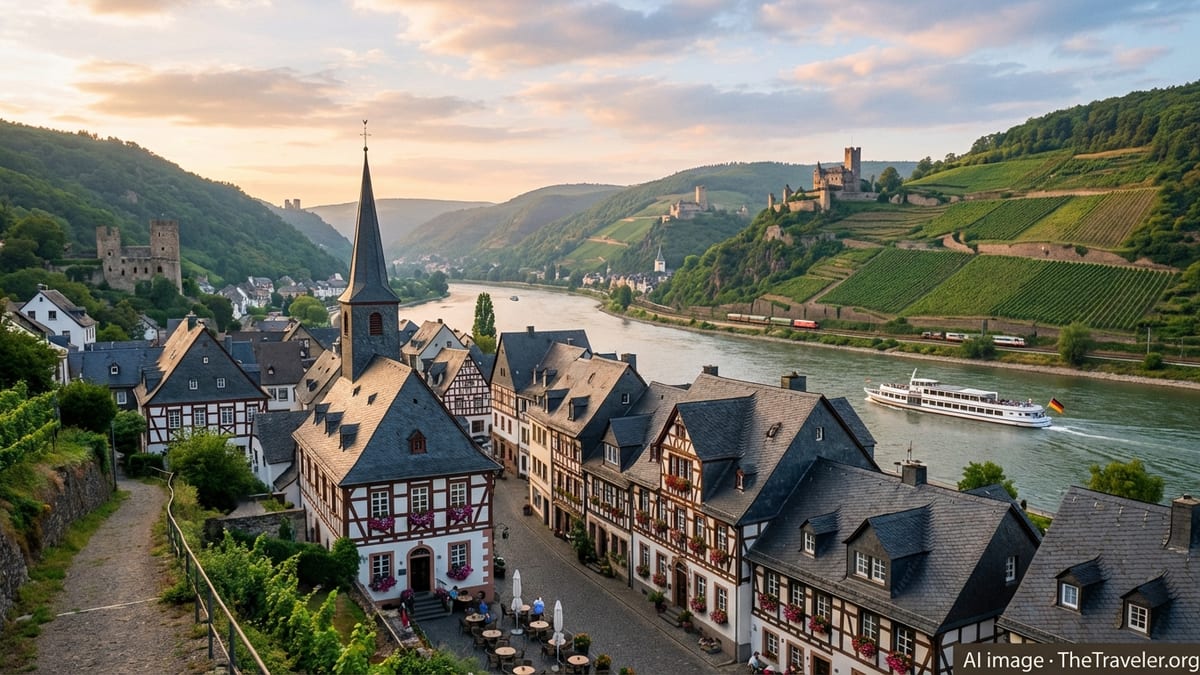
Germany’s river valleys between Koblenz, Mainz, and Trier have long been associated with Romantic literature and painting, and they still feel like a living postcard of castles and steep vineyards. The Middle Rhine, in particular, is dotted with hilltop fortresses, terraced vines, and small towns clustered at bends in the river. Passenger ferries and local trains make it simple to hop between villages, giving travelers a relaxed, linear way to explore without a car. The combination of river views, historic architecture, and easy logistics makes this one of the country’s most approachable scenic regions.
The Moselle Valley, curving westward toward Luxembourg, often feels quieter than the better-known Rhine. Vine-covered slopes rise sharply above the water, and half-timbered river towns come with intimate wine taverns and hillside ruins. Cycling paths and riverside promenades encourage slow travel: it is easy to spend an entire day covering short distances, stopping for tastings and short hikes to viewpoints above the valley. Many travelers choose to base themselves in a single town and explore by day, returning in the evening for wine grown on the very slopes they have walked through.
Hidden gems abound in these valleys. Small towns such as Bacharach and other similarly sized river settlements maintain an almost theatrical concentration of half-timbered houses, narrow alleys, and old town walls. Away from peak summer days, they can still feel largely residential, with locals outnumbering visitors at weekly markets and neighborhood cafés. Further along Lake Constance in the southwest, compact lakeside towns such as Meersburg combine medieval hilltop castles with vineyard walks and calm waterfront promenades that remain under many travelers’ radar.
For those interested in industrial heritage alongside romantic scenery, the Rhine corridor also connects easily into Germany’s former coal and steel heartlands. Just inland from the river, repurposed factory complexes and coking plants now host design centers, festivals, and climbing walls. This overlay of post-industrial landscapes on deep-rooted river culture offers a very different flavor of “Romantic Germany” than the castle-and-vineyard archetype, and underlines how varied the country’s river regions have become.
The Black Forest and Southwest Germany
Southwest Germany, anchored by the state of Baden Württemberg, balances innovation-driven cities with soft, forested hills and spa towns. Stuttgart, the regional capital, is at once industrial and green, with inner-city vineyards, expansive parks, and museums dedicated to the region’s automotive history. Beyond the city, palace towns such as Ludwigsburg and university centers like Heidelberg and Tübingen offer a smaller-scale, walkable experience where cobbled streets and riverside paths define the urban fabric.
The Black Forest itself is a patchwork of dense woodlands, high meadows, and quiet valleys stretching from the Swiss border north toward Karlsruhe. Contrary to its dramatic reputation, much of the region feels gentle rather than forbidding, with rounded hills, farmhouses perched above misty valleys, and narrow-gauge railway lines connecting spa towns and villages. Hiking and cycling networks are extensive, but it is equally common to see travelers simply base themselves in a single town and use local buses or scenic trains for day trips.
Spa tradition runs deep here. Towns like Baden Baden, with its historic bathhouses and grand hotels, have reinvented themselves as modern wellness destinations that still retain Belle Époque architecture and a social promenade culture. Smaller thermal resorts offer quieter, less formal experiences where local residents and visitors share the same pools and saunas. Between spa sessions, travelers find a food culture that leans heavily on regional produce, from forest mushrooms to farm cheeses, often served in rustic guesthouses that blur the line between restaurant and family living room.
Southwest Germany also rewards curiosity about its lesser-known corners. Vine-covered hills along the Baden Wine Route host villages where half-timbered houses frame small squares, and many local wineries still operate on a family scale. Lake Constance, at the region’s southern edge, ties Germany to Switzerland and Austria; ferries, lakeside promenades, and mild summers make it feel almost Mediterranean in spirit, particularly in smaller towns that have not fully entered the mainstream tourist circuit.
Eastern Germany, Culture Capitals, and Quiet Countrysides
The eastern states of Saxony, Saxony Anhalt, Thuringia, and Brandenburg combine ornate old towns with landscapes that remain comparatively uncrowded by international tourism. Dresden and Leipzig anchor Saxony’s urban offer, with reconstructed baroque architecture, major art collections, and a thriving music and festival scene. Smaller cities such as Chemnitz, which holds the title of European Capital of Culture in 2025, are using that spotlight to showcase industrial heritage sites, new cultural venues, and redesigned public spaces in formerly overlooked neighborhoods.
Scattered across eastern Germany, dozens of mid-size towns encapsulate centuries of architectural and intellectual history in tightly walkable centers. Weimar, for example, represented in recent tourism analyses as part of one of Germany’s most attractive rural districts, brings together literary heritage, Bauhaus design, and landscaped parks along the Ilm river. Nearby, Erfurt and Jena add medieval bridges, hilltop fortifications, and university life to the mix. Travelers who link these towns by regional train often find a much slower rhythm than in larger western cities, with cafés, bookshops, and local markets setting the pace.
Just as compelling are the truly small places that rarely make it into mainstream itineraries. Towns like Görlitz, close to the Polish border, have earned quiet attention in recent years for their almost perfectly preserved streetscapes that span Gothic to early modern styles. Its architecture has drawn international film productions, yet the town still sees far fewer visitors than its cinematic profile might suggest. Elsewhere in Saxony and Brandenburg, riverside villages and former mining areas are transforming into recreation zones where lakes, bike paths, and nature reserves reclaim formerly industrial landscapes.
Some municipalities in eastern Brandenburg have even launched creative campaigns to attract new residents and visitors, including short-term trial stays that introduce people to local life. For travelers, these initiatives translate into better-maintained guest accommodation, guided tours led by residents, and a growing sense of pride in local heritage. While such towns remain firmly in “hidden gem” territory, they hint at how eastern Germany is actively reshaping its image from post-industrial hinterland to a place of opportunity, culture, and accessible nature.
Northern Coasts, Islands, and Baltic Sea Charms
Germany’s northern coastline on the North Sea and Baltic Sea offers a completely different travel experience from the country’s interior. Here the focus shifts to dunes, sea breezes, and long horizons. Along the North Sea, tidal flats, dikes, and thatched-roof villages define a landscape shaped as much by wind and water as by human hands. Coastal towns host classic strandkorb beach chairs, seafood smokehouses, and lighthouses looking out over shallow waters where the tide retreats dramatically twice a day.
The Baltic coast, by contrast, tends to have softer shorelines, chalk cliffs in places, and resort towns whose spa pavilions and piers date from the 19th century. Islands such as Rügen and Usedom feature long sandy beaches, beech forests, and small historic centers with ornate seaside villas. Cycling paths knit together coastal resorts and inland lakes, while narrow-gauge steam railways on some islands remain working reminders of early seaside tourism. For travelers based in Berlin or Hamburg, many of these locations are within half a day’s reach by train, making them viable extensions to a city-focused itinerary.
While some resorts have become firmly established holiday favorites for domestic visitors, other coastal corners retain a genuinely low-key atmosphere. Fishing harbors lined with simple huts selling fresh catch of the day sit only a short drive from more polished promenades. Inland from the main beaches, quiet villages are threaded between fields and small lakes, offering farmhouse stays and minimalist design guesthouses that appeal to travelers seeking both simplicity and comfort. The relatively flat terrain and fresh coastal climate make the region particularly well suited to gentle outdoor activity rather than high-adrenaline sports.
Seasonality plays a large role in shaping the character of the German coasts. Summer brings beach life and busy promenades, while spring and autumn draw walkers, birdwatchers, and those who prefer moody skies to blazing sun. Winter, although quieter, has its own pull for travelers who enjoy storm watching, spa visits, and near-empty beaches. Planning with shoulder seasons in mind can reward visitors with lower prices, more availability, and a sense of everyday coastal life that is harder to glimpse in peak holiday months.
Urban Germany Beyond the Big Four
Beyond Berlin, Munich, Hamburg, and Cologne, a constellation of mid-size cities offers many of the same cultural and culinary advantages with far fewer crowds. In the southwest, university towns such as Freiburg, Heidelberg, and Tübingen combine strong café cultures, riverside walks, and youthful atmospheres shaped by large student populations. Their compact centers, generally spared from heavy postwar reconstruction, retain historic street patterns and lively market squares where daily routines unfold very much in the open.
In the west, the Rhine Ruhr metropolitan region illustrates how a former industrial belt has recast itself as a multi-city cultural zone. Dortmund, Essen, and Duisburg, among others, have turned steelworks, coking plants, and gasometers into art spaces, event venues, and viewing platforms. Recent tourism figures from cities like Dortmund show steady growth in overnight stays, supported by new hotels, improved visitor centers, and creative reuse of industrial heritage. Travelers interested in contemporary art, architecture, and urban regeneration often find this region richly rewarding, especially when contrasted with older, more traditional city images.
Farther south, cities such as Nuremberg and Augsburg offer dense layers of history, from medieval fortifications to early industrial canals. Nuremberg has built a particularly comprehensive tourism infrastructure, with dozens of museums covering art, design, science, and local history, as well as themed tours that address its complex role in the 20th century. These cities also serve as gateways to nearby rural areas, making it easy to pair an urban base with day trips to small towns, hiking areas, and wine regions.
Travelers who venture into lesser-known urban centers often remark on how manageable they feel. Public transport networks are robust, pedestrian zones are extensive, and cultural institutions are rarely overwhelmed even during busy months. For repeat visitors seeking new angles on Germany, building an itinerary around a series of these mid-size cities, connected by efficient trains, can be just as satisfying as focusing on the international stars.
Hidden Gems and How to Find Them
“Hidden gems” in Germany are rarely completely unknown, especially to regional travelers, but many remain far below the radar of international tourism. They include small river towns in the Moselle and Main valleys, lakeside villages on Lake Constance, and forest hamlets situated at the edge of national parks. What these places share is a scale that encourages walking, a strong sense of local identity, and an economy that often depends more on regional visitors and residents than on bus tours from abroad.
Practical strategies help in uncovering these quieter spots. Looking at regional tourist board maps rather than only national campaigns often reveals lesser-known nature reserves, minor wine routes, or historic towns not heavily marketed overseas. Examining train timetables or regional bus routes can also highlight recurring local hubs where multiple lines intersect, hinting at market towns and small cities that serve large rural catchments. Choosing one such hub as a base for a few days allows travelers to radiate out into surrounding villages and landscapes without constantly changing accommodation.
Recent travel reporting has highlighted towns such as Monschau in North Rhine Westphalia and Meersburg in Baden Württemberg as examples of under-the-radar destinations that still feel lived-in rather than curated. Others, like Görlitz in eastern Saxony, have gained a modest degree of fame among film crews and architecture enthusiasts but remain free of mass tourism infrastructure. In each case, the draw is rarely a single “must see” sight; instead it is the cumulative effect of cobbled streets, riverside walks, and the chance to follow local routines at a slower pace.
For travelers concerned about sustainability and overtourism, deliberately including such hidden gems can be a meaningful choice. Spreading nights across different regions, traveling in shoulder seasons, and favoring locally owned guesthouses and restaurants help support communities that are actively trying to maintain their character. Germany’s well-developed public transport and regional ticket options make it realistic to reach many of these places without a car, which further reduces environmental impact and encourages a more immersive, unhurried style of exploration.
The Takeaway
Germany is not a single destination but a network of cityscapes, river valleys, coastal stretches, and forested uplands, each with its own tempo and traditions. Iconic places such as Berlin, Munich, the Rhine Valley, and Bavaria’s castles remain deservedly popular, yet they are only starting points. Just beyond them lie mid-size cities anchored in centuries of trade and scholarship, as well as small towns and villages that have quietly preserved their built heritage and local customs.
Planning a rewarding journey through Germany means thinking in terms of regions rather than just individual cities. Linking a capital with a river valley, a mid-size university town, and a quieter coastal or forest area allows you to experience the country’s breadth without rushing. It also opens space for serendipity: discovering a small-town market, stumbling onto a local festival, or pausing in a café that is decidedly not on any list. In a country with such reliable infrastructure and dense rail connections, it is easier than many travelers assume to step off the most familiar routes.
Whether you are tracing Romantic river landscapes, exploring repurposed industrial sites, or wandering car-free old towns beside the Baltic Sea, Germany rewards curiosity and a willingness to look past stereotypes. The best areas to visit are often those where global landmarks and everyday life sit comfortably side by side. By combining headline destinations with lesser-known regions and hidden gems, you can create an itinerary that feels personal, balanced, and deeply connected to the varied landscapes and communities that define modern Germany.
FAQ
Q1. What is the best time of year to visit Germany for a first trip?
The most balanced months for a first visit are generally May, June, September, and early October, when weather is mild, outdoor cafes and hiking trails are active, and major sights are open but crowds are more manageable than in peak summer. Winter has its own appeal around Christmas markets, but days are shorter and some rural services run on limited schedules.
Q2. Which German regions are especially good for travelers without a car?
Germany’s long distance and regional trains make it easy to travel without driving, especially between major cities and larger towns. Regions like the Rhine and Moselle valleys, the area around Lake Constance, parts of the Black Forest, and the Baltic Sea coast all have dense public transport networks, with local buses, ferries, and scenic branch lines that connect villages and trailheads to main rail routes.
Q3. How many days should I plan for Berlin compared with the rest of Germany?
For most travelers, three full days in Berlin allows time for key historical sites, a museum visit, and exploration of a couple of neighborhoods. On a 10 to 14 day trip, it often makes sense to spend roughly a third of the time in Berlin and the remaining days split between one or two additional regions, such as Bavaria, the Rhine Valley, or the Baltic coast, to balance urban and rural experiences.
Q4. Are Germany’s smaller towns and hidden gems suitable for families?
Many of Germany’s lesser known towns work very well for families, thanks to traffic calmed centers, public playgrounds, and easy access to nature. River and lake regions often offer boat trips, gentle cycling paths, and small museums tailored to children, while family run guesthouses are accustomed to hosting multi generational groups. It is wise to check seasonal opening hours for outdoor pools, cable cars, and adventure parks when planning.
Q5. How expensive is it to travel across multiple regions in Germany?
Costs vary by region and season, but Germany offers many ways to keep transport affordable. Regional day passes and state specific tickets can significantly reduce rail and bus fares if you plan your route around certain lines and times of day. Accommodation ranges from simple guesthouses and vacation apartments to high end hotels, so adjusting lodging style and focusing restaurant splurges on a few key meals can keep a multi region itinerary within a moderate budget.
Q6. Do I need to speak German to visit smaller towns and rural areas?
In large cities and major tourist centers, English is widely spoken in hotels, restaurants, and visitor services. In smaller towns and rural regions, basic German phrases are appreciated and can be helpful, though many younger residents and people working in tourism understand at least some English. Carrying a translation app and learning simple greetings, numbers, and restaurant terms will usually be enough to navigate everyday situations comfortably.
Q7. What is the best way to include the Alps and a river valley in one trip?
A common approach is to use Munich or another southern city as a base for a few days in the Alps, then travel north by train to the Rhine or Moselle for several nights in a riverside town. Routes via Nuremberg or Stuttgart break up the journey and add an extra urban stop. Planning around hubs with good rail connections makes it straightforward to combine mountain walks, lake excursions, and castle visits with boat rides and wine villages in a single itinerary.
Q8. Are Germany’s coastal regions worth visiting outside summer?
Yes, the North Sea and Baltic coasts can be rewarding well beyond peak beach season. Spring and autumn often bring clear light, quieter promenades, and good conditions for walking and cycling. Many spa facilities operate year round, and some travelers specifically seek out winter stays for storm watching, sauna visits, and peaceful seaside towns. Pack layers and windproof clothing, as weather can change quickly outside high summer.
Q9. How can I find less crowded alternatives to Germany’s most famous castles and palaces?
While major palaces remain highlights, each region has lesser known fortresses, manor houses, and monastery complexes that see fewer visitors. Local tourist offices and regional heritage routes are helpful starting points, and guidebooks often highlight “second tier” sites nearby headline attractions. Visiting early or late in the day, or choosing shoulder season dates, can also make well known sites feel calmer, while smaller castles in nearby towns may offer more relaxed visits with similar views.
Q10. What should I keep in mind regarding sustainability when traveling in Germany?
Germany has strong environmental standards, and many destinations actively promote low impact travel. Using trains and public transport rather than domestic flights or extensive driving significantly reduces emissions, while staying longer in each stop cuts down on transit days. Choosing locally owned accommodation, respecting marked trails, avoiding litter, and traveling in shoulder seasons all help distribute tourism pressure and support communities that are working to preserve both natural landscapes and historic urban areas.