

Choosing the right bank in Italy is a critical operational decision for foreign residents and expats. Banking affects how quickly salary can be received, how rent and utilities are paid, and how easily money moves across borders. Italy’s banking system is stable but often conservative, and the experience for non-Italians ranges from straightforward with some providers to highly bureaucratic with others. This briefing evaluates the main types of banks and specific institutions that tend to work better for foreign residents and expats, with a focus on access, costs, and usability rather than investment or complex wealth products.
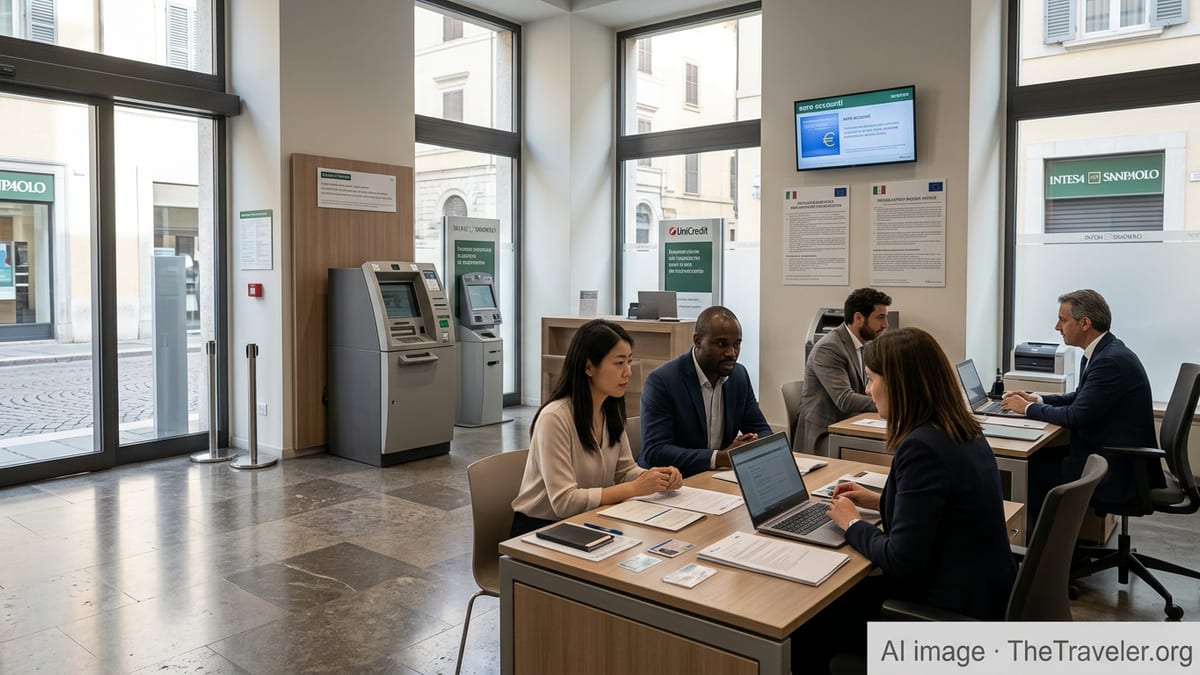
Banking Environment in Italy for Foreign Residents
Italian law allows both residents and non-residents to hold bank accounts, but there is a practical gap between what is legally possible and what branches are willing to do in practice. Banks must comply with strict anti-money laundering and customer due diligence rules, which often leads to extra documentation demands for foreigners, such as proof of legitimate income, a clear purpose for the account, and sometimes evidence of a local residential address even if this is not strictly required by law for non-resident accounts.
Most expats will encounter two broad account types: resident current accounts and non-resident accounts. Resident accounts are standard domestic current accounts tied to an Italian address and often to Italian tax residency. Non-resident accounts are designed for people who live abroad but need an Italian IBAN, typically for property ownership or regular payments in Italy. Non-resident accounts can involve higher annual fees and more restrictive features but may be easier to obtain initially for those who have not yet completed residency registration.
Regardless of bank, the minimum documentation generally includes a valid passport or EU identity card and a codice fiscale, the Italian tax identification number, which foreign residents can usually obtain before or soon after arrival. Additional items can include proof of address (either in Italy or abroad), employment or study documentation, and in some cases a residence permit card or formal residency registration with the municipality. Requirements and flexibility vary significantly by institution and even by individual branch manager.
Foreign residents should expect longer decision times and potentially multiple in-branch visits with traditional banks. Digital-only and hybrid banks are gradually improving access through app-based onboarding, but even these usually still require a codice fiscale and residency in one of the supported European countries. As a result, many expats combine one local Italian bank account for domestic payments with at least one international or multi-currency account for cross-border transfers and currency management.
Evaluation Criteria for “Best” Banks for Expats
For relocation planning, the most useful banks are not necessarily the largest or most profitable, but those that provide predictable access and manageable friction for foreign clients. In assessing options, the following criteria are particularly relevant for expats and mobile professionals:
First, account opening accessibility matters. This includes whether the bank offers explicit non-resident or expat products, accepts foreign proof of address, allows account opening before full residency registration, and supports remote or digital onboarding. Banks that can open accounts using only a passport and codice fiscale, at least initially, are generally more practical during the early months of relocation.
Second, fee structure and transparency significantly affect day-to-day cost. Important elements are monthly account fees, card issuance costs, domestic transfer charges, ATM withdrawal fees, and surcharges for international transfers or foreign currency transactions. Many traditional Italian banks charge monthly account maintenance fees in the range of roughly 5 to 15 euros, with higher pricing for non-resident packages, while a number of digital banks and multi-currency providers advertise low or zero monthly fees but may add costs at the point of currency conversion.
Third, digital usability and support in foreign languages are critical for non-Italian speakers. This includes the quality of mobile and web banking apps, availability of English-language interfaces and customer service, and support for contactless payments and online card controls. Some major Italian retail banks offer English-language digital channels, but implementation is inconsistent; digital-first providers and international fintechs tend to offer a more standardized English experience.
Finally, international functionality is central for expats. This covers the cost and speed of cross-border transfers, whether the account provides an Italian IBAN for receiving local payments, and how competitive the bank’s foreign exchange margins are. Many expats use an Italian IBAN account for receiving salaries or paying local bills, combined with a separate multi-currency account to manage transfers between Italy and their home country at more favorable exchange rates.
Major Italian Retail Banks with Strong Expat Relevance
Among the large domestic banks, Intesa Sanpaolo and UniCredit stand out for their extensive branch networks, diversified services, and relatively structured processes for foreign clients. Intesa Sanpaolo is Italy’s largest banking group by assets, serving millions of retail customers nationally and across Europe. Its scale translates into broad physical coverage, including in smaller cities and regional centers, and a full range of products from basic current accounts to mortgages and investment services. For foreign residents, the main advantages are availability of English-speaking staff in larger branches, relatively modern digital platforms, and the possibility of converting a non-resident account into a standard resident account once local documentation is complete.
UniCredit is another major pan-Italian bank with a significant presence in Central and Eastern Europe. For expats, UniCredit is regarded as one of the more accessible options for non-resident and newly arrived customers, with reports that certain branches can open accounts for non-residents using a foreign passport and codice fiscale, sometimes without an Italian address, provided the customer can explain the purpose of the account and meet compliance checks. Non-resident accounts, however, are often priced at a premium and may involve annual costs that can be materially higher than resident accounts, reflecting the bank’s additional compliance workload.
Other sizable retail banks such as BPER Banca and Crédit Agricole Italia also serve foreign clients but tend to be more regionally focused and more dependent on branch-level discretion. Crédit Agricole Italia, part of the French banking group, may be particularly interesting for French-speaking expats and cross-border professionals who value continuity with services in France. As with most traditional banks, the foreign resident experience can vary: certain branches are accustomed to working with international students and professionals, while others are conservative and insist on local residency documents before opening an account.
Traditional Italian banks remain essential if the relocation plan includes applying for local credit, such as a mortgage, or if the employer or landlord prefers or insists on an Italian IBAN from a mainstream domestic institution. However, these banks are usually not optimized for low-friction international transfers or for customers who move between countries frequently, which is why many expats complement them with digital or multi-currency accounts.
Digital and Online Banks Serving Residents in Italy
Digital banks and online-focused players have become increasingly important for foreign residents in Italy who are comfortable managing finances via smartphone. A notable example is N26, a German-licensed mobile bank operating in Italy and other European countries. N26 offers current accounts with local IBANs for residents of supported countries, including Italy, and provides an entirely app-based onboarding flow. Customers typically need a government-issued ID, a smartphone, and a codice fiscale; residency must be in one of the supported European countries. The user interface and support are available in multiple languages, including English, which is attractive for expats.
Fineco Bank is another online-oriented provider that is frequently mentioned among expats. It started as a direct bank and securities platform in Italy and now serves clients in several European countries and the United Kingdom. Fineco’s Italian operations include accounts that can be opened by non-residents in some cases, usually in person, and then converted to resident accounts when documentation is updated. For foreign residents who expect to build investment portfolios or actively trade, Fineco’s integrated brokerage platform is often a differentiator compared with purely retail-focused banks.
Other digital solutions, such as Widiba and various regional online brands, operate as part of larger Italian banking groups. While they may have competitive pricing and good digital tools, their policies toward non-residents are often more restrictive, requiring Italian residency or established ties. Moreover, support in English may be limited outside the main metropolitan centers. For relocation planning, digital banks can significantly reduce the friction of everyday payments and card usage, provided the expat can meet residency and identification requirements.
It is important to note that digital banks operating under other European licenses but not specifically in Italy can still be valuable for mobile professionals but may not provide an Italian IBAN. Some employers, landlords, and public bodies in Italy are now more flexible on accepting other euro-area IBANs, but there are still practical cases where an Italian IBAN is preferred. As a result, expats should check which IBAN formats are accepted by their employer, utility companies, and local authorities when designing their banking setup.
International Multi-Currency and Fintech Accounts
Multi-currency accounts offered by international fintech providers such as Wise or Revolut have become widespread among globally mobile workers, including those relocating to Italy. These services allow users to hold balances in multiple currencies, transfer money internationally using exchange rates that are often closer to mid-market, and spend with debit cards that automatically convert currencies at relatively low cost. For expats who maintain financial commitments in their home country while earning income in euros, such accounts can materially reduce currency conversion costs.
However, there are structural limitations. While these providers usually offer European IBANs, they may not always issue Italian IBANs specifically. In practice, this can mean that some Italian employers or government bodies treat these accounts as foreign, even if they are euro denominated, and may be reluctant to send salaries or payments there. Additionally, these accounts are generally not full-service banks for local purposes: they do not provide traditional cheque facilities, local mortgages, or certain types of direct debit arrangements that remain common in Italy.
From a risk management perspective, expats should also consider the regulatory environment. Multi-currency fintechs are typically licensed as electronic money institutions or banks in a specific European jurisdiction, with deposit protection schemes that may differ from Italy’s domestic deposit guarantee system. While customer funds within protection limits are generally safeguarded, the legal mechanisms and supervisory authorities are different. For relocation planning, this suggests that multi-currency accounts are highly effective as a complement to, rather than a substitute for, a local Italian bank account.
Despite these constraints, combining an Italian IBAN account with a multi-currency fintech account is often the most cost-efficient model for cross-border professionals. The Italian account can receive salary and handle domestic direct debits, while outgoing international transfers and large currency conversions can be routed through the multi-currency provider to secure better exchange rates and lower fees.
Comparative Overview of Leading Options for Expats
The following simplified comparison groups leading banks and providers commonly used by foreign residents in Italy. Actual conditions vary by branch and customer profile, so this overview should be treated as indicative rather than exhaustive.
| Provider type | Typical strengths for expats | Typical constraints |
| Intesa Sanpaolo, UniCredit (large traditional banks) | Dense branch networks, strong integration with Italian payroll and billing systems, structured path from non-resident to resident account, access to mortgages and loans over time. | Higher and more complex fees, branch-dependent flexibility, longer onboarding and heavy paperwork, variable English-language support. |
| Fineco, N26 and similar digital-oriented banks | Modern apps, clear pricing, better English support, relatively fast onboarding for eligible residents, combined banking and investment in some cases. | Residency constraints, limited or no cash handling, less suited for clients who prefer face-to-face service, some reluctance from traditional landlords or local bodies if not familiar with the brand. |
| International multi-currency accounts (e.g. Wise, Revolut) | Competitive exchange rates, low-cost cross-border transfers, instant or near-instant transfers between own accounts, strong mobile user experience. | Often no Italian IBAN, limited role in domestic banking ecosystem, no traditional credit facilities, regulatory framework outside Italy. |
| Regional and cooperative banks | Local knowledge, potential flexibility for clients introduced by local employers or notaries, useful in smaller towns. | Highly variable policies toward foreigners, limited English services, less standardized digital tools, sometimes insist on established residency. |
For a typical salaried expat relocating to a major Italian city, a realistic strategy is to prioritize a mainstream bank with a proven track record of working with foreigners, such as Intesa Sanpaolo or UniCredit, and then supplement this with a digital or multi-currency account for international needs. Property buyers or retirees may place more weight on banks that explicitly offer non-resident accounts, even if fees are higher, in order to secure an Italian IBAN before spending substantial time in the country.
The Takeaway
Italy’s banking system presents a mixed picture for foreign residents and expats. Legally, non-residents and foreigners can hold accounts, but operationally, the experience is shaped by strict compliance rules, conservative branch practice, and a still-evolving approach to digital onboarding. Large banks such as Intesa Sanpaolo and UniCredit provide the most predictable infrastructure for salaries, domestic transfers, and access to credit, but they are often slower and more bureaucratic in onboarding foreign customers.
Digital banks, notably N26 and Fineco’s online platform, offer greater convenience, clearer pricing, and more robust English-language support, especially for those who already have European residency and a codice fiscale. Meanwhile, international multi-currency accounts are highly effective tools for managing cost and speed of cross-border transfers, but their lack of Italian IBANs or local integration means they function best as supplements rather than replacements for domestic accounts.
From a relocation planning perspective, candidates considering a move to Italy should budget time and administrative capacity for banking setup, prioritizing acquisition of a codice fiscale and collecting clear documentary evidence of income, address, and purpose of account. Comparing both local banks and international providers in advance, and being ready to maintain at least two complementary accounts, significantly increases the likelihood of a smooth financial transition.
FAQ
Q1. Can non-residents open a bank account in Italy before moving?
In principle yes, Italian regulations allow non-resident individuals to hold banking relationships. In practice, only a limited number of banks are prepared to open non-resident accounts, and most will require at least a passport, a codice fiscale, proof of foreign address, and a clear explanation of why the account is needed. Expect higher fees and the possibility of needing an in-person appointment.
Q2. Is an Italian bank account legally required to live or work in Italy?
There is no general legal obligation to hold an Italian bank account solely because of residency. However, employers, landlords, and utility providers often find it administratively easier to use Italian IBANs. As a result, while not strictly mandatory, a local account is functionally very useful for long-term residents, particularly employees and tenants.
Q3. Which large Italian banks are most commonly used by expats?
Intesa Sanpaolo and UniCredit are the two most frequently referenced large retail banks for foreign residents, due to their national branch networks and experience managing accounts for international clients. Other groups such as Crédit Agricole Italia or BPER Banca also work with foreigners, but processes can be more localized and branch-dependent.
Q4. What documents are usually required to open a bank account in Italy?
Typical requirements include a valid passport or EU identity card, a codice fiscale, and some proof of address either in Italy or abroad. Many banks also request evidence of income or study, such as an employment contract or university enrollment letter, and may ask for a residence permit or municipal registration once available.
Q5. Are digital banks like N26 or Fineco good options for expats in Italy?
Yes, for expats who are comfortable banking by smartphone or web, N26 and Fineco are often attractive due to user-friendly apps, clear fee structures, and wider language support. Eligibility usually depends on having residency in a supported European country and a codice fiscale, and some Italian landlords or smaller employers may be less familiar with these brands.
Q6. How expensive are non-resident bank accounts compared with resident accounts?
Non-resident accounts in Italy are generally more expensive, with annual charges that can be significantly higher than standard resident current accounts. The price differential reflects additional compliance work and perceived risk. Once an expat becomes a tax resident and updates documentation, banks often allow conversion to cheaper resident account packages.
Q7. Do Italian banks offer services in English?
In major cities and at larger branches of banks like Intesa Sanpaolo and UniCredit, staff are more likely to speak English and some online banking platforms provide English-language interfaces. However, this is not universal, especially in smaller towns, and customers should not assume full English support in all branches or documents.
Q8. Can a multi-currency account replace an Italian bank account?
Multi-currency accounts from providers such as Wise or Revolut are excellent for low-cost international transfers and currency conversion, but they generally do not fully replace a domestic Italian account. They may not provide Italian IBANs, and some local employers, landlords, and public entities still prefer or require Italian-bank IBANs for payments.
Q9. How long does it usually take to open an Italian bank account?
If all documents are in order and the bank is accustomed to working with foreigners, the process can be completed in one or two branch visits or a few days via a digital onboarding flow. Where branches are conservative or unfamiliar with foreign clients, the process can extend to several weeks, especially if additional compliance checks are required.
Q10. Is it advisable to keep a bank account outside Italy after relocating?
Many expats maintain at least one account in their home country or another financial center alongside an Italian account. This approach provides flexibility for holding savings in different currencies, managing international obligations, and mitigating any short-term disruptions if there are changes in Italian banking arrangements or residency status.