

More news on this day
As cruise lines race to build ever larger and more elaborate vessels, a new generation of mega ships entering service through 2026 is reshaping expectations of what a holiday at sea can offer global travelers.
Get the latest news straight to your inbox!
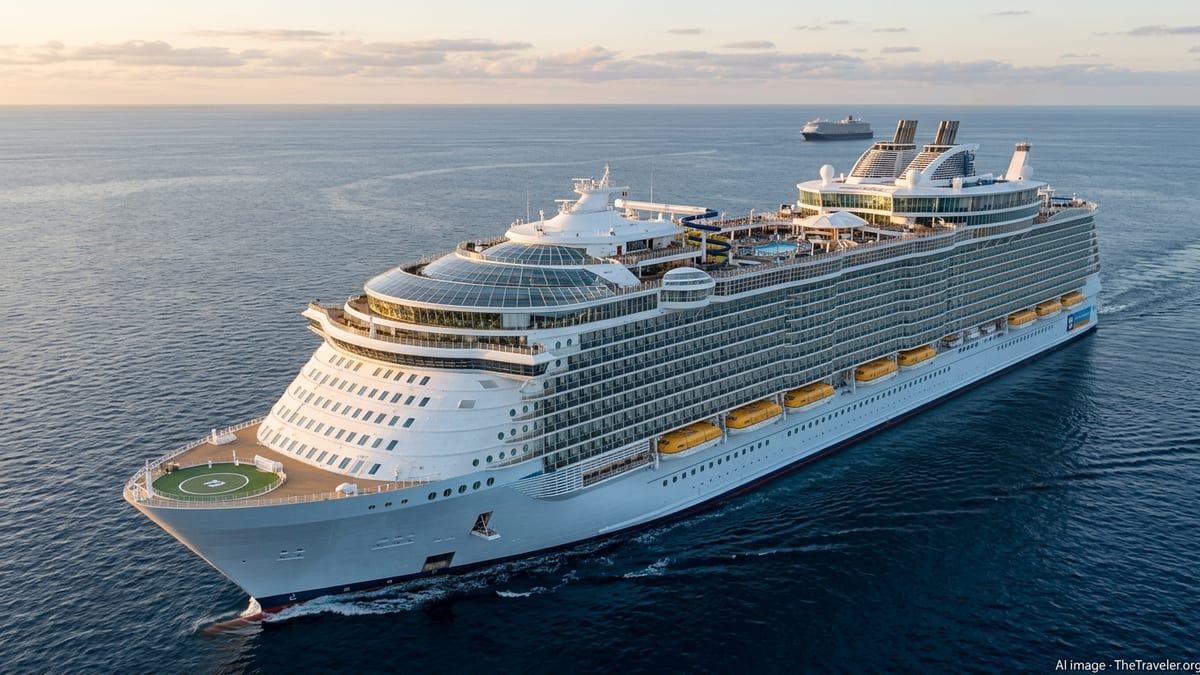
Icon-Class Giants Set the Benchmark for Mega Cruise Ships
Royal Caribbean’s Icon class remains the headline story in 2026, with Icon of the Seas and Star of the Seas already sailing and a third sister, Legend of the Seas, scheduled to join the fleet in mid-2026. Publicly available specifications indicate that Icon of the Seas and Star of the Seas each measure around 250,000 gross tons, making them the largest cruise ships in the world by volume, with capacity for more than 5,600 guests at double occupancy and over 7,000 at maximum load.
These floating resorts are designed as “neighborhood” ships, dividing their 20 or so decks into distinct themed zones that function like mini districts inside a compact city. Icon of the Seas, for example, features family-focused Surfside, a lush open-air Central Park, and the Thrill Island area anchored by what cruise industry coverage describes as the largest waterpark at sea, complete with record-breaking slides and multi-level splash zones.
Legend of the Seas, due to debut in the Mediterranean in 2026, is expected to follow the template established by its Icon-class predecessors while tailoring venues and itineraries more closely to European tastes. Deployment guides published by the line point to Western Mediterranean sailings as a core focus, underscoring how these mega ships are no longer confined to Caribbean routes but increasingly operate as global city-scale attractions at sea.
Cruise awards compiled for recent seasons suggest that Icon of the Seas has already become a reference point for the wider industry, with editors’ picks and passenger reviews frequently highlighting its sheer range of dining, entertainment and accommodation categories, from multi-level family suites to exclusive suite enclaves with private pools and restaurants.
Oasis-Class Evolution: Utopia and Wonder of the Seas
Alongside the Icon class, Royal Caribbean’s Oasis-class ships continue to rank among the most influential vessels at sea in 2026. Wonder of the Seas and Utopia of the Seas, both surpassing 230,000 gross tons, remain central to the brand’s strategy of pairing short, resort-style Caribbean itineraries with big-ship amenities that rival land-based mega resorts.
Wonder of the Seas is frequently cited in industry reports for its open-air Central Park lined with thousands of live plants, its split superstructure that frames an outdoor AquaTheater, and its dedicated suite neighborhood concept. These design elements have helped set a template that many new large ships now follow, prioritizing multi-use outdoor spaces, tiered entertainment zones and neighborhood-style wayfinding.
Utopia of the Seas, introduced in 2024 and sailing into 2026 on mostly short itineraries, has been positioned as a high-intensity “weekend getaway” ship. Public deployment summaries show it concentrating on 3 and 4 night Caribbean cruises, but effectively compressing a week’s worth of dining, bars and entertainment into a long weekend. The ship’s size, neighborhood layout and water-based attractions aim squarely at younger travelers and groups seeking festival-like energy alongside more traditional cruise comforts.
For global tourists comparing large-ship options, the Oasis-class evolution demonstrates how capacity and scale can be channeled into distinct travel styles. Where Icon-class aims to be a complete family destination at sea, the latest Oasis ships are framed more as high-energy, short-break resort experiences, illustrating how “best” is increasingly defined by trip style rather than size alone.
Sun Princess and the Rise of Glass-Domed Piazza Design
Princess Cruises has taken a different design direction with Sun Princess, the first in its new Sphere class and one of the most talked-about premium ships sailing into 2026. Weighing in at just under 180,000 gross tons, Sun Princess is smaller than the Icon and Oasis giants but still firmly in the mega-ship category, carrying more than 4,000 passengers and introducing a contemporary interpretation of the line’s traditionally classic style.
Central to the design is a multi-deck, glass-enclosed sphere and piazza concept, where natural light floods indoor spaces and blurs the line between interior and exterior. Cruise industry reviews highlight the dramatic outward-facing architecture, which creates more sea views from dining rooms, lounges and walkways, an approach that contrasts with the more inward-focused layouts of some earlier mega ships.
Sun Princess also reflects a broad shift toward more flexible, resort-like public spaces. Rather than relying solely on large, single-purpose theaters or dining rooms, the ship incorporates smaller venues, specialty eateries and casual social hubs intended to disperse crowds and deliver a more boutique feel despite its size. Reports indicate that cabin design follows the same logic, with updated standard staterooms and new suite categories targeted at guests seeking a premium feel without committing to ultra-luxury lines.
With a sister ship, Star Princess, due to follow, the Sphere class is positioning Princess Cruises as a key player for travelers who want the scale and amenity choice of a mega ship but prefer a somewhat quieter, more design-forward onboard atmosphere than that found on the largest family-focused vessels.
Emerging Mega Ships for 2026 and Beyond
Beyond Royal Caribbean and Princess, other major brands are rolling out large newbuilds that will help define the best cruise options in 2026. Industry new-ship trackers point to additional large vessels for lines such as Norwegian Cruise Line, MSC Cruises and others, many of which aim to balance headline-grabbing features with more sustainable operations and improved energy efficiency.
Some 2026 deliveries build on existing classes with incremental changes, such as expanded waterparks, more indoor-outdoor dining spaces and upgraded suite complexes. Others experiment with new hull forms, revised deck plans and alternative fuels designed to meet increasingly strict environmental regulations, signaling that the era of mega ships is also an era of more energy-conscious design.
For international travelers, one of the most notable shifts is geographic. While the biggest ships first concentrated on Caribbean and North American homeports, deployment documents now show broader patterns, including longer Mediterranean seasons, more Middle East and Asia itineraries, and repositioning cruises that effectively turn the ship itself into a long-haul transport alternative for certain routes.
As these ships enter service and fan out across regions, the definition of “best” increasingly includes where a ship sails and how it connects to marquee destinations, not only the hardware on board. For many tourists, being able to experience an Icon-class or Sphere-class vessel while also calling at ports in Europe, Asia or the South Pacific represents a key factor when choosing among the top cruise ships in 2026.
How Travelers Are Choosing Among the Biggest Ships
Against this backdrop of rapidly expanding capacity, traveler preferences are becoming more nuanced. Cruise award programs and passenger review aggregations suggest that the largest ships do not automatically win across all categories; instead, guests weigh factors such as crowd management, cabin design, dining variety, entertainment quality and itinerary choice.
Families and multi-generational groups are often drawn to Icon- and Oasis-class ships for their extensive waterparks, kids’ clubs and high-energy entertainment. Couples and design-focused travelers may gravitate toward ships like Sun Princess, which offer large-ship amenities in a setting that feels closer to an upscale resort. Others place a premium on ports of call or on quieter, mid-sized vessels that sacrifice some headline features in return for more space per passenger.
Publicly available pricing data also indicates that the newest and most talked-about mega ships typically carry a premium, especially in their first years of service. Travelers willing to sail slightly older but still very large ships can often access similar itineraries at lower fares while still enjoying many of the same headline amenities, from multi-venue dining to sophisticated entertainment.
What unites the leading contenders for the best cruise ships in the world in 2026 is the move toward cruise vessels that operate as fully fledged floating cities. Whether in the Caribbean, Mediterranean or beyond, these ships aim to deliver an end-to-end resort experience at sea, reshaping how global tourists think about ocean travel and the balance between ship and shore in their holiday plans.