

Portugal is compact enough that you can sleep in a city and spend your days chasing palaces, vineyards, beaches and mountain vistas without changing hotels. From Lisbon and Porto, excellent rail, bus and highway connections put some of the country’s most atmospheric towns and landscapes within easy reach for a single unforgettable day. This guide focuses on the most rewarding day trips from both cities, with practical context to help you decide where to go next.
How to Choose Day Trips from Lisbon and Porto
Lisbon and Porto sit on opposite ends of Portugal’s main north south corridor, linked by frequent trains that currently take around two hours and forty five minutes. A new high speed line is under construction that is expected to shorten that journey significantly toward the end of the decade, which will make combining both hubs and their surrounding regions even easier on a single trip. For now, most travelers treat each city as a separate base and focus on day trips within a two hour radius.
When planning day trips, think in themes. From Lisbon, the classic choices are fairytale palaces, medieval hill towns, wine country and Atlantic beaches. From Porto, the focus shifts to the Douro vineyards, charming small cities with deep religious and political history, and rugged mountains that feel a world away from the coast. You will rarely see everything in one visit, so it helps to match your excursions to your interests.
Public transport in Portugal is generally reliable and affordable. Trains are convenient for many major day trip routes such as Lisbon to Sintra or Cascais and Porto to Braga or Guimarães. Regional buses fill in gaps to smaller towns and coastal resorts but may run less frequently on Sundays and public holidays, so checking timetables the day before is wise. For more remote nature escapes such as national parks and river valleys, renting a car or joining a small group tour usually unlocks far more flexibility.
Seasonality also matters. Coastal and river destinations are at their best from late spring through early autumn, when ferries, river cruises and beach facilities operate at full strength. Mountain and interior regions can be crisp or even snowy in winter, but that quieter period can be rewarding if you enjoy empty trails and cozy village stays. In peak summer, popular palace towns and vineyards can feel crowded by midday, so early departures and pre booked entrance tickets are your best defense against long queues.
Classic Lisbon Day Trip: Sintra and the Atlantic Coast
If you only have time for a single day trip from Lisbon, Sintra is the obvious choice. This small town, wrapped in the evergreen folds of the Serra de Sintra hills, is celebrated for its collection of palaces, aristocratic estates and castle ruins that together form a UNESCO World Heritage landscape. Regular suburban trains from Lisbon’s Rossio station reach Sintra in about forty five minutes, which makes it extremely easy to slot into even a short stay in the capital.
Most first time visitors pair Pena Palace with the ruined Moorish Castle that looms on a ridge just below it. Pena’s brightly painted terraces and dramatic turrets draw crowds from mid morning onward, so seasoned travelers aim for the first entry slots of the day and use local buses or rideshares to climb directly from the station to the palace. From there, walking down via the castle into Sintra’s historic center allows you to avoid uphill bottlenecks and recover over a coffee and traditional travesseiro pastry in town.
Those with a full day and extra energy can add a third stop such as Quinta da Regaleira, famous for its garden tunnels and initiation well, or the quieter Monserrate estate on the edge of town. A useful circular bus route connects many of these sights, but in high season services can be crowded. Factor in waiting times and aim to be back at the station before the late afternoon crush of returning day trippers. Trains run into the evening, yet the most comfortable journeys tend to be those that leave before sunset.
For travelers who want sea views alongside palaces, Sintra combines naturally with the Atlantic coast. A regional bus links the town with Cabo da Roca, the westernmost point of mainland Europe, and the resort of Cascais further south. On a long summer day you can explore a palace or two in Sintra, head out for dramatic cliff scenery at Cabo da Roca, then finish with an evening stroll and seafood dinner in Cascais before riding the coastal train back to Lisbon’s Cais do Sodré station.
Medieval Towns and Sacred Sites North of Lisbon
North of Lisbon you find a string of towns that showcase Portugal’s medieval and religious heritage. Among them, Óbidos is often the most beloved. Encircled by intact walls and crowned by a castle, this hill town feels almost theatrical with its whitewashed houses, trailing bougainvillea and narrow cobbled lanes. From Lisbon, it is usually reached by bus in around one hour, though organized excursions may combine it with other stops. Once you pass through the gates, the pace slows to a gentle wander, punctuated by tastings of the local sour cherry liqueur, usually served in tiny chocolate cups.
Further inland, Fátima draws pilgrims from around the world to its sanctuary complex, which commemorates reported Marian apparitions in 1917. Even for visitors without a religious background, the scale of the esplanade, basilicas and chapels can be striking. Many day tours link Fátima with the nearby Batalha Monastery and Alcobaça Monastery, both listed as UNESCO World Heritage Sites for their Gothic and Cistercian architecture. This combination gives a compact yet powerful overview of faith, politics and artistry in Portugal’s formative centuries.
Batalha’s monastery was built to celebrate a decisive 14th century victory that helped secure Portuguese independence, and its richly sculpted cloisters and so called Unfinished Chapels showcase the exuberant Manueline style that emerged later. Alcobaça, by contrast, is known for its austere lines and the intricately carved tombs of King Pedro I and Inês de Castro, whose tragic love story has become part of national legend. Walking from one cool stone nave to another, it is easy to sense how religious life once structured these communities.
While it is possible to visit some of these destinations independently by bus from Lisbon, the distances and limited public transport frequencies make them well suited to guided day trips or self drive circuits. Roads are generally good and well signposted, and having your own vehicle allows you to linger later in the afternoon, when day tour crowds thin and the light softens over tiled rooftops and surrounding fields.
Wine Country and Wild Coast: Arrábida, Setúbal and the Alentejo
South and east of Lisbon, the landscape quickly opens into vineyards, cork forests and luminous stretches of coastline. One of the most striking natural escapes is Arrábida Natural Park, a protected area of limestone hills and sheltered coves overlooking the deep blue of the Atlantic. The nearest city, Setúbal, sits across the Tagus estuary and Sado River and can be reached by train or bus from Lisbon in about one hour, after which local taxis or tours ferry visitors into the park’s viewpoints and beaches.
On a clear day, the contrast between the park’s white cliffs, dense green vegetation and turquoise coves feels almost Mediterranean. Small beaches tucked under the hills are enormously popular with Lisboetas in summer, so parking can be restricted and some roads close to private vehicles on peak days. If you plan a high season visit, arriving early or relying on shuttle buses is often more practical than driving directly to every cove. Seafood restaurants around Setúbal’s waterfront provide a relaxed finale to the day, with grilled fish and regional wines paired with sunset views over the harbor.
Further inland, the Alentejo region offers a different kind of escape. Évora, its best known city and a UNESCO World Heritage site, lies about ninety minutes from Lisbon by road. Once within its 14th century walls, you encounter Roman remains, whitewashed lanes and a remarkable collection of churches and palaces, as well as the haunting Capela dos Ossos, a chapel decorated with thousands of human bones. The atmosphere is slower and more contemplative than in Lisbon, and many travelers remember the city’s long lunches almost as vividly as its monuments.
Évora also serves as a gateway to the wider Alentejo countryside, known for its rolling plains, cork oak groves and wineries. While visiting vineyards can be complex without a car, several operators now run small group wine focused day trips from Lisbon that include tastings at estates outside the city and time for a walk in Évora’s historic core. In cooler months, when coastal breezes can be brisk, this interior route is particularly appealing for its golden light and calmer feel.
From Porto: Douro Valley Vineyards and River Villages
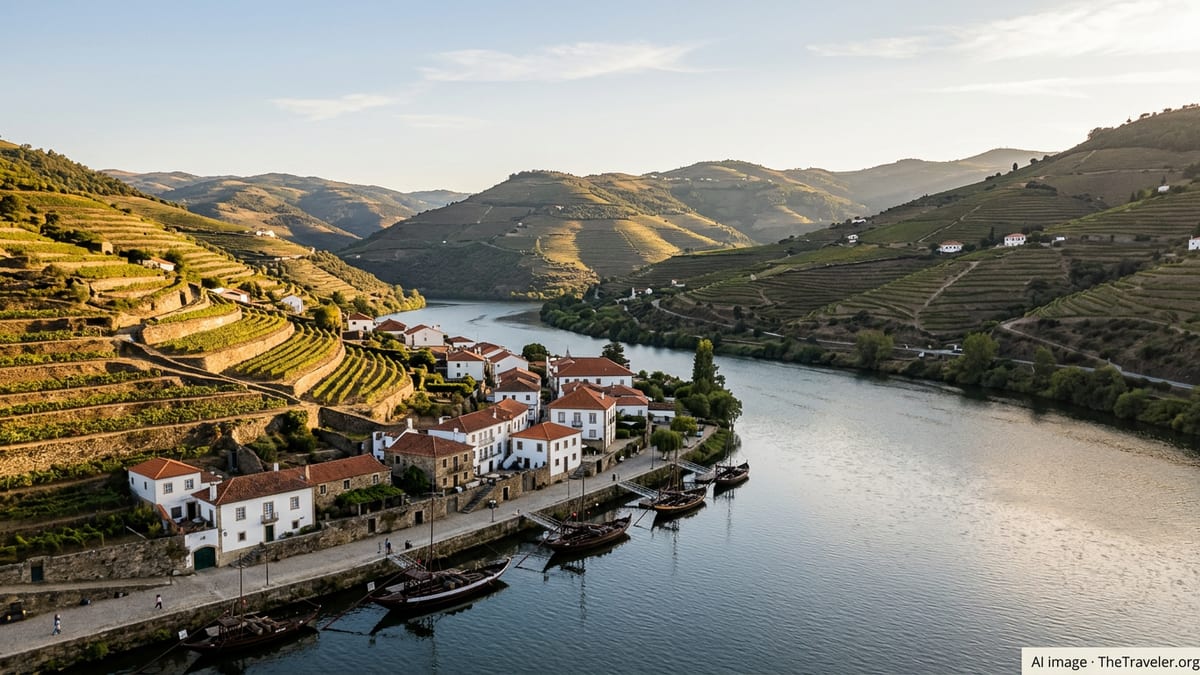
For travelers based in Porto, the Douro Valley is the definitive day trip. Carved by the Douro River as it winds inland from the Atlantic, this region is characterized by steep slopes carved into terraces, some of which have been under vine for centuries. It is the heartland of port wine production and, increasingly, a source of highly regarded still wines. The journey itself is memorable, whether you travel by train following the river or by road along a series of switchbacks and scenic viewpoints.
Regional trains depart Porto’s São Bento and Campanhã stations several times per day, following the Douro line to towns such as Peso da Régua and Pinhão. The ride to Régua usually takes around two hours, continuing roughly thirty minutes to an hour further for smaller stations deeper in the valley. Seats are inexpensive by Western European standards, and in the busier months from May to October it is sensible to book ahead, especially if you want specific departure times or window seats for photography.
Pinhão, near the center of the valley’s wine producing area, works well as a base for a day’s exploration. From its small station decorated with azulejo tiles, you can walk to the riverfront, board short scenic cruises and visit nearby quintas for tastings and cellar tours. Some estates are reachable on foot, while others require a short taxi or pre arranged shuttle. Because tastings often include generous pours of fortified wine, many travelers prefer to rely on trains, boats or private drivers rather than doing a self drive tour.
For a different perspective, some visitors opt for combined rail and river excursions that pair a one way train ride with a cruise back to Porto. These trips tend to operate in the main visitor season and may include meals on board. Regardless of how you go, starting early maximizes time among the vineyards and allows for a leisurely lunch with river views before you work your way back to the city in the evening.
Historic Cities Around Porto: Braga, Guimarães and Aveiro
Several of northern Portugal’s most atmospheric small cities sit within an hour or so of Porto, making them ideal for culture rich day trips. Braga, reached by frequent trains or buses in roughly one hour, is one of the country’s oldest cities and remains an important religious center. Its historic core is dense with churches, baroque fountains and pedestrianized streets lined with cafes. Many visitors pair a stroll through the center with a visit to the Bom Jesus do Monte sanctuary, whose monumental baroque stairway climbs a forested hill outside town.
Not far away, Guimarães carries the title of Portugal’s birthplace, reflecting its role in the early formation of the kingdom. The compact old town combines a hilltop castle, a palace once used by the Dukes of Braganza and handsome medieval squares that come alive on sunny afternoons. Direct trains from Porto usually take around an hour and drop you within walking distance of the center, though local buses and taxis can help you reach the castle if you prefer to avoid the uphill walk.
South of Porto, Aveiro offers a change of scenery with its canals, colorful moliceiro boats and art nouveau facades. It is sometimes nicknamed the Venice of Portugal, although the atmosphere is much more low key. The city is about an hour from Porto by train, and many travelers combine the historic center with a short hop to the nearby beaches and striped houses of Costa Nova. Regional sweets, especially the egg based ovos moles, are another draw and make an easy edible souvenir for the trip back north.
All three of these destinations are straightforward to visit independently using public transport, and each can comfortably fill a full day at a relaxed pace. If your time in Porto is limited, prioritizing one or two that match your interests usually leads to a more satisfying experience than trying to string them all together in a single whirlwind tour.
Nature Escapes from Porto: National Parks, Trails and Beaches
Urban Porto sits within reach of surprisingly wild landscapes. Around ninety minutes to the northeast by car, Peneda Gerês National Park stretches across mountainous terrain laced with old stone villages, waterfalls and reservoirs. It is Portugal’s only official national park and feels dramatically different from the coastal plain. Hiking trails range from short, marked circuits near main roads to more demanding routes that require navigation skills. In summer, natural river pools provide refreshing swims, while in cooler seasons low clouds and changing foliage lend the valleys a moody allure.
Public transport into the deeper reaches of Peneda Gerês is limited, so most visitors either rent a car or join guided excursions from Porto that handle logistics and route choice. Road surfaces are generally good, but winding mountain drives demand unhurried pacing. Once in the park, infrastructure remains modest. Outside a few popular viewpoints and lakeside picnic spots, it is easy to find quiet corners where you hear little but wind and water.
Closer to the city, there are easier going nature options. The coastal town of Espinho, about thirty minutes by urban train from Porto, offers a broad sandy beach, surf schools and a weekly market that draws locals from the wider region. On warm days, it works well as a straightforward escape for those mainly interested in sea air and fresh grilled fish rather than complex sightseeing. Other travelers head the opposite direction to Arouca, roughly an hour inland, to tackle the Paiva Walkways, a wooden trail that hugs a river gorge, and to cross the dramatic suspension bridge known as 516 Arouca.
If your schedule allows for only one nature focused day out, your choice may come down to travel time and how comfortable you are with driving. Peneda Gerês rewards the extra effort with a sense of remoteness that is rare on the Portuguese mainland, while closer beaches and river trails are easier to slot into a short break. In either case, sturdy footwear, layered clothing and plenty of water will make the experience far more enjoyable.
The Takeaway
Whether you base yourself in Lisbon, Porto or both, Portugal’s manageable distances and dense web of transport connections make day trips an essential part of any itinerary. Palace crowned hills, fortified monasteries, vineyard lined valleys and wild Atlantic headlands all sit within a couple of hours of the city centers, allowing you to experience a surprising variety of landscapes and stories without packing and unpacking.
The key is to be selective. A first time visitor to Lisbon might focus on Sintra, a medieval town such as Óbidos or Batalha, and a coastal or countryside escape like Arrábida or Évora. From Porto, pairing the Douro Valley with one or two historic cities such as Braga or Guimarães gives a rounded sense of the north, with an optional extra day devoted to mountains or beaches. If you travel in the busier months, booking key tickets and trains in advance, starting early and staying flexible about exact timings all help keep the days relaxed rather than rushed.
As infrastructure improves over the coming years, including the planned high speed rail link between Lisbon and Porto, it will become even easier to fold both regions into a single trip. For now, the pleasure lies in choosing a direction each morning and letting the day unfold, whether that means tracing a monastery cloister in silence, tasting port on a terrace above the Douro, or simply watching the Atlantic crash against a cliff while fishing boats head home.
FAQ
Q1. Can I visit both Lisbon and Porto day trip regions on a single short trip?
It is possible to sample both regions in one itinerary, but with limited time it is wiser to choose one city as your main base and focus on two or three nearby day trips rather than rushing between them.
Q2. Is it better to rent a car or rely on trains and buses for day trips?
Trains and buses are excellent for popular routes such as Lisbon to Sintra or Porto to Braga and Guimarães, while a rental car or small group tour is more convenient for remote nature areas and multi stop countryside itineraries.
Q3. How far in advance should I book trains for day trips in Portugal?
For suburban routes like Lisbon to Sintra you can usually buy tickets on the day, but for longer or scenic lines such as the Douro Valley it is sensible to book several days ahead in peak season.
Q4. Are day trips still worthwhile in winter?
Yes, although your focus may shift from beaches and islands to historic towns, monasteries and wine regions, which can be atmospheric with fewer crowds and cooler temperatures.
Q5. Which day trips are most family friendly?
Sintra’s palaces, Cascais’s beaches, the Douro river cruises and compact towns like Aveiro or Óbidos tend to work well for families thanks to short walking distances and varied activities.
Q6. Do I need guided tours, or can I organize everything myself?
Many destinations are easy to visit independently using public transport, but guided tours can be useful when combining several remote sites in one day or when you want in depth historical or wine expertise.
Q7. How should I dress for day trips in Portugal?
Comfortable walking shoes, sun protection and light layers are important almost year round, with waterproof gear and warmer clothing recommended for mountain or off season excursions.
Q8. Are major sights on these day trips accessible for travelers with limited mobility?
Accessibility varies widely, as many historic centers have steep cobblestones and stairs, so checking current information and contacting specific palaces or tour providers in advance is advisable.
Q9. Can I taste wine on day trips without driving?
Yes, in regions like the Douro Valley or Alentejo you can rely on trains, river cruises or organized tours that include transport between estates, allowing you to taste safely without needing to drive.
Q10. What is the biggest mistake travelers make when planning day trips from Lisbon or Porto?
Overloading the schedule is the most common pitfall; choosing fewer destinations and allowing time for meals, transport delays and simple wandering usually leads to a more enjoyable experience.