

The United Kingdom is one of the easiest places in Europe to explore on a day trip. Trains and coaches radiate from major cities, compact historic centres reward aimless wandering, and landscapes shift quickly from skyline to seashore to rugged moorland. Whether you are based in London, Edinburgh, Manchester or another regional hub, you can step onto a morning train and be somewhere entirely different in time for lunch, returning to your base the same evening. This guide highlights some of the best and most reliable day trips in the UK right now, with a focus on places that combine atmosphere, walkability and straightforward transport.
Bath: Roman Baths and Georgian Elegance
Bath is regularly picked out as one of the most satisfying day trips in England, and with good reason. The compact city centre is built from warm honey-coloured stone, its crescents and terraces curving around a natural bowl. At its heart sit the remarkably preserved Roman Baths, where steaming mineral water still rises from the depths and museum displays trace nearly two millennia of spa culture. Nearby, Bath Abbey and the colonnaded Pump Room complete a harmonious ensemble that feels almost theatrical in its perfection.
For many visitors, the joy of Bath lies in simply walking its streets. The Royal Crescent and the Circus showcase some of the best Georgian town planning in Britain, their graceful facades looking out over green lawns and distant hills. Just a short stroll away, the Assembly Rooms and Pulteney Bridge underline how much 18th century ambition and money once flowed through this small city. Cafes, independent bookshops and fashion boutiques have moved into the old stone buildings, giving Bath a lived-in rather than museum-like feel.
Bath works especially well as a day trip because it combines headline sights with easy logistics. Direct trains from London and Birmingham arrive close to the historic core, and most major attractions are within a ten to fifteen minute walk of the station. Visitors based in Bristol, Cardiff and the Cotswolds will also find it an appealing day out, with frequent regional services. Allow at least half a day for the Roman Baths and a walking circuit of the main landmarks, then leave time to linger in one of the city’s many tearooms or modern spa facilities.
Timing matters if you want to avoid crowds. Weekdays outside peak school holidays tend to be quieter, and early entry to the Roman Baths can offer a calmer experience. In winter, Bath’s streets take on a softer, misty quality, while in summer nearby countryside walks along the Kennet and Avon Canal or up to Alexandra Park add another dimension to your visit.
Brighton: Seaside Energy on the South Coast
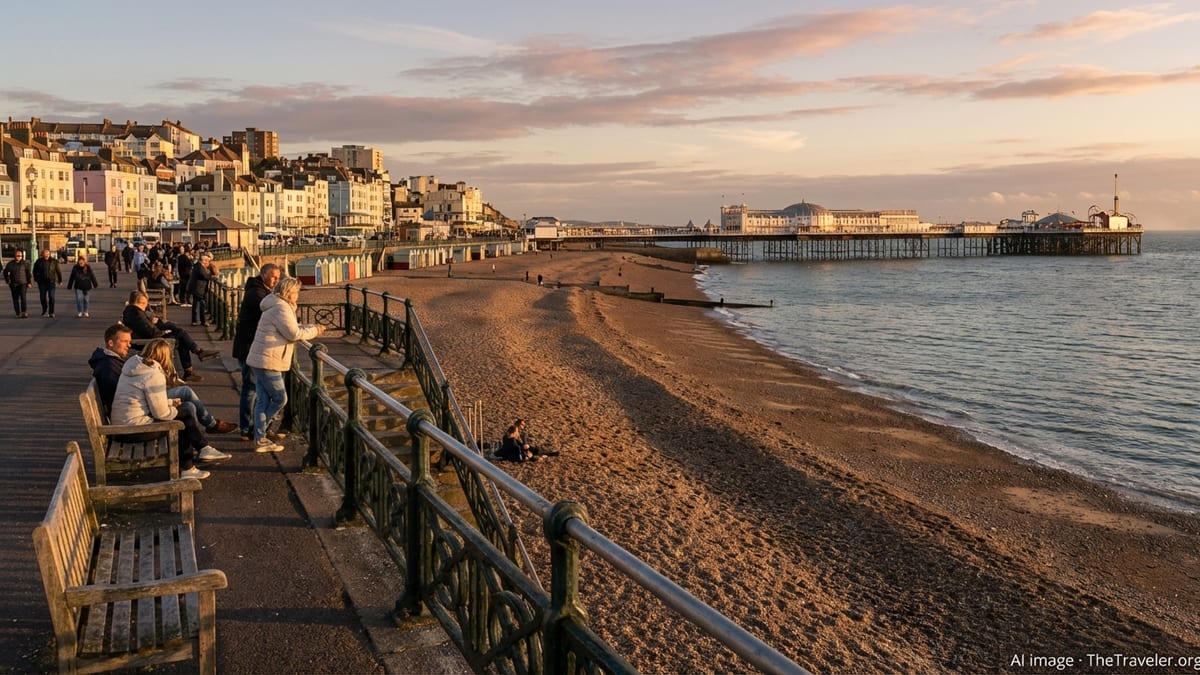
Brighton has long been London’s favourite seaside escape, but it has evolved into a destination that stands firmly on its own. The city pairs traditional pier amusements and pebble beaches with a distinctly creative, independent spirit. The ornate onion domes of the Royal Pavilion hint at Brighton’s history as a pleasure resort, while the surrounding streets teem with vintage shops, galleries and small venues that reflect its contemporary, bohemian edge.
For a day trip, the centre of Brighton is usefully compact. The main railway station sits on a hill above town, and within ten minutes on foot you can be threading through the warren of alleys known as the Lanes, where jewellers, chocolatiers and antiques dealers crowd into old fishermen’s houses. North of here, the North Laine district offers a more alternative flavour, with street art, record shops and casual cafes popular with students and young creatives.
Down on the seafront, Brighton Palace Pier delivers the classic British seaside formula: arcades, fairground rides and stands selling hot doughnuts and fish and chips. Walk west along the promenade to see the skeletal remains of the West Pier and a long line of colourful beach huts that continue into neighbouring Hove. Even on cooler days, the wide pedestrian and cycling paths make it easy to cover distance, and the open seascape feels like a deep breath after time in the city.
Brighton is one of the simplest day trips in the UK in practical terms. Fast, frequent trains link it to London, and direct services also run from Gatwick Airport and other south coast cities. The town’s popularity means weekends, bank holidays and sunny summer days can feel very busy, so off-season visits in spring and autumn often provide a more relaxed experience while still offering lively nightlife and dining options.
York: Walled City of Minsters and Medieval Lanes
York condenses nearly 2,000 years of history into a city centre that can be comfortably explored in a single day, but which rewards repeat visits. Roman foundations, Viking relics and medieval guildhalls sit side by side, framed by remarkably intact city walls. At the skyline’s centre rises York Minster, one of northern Europe’s most impressive Gothic cathedrals, its intricate stonework and stained glass dominating views across the rooftops.
Walking is the best way to appreciate York. A lap of the city walls offers elevated views of gardens, church spires and the tangle of streets below. Inside the walls, the Shambles is the most famous thoroughfare: a narrow, twisting medieval street where timber-framed buildings nearly meet overhead. Surrounding lanes and snickelways hide independent bookshops, small pubs and tearooms, many in centuries-old premises that lean at improbable angles.
York’s museums add further depth for a day trip. The National Railway Museum showcases historically important locomotives and carriages in vast halls near the station, while other attractions explore everything from Viking-era York to the city’s chocolate-making heritage. Many of these venues are within easy walking distance of each other, making it simple to mix indoor and outdoor experiences according to the weather.
Rail connections make York one of the most accessible historic cities in Britain. It sits on the main line between London and Edinburgh, with frequent services from both, and good links to Manchester, Leeds and Newcastle. This connectivity, combined with the city’s compact scale, makes York ideal for a carefully planned day trip: arrive early, book timed entry to the Minster if required, and allow space in your schedule for unstructured wandering and a slow lunch in one of the city’s many traditional pubs.
Scottish Highlands from Edinburgh: A Taste of Wild Scotland
While the Scottish Highlands deserve far more than a single day, travellers based in Edinburgh can still sample their drama on a carefully structured day trip. Popular itineraries focus on the landscape to the north and west of the city, where lochs, glens and small stone villages replace the Georgian terraces of the capital. Roads and railways climb into increasingly rugged country, with peaks, moorland and wide skies that feel a world away from urban Scotland.
Many visitors opt for organised coach or small-group tours from Edinburgh, which simplify logistics and maximise what can be seen in limited time. Typical routes include stops at atmospheric lochs, castle viewpoints and short walking spots, along with small towns that offer lunch and a chance to stretch legs. Some itineraries extend as far as Glencoe or the edge of the Isle of Skye, while others combine Highland scenery with visits to historic sites or whisky distilleries.
Independent travellers can also travel north by train, with routes from Edinburgh to Inverness and beyond offering extended windows onto Highland landscapes. While a simple out-and-back rail journey does not allow for as many stops as a guided tour, it can still provide a powerful sense of scale and atmosphere. Towns such as Pitlochry and Aviemore, located within striking distance of the Cairngorms, work well as rail-accessible bases for short walks and local exploration on a long day out.
Weather flexibility is crucial when planning any Highland day trip. Conditions can change quickly, even in summer, and layers, waterproofs and suitable footwear are essential. In winter, daylight hours are short, which limits how far from Edinburgh it is realistic to travel and still enjoy viewpoints in natural light. Checking seasonal tour schedules and transport timetables in advance will help ensure that your chosen itinerary is operating on your intended date.
Cardiff and the Coast of South Wales
For visitors based in London or the English Midlands, Cardiff offers one of the easiest introductions to Wales as a day trip. The Welsh capital pairs a revitalised waterfront with a compact city centre dominated by an unusual castle that blends Roman remains, medieval walls and exuberant Victorian Gothic interiors. The walk from the main railway station to the castle, pedestrianised shopping streets and indoor market is short, which makes the city manageable in a single day.
Cardiff Bay, a short bus or train ride from the centre, showcases the city’s more modern face. Former docklands have been transformed into a broad waterside promenade with cultural venues, restaurants and public art. Visitors can stroll along the barrage with views back to the city, or take short boat trips that hint at the broader geography of the Bristol Channel. On clear days, the wide skies and reflective water make this one of the most attractive urban waterfronts in the UK.
Time-pressed travellers sometimes combine Cardiff with a taste of the South Wales coast. Organised day tours and private drivers can include stops at places such as the Vale of Glamorgan or the ruins of nearby castles. However, even if you remain within the city itself, you can still experience distinctively Welsh culture in its bilingual signage, rugby heritage and vibrant arts scene. Cafes and pubs often showcase local produce and beer, adding a culinary dimension to a Cardiff day trip.
Regular trains link Cardiff with London, Bristol and cities across the Severn Estuary, and coach services add extra flexibility. Weekends around major sporting fixtures can be extremely busy and may push up accommodation prices, but day visitors who travel in and out on the same day can often sidestep the worst of the congestion by arriving early and departing after the main crowds have dispersed.
From London: Stonehenge, Windsor and Oxford in One Long Day
Some of the most sought-after day trips in the United Kingdom revolve around classic names: Stonehenge, Windsor Castle and the university city of Oxford. Each can be visited separately, but a growing number of operators now stitch them into long but memorable single-day itineraries that depart from London. These combination trips appeal to visitors with limited time who still want to experience a cross-section of English history, from prehistoric ritual landscapes to medieval royalty and academic tradition.
Stonehenge, set on an exposed plain in Wiltshire, continues to attract visitors from around the world. Access is carefully managed, with a visitor centre, shuttle buses to the stone circle and timed entry. As a day trip component, it is usually combined with a brief stop in nearby Salisbury or another regional town, but travellers on multi-stop coach tours should expect their time at the site itself to be limited. Weather can be bracing even in warmer months, so layers and windproof clothing are wise.
Windsor, closer to London, provides a contrasting experience focused on royal heritage. The town’s compact streets rise towards the walls of Windsor Castle, whose State Apartments, chapel and exhibitions can occupy visitors for several hours. Many itineraries allow for free time in Windsor’s town centre as well as a walk in adjacent parkland if schedules permit. Crossing the bridge to Eton offers a quieter scene of riverside terraces and the brick and stone buildings of the famous college.
Oxford brings yet another shift in mood, with its famous skyline of spires and domes, cobbled lanes and riverside meadows. Day trippers can tour selected university colleges, visit museums or simply admire the architecture while walking between the Bodleian Library, Radcliffe Camera and covered market. Travel times and distances mean that visiting Stonehenge, Windsor and Oxford in a single day makes for an early start and late return, but for those comfortable with a busy schedule it can be an efficient way to experience three of southern England’s most emblematic destinations.
From Manchester and the North: Lakes, Peaks and Historic Cities
Travellers based in Manchester, Liverpool, Leeds or other northern cities have their own rich menu of day trips. The Lake District lies within reach by rail and road, offering a classic combination of glacial lakes, stone-built villages and fell-side walking paths. Towns such as Windermere, Ambleside and Keswick serve as gateways to scenic cruises, short hill walks and literary sites associated with writers like William Wordsworth and Beatrix Potter. Even a single day can be enough to ride a boat across a lake, follow a valley path and enjoy a pub meal by an open fire.
Closer to Manchester, the Peak District delivers rugged gritstone edges, rolling moorland and limestone dales. Train-accessible villages on the edges of the national park make it feasible to spend a day walking without a car, although bus connections and organised tours increase your options. On fine days, the contrast between urban Greater Manchester and open upland landscapes can feel striking, especially for visitors more familiar with the south of England.
Northern England also excels when it comes to historic city day trips. Chester, with its Roman amphitheatre, black-and-white timbered galleries and almost complete city walls, is a manageable excursion from Manchester or Liverpool. Newcastle upon Tyne combines Victorian industrial grandeur with a riverside modern cultural scene, linked by a cluster of bridges over the River Tyne. York, already discussed in detail, also sits within this northern network, and can be easily reached from several major cities in the region.
As with other parts of the UK, public transport makes many of these northern day trips straightforward. Rail lines and intercity coaches connect hubs efficiently, while local buses and hop-on hop-off services in tourist hotspots broaden your reach. Weather in upland areas can change quickly, so even for short low-level walks it is sensible to bring waterproofs and appropriate footwear, and to check local conditions before setting off.
The Takeaway
Day trips in the United Kingdom reward both meticulous planners and spontaneous travellers. High-frequency trains, dense historic centres and varied landscapes mean you can move from capital city bustle to cathedral quiet or coastal air in a matter of hours. Cities such as Bath, Brighton, York and Cardiff showcase different strands of British and Welsh history and contemporary life, while excursions to the Scottish Highlands, English national parks and world-famous sites like Stonehenge offer an accessible taste of wilder or more ancient landscapes.
To make the most of a UK day trip, think carefully about your priorities. If you prefer museums and architecture, focus on compact historic cities where you can see a lot on foot. If scenery is your main goal, consider guided tours or rail journeys that maximise time outdoors rather than in transit. In all cases, checking current transport timetables and any booking requirements for major attractions will help avoid disappointment, especially during peak travel periods and around public holidays.
Perhaps the greatest strength of day trips in the UK is their flexibility. You can build them into a longer journey across the country, or use them to deepen your experience of a single base city by exploring its wider region. With sensible footwear, layered clothing and an eye on the weather forecast, you will find that even a single well-chosen day out can provide lasting impressions of the landscapes, cities and stories that make the United Kingdom distinctive.
FAQ
Q1. What is the easiest day trip from London for first-time visitors?
Bath, Windsor and Brighton are all straightforward from London by train, with frequent services and compact centres that are easy to explore on foot.
Q2. Can I visit Stonehenge, Windsor and Oxford in one day?
Yes, but it makes for a long and tightly scheduled day. Many travellers choose an organised coach tour to handle the logistics and timed entries.
Q3. Do I need to book train tickets for UK day trips in advance?
Advance tickets can be cheaper on intercity routes, but many services also sell flexible tickets on the day. Booking ahead is advisable at busy times.
Q4. Are UK day trips feasible without renting a car?
In many cases, yes. The UK has an extensive rail and coach network, and numerous guided tours depart from major cities to popular day trip destinations.
Q5. What is the best season for day trips in the United Kingdom?
Spring and early autumn often offer mild weather and fewer crowds. Summer brings longer daylight hours, while winter can be atmospheric in historic cities.
Q6. How much time should I allow for a typical day trip?
A full day trip usually runs from early morning to early evening. Aim for at least six to eight hours at your destination, plus travel time.
Q7. Are UK day trips suitable for families with children?
Many are. Seaside towns, castles, open-air museums and shorter countryside walks can work very well, especially if you plan regular breaks and snacks.
Q8. What should I pack for a UK day trip?
Comfortable walking shoes, a light waterproof jacket, layered clothing, a refillable water bottle, snacks and any pre-booked tickets or ID you might need.
Q9. Is it necessary to book attractions like the Roman Baths or York Minster in advance?
Booking ahead is increasingly common for major attractions, especially in peak seasons and on weekends, and can help you avoid long queues.
Q10. Can I fit more than one destination into a single day trip?
Sometimes, particularly if places are close together, but rushing can reduce enjoyment. It is often better to explore one destination thoroughly than to skim several.