

The Netherlands may be compact, but it offers an impressive variety of landscapes and experiences within a few hours’ travel: historic canal cities, wild North Sea dunes, car free islands, and farmland threaded with bike paths. For travelers willing to look beyond clichés of tulips and windmills, the country reveals cutting edge architecture, rewilded nature reserves, and villages where water is still the main street. This guide highlights some of the best places to visit across the Netherlands, from city centers to the Wadden Islands and the green heart of the countryside.
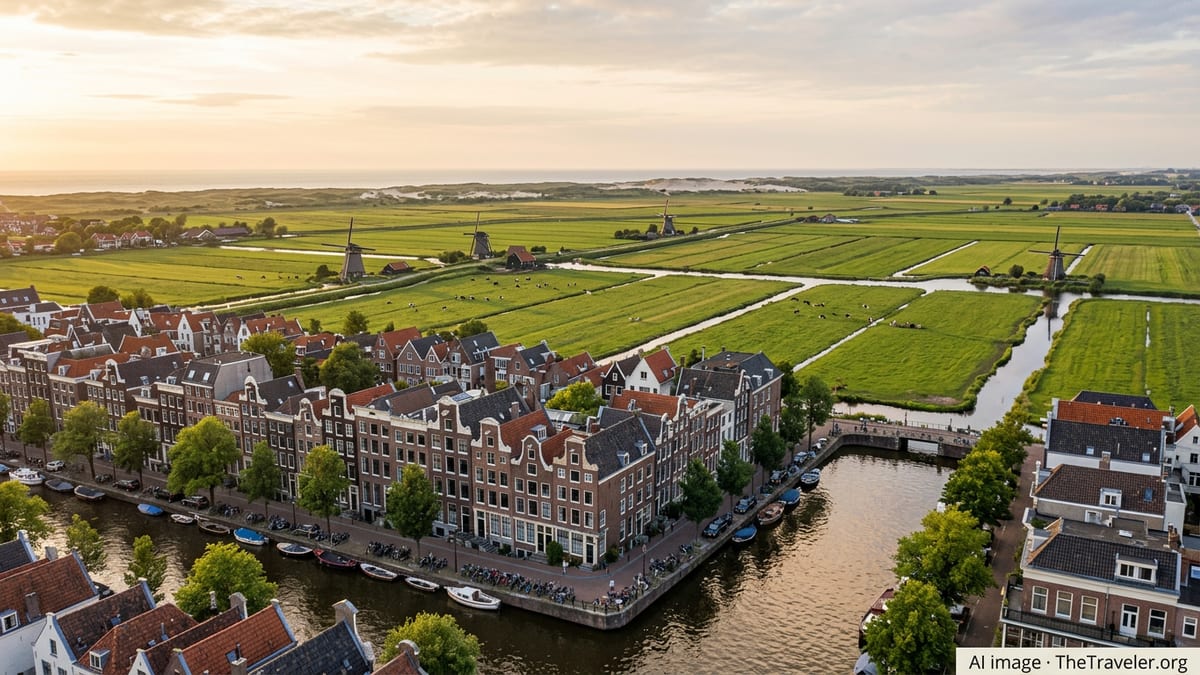
Amsterdam and the Classic Canal Heartland
Most journeys through the Netherlands begin in Amsterdam, and with good reason. The capital’s historic canal ring, a UNESCO World Heritage site, frames narrow brick townhouses and gabled warehouses that speak to the city’s Golden Age past. Museum heavyweights such as the Rijksmuseum and Van Gogh Museum sit beside smaller galleries, neighborhood markets, and brown cafés that remain part of daily life rather than museum pieces. Despite the crowds, a dawn or late evening walk along the canals still feels intimate, with reflections of bridges and bicycles rippling on the water.
To see a more everyday side of the Netherlands while staying near the capital, look to cities such as Haarlem, Leiden, and Utrecht. Haarlem combines an atmospheric market square with hofjes, or historic almshouse courtyards that now feel like secret gardens. Leiden is a university city with a dense network of canals, lively bars, and scientific heritage tied to its centuries old university. Utrecht, with its split level canals and vaulted wharf cellars now converted into cafés and studios, offers many of the same charms as Amsterdam on a smaller, more relaxed scale.
This region, sometimes referred to as the Randstad’s historic core, is also where visitors encounter some of the country’s most recognizable imagery. Traditional windmills survive in and around Amsterdam, while spring brings waves of color to bulb growing areas in nearby North Holland and South Holland. Even when the tulips are not blooming, the flat, watery landscape and long sightlines from dike tops and cycle paths define the Dutch relationship with reclaimed land.
Rotterdam, The Hague, and the Modern Maritime Coast
To understand the contemporary Netherlands, head south and west to Rotterdam and The Hague. Rotterdam, heavily bombed in the Second World War, rebuilt itself with a strikingly modern skyline that has earned it a reputation as the country’s architectural capital. Here, container terminals and working docks still dominate the Nieuwe Maas river, but bold residential towers, cultural institutions, and the landmark Erasmus Bridge have turned the waterfront into a showcase of design and urban regeneration.
The Hague, a short train ride away, blends coastal resort, royal city, and international political hub. It hosts the Dutch government and the International Court of Justice, yet much of its appeal lies at street level: tree lined avenues, embassies housed in grand mansions, and museums such as the Mauritshuis, which holds works by Vermeer and Rembrandt. Just beyond the city, Scheveningen and neighboring seaside districts offer long sandy beaches, surf schools, and promenades that are busy on sunny days but retain a local feel outside peak summer.
Along this stretch of South Holland’s coast, smaller towns like Delft and Gouda offer a slower rhythm and a clear sense of tradition. Delft’s canals and brick facades are closely associated with the blue and white pottery that bears its name, while Gouda is known for its centuries old cheese market and a compact center filled with step gables and stained glass. Together with Rotterdam and The Hague, these places show how the Netherlands manages to layer maritime commerce, modern institutions, and historic townscapes along a relatively short section of coastline.
North Sea Beaches and Dune Landscapes
Running almost the entire length of the country, the North Sea coast is more varied than its reputation for breezy beaches suggests. Much of it is protected by bands of dunes and nature reserves where cycling and walking paths weave through sandy hills covered in grasses and low shrubs. Near Haarlem, the Zuid Kennemerland National Park offers a mix of dune forests, open sand, and freshwater lakes that attract birdlife and, increasingly, large grazers introduced as part of rewilding efforts. Farther south, the dunes near The Hague and Rotterdam form both a natural playground and an important line of coastal defense.
Beach culture here is distinctively Dutch. Resorts such as Zandvoort, Noordwijk, and Katwijk combine wide strands with seasonal beach clubs that rise on stilts in spring and are dismantled at the end of summer. Even in cooler months, locals head out in all weather for windswept walks, hot drinks in glass fronted cafés, and kite flying along the shore. The coast is easily reached by train or bus from major cities, making it an attractive day trip for visitors who want a contrast to urban sightseeing.
Southwest in the province of Zeeland, the relationship between land and sea becomes still more apparent. This low lying region is threaded with estuaries, islands now connected by dams, and engineering works that form part of the country’s wider Delta Plan for flood protection. Travelers come for quiet beaches, seafood, and a sense of spaciousness rare in more densely populated provinces, as well as for a better understanding of how the Netherlands has spent decades reshaping its shoreline to manage rising water levels.
Wadden Islands and the Wild North
For a feeling that is both coastal and distinctly remote by Dutch standards, the Wadden Islands in the north are hard to beat. The chain stretches along the shallow Wadden Sea, itself recognized as a UNESCO World Heritage site for its rich mudflats, tidal channels, and birdlife. Texel, the largest and easiest island to reach, offers a blend of long beaches, countryside dotted with sheep farms, and a lighthouse marking its northern tip. Well signposted cycling routes radiate from the main villages, making it easy to explore dunes, wetlands, and small harbors in a single leisurely day.
Farther along the chain, islands such as Vlieland, Terschelling, Ameland, and Schiermonnikoog feel progressively quieter and more car free. Some restrict private vehicles or keep them out of village centers, encouraging visitors to move at the pace of bicycles and footpaths. Schiermonnikoog, in particular, is known for having some of the widest beaches in Europe and a national park that covers almost the entire island. The emphasis here is on space, wind, and sea birds rather than built attractions, so these islands suit travelers who value nature, walking, and simple seaside pleasures.
On the mainland side of the Wadden Sea, the northern provinces of Friesland and Groningen provide their own mix of water, historic towns, and big skies. Friesland is famous domestically for its lakes and canals, which support a popular network of sailing routes in summer and, in cold winters, long distance skating when conditions permit. Its small cities, including Leeuwarden and Sneek, blend regional language and identity with museums, cafés, and waterfronts that remain closely tied to boating culture. Groningen, anchored by a youthful university city of the same name, combines lively nightlife with a largely rural hinterland of old village churches and raised terps, or artificial dwelling mounds built to stay above historic floods.
Canal Villages, Lakes, and the Green Heart Countryside
Between the country’s major cities lies the Groene Hart, or Green Heart, a patchwork of meadows, peatlands, and waterways that has remained relatively rural despite surrounding urban growth. This is classic Dutch polder country: rectangular fields bordered by ditches, black and white cows, and long, straight roads atop dikes. It is also one of the best places to experience the Netherlands by bicycle. Extensive cycling infrastructure links villages, farms, and nature reserves, allowing visitors to ride for hours on separated paths that keep them largely away from car traffic.
Some of the most atmospheric spots in this landscape are canal based villages where water rather than asphalt is still the main thoroughfare. Giethoorn, in the province of Overijssel, is perhaps the most photographed example, with thatched cottages, wooden bridges, and small boats gliding along narrow waterways. Nearby, the Weerribben Wieden National Park protects one of Western Europe’s largest freshwater wetlands, a maze of reed beds, lakes, and peat canals that attracts canoeists, bird watchers, and those interested in traditional lowland farming.
Other countryside highlights include the lakes around Loosdrecht and the river landscapes of the Betuwe, where orchards burst into blossom in spring. In the east, the Hoge Veluwe National Park offers heaths, forests, and drifting sand dunes, as well as a major art museum and sculpture garden tucked into the woods. These areas show a different side of the Netherlands, one in which quiet roads, farm stands, and long horizons dominate instead of tram lines and tower blocks.
Historic Towns, Fortresses, and Living Heritage
Beyond the best known cities, the Netherlands is dotted with mid sized and smaller towns that reward unhurried exploration. Places such as Maastricht in the far south, ’s Hertogenbosch in North Brabant, and Deventer and Zutphen along the IJssel River retain medieval street patterns and fortified silhouettes that feel distinct from the Randstad’s grid. Maastricht, close to both Belgium and Germany, has a more hilly setting by Dutch standards and a culinary scene influenced by its neighbors, while ’s Hertogenbosch is known for its cathedral, canals, and chocolate topped pastries called Bossche bollen.
Elsewhere, former trading towns such as Alkmaar, Hoorn, and Enkhuizen on the IJsselmeer tell the story of seafaring wealth and the shift from open sea to inland lake after twentieth century land reclamation projects. Traditional cheese markets still operate seasonally in places like Alkmaar and Gouda, with carriers in white outfits and straw hats transporting wheels of cheese across historic squares. While these events cater in part to visitors, they also reflect rituals and regional products that remain part of local identity.
Scattered throughout the country, especially around former borders and river crossings, are fortresses and defensive lines that have been repurposed as parks, museums, and walking routes. The New Dutch Waterline, a system of inundation fields and forts designed to flood key corridors in times of war, now forms the backbone of a long distance trail. Restored bastions shelter cafés, galleries, and small visitor centers. By visiting these locations, travelers can see how the same ingenuity that tamed rivers and seas for agriculture was turned toward military defense and is now, in peacetime, being adapted yet again for recreation.
The Takeaway
Travelers often arrive in the Netherlands with a mental picture dominated by Amsterdam’s canals and fields of tulips, but the country quickly reveals a broader palette. Modern skylines in Rotterdam, diplomatic corridors in The Hague, sweeping dune reserves, the tidal flats of the Wadden Sea, and quiet polder villages all contribute to a landscape where water and human intervention are in constant dialogue. Distances are short, and public transport is efficient, which makes it easy to combine cities, coastlines, islands, and countryside within a single trip.
The most rewarding itineraries move at a slightly slower pace: renting a bicycle instead of calling a taxi, pausing in a village café between trains, or spending a few days on an island rather than rushing through a checklist of sights. In doing so, visitors gain a better sense of how Dutch people live with their environment every day, from commuting along cycle paths to spending weekends on the water. Whether you come for museums, modern architecture, wide open beaches, or the simple pleasure of watching clouds pass over flat fields, the Netherlands offers more depth and variety than its modest size might suggest.
FAQ
Q1. When is the best time of year to visit the Netherlands?
The most comfortable months for most travelers are from April to October, when days are longer and outdoor cafés, beaches, and festivals are in full swing. Spring is popular for flower fields, while late summer often brings the warmest beach weather. Winter visits can be atmospheric in cities, but expect short daylight hours and changeable conditions.
Q2. How many days do I need to see more than just Amsterdam?
With five to seven days, you can reasonably combine Amsterdam with one or two nearby historic cities, a day on the coast, and an excursion into the countryside. Ten days or more gives you time to add at least one Wadden Island or a trip to the southern or eastern provinces without feeling rushed.
Q3. Is it easy to get around the Netherlands without a car?
Yes. The country has an extensive rail and bus network, frequent services between major cities, and local trains that reach many smaller towns. Buses and regional trains connect to ferry terminals for the Wadden Islands. Once you arrive, cycling and walking often become the most convenient ways to explore.
Q4. Do I need to be an experienced cyclist to enjoy biking in the Netherlands?
No. The terrain is largely flat, and there is a dense network of dedicated cycle paths, clear wayfinding signs, and bike rental shops in most towns and cities. Even beginners can manage short rides between villages or along the coast. Helmets are not mandatory for adults, but many visitors choose to wear them for added safety.
Q5. Which Wadden Island is best for a first time visitor?
Texel is often the easiest choice, as it has frequent ferry connections, varied landscapes of beaches and farmland, and several villages with accommodation and restaurants. It works well for families and first time visitors, while smaller islands like Vlieland or Schiermonnikoog appeal to those seeking more solitude.
Q6. Can I visit tulip fields outside the peak bloom season?
The most vivid displays of tulips typically occur from mid April to early May, and outside this window many fields return to ordinary farmland. However, even when bulbs are not in bloom, the regions where they are grown still offer classic polder scenery, cycle routes, and coastal areas that make them worthwhile to visit.
Q7. Are Dutch beaches suitable for swimming?
In summer, many locals swim in the North Sea, especially on sunny, calm days when lifeguards are present at designated beach sections. Water temperatures are cooler than in southern Europe, and conditions can change quickly, so it is important to follow local flags and safety advice. Outside the warmest months, most people visit the beach for walking rather than bathing.
Q8. How expensive is travel in the Netherlands compared with neighboring countries?
Costs are generally comparable to other northwestern European countries. Accommodation and dining in major cities tend to be the most expensive elements, while public transport offers reasonable value, especially for regional travel passes. Visiting smaller towns, self catering, and using bicycles instead of taxis can help keep a trip within budget.
Q9. What should I pack for a trip that includes cities, coast, and countryside?
Layers are essential, as weather can shift quickly, sometimes within a single day. A lightweight waterproof jacket, comfortable walking shoes, and a wind resistant layer are useful for both urban sightseeing and coastal walks. If you plan to cycle, consider bringing gloves and a compact backpack or pannier for carrying water and extra clothing.
Q10. Is English widely spoken in the Netherlands?
Yes. Many Dutch people speak English to a high level, especially in cities, tourist areas, and on public transport. Learning a few basic Dutch phrases is appreciated, but visitors who rely on English will generally have little difficulty navigating trains, reading information boards, or interacting in shops and restaurants.