

From the beaches of Gulf Shores to the music clubs of Birmingham and the rocket trails of Huntsville, Alabama covers a lot of ground. Reliable mobile data can make the difference between a smooth Southern road trip and frustrating dead zones. With U.S. carriers expanding 5G and digital eSIM options, travelers now have more ways than ever to stay connected across the state, but choosing the right one depends on where you are going, how long you are staying, and what you need your phone to do.
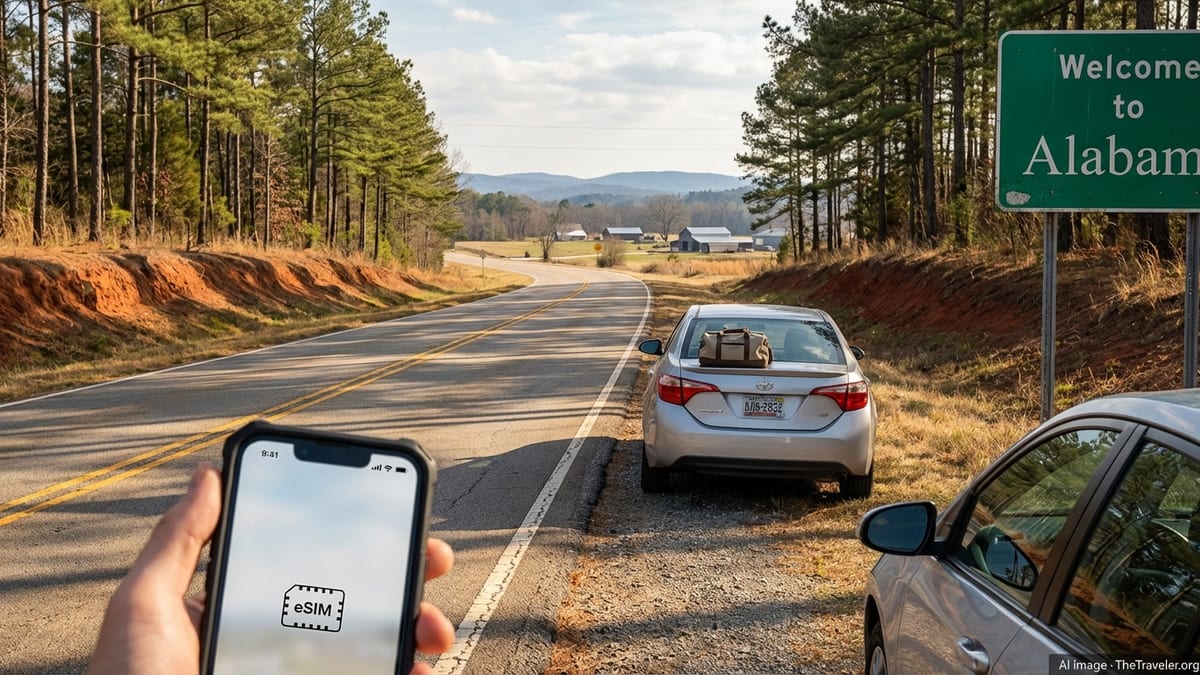
Understanding Mobile Coverage Across Alabama
Before choosing a SIM or eSIM, it helps to understand how the major networks actually perform in Alabama. Independent coverage analyses consistently rank AT&T as providing the broadest overall coverage in the state, with 4G LTE service reaching nearly all populated areas and especially strong performance in smaller towns and rural regions. That makes it a dependable choice if your itinerary includes long drives through countryside, state parks, and smaller communities between major cities.
Recent comparisons show that T-Mobile leads in statewide 5G footprint, with 5G service available across much of Alabama’s more populated corridors, while AT&T follows closely for 5G availability and remains particularly strong in northern Alabama. Verizon’s 5G coverage is more concentrated around key urban centers such as Birmingham, Huntsville, and Montgomery, but its network still delivers competitive speeds and solid 4G coverage in many parts of the state. Travelers who prioritize maximum rural reliability generally favor AT&T, while those planning to stay mostly in cities and along major highways may find T-Mobile’s 5G footprint appealing.
The practical takeaway is that Alabama is relatively well covered compared with many other U.S. states, but there are still patches of weaker service, particularly in very remote areas and some stretches of coastline or forest. Your experience will vary by carrier, by device, and even by street corner in denser neighborhoods. When choosing between SIM or eSIM plans built on these networks, the underlying carrier matters more than the brand name reselling the service, so pay attention to which backbone network a provider uses rather than just its marketing.
Because coverage maps can be optimistic, travelers planning off-the-beaten-path adventures should not rely solely on a single online map. If you expect to spend time hiking, camping, or driving back roads, consider downloading offline maps and confirming coverage directly with your chosen provider before departure. This is especially useful for safety apps, navigation, and mobile ticketing that can be difficult to access without a stable connection.
Who Needs a Local SIM or eSIM in Alabama
Not every traveler needs to swap SIMs when visiting Alabama. U.S. residents whose existing plans already include nationwide data and voice can usually roam within the country at no extra cost, whether they are driving from Georgia or flying in from California. If your current domestic plan offers unlimited or high data allowances and you are satisfied with your carrier’s coverage on its national map, there may be no need to change anything before your trip.
International visitors face a different calculation. Many foreign mobile plans either do not cover U.S. roaming at all or charge high daily fees for limited data. For these travelers, a local U.S. SIM or eSIM can dramatically cut costs, provide better speeds, and avoid bill shock when the trip is over. The added benefit is that local plans are designed for American usage patterns, so they typically include generous data allowances suitable for navigation, ride-hailing, social media, and streaming.
Short-stay visitors staying mostly in major cities might prefer flexible tourist-oriented eSIMs that activate instantly via app and do not require visiting a store. These digital plans are particularly helpful if you land late at night, want connectivity as soon as the aircraft door opens, or plan to keep your home-country physical SIM active for banking codes and messaging. For longer trips or those who want a local U.S. phone number for calls and texts, a traditional prepaid SIM from a U.S. carrier or reseller can be more convenient.
Ultimately, the decision comes down to three questions: how long you will be in Alabama and the United States, how much data you expect to use, and whether you need a local number for voice calls. Once you are clear on these basics, it becomes much easier to evaluate the growing menu of SIM and eSIM options that run on the major U.S. networks within the state.
Major U.S. Carriers and Their Alabama Performance
Alabama’s mobile landscape is dominated by the same three national carriers that serve most of the United States: AT&T, T-Mobile, and Verizon. Each operates its own physical network and then sells wholesale access to smaller brands known as mobile virtual network operators, or MVNOs. As a traveler, you can either buy directly from these big carriers or choose an MVNO that rides on their infrastructure while offering different pricing and plan structures.
AT&T is frequently cited as providing the best overall statewide coverage in Alabama, with particularly strong 4G LTE reach and well-established 5G service in northern parts of the state. Third-party analyses indicate that more than nine-tenths of Alabama’s land area sees AT&T 4G coverage, and its 5G footprint continues to expand in and around cities and key transport routes. Travelers driving between Huntsville, Birmingham, Tuscaloosa, and Mobile often report consistent coverage, making AT&T-backed plans a safe choice if you want to minimize dead zones.
T-Mobile tends to shine in 5G availability and urban performance. Recent data suggests that its 5G network covers a large share of the state, especially around Birmingham and Huntsville, and extends along interstate corridors that connect major hubs. In some locations, T-Mobile’s average 5G speeds can outpace competitors, which is useful for heavy data users who stream high-definition media or use their phone as a hotspot. However, T-Mobile coverage can be more variable in very rural pockets, so it is better suited to itineraries sticking close to cities and major roads.
Verizon, long known for its strong U.S. network, offers robust 4G coverage across Alabama but currently has a more limited 5G footprint compared with AT&T and T-Mobile. Where Verizon 5G is available, particularly in Birmingham, Huntsville, and Montgomery, performance can be excellent. Some travelers value Verizon’s reputation for reliability and may already use it at home, making it a convenient choice. For Alabama-specific travel, though, most independent coverage comparisons currently place AT&T at the top for breadth, with T-Mobile an appealing alternative for those chasing the widest 5G availability.
eSIM Options for Alabama Travelers
eSIM technology has become mainstream on modern smartphones, and it is an excellent option for Alabama visitors who want flexibility. An eSIM is a digital SIM profile embedded in your device that can be activated through a QR code or mobile app, eliminating the need to physically swap plastic cards. Many popular travel eSIM brands provide data-only plans for the United States that run on one of the big three U.S. networks, giving you full access to coverage in Alabama without setting foot in a store.
International travelers often gravitate toward global eSIM marketplaces that let you purchase regional or country-specific plans before departure. These services typically offer U.S. data packages ranging from a few days to several weeks, with tiered data allowances to match different usage patterns. Once purchased, you simply install the eSIM profile from the app, follow on-screen instructions to set it as your data line, and you are online as soon as your plane lands in Birmingham or Mobile.
One important detail is that many travel-focused eSIM plans for the United States are data-only. That means you will not receive a local U.S. phone number for traditional voice calls and SMS messages. For many travelers this is not a problem, as they rely on internet-based calling and messaging apps such as WhatsApp, FaceTime, or similar services over data. If you expect to communicate with local businesses that still prefer regular phone calls or text messages, you may want to maintain access to your home-country number or combine a data eSIM with a separate local voice solution.
Coverage for these eSIM offerings in Alabama depends entirely on which underlying carrier they use. Some providers clearly state whether their U.S. plans use AT&T, T-Mobile, or Verizon infrastructure, while others do not disclose this information prominently. If you know your route will take you into more rural areas, choosing a plan backed by AT&T can be beneficial. If your travel is concentrated in and between Alabama’s major cities, a plan relying on T-Mobile may be perfectly adequate and could offer strong 5G performance where available.
Physical Prepaid SIM Cards and MVNOs
Although eSIMs are convenient, traditional physical SIM cards remain widely available and are often the most straightforward option for travelers who want a local number and do not mind a quick stop at a store. In Alabama, you can buy prepaid SIMs or starter kits from major carrier shops, big-box retailers, supermarkets, pharmacies, and airport kiosks. Many of these offerings are MVNOs that run on one of the big three networks but package service differently, sometimes with better value for heavy data users or longer stays.
For example, some MVNOs that use AT&T’s network emphasize broad coverage and offer simple monthly plans with fixed data caps and hotspot allowances, making them attractive for travelers driving widely across the state. Others riding on T-Mobile or Verizon networks may focus on high-speed 5G data in urban areas, bundling unlimited data at lower prices with some limitations on hotspot or video quality. Because MVNOs typically do not operate their own retail stores, their SIMs are often sold in convenience outlets or online, with activation completed through an app or website.
When considering a physical SIM, confirm that your phone is unlocked and compatible with U.S. frequency bands. Most modern devices from major manufacturers support U.S. networks, but very old or budget handsets can have issues. If your phone accepts eSIMs, many MVNOs now support eSIM activation as well, blurring the line between physical and digital options. However, for travelers who feel more comfortable seeing a card in hand and speaking to a human during setup, a prepaid SIM from a physical store can still be reassuring.
Physical SIMs also make sense if you anticipate using your phone number for authentication, deliveries, or local calls that require reliable SMS reception. While messaging apps over data can handle many scenarios, some services still insist on SMS-based codes to a U.S. number. In those cases, a prepaid SIM with voice and text included can be the simplest solution for the duration of your Alabama stay.
Practical Tips for Choosing the Right Plan
Once you have settled on the type of SIM or eSIM that suits your travel style, a few practical checks can save time and frustration. Start by estimating your realistic data needs. Navigation, ride-hailing, and moderate social media use typically consume modest amounts of data, while high-definition video streaming, frequent hotspot use, and large file uploads can add up quickly. For a weeklong Alabama road trip with regular mapping, browsing, and photo sharing, many travelers find a mid-range data allowance sufficient, while digital nomads working remotely might need significantly more.
Next, match your expected coverage requirements with your route. If your trip is concentrated around Birmingham, Huntsville, Montgomery, Mobile, and popular tourist corridors, plans based on either AT&T or T-Mobile generally work well and give access to expanding 5G networks. If you anticipate long drives through sparsely populated areas, small towns, or state forests, leaning toward a plan that uses AT&T’s network can provide extra peace of mind due to its strong record for statewide reach. Regardless of carrier, downloading offline maps of Alabama in your preferred navigation app remains a wise backup.
Price comparisons also matter, but the cheapest option is not always the best. Some ultra-low-cost plans throttle speeds after a small amount of high-speed data, which can be frustrating if you rely on your phone for work or navigation. Look beyond headline data allowances to see whether hotspot use is permitted, whether speeds are reduced after a certain threshold, and whether roaming within the United States is fully included. For a short vacation, paying slightly more for a plan with generous high-speed data and simple terms can be worth it.
Finally, think about activation timing. Many eSIM providers allow you to buy and install your plan days or weeks before departure and then activate it once you land, while physical SIMs usually require you to be in the United States. If you are arriving late or on a tight schedule, having an eSIM ready to go means you can order rides, check hotel confirmations, and navigate directly from the airport without hunting for a kiosk. If you prefer in-person help, plan a stop at a carrier or electronics store early in your itinerary, especially in cities such as Birmingham, Huntsville, or Montgomery where options are more plentiful.
Using Data Safely and Efficiently While Traveling
Once your Alabama SIM or eSIM is up and running, a few habits can stretch your data and protect your privacy. Consider turning on data-saving modes in your phone’s settings and in key apps, which can reduce background usage and limit high-resolution media by default. Many streaming and social platforms allow you to lower video quality or download content over Wi-Fi ahead of time, which is especially helpful for road trips where mobile reception may temporarily weaken.
Public Wi-Fi is common in hotels, cafes, and some attractions across Alabama, but its quality and security vary. For sensitive tasks such as online banking or accessing work systems, avoid unknown networks or use a reputable virtual private network service. Even on your local mobile connection, keeping your device’s software updated and using strong authentication for key accounts helps reduce security risks while on the road.
For navigation and outdoor activities, it is wise to download offline maps of your planned regions. This step not only protects you against dead zones but also reduces the constant data demands of real-time map loading. Many modern map apps allow you to download large areas covering entire states or regions, which is particularly useful if you are driving between the Tennessee border and the Gulf Coast or exploring the Appalachian foothills.
Battery management also intersects with connectivity. Running a 5G connection, GPS, and screen at high brightness for long stretches can drain your phone faster than expected in Alabama’s often warm climate. Carrying a compact power bank and charging cable, and using power-saving modes when navigating, can keep your device functional throughout the day. That way, your carefully chosen SIM or eSIM plan remains useful when you need it most.
The Takeaway
Alabama is well positioned for connected travel, with strong statewide coverage from major U.S. carriers and an expanding web of 5G service in and around its cities. AT&T currently stands out for broad coverage across the state, T-Mobile excels in 5G reach, and Verizon remains a solid contender in key urban centers. Whether you are visiting for music, history, space exploration, or the beaches of the Gulf Coast, you can expect dependable mobile service in most populated areas when you choose a plan that aligns with your route.
For U.S. residents, your existing plan may already provide everything you need for an Alabama trip. International travelers, however, can often save money and gain better service by opting for a local SIM or eSIM that taps into the major U.S. networks. Travel-focused eSIMs are ideal for quick, low-hassle connectivity, while physical prepaid SIMs and MVNO offerings work well for longer stays or when you want a local phone number.
The best choice comes down to your itinerary, data needs, and comfort with digital activation. By assessing where in Alabama you will travel, how heavily you use your phone, and whether you need voice services, you can narrow the field to a handful of well-suited options. With a bit of planning before departure, your SIM or eSIM will quietly support your journey while you focus on exploring the state’s food, music, and landscapes.
FAQ
Q1. Do I really need a local SIM or eSIM to travel in Alabama?
Many U.S. residents can use their existing nationwide plans without changes, but international visitors typically benefit from a local SIM or eSIM for lower costs and better data speeds.
Q2. Which carrier generally has the best coverage in Alabama?
Independent analyses often rank AT&T as having the broadest statewide coverage in Alabama, while T-Mobile provides extensive 5G availability and Verizon performs well in key cities.
Q3. Are eSIMs widely supported for use in Alabama?
Yes. Most modern smartphones from major manufacturers support eSIM, and many travel providers sell U.S. data eSIMs that work across Alabama on the major networks.
Q4. Can I get a U.S. phone number with an eSIM in Alabama?
Some eSIM offerings include a local number, but many travel-focused eSIMs are data-only. If you require a U.S. number for calls and SMS, look for a plan that specifically includes voice service or consider a physical prepaid SIM.
Q5. Where can I buy a physical SIM card once I arrive?
Physical SIMs are commonly sold in carrier stores, electronics retailers, big-box shops, supermarkets, and some airport kiosks in Alabama’s major cities.
Q6. Will a U.S. SIM or eSIM work outside Alabama if I continue traveling?
Most U.S. prepaid and eSIM plans cover nationwide usage, so a plan used in Alabama should also function in other states, but always verify this in the plan details.
Q7. How much data should I budget for a one-week Alabama trip?
Light to moderate users who mainly navigate, message, and browse often find a mid-range data allowance sufficient for a week, while frequent streamers or remote workers may need significantly more.
Q8. Is 5G available throughout Alabama?
5G is available in and around major cities and along many key routes, but it is not universal. In more remote areas, your device will typically fall back to 4G LTE.
Q9. What should I do if I plan to visit rural or remote parts of the state?
If your itinerary includes back roads, small towns, or parks, consider a plan on a network known for strong rural coverage, download offline maps, and avoid relying solely on high-speed 5G.
Q10. Can I keep using my home-country SIM while adding an Alabama eSIM?
Yes, many dual-SIM and eSIM-capable phones allow you to keep your home SIM active for important messages while using a local Alabama data eSIM for everyday connectivity.