

I went to Lake Lucerne with a head full of postcard images: mirror-still water, gentle steamboats gliding past pretty villages, and easy access to big mountains with big views.
What I actually found was a more complicated mix of beauty, logistics, weather roulette, surprisingly high prices, and some very real crowds. It was still worth it, but not in the dreamy, effortless way that brochures and Instagram suggest.
Arriving in Lucerne and First Impressions of the Lake
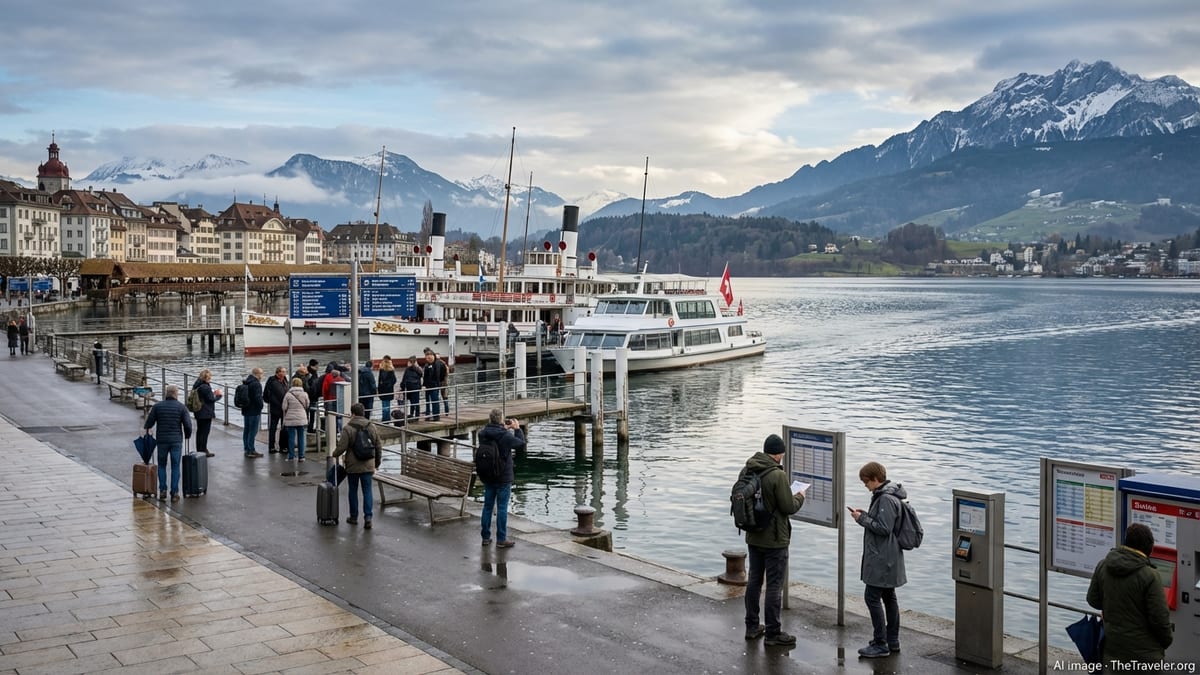
My base was Lucerne, which feels almost purpose-built as the front door to Lake Lucerne. The old town is lovely and the lakefront promenade, especially around the Bahnhofquai, makes a strong first impression. The mountains around the lake form a dramatic backdrop that is even more striking in person than in photos, at least on a clear day. I caught my first glimpse of the iconic paddle steamers moored in a neat row and, for a moment, it matched my romantic expectations almost perfectly.
Then I noticed the crowds and the queues. Around the main pier the atmosphere is busy and slightly chaotic, especially when several tour groups arrive at once. The boat company has clear signboards and a printed timetable, but if you show up at a popular departure without a plan it can feel overwhelming. In winter and shoulder seasons the timetable is thinner, so missing a boat can mean a long wait despite the year-round operation of the fleet under changing seasonal schedules.
What did surprise me in a good way was how close everything is. The main boat piers sit directly across from the train station. I could step off a train and within minutes be buying a boat ticket or walking along the waterfront. It made spontaneous decisions possible, even if spontaneity sometimes translated into standing in line with a lot of other people who had the same idea.
Cruising Lake Lucerne: Beauty, Prices, and Timetables
Lake Lucerne is one of those places where the boat is not just transport but the main attraction. The navigation company runs boats all year, with a reduced winter timetable and far more departures in summer. I appreciated that I could still get out on the water outside peak season, but it quickly became obvious that “all year” comes with caveats. On quieter days I had to work around long gaps between departures, and some piers had barely any service.
Price-wise, this is not a cheap outing if you are paying full fare. The long route all the way to Flüelen, which is the classic cruise, can easily run into the dozens of francs one way in second class, and even short hops like Lucerne to Weggis add up. There is a winter day pass that softens the blow if you plan to be on the lake a lot, and the usual Swiss passes like GA, Swiss Travel Pass, and Half Fare are valid, which helped. Without a pass, though, I would have hesitated before hopping on and off boats freely.
The experience itself varied a lot depending on the vessel and the weather. On a clear morning, sitting outside on a modern motor vessel was bliss: low hum of the engines, snow-dusted peaks above the water, and small villages sliding past. On a foggy, rainy afternoon the charm dropped sharply. The views were mostly grey, condensation fogged the windows, and everyone crowded into the same saloon space. It felt claustrophobic, and I started to resent how much I had paid to see my own reflection in the glass.
I also tried a round trip towards Weggis and Hertenstein, a route marketed as a “riviera” style excursion. The idea is lovely: sail out, walk along the lakeshore, sail back. In reality, in winter the lakeside promenade felt a bit lifeless, with several places closed and a chilly wind off the water. The advertised flexibility about choosing my return time was real, but I still had to keep one eye on the timetable so I did not end up stranded. If I did this again, I would go during late spring or summer and time it for an afternoon when I could linger in the sun instead of power-walking to stay warm.
Lucerne’s Lakeside Villages: Weggis, Vitznau, and Beyond
After a day or two in Lucerne itself, I started exploring the villages dotted around Lake Lucerne: Weggis, Vitznau, and Brunnen in particular. They all look delightful from the water, and the approach is half the fun. The boat glides in, the village church comes into view, and the hills behind rise steeply in a way that feels very alpine yet still gentle.
Weggis is often described as the “Riviera” of the lake. On a sunny day, with palm trees along the promenade and the Rigi massif rising behind, I could see why. I walked from the boat station up to the aerial cable car for Rigi. The walk itself is straightforward, but it is uphill and, with luggage or in bad weather, it would not feel idyllic. There is also the practical issue of construction and maintenance; when I visited, parts of the facilities around the boat station and the cable car area were in flux, and I had to navigate around temporary fences and signs. It was not hard, but it definitely broke the fantasy a little.
Vitznau had a quieter, more traditional feel and is the launching point for one of the cogwheel railways up to Mount Rigi. The views from the lakeshore are spectacular, and there is a strong sense of being surrounded by mountains. The downside is that there is not a huge amount to do if you are not heading up the mountain. A lakeside stroll, a coffee, and a quick look at the historic train station will probably be enough for most visitors. I enjoyed the atmosphere but found myself checking the timetable and planning my onward journey sooner than expected.
Brunnen, further down the lake, struck me as more of a real working town, less polished and more lived-in. It had fewer tourists and more functional shops and services. That made it feel less like an open-air museum and more like somewhere you could actually stay a few days and settle in. The trade-off is that it lacks some of the cute, old-world charm that makes Lucerne itself so photogenic. If you want postcard-perfect facades, you might be underwhelmed, but if you are looking for a less tour-group-heavy base, Brunnen has appeal.
Mount Rigi: Classic Views with a Few Practical Surprises
From the moment I started planning, everyone told me I had to go up Mount Rigi. The mountain railways operate all year, with seasonal timetables, and the combination of cogwheel train and cable car is one of the defining Lake Lucerne experiences. I went up via Vitznau and down via Weggis to make a loop with the boat.
The cogwheel train ride from Vitznau was a highlight. The carriages are old-fashioned in a way that feels authentic rather than kitschy, and watching the lake drop away behind the train as it climbs is frankly spectacular. The problem is that everyone else has been told the same thing. I went on a day with decent weather, and the train was extremely busy. I stood most of the way and, at times, all I could see was the back of other people’s jackets rummaging for phones and cameras. It was still worth doing, but I would not call it a serene experience.
At the top, Rigi Kulm, the famous 360 degree view did live up to the hype, at least for the half hour before the clouds rolled in. I could see multiple arms of the lake, distant peaks, and villages far below. What caught me off guard were the scale of development and the crowds. Concrete walkways, hotel buildings, antennas, and a knot of people all jostling for the same viewpoint made it feel more like an outdoor shopping center with a great view than a peaceful mountaintop. It was not ugly, but it was far from wild.
Descending to Rigi Kaltbad and then taking the cable car to Weggis was smoother and less crowded, and the lake views on the way down were fantastic. I also had to remember that the valley station at Weggis is not fully barrier-free and that the lift had intermittent issues, which would have been a serious inconvenience for anyone with mobility needs. Between planned maintenance windows and day-to-day glitches, I learned that I could not just assume seamless access. It reinforced the need to check operating information right before heading out.
Mount Pilatus: Logistics, Closures, and Weather Roulette
Mount Pilatus was my other big mountain goal, in part because of its reputation as the steepest cogwheel railway in the world and in part because it looms directly over Lucerne like a promise. The reality of visiting Pilatus is completely dictated by the date of your trip. The cogwheel railway from Alpnachstad runs from mid May to mid November. Outside that window, your only option is the gondola and aerial cableway from Kriens. That distinction matters a lot for both the experience and the logistics.
I visited during the shoulder season, so the cogwheel train was technically operating but only on certain schedules, and the boat connection between Lucerne and Alpnachstad ended earlier in autumn. That meant I had to piece together train and boat times quite carefully. At one point, a late-running local train made me miss my preferred connection, and I ended up sitting in Alpnachstad longer than expected watching the lake but not doing much else. The area around the lower station is functional rather than charming, so the wait dragged.
When I finally boarded the cogwheel train, it was absolutely an experience worth having. The gradient is ridiculous, and the way the track climbs almost straight up the mountainside made me feel like I was in some kind of slow roller coaster. However, the windows did not open, and on a busy day with a full carriage and strong sun, the car felt stuffy. Several of us shifted around just trying to find a patch of glass without too much glare. It was thrilling, but not especially comfortable.
At Pilatus Kulm, the mountain station area is heavily built up, with hotels, restaurants, terraces, and well-marked viewing platforms. On my visit, clouds moved in and out quickly, so the view alternated between breathtaking and completely gone. I had maybe 20 to 30 minutes of clear panorama; the rest of the time was white-out and wind. Watching other people arrive and realize they had paid for a view that did not exist in that moment was painful. My own expectations were tempered by the weather forecast, so I was not shocked, but it really drove home how risky it is to treat any single mountain visit as guaranteed.
Balancing Boats, Mountains, and Budgets
One of the challenges of Lake Lucerne is that all the headline experiences cost real money, and they stack up quickly if you try to do them all. A long boat ride, plus Rigi, plus Pilatus, plus smaller side trips to villages: even with some discounts or a rail pass, the total by the end of a few days felt significant. I found myself constantly doing mental arithmetic and asking whether one more boat ride or cable car was worth it.
I also underestimated how much transit time would eat into my days. The boat from Lucerne to Flüelen can take around two and a half hours one way. Trains and buses connect the villages, but you rarely move quickly, and you are always shaped by fixed timetables. In theory, I could have turned every journey into a scenic experience; in reality, there were moments when I was simply tired of planning around departure boards and wanting more unstructured time on shore.
If I were to repeat the trip, I would streamline significantly. I would probably pick either Rigi or Pilatus as my main mountain day, not both, and I would choose one long lake cruise and one shorter village-focused round trip, instead of treating the boats primarily as transport. I would also make more use of the discounted seasonal day passes rather than buying individual tickets on impulse. Having a clearly defined “expensive day” on which I did all the major activities would have felt psychologically easier than a constant drip of smaller charges.
Crowds, Seasons, and the Myth of the Perfect Day
In photos, Lake Lucerne often looks timeless and calm. In reality, the vibe changes drastically with the season and the weather. Summer and sunny weekends bring big crowds, particularly at the main boat piers and on the classic mountain routes. Shoulder seasons and weekdays are calmer, but then you run into reduced timetables and occasional maintenance closures of cable cars or boat piers.
On one of my days the forecast was marginal, with clouds and possible showers. I almost canceled a planned boat and mountain combo, worried the views would be wasted. I went anyway and ended up with shifting conditions: dramatic clouds over the lake, brief bursts of sunshine, and, at higher altitudes, full fog. It was atmospheric, but it was not the pristine alpine panorama I had imagined. I was glad I had gone, but I wished my expectations had been more flexible from the start.
The other seasonal surprise is how different the villages feel outside of summer. In winter and early spring, some waterfront cafes are closed or running on limited hours, promenades feel quiet, and flowers and greenery are obviously missing. The mountains remain impressive, but the “holiday atmosphere” is muted. This is not necessarily a negative; I liked having space to myself and lower crowd levels. But anyone expecting a beach-resort-like buzz will be disappointed in the colder months.
There is no perfect season that solves everything. Summer gives you more frequent boats, better chances of clear views, and open restaurants, but also higher prices in practice and more people. Winter and shoulder seasons are calmer and sometimes cheaper, but come with logistical friction and a higher risk of weather-related frustration. The only real solution is to accept that Lake Lucerne is not a controllable theme park; it is a living region with its own rhythms and compromises.
The Takeaway
By the time I left Lake Lucerne, my mental image of the place had shifted from a single postcard view to a patchwork of very different moments: the quiet of early morning mist on the lake, the crush of people jostling for a photo on a mountaintop platform, the shy charm of a lakeside village in the off-season, the slightly weary feeling of waiting for another connection as the day wore on.
Was it worth it? Yes, but not unconditionally. It was worth it because when the elements lined up, the combination of water, villages, and mountains was extraordinary. Sitting on the deck of a boat as it curved into a new arm of the lake, or watching the light change on the peaks from a high viewpoint, felt like scenes I will remember for a long time. The problems were not about a lack of beauty; they were about expectations and the work required to access that beauty.
I would recommend Lake Lucerne to travelers who enjoy planning, who understand and accept Switzerland’s price level, and who are willing to treat each day as a weather-dependent experiment rather than a guaranteed checklist of perfect experiences. It suits people who like combining slow travel on boats and trains with occasional big-ticket mountain outings, and who do not mind a bit of timetable juggling.
If your budget is tight, if you dislike crowds, or if you will be devastated by a mountain view obscured by clouds, you might want to limit the number of major excursions and focus more on simple pleasures: lakeside walks from Lucerne itself, a single well-timed boat trip, and maybe one mountain chosen carefully based on the forecast. Approached with that mindset, Lake Lucerne becomes less of a glossy brochure fantasy and more of a layered, rewarding place that is allowed to have off days and still be memorable.
FAQ
Q1. Is it better to visit Lake Lucerne in summer or in the shoulder seasons?
In summer you get more frequent boat departures, livelier villages, and a higher chance of clear views, but also more crowds and a sense of everything being fine-tuned for tourism. In the shoulder seasons timetables are thinner and some facilities close for maintenance, yet the atmosphere is calmer and you have more space. If you value flexibility and buzz, summer is better; if you prefer quieter experiences and can accept some logistical compromises, shoulder seasons work well.
Q2. Are the lake cruises worth the price if I already have scenic train rides planned elsewhere in Switzerland?
The cruises are expensive at full fare, especially longer routes, but the lake gives you a different perspective than the trains. You see villages and mountains from water level and can connect several small places without constant transfers. If you have a Swiss Travel Pass or Half Fare Card, the boats feel much better value. Without a pass, I would pick one or two carefully chosen cruises instead of treating the boats as everyday transport.
Q3. Should I prioritize Mount Rigi or Mount Pilatus if I only have time for one?
Rigi feels slightly more relaxed and accessible, with year-round cogwheel trains and a mix of viewpoints and walking paths. Pilatus feels more dramatic, with the extreme cogwheel gradient and a sharper, craggier summit area, but its classic route is very seasonal. If you like historic railways and gentler landscapes, I would lean toward Rigi. If you want something steeper and more intense and are visiting between mid May and mid November, Pilatus may feel more unique.
Q4. Do I need to book boat and mountain tickets in advance?
For standard boat rides on Lake Lucerne, I found that advance booking was mostly unnecessary outside of very busy days; you can usually buy tickets on the spot, especially if you are flexible about times. For mountain railways, advance online tickets can save you time but do not fix weather issues. I preferred to wait until I had a reasonably reliable forecast for at least a few hours before committing to an expensive mountain outing.
Q5. How bad are the crowds on Lake Lucerne and the nearby mountains?
Crowds concentrate around Lucerne’s main piers, on classic long cruises, and on Rigi and Pilatus when the weather is good. At peak times expect full boats, busy viewing platforms, and lines at restaurants. It is rarely chaotic in a dangerous sense, but the sense of serenity often seen in photos is hard to find. Going early in the day, choosing less popular departure times, and visiting in shoulder seasons all help a lot.
Q6. Is Lake Lucerne a good base without a car?
Yes, as long as you are comfortable living by timetables. The region is set up around public transport, and the boat piers in Lucerne sit directly in front of the train and bus station. I traveled everywhere by train, boat, and bus without major issues, but I had to pay attention to seasonal schedules and accept that some connections would never be “fast.” A car can be useful for reaching smaller places, but parking and road navigation around the lake are not always relaxing.
Q7. Are the lakeside villages interesting enough to stay in, or is it better to base in Lucerne?
The lakeside villages are pretty, but most are small and quiet once you step away from the waterfront. For a first visit, Lucerne makes a better base thanks to its range of accommodation, restaurants, and transport options. Villages like Weggis, Vitznau, and Brunnen work well if you want a slower pace and do not mind fewer dining and nightlife choices. I enjoyed visiting them but was glad to sleep in Lucerne where the evenings felt more alive.
Q8. What happens if the weather is bad when I planned a big mountain day?
If clouds close in, views can vanish completely and you may find yourself on a mountaintop seeing nothing but fog. The railways still run unless there is severe weather, so your ticket remains valid but the experience can be underwhelming. On my trip I tried to stay flexible, checking the forecast each evening and treating mountain visits as optional rather than guaranteed. If you cannot be flexible, go anyway but lower your expectations and focus on the novelty of the ride itself rather than the panorama.
Q9. Is Lake Lucerne suitable for travelers on a tighter budget?
Lake Lucerne is challenging on a strict budget because the signature experiences, like long cruises and mountain railways, are high-priced by global standards. That said, there are ways to keep costs down: focus on shorter boat rides, use day passes or rail passes strategically, enjoy free lakeside promenades and viewpoints near Lucerne, and limit yourself to one major mountain excursion. I would not call it a budget destination, but it is possible to enjoy the area without doing every expensive activity.
Q10. Would I go back to Lake Lucerne, and what would I do differently?
I would go back, but with clearer priorities and less pressure to see everything. I would pick one mountain, probably Rigi, and time it for a day with the best forecast. I would plan one full day on the lake itself, using a day pass to hop on and off boats slowly, and then allow another day just to enjoy Lucerne without chasing boats or trains. With those changes, I think the region would feel less like a checklist and more like the tranquil, scenic place I originally imagined.