

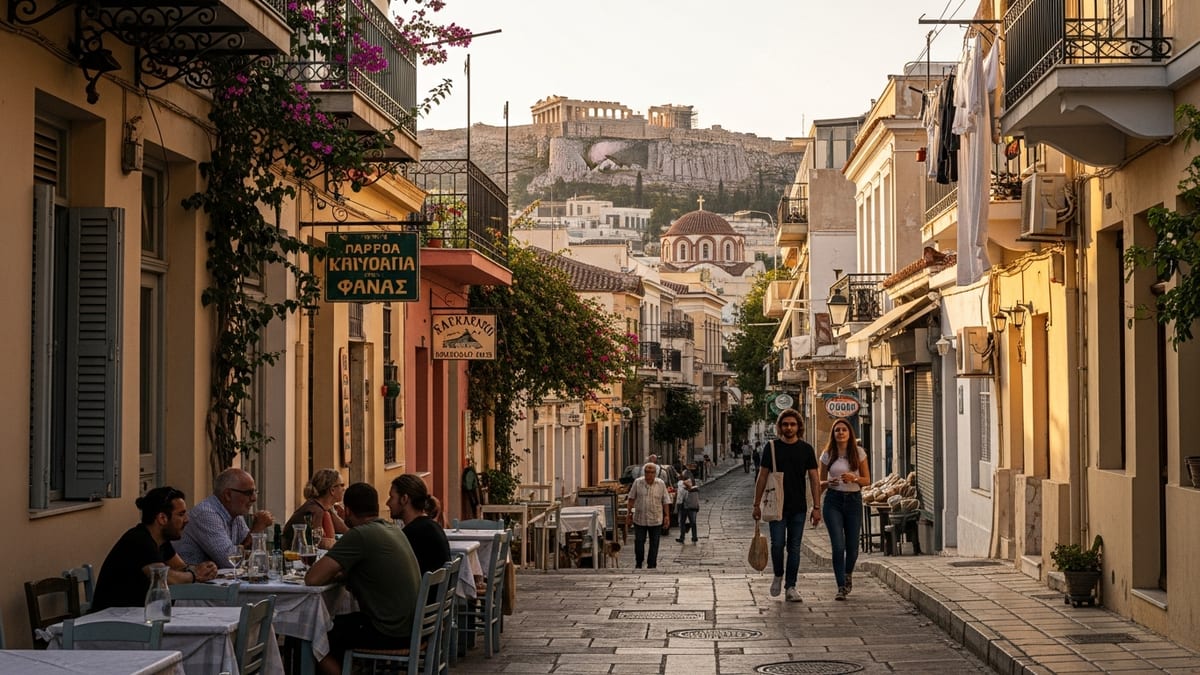
Athens is so closely associated with the Acropolis that many visitors forget the city is far more than its famous hilltop. Beyond the marbled slopes and postcard views lies a modern capital of nearly four million people, layered with street markets, contemporary culture, inventive food and a coastline that feels a world away from the busy center. Spend a few days here and you will find that the real magic of Athens unfolds in its neighborhoods, on its hills at sunset and around long, leisurely meals that stretch late into the night.
Get Lost in the Neighborhoods: Plaka, Psiri and Beyond
Once you have admired the Parthenon from afar, the most rewarding way to understand Athens is to walk through its old and new districts. At the foot of the Acropolis, Plaka is the city’s historic heart, with neoclassical mansions, flower-filled balconies and narrow lanes that still follow ancient street patterns. This is where you feel the oldest layers of Athens, from tiny Byzantine chapels to family-run tavernas that have served the same dishes for generations. Aimlessly turning corners here is half the pleasure, particularly early in the morning or late in the evening, when tour groups fade and shutters begin to rattle open or closed.
Northwest of Plaka, Psiri has transformed over the past two decades into one of Athens’ liveliest night-time hubs. Once a neighborhood of workshops and small factories, it is now dense with bars, mezedopolia serving shared plates and cafes spilling tables across small squares. Psiri is where you are most likely to find live rebetiko music in a tucked-away space reached via a graffiti-covered alley. The atmosphere is at its best from late evening into the early hours, when locals crowd pavements, street artists work new murals and the lines between bar, gallery and performance space often blur.
For a more lived-in, everyday feel, wander a little further to Exarchia or Koukaki. Exarchia, north of Omonia Square, has long been known as Athens’ anarchist and student quarter, with bookshops, political murals and inexpensive cafes that stay open late. Despite its reputation for protests, on most days it feels like a sociable, bohemian village where people linger over strong coffee and backgammon. Koukaki, just south of the Acropolis Museum, has quietly become one of the city’s most desirable addresses, full of small bakeries, creative bistros and tree-lined streets that make it ideal for an evening stroll followed by a glass of wine on a corner terrace.
Climb Athens’ Hills for Panoramic Sunsets
The Acropolis is not the only viewpoint in town. Athens is ringed by smaller hills that offer sweeping views over terracotta roofs and the Saronic Gulf, each with its own character. Mount Lycabettus, the highest point in central Athens, rises above the upscale district of Kolonaki to nearly 300 meters. You can reach the summit by funicular from Aristippou Street or by walking shaded paths through pine trees. At the top, a small whitewashed chapel crowns a rocky outcrop, and a circular terrace opens onto a 360-degree panorama over the city, sea and mountains. Time your visit for late afternoon: the heat has softened and the light over the city shifts from gold to pink to deep blue.
For a quieter and more local experience, head to Philopappos Hill, also known as the Hill of the Muses, opposite the Acropolis. A network of stone paths, many laid out by the architect Dimitris Pikionis in the 1950s, threads through eucalyptus and pine trees up to the Philopappos Monument. The climb is short but atmospheric, and at the summit you are rewarded with an iconic side-on view of the Parthenon, especially dramatic at sunset when the temple glows and the city lights begin to flicker below. This is a favorite gathering place for Athenians, who often bring snacks and bottles of wine to share as they watch night fall over their city.
Closer to the alternative neighborhoods of Exarchia and Neapoli, Strefi Hill offers another small, green escape. Once a limestone quarry, it was donated to the city in the 1960s and planted with trees, making it a local park threaded with paths and scattered with viewpoints. From its terraces you can look across to both Lycabettus and the Acropolis while avoiding the crowds. It is particularly pleasant in the early evening, when dog walkers, families and friends gather on benches and the sound of the city below softens into a distant hum.
Immerse Yourself in Athens’ Contemporary Culture
Athens is often treated as a museum of classical antiquity, but its contemporary art and cultural scene has grown rapidly in the past decade. One of the most significant new landmarks is the Stavros Niarchos Foundation Cultural Center in the coastal suburb of Kallithea. Designed by architect Renzo Piano and completed in the late 2010s, this vast complex houses the Greek National Opera and the National Library of Greece, surrounded by a landscaped park that rises gradually to a rooftop terrace with spectacular sea and city views. Families picnic on the lawns, joggers circle the canal and free or low-cost events, from concerts to film screenings, are held throughout the year, particularly in summer.
Closer to the center, the Museum of Cycladic Art and the Benaki Museum present high-quality collections that move beyond the standard Acropolis narrative. The Museum of Cycladic Art focuses on the minimalist marble figures and artifacts of the Cyclades islands, displayed in luminous galleries that feel surprisingly modern, despite the age of the objects. The Benaki Museum, in its neoclassical building on Vasilissis Sofias Avenue and its satellite locations, covers Greek culture from prehistory through the 20th century, including folk costumes, Byzantine icons and modern design. Together, they broaden the story of Greek art far beyond the familiar classical period.
For something more industrial and experimental, visit Technopolis in the Gazi district. Once the city’s gasworks, this complex of brick buildings and metal structures has been transformed into a cultural venue with exhibition spaces, performance halls and open-air courtyards. Since its official opening in 1999, it has hosted concerts, art fairs, design festivals and community events that reflect Athens’ creative energy. The surrounding neighborhood of Gazi has become synonymous with nightlife, with clubs and bars built into former warehouses and factory buildings, attracting a young crowd late into the night.
If your visit coincides with summer, look out for the Athens Epidaurus Festival, which runs from May to October. In Athens, many events take place at the Odeon of Herodes Atticus, a restored Roman amphitheater on the southern slope of the Acropolis. Attending a concert or play here under the night sky, with the lit Parthenon visible above, is one of the capital’s most memorable cultural experiences and feels far removed from a daytime museum visit.
Eat Like an Athenian: Markets, Meze and Modern Greek Cuisine
Food is central to daily life in Athens, and the best way to understand the city’s appetite is to start at Varvakios Agora, the central food market on Athinas Street. Established in the 19th century, the market sprawls across a large block, with separate sections for meat, fish, produce and dry goods. Mornings here are a sensory overload: fishmongers call out prices as they unload crates of sardines, octopus and red mullet, butchers work swiftly behind glass counters piled with lamb and goat, and stalls specialize in olives, spices, dried herbs and nuts. The market is generally open from early morning to mid-afternoon from Monday to Saturday, and it is busiest in the hours before noon.
Within and around the market are simple canteens and tavernas that serve traditional dishes to market workers, chefs and in-the-know visitors. One of the defining experiences is sitting at a narrow counter with a bowl of steaming soup or a plate of slow-cooked beans, eaten with thick slices of bread and a glass of wine. These are the unscripted lunches that reveal how Athenians really eat, far from the polished menus of tourist-oriented restaurants. Outside, narrow streets like Evripidou are lined with specialist shops selling cured meats, sausages, pastourma and sujuk, as well as delicatessens filled with regional cheeses, honeys and preserves.
Beyond the market, the city’s food scene reflects a confident, modern Greek cuisine. In districts like Syntagma, Kolonaki and Koukaki, you will find bistros that reinterpret classics such as moussaka, gemista (stuffed vegetables) and grilled seafood, often using ingredients sourced from small producers across the country. Wine bars focus on indigenous grape varieties like assyrtiko and xinomavro, while bakeries experiment with updated versions of traditional sweets, from baklava to galaktoboureko. Even street food has evolved beyond the ubiquitous gyros and souvlaki, with small shops specializing in Cretan pies, Thessaloniki-style koulouri and vegan interpretations of Greek comfort dishes.
To eat like a local, pay attention to timing. Athenians typically have a light breakfast, a mid-afternoon lunch and a late dinner, often after 9 p.m. Meze, small plates meant for sharing, are central to socializing; order several dishes for the table rather than individual mains, and linger over them while sipping ouzo or tsipouro. Do not rush: in Athens, the pace of a meal is as important as the dishes themselves.
Track Down Street Art and Alternative Spaces
Over the past 15 years, Athens has emerged as one of Europe’s most notable street art capitals, its walls transformed into a dynamic, open-air gallery. Neighborhoods such as Psiri, Metaxourgio and Exarchia are especially dense with murals and stencils, ranging from politically charged pieces responding to the financial crisis to large-scale works by internationally known artists. Wandering these streets, you quickly understand that graffiti here is not simply decoration, but often commentary on social, economic and cultural issues.
Metaxourgio, once a working-class area around a now-closed silk factory, has become a canvas for ambitious murals that cover the sides of apartment blocks and empty lots. The contrast between weathered neoclassical buildings and bold, contemporary artwork creates a powerful visual dialogue between past and present. Small galleries, artist studios and creative co-working spaces have opened in restored townhouses, and occasional open studios or neighborhood festivals give visitors the chance to step inside these spaces.
In Exarchia, street art takes a more explicitly political tone, reflecting the area’s long association with student movements and activism. Slogans, portraits and symbolic imagery cover building facades and staircases, while alternative bookstores, independent cinemas and music venues anchor a countercultural scene that is uniquely Athenian. It is best to visit during the day or early evening, when cafes are busy and the atmosphere is relaxed. Guided tours led by local artists and researchers can provide useful context to understand the stories behind particular works and how they relate to recent Greek history.
Athens’ creative energy is also evident in its repurposed industrial spaces. Former factories and warehouses in areas like Gazi, Rouf and Votanikos now host theaters, design shows, film screenings and underground music nights. Many events are promoted primarily through social media and word of mouth, so staying flexible and talking with locals can lead you to pop-up exhibitions, performances and parties that you will not find in traditional guidebooks.
Escape to the Sea: The Athenian Riviera and Island Day Trips
One of the great surprises for many first-time visitors is just how close Athens is to the sea. South of the city center, the tram and coastal roads trace what is often called the Athenian Riviera, a string of beaches, marinas and seaside promenades stretching from Palaio Faliro to Vouliagmeni and beyond. On a hot day, escaping the traffic and noise for the sound of waves is an essential Athenian ritual. Even a short tram ride from Syntagma delivers you to Flisvos Marina and nearby beaches, where you can swim, walk the promenade or sit in a cafe overlooking bobbing sailboats.
Further along the coast, Glyfada, Voula and Vouliagmeni offer more refined seaside experiences. Glyfada is full of boutiques, cafes and upmarket restaurants, making it a popular weekend destination for shopping and dining after a swim. Vouliagmeni, set in a sheltered bay, is famous for its organized beaches with loungers and beach bars, as well as the thermal Lake Vouliagmeni, whose mineral-rich waters stay warm year-round. Here, you can float beneath limestone cliffs and eucalyptus trees, a peaceful counterpoint to the dense streets of central Athens.
For those with a full day to spare, the Saronic Islands provide an easy island escape. Ferries and hydrofoils from Piraeus connect Athens to Aegina, Hydra and Poros in as little as 40 to 90 minutes, depending on the island and vessel. Aegina is known for pistachio orchards, seaside tavernas and the Temple of Aphaia; Hydra has car-free, stone-built lanes and a glamorous artistic history; Poros offers pine-covered hills and calm bays perfect for swimming. Returning to Athens in the evening, salty-haired and sun-tired, you will appreciate how the city functions as both a cultural capital and a gateway to the Aegean.
Experience Athens After Dark
Nightfall is when Athens truly comes into its own. As the sun sets, rooftop bars across the center open their doors, each vying for the best Acropolis view. From terrace lounges near Monastiraki and Syntagma to more low-key spots in Koukaki, these venues frame the Parthenon as it lights up against the sky, while DJs spin relaxed sets and bartenders mix cocktails using Greek spirits and ingredients. Reservations are a good idea for weekend nights, although many places will accommodate walk-ins at off-peak times.
Down at street level, the city’s cafe culture shifts effortlessly into a bar scene. In areas such as Kolonaki, young professionals fill sleek wine bars and cocktail spots, while in Psiri and Gazi, the atmosphere is more improvisational, with sidewalk tables, live bands and impromptu dancing. Athens has a long tradition of live music, from small venues devoted to rebetiko and laiko to larger clubs hosting local and international acts. Listening to a bouzouki player in a dimly lit bar or discovering a jazz quartet in a former warehouse is part of what makes nights here feel spontaneous and alive.
The city also has a rich tradition of open-air cinemas that operate from late spring to early autumn. These theaters, often set on rooftops or courtyards scented with jasmine and night-blooming flowers, screen recent releases and classic films under the stars. Some, like those near Thissio or Zappeion, offer postcard-worthy backdrops of illuminated monuments beyond the screen. Arrive early to secure a good seat, order a cold beer or lemonade and experience a form of summer entertainment that Athenians cherish.
The Takeaway
To experience Athens beyond the Acropolis is to recognize it as a living, evolving city rather than a backdrop for ancient ruins. Its neighborhoods reveal distinct personalities, from the refined streets of Kolonaki to the anarchic murals of Exarchia. Its hills and coastal promenades provide space and perspective, allowing you to see how the city fits into its natural setting between mountains and sea. Contemporary cultural venues sit comfortably alongside historic churches and neoclassical mansions, reflecting a society that continues to reinterpret its long history.
What sets Athens apart is the way everyday life spills into public space. Markets, pavements, squares and seaside promenades are all stages on which Athenians talk, argue, flirt, celebrate and mourn. Travelers who slow down, linger at cafe tables, explore side streets and accept spontaneous invitations will find that the city opens itself generously. The Acropolis will always be there, presiding over it all, but the true heart of Athens beats strongly in the stories, flavors and encounters that unfold far below its timeless columns.
FAQ
Q1: How many days should I spend in Athens if I want to explore beyond the Acropolis?
Most travelers find that three full days in Athens allows enough time for the Acropolis plus several neighborhoods, a hilltop sunset, the central market and a night out. If you want to include a day trip to the coast or a nearby island, aim for four to five days.
Q2: Is it easy to get around Athens without a car?
Yes. The metro, tram and buses cover most areas visitors want to see, and taxis are plentiful and relatively affordable compared with many European capitals. Many central sights and neighborhoods are walkable, so comfortable shoes are more important than car keys.
Q3: What is the best time of year to visit Athens for outdoor activities and less crowding at major sights?
Late spring, from April to early June, and autumn, from late September to early November, are ideal. Temperatures are comfortable, the sea is often warm enough for swimming and popular sites are less crowded than in July and August, when heat and visitor numbers peak.
Q4: Is Varvakios Agora, the central market, suitable for children and sensitive travelers?
The market is completely safe but can be overwhelming because of strong smells, raw meat and fish displays and the general noise and bustle. Children who are curious about food usually enjoy it, but those sensitive to sensory overload might prefer a shorter visit or focusing on produce and dried goods rather than the meat and fish halls.
Q5: Are Athens’ alternative neighborhoods like Exarchia safe to visit?
Exarchia and similar areas are generally safe during the day and early evening, when residents, students and families fill cafes and streets. Demonstrations and police activity sometimes occur around central squares; if you encounter a large protest, it is wise to observe from a distance or choose another route. As in any big city, keep an eye on belongings and avoid poorly lit back streets late at night.
Q6: How expensive is eating out in Athens compared with other European capitals?
Athens can be very good value, especially if you eat where locals do. Simple tavernas, market canteens and neighborhood souvlaki shops offer filling meals at modest prices, while modern bistros and fine-dining restaurants are still often cheaper than equivalents in northern Europe. Ordering shared plates for the table is both economical and culturally appropriate.
Q7: Can I visit the Stavros Niarchos Foundation Cultural Center without a ticket to a performance?
Yes. The park, canal, outdoor spaces and many indoor areas are open to the public, and you can walk the gently sloping paths up to the rooftop terrace for free. Some exhibitions or special events require tickets, and performances by the Greek National Opera are ticketed, but the complex itself is designed as an accessible public space.
Q8: What should I wear when visiting churches and monasteries in Athens?
While Athens is a modern city with relaxed fashion, Orthodox churches expect visitors to dress respectfully. Shoulders should be covered, shorts and skirts should reach at least to the knee and hats should be removed inside. Bringing a light scarf is useful, especially in summer, if you plan to step into multiple churches during a day of sightseeing.
Q9: Is it realistic to visit a nearby island as a day trip from Athens?
Yes. Islands such as Aegina, Hydra and Poros are reachable from Piraeus in roughly 40 to 90 minutes by ferry or hydrofoil, making them popular day trips. An early departure and evening return allow time for a swim, a leisurely lunch and a stroll, while still sleeping in your Athens hotel.
Q10: Do I need to speak Greek to enjoy neighborhoods beyond the main tourist areas?
No. English is widely spoken in Athens, especially among younger people and those working in hospitality, shops and transport. Learning a few basic Greek phrases, such as greetings and thanks, is appreciated and can deepen interactions, but you will be able to navigate menus, tickets and daily tasks comfortably in English.