

Few cities pack as much energy into a compact footprint as Hong Kong. Here, glass towers rise beside jungle-green hills, incense curls through side-street temples and night markets glow under strings of bare bulbs. Whether you come for the skyline, the hiking or the markets, Hong Kong rewards visitors who look beyond the surface to explore its harbourfronts, ridgelines and crowded lanes at street level.
Reading the Skyline: Victoria Harbour at Every Hour
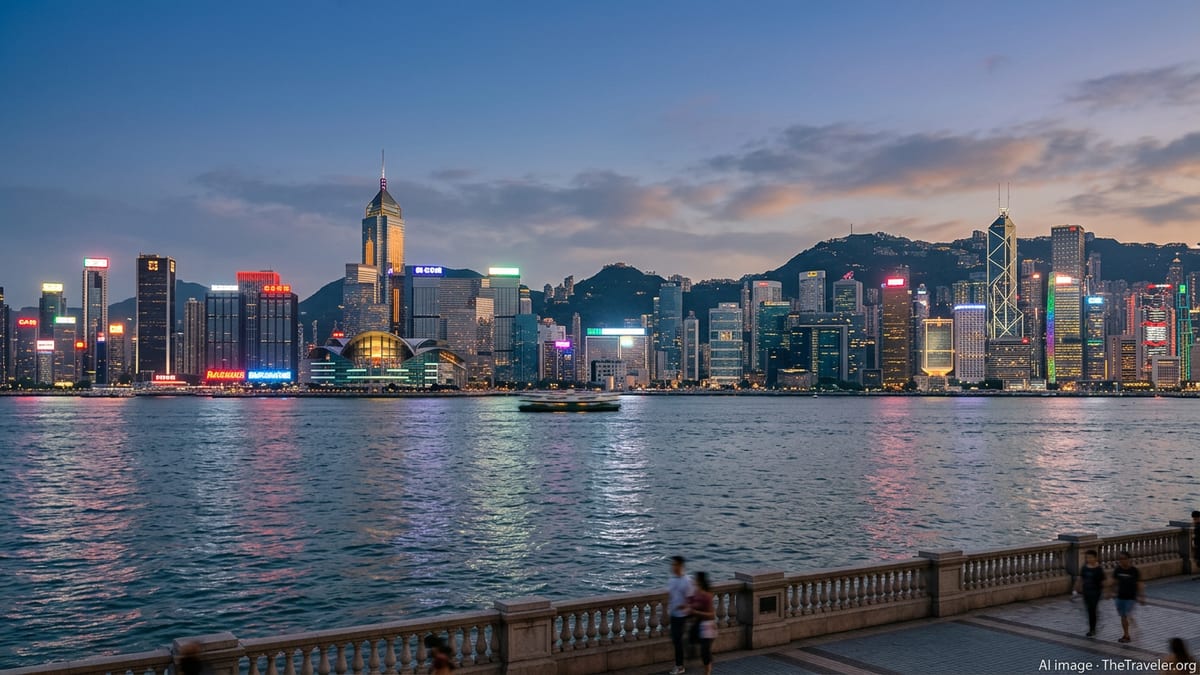
Hong Kong’s skyline is its calling card, a jagged curtain of towers wrapped around Victoria Harbour. One of the most memorable ways to experience it is simply to move with the city’s rhythm: watch container ships slide past, Star Ferry boats trace lazy arcs and office lights wink on as the sun drops behind distant hills. Late afternoon into early evening is especially atmospheric, when the glass facades shift from gold to deep blue and the first neon flickers to life.
On the Kowloon side, the Tsim Sha Tsui waterfront promenade offers a broad, level walkway with unobstructed views across the water. Benches, open spaces and intermittent street performers make it as popular with local families as with visitors. You can pick out major landmarks on Hong Kong Island, from the sharp angles of the Bank of China Tower to the tapered spire of Two International Finance Centre, and watch the reflections ripple in the harbour below.
Out on the water, the Star Ferry still offers perhaps the most evocative way to read the skyline. The short crossing between Tsim Sha Tsui and Central or Wan Chai takes only minutes, but the perspective of double-decked green-and-white boats threading between modern piers and historic clock towers is pure Hong Kong. Evening departures feel particularly romantic as the buildings switch to their night-time glow and the city’s famous night-time harbour light displays shimmer across the water.
Nightfall adds another layer, as towers light up in shifting colours and animated patterns. On clear evenings, the skyline becomes a vast light sculpture stretching from the Central business district through Wan Chai to North Point. Even in hazier or overcast weather, the glow from thousands of windows and neon signs paints the low clouds in soft pinks and oranges, giving the harbour a moody, cinematic quality that feels quintessentially urban Hong Kong.
The Peak and Beyond: Iconic Views from Above
Victoria Peak remains the city’s classic viewpoint, and for good reason. From this high point above the Central district, Hong Kong Island’s skyscrapers tumble steeply down to the harbour while Kowloon’s dense grid extends into the distance. On clear days you can see far beyond the urban core, with Lantau Island’s mountains and scattered outlying islands punctuating the South China Sea.
Many visitors ride the historic Peak Tram, which hauls its way up the hillside at gravity-defying angles. Inside the glass-sided carriages, the city seems to tilt backwards as you climb between apartment blocks and banyan trees. At the top, purpose-built viewing terraces provide sweeping photo opportunities, but it is worth wandering a few minutes away from the main complex for quieter vantage points with equally impressive views.
For a more tranquil experience, the circular Lugard Road and Harlech Road walking paths trace the contours of the hillside through dense subtropical vegetation. Here, birdsong and the rustle of leaves replace traffic noise, and you get changing glimpses of the skyline through gaps in the foliage. The path is mostly level, making it accessible for casual walkers, yet the sense of being in the forest above one of the world’s great financial centres is striking.
Timing matters on the Peak. Late afternoon offers softer light and cooler air, with the reward of watching the city shift from daylight to after-dark luminosity. On particularly humid or foggy days, low clouds can swallow the skyline, creating an otherworldly scene of towers piercing the mist. Even when visibility is not postcard perfect, the experience of standing above such an intense urban landscape remains unforgettable.
Urban Hikes: Dragon’s Back and the Hong Kong Trail
One of Hong Kong’s greatest surprises is how quickly its vertical cityscape gives way to green hills and coastal cliffs. The Dragon’s Back trail on the southeast of Hong Kong Island has become a favourite for visitors, consistently praised for its mix of accessibility and drama. A short ride from the city brings you to the trailhead, and within minutes you are walking along a rolling ridge with the South China Sea spread out below.
From the high points on Dragon’s Back, you can look back towards the skyscrapers of Quarry Bay and Taikoo Shing, then pivot to face Shek O’s beaches, rocky headlands and small islands. On clear days the water glitters in multiple shades of blue and green, while paragliders often circle lazily overhead. The up and down sections give your legs a workout, but most reasonably fit walkers can complete the route in a few hours with time for photo stops.
Beyond this famous ridge, the longer Hong Kong Trail links many of the island’s green spaces, running from Victoria Peak all the way to Big Wave Bay. The full length is typically tackled in sections rather than in a single push, with some stretches winding through forested gullies and others skirting quiet reservoirs. It is common to step off a bus or tram, walk a wooded segment of the trail and finish on a beach, compressing mountain and sea into a single day.
Weather is an important consideration for any Hong Kong hike. The cooler months from roughly November to March are usually the most comfortable for longer walks, with less humidity and clearer skies. In the subtropical summers, early morning starts help you avoid the worst heat and sudden downpours. Whatever the season, pack water, sun protection and footwear with decent grip, since sections of stone steps can become slick after rain.
Lantau Island: Peaks, Temples and Coastal Calm
To understand Hong Kong’s breadth, it helps to get out of the core urban districts and spend time on Lantau Island. Larger in area than Hong Kong Island but far less densely developed, Lantau offers rugged peaks, quiet villages and a slower pace. At its centre rises Lantau Peak, one of the territory’s highest summits, which rewards early risers with sunrise scenes that rank among the region’s most memorable.
Many hikers begin near the Ngong Ping plateau, home to the Big Buddha statue and Po Lin Monastery. The area draws both pilgrims and sightseers, with incense drifting from temple courtyards and vegetarian canteens serving simple meals to day-trippers. A cable car connects the plateau to the Tung Chung area, passing over tidal flats, forested hills and faintly visible airport runways, illustrating how wild and developed Hong Kong can be within a single line of sight.
Those keen to stretch their legs further can tackle sections of the Lantau Trail, a loop that traverses open ridges, stone staircases and pine-covered hillsides. The route includes sustained climbs, but the rewards are panoramic views out over the South China Sea, with cargo ships tracing lines far below and island silhouettes fading into the haze. On breezier days, the air feels noticeably fresher than in the city, and the only sounds may be wind, insects and distant waves.
Lantau is not only about mountains. Its southern coast features long, relatively uncrowded beaches where you can watch surfers, paddle in shallow water or linger over seafood at low-key restaurants. Small villages and stilt-house communities around places such as Tai O show another side of Hong Kong life, where tidal rhythms and fishing traditions still shape the day. Taken together, these experiences reveal the territory’s quieter, more contemplative personality.
Markets of Kowloon: Night Stalls, Fortune Tellers and Street Food
No exploration of Hong Kong feels complete without time in its markets, and many of the most atmospheric cluster in Kowloon. Temple Street Night Market, in Yau Ma Tei and Jordan, is perhaps the best known. As dusk falls, metal frames and tarpaulins transform the street into a corridor of stalls selling everything from T-shirts and gadgets to tea sets and souvenirs. Neon signs and the smell of stir-frying garlic hang in the warm air, while fortune tellers set up small tables under bare bulbs.
A short ride away, the stretch of Tung Choi Street known as Ladies’ Market in Mong Kok squeezes hundreds of stalls into a few busy blocks. Here, bargaining is part theatre, part transaction. The goods are rarely unique, but the spectacle of hawkers calling out prices and shoppers weaving between racks of clothing, accessories and novelty items offers a lively snapshot of Hong Kong’s informal economy. Parallel streets may host goldfish sellers, flower vendors or traditional herbal shops, each with its own rhythms.
Street food is integral to the market experience. Around these districts you can graze your way through skewers, fish balls in curry sauce, egg waffles, milk tea and other Hong Kong specialities sold from tiny shops and walk-up windows. Some stalls operate on little more than a metal cart and a charcoal brazier, yet they attract loyal queues of locals who swear by a particular vendor’s recipe. Eating this way is not about fine dining; it is about standing at a crowded corner with a plastic cup or paper tray and tasting the city’s everyday flavours.
Visitors should keep a few practical tips in mind. Markets tend to get busiest in the evening, particularly on weekends and public holidays, and the crush can be intense. Carry small change or stored-value cards, watch your belongings in crowds and be prepared for some vendors to prefer cash over digital payments. Prices are often negotiable on non-food items, but basic courtesy goes a long way: a smile, a greeting and a willingness to walk away politely if you and a seller cannot agree.
Neighbourhood Energy: From Central’s Towers to Sham Shui Po’s Workshops
Between the peaks and the markets, Hong Kong’s neighbourhoods each offer their own take on the city’s blend of old and new. On Hong Kong Island, the Central and Sheung Wan districts mix corporate towers with colonial-era buildings, cocktail bars and historic temples. Escalators and steep staircases knit these layers together, carrying office workers, shoppers and residents past street art, bamboo scaffolding and corner shrines scented with incense coils.
Across the harbour, Mong Kok lives up to its reputation for density, with sidewalks that can feel like moving rivers of people. Here, commercial blocks sit above wet markets and traditional medicine shops, and overhead signs still crowd the streetscape in some pockets. The energy can be overwhelming, but even a short wander reveals how Hong Kong’s reputation as a city that never quite slows down was earned.
For a different side of urban life, the older industrial and working-class districts of Sham Shui Po and neighbouring Cheung Sha Wan showcase hardware alleys, fabric streets and repair workshops that have served the city for decades. Small eateries and cha chaan teng diners squeeze into narrow shopfronts, dishing up noodles, milk tea and classic Hong Kong comfort food to construction workers and students alike. In recent years, creative spaces and independent studios have begun to occupy some of the old factory buildings, adding another layer to the area’s character.
Exploring these neighbourhoods on foot or via the historic double-decker trams allows you to notice details often missed from taxis or the metro. Weathered shop signs, fruit stalls arranged by colour, rooftop gardens sprouting above busy junctions and quiet alleys lined with potted plants all contribute to the sense that Hong Kong is both relentlessly modern and deeply rooted. Taking time to pause at a streetside bench, sip a drink and simply watch people go about their routines can be as revealing as any formal attraction.
Seasonal Highlights and Practical Tips
Hong Kong can be visited year-round, but the experience changes with the seasons. Cooler months from roughly late autumn into early spring are often considered ideal for those prioritising outdoor activities, as humidity drops and skies are more likely to be clear. These are prime times for tackling landmark hikes such as Dragon’s Back or Lantau Peak and for lingering comfortably along the harbourfront after dusk.
Festive periods bring extra colour and crowds. Around Lunar New Year, markets swell with flower stalls and holiday decorations, while temples and public squares host cultural performances. Autumn’s Mid-Autumn Festival sees lantern displays and mooncake stalls appear across the city. These celebrations can be rewarding to witness, but accommodation and popular attractions may be busier and more expensive, so planning ahead is wise.
Getting around is straightforward thanks to an efficient public transport network that includes the MTR metro system, buses, trams and ferries. Stored-value cards help simplify transfers between different modes and are widely accepted at convenience stores and some smaller businesses. Taxis are plentiful in most urban areas, though traffic can be heavy at peak times and in popular nightlife districts.
Health and comfort are worth prioritising in Hong Kong’s subtropical climate. In warmer months, heat and humidity can be intense, particularly in built-up districts and on exposed trails. Light clothing, regular water breaks and strategic indoor pauses in air-conditioned malls or cafes help keep days pleasant. It is also sensible to monitor local weather forecasts, as heavy rain and thunderstorms can appear quickly and affect outdoor plans, particularly in the wet season.
The Takeaway
Hong Kong’s appeal lies in the way contrasting elements sit side by side. Within a single day you can breakfast in a crowded diner, ride a tram past canyons of glass, look down on that same skyline from a forested ridge and bargain for trinkets in a neon-lit street market. The city’s famed harbour views and vertical architecture form the backdrop, but its personality lives just as strongly on its hiking trails, in its food stalls and along its crowded pavements.
For first-time visitors, focusing on the trio of experiences that Hong Kong does best is a rewarding approach: see the skyline from multiple angles, walk at least one of the accessible coastal or ridge trails, and spend an unhurried evening wandering a traditional market district. Build in time to explore a few neighbourhoods away from the most obvious sights, and you will leave with a more layered sense of how this tightly packed territory breathes, works and plays.
FAQ
Q1. When is the best time of year to visit Hong Kong for skyline views and hiking?
The most comfortable months are generally from around November to March, when humidity is lower, temperatures are milder and visibility is often better for harbour vistas and ridge-top walks.
Q2. Is Victoria Peak worth visiting if the weather is cloudy or hazy?
Even in hazy or cloudy conditions, Victoria Peak can be rewarding. Low clouds and mist can create dramatic, atmospheric views, though very dense fog may obscure the skyline almost entirely.
Q3. How difficult is the Dragon’s Back hike for someone with average fitness?
Dragon’s Back is considered moderately challenging. There are some up and down sections and stone steps, but most people with average fitness and proper footwear can complete it in a few hours at a relaxed pace.
Q4. Are Hong Kong’s night markets safe to visit after dark?
Hong Kong’s major night markets are typically busy and feel lively rather than threatening, though visitors should take standard precautions such as watching valuables, staying aware of surroundings and avoiding overly aggressive touts.
Q5. Can I pay by card at street markets and small food stalls?
Many larger shops and some stalls accept cards or digital payments, but a number of smaller vendors still prefer cash. Carrying some local currency makes buying snacks and souvenirs much easier.
Q6. How much time should I allow to explore Temple Street Night Market and nearby areas?
Plan on at least two to three hours to wander the stalls, sample street food and soak up the atmosphere, with extra time if you also explore nearby side streets or sit down for a full meal.
Q7. Is it realistic to combine a hike and a market visit in the same day?
Yes, many visitors hike in the morning or early afternoon and then head to markets in the evening. The key is to pace yourself, stay hydrated and allow for rest between activities.
Q8. Do I need a guide for hikes like Victoria Peak or Dragon’s Back?
Most popular routes are well signposted and can be done independently by reasonably prepared walkers. A guide can still be useful if you prefer added context, navigation support or are new to hiking.
Q9. What should I wear for visiting markets and temples in Hong Kong?
Light, breathable clothing and comfortable walking shoes are recommended. For temples, modest dress that covers shoulders and knees is appreciated, especially if you plan to enter prayer halls.
Q10. How many days do I need to experience Hong Kong’s skyline, hikes and markets?
A stay of three to five days usually allows time to see key harbour viewpoints, complete at least one signature hike and spend relaxed evenings in different market districts.