

India’s Taj Mahal may be the country’s most recognisable landmark, but it is only one chapter in an endlessly varied story. From sacred riverfronts and desert forts to tropical backwaters and snowbound passes, India rewards travellers who look beyond the postcard icon. As tourism infrastructure improves and e-visa rules are gradually liberalised, it has never been easier to explore deeper and stay longer. This guide highlights some of the most memorable things to do in India beyond the Taj Mahal, focusing on experiences that connect you to the country’s living cultures, landscapes and everyday rhythms.
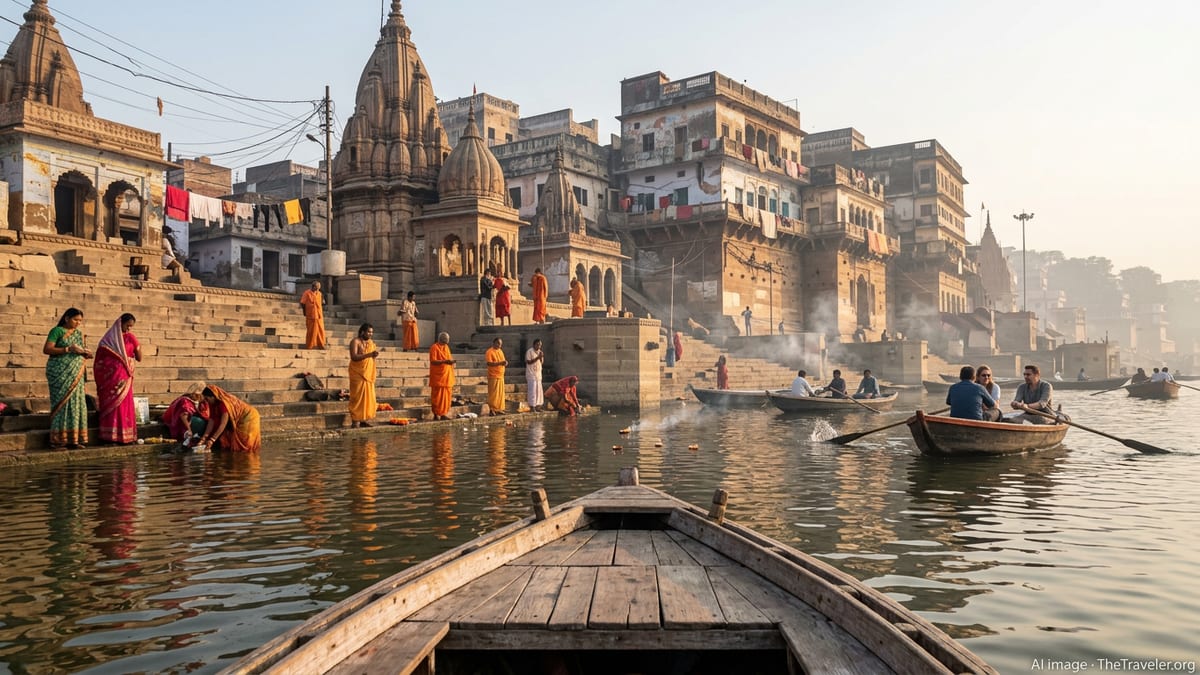
Lose Yourself In The Spirit Of Varanasi
Few places capture the spiritual intensity of India like Varanasi, the ancient city that rises in tiers above the Ganges River. Predawn, long before the sun appears, priests, pilgrims and wrestlers in riverside akharas begin their daily rituals on the ghats, or bathing steps. As the sky lightens, the river fills with rowboats and silhouettes of bathers wading into the water, while the city’s labyrinth of alleys slowly wakes up to the clatter of tea glasses and temple bells. Experiencing this transition from darkness to first light on a boat ride is one of the most powerful introductions to India you can have.
Later in the day, the city’s sacred core reveals itself in small details: a lone musician rehearsing a raga in a riverside palace, a funeral procession slipping quietly through the crowd with marigold-covered pyres, or a sudden vista of the river framed by crumbling Mughal balconies. The famous evening aarti ceremony, performed simultaneously at several ghats with lamps, conch shells and drums, is no longer a secret, and crowds can be intense. Even so, watching flickering flames reflected in the dark river while mantras echo across the water remains an indelible experience, especially if you view it from a modest rowboat rather than the packed main platforms.
Allow time away from the ghats to wander the old town’s alleyways, where incense, street food and silk shops compete for your attention. You can step into quiet courtyard shrines, visit music houses that have trained generations of classical artists, or simply sit with a chai vendor and watch the city’s steady flow of life. For many visitors, Varanasi becomes less about ticking off sights and more about surrendering to a place where life, death and devotion coexist in the open.
Drift Through Kerala’s Backwaters And Hill Country
On India’s southwest coast, the state of Kerala offers a gentler pace that contrasts sharply with the buzz of the big northern cities. The backwaters, a lacework of canals, rivers and lagoons running parallel to the Arabian Sea, are one of the country’s great slow-travel experiences. Traditional kettuvallam rice barges have been converted into houseboats with wide decks and simple cabins, allowing you to glide past coconut groves, village churches and paddy fields at walking speed. Life plays out at the water’s edge, from schoolchildren ferrying across channels to fish vendors poling their way between hamlets.
For a more intimate look at backwater life, consider basing yourself in a homestay on one of the smaller canals and exploring by canoe or on foot. This allows you to see coir rope-making, toddy tapping and village markets up close, and it keeps more of your tourism spend within local communities. In the evenings, the air is soft and humid, with the sounds of temple music and distant boat engines carrying across still water. It is a setting that invites long conversations, slow reading and a rare sense of unhurried time.
Kerala’s appeal extends inland to the Western Ghats, where tea and spice plantations drape the hillsides. In the misty resort towns of Munnar or Wayanad, trails wind through cardamom forests and eucalyptus groves, with viewpoints that open onto rolling carpets of tea. Wildlife sanctuaries in Periyar and nearby reserves offer chances, though never guarantees, of seeing elephants, bison and a wealth of birdlife on guided walks and boat safaris. Combining a few days on the backwaters with time in the hills gives you a rounded portrait of southern India’s landscapes and flavours.
Explore Rajasthan’s Forts, Desert Towns And Leopard Country
While many travellers know Rajasthan for the honey-coloured ramparts of Jaipur and the blue lanes of Jodhpur, the state’s less crowded corners can be even more rewarding. In cities such as Udaipur, with its lakeside palaces and havelis reflected on the water, you can trace layers of Rajput history while still finding quiet rooftop terraces to watch the evening light soften the surrounding Aravalli hills. Smaller towns like Bundi or Alsisar add a sense of discovery with faded stepwells, intricately painted mansions and markets where few foreign visitors appear.
Rajasthan’s desert edge offers another dimension. Near Jaisalmer and Bikaner, dunes spill toward the horizon, and camel safaris or jeep excursions at dusk reveal vast skies painted in orange and violet. Overnight stays in well-run desert camps can be surprisingly comfortable, with clear views of the Milky Way on cloudless nights. Beyond the classic desert image, new wildlife experiences have emerged in the rocky outcrops around Jawai and at sanctuaries near Udaipur, where leopards have adapted to living alongside pastoral communities. Spotting one of these elusive cats at dawn on a hillside of ancient granite boulders is an unforgettable moment for wildlife enthusiasts.
Equally compelling are the region’s living traditions. Time your visit to coincide with a rural fair or festival, and you may witness nomadic herders trading livestock, folk musicians playing desert ballads, and vibrant processions carrying deities through the streets. These events remind you that Rajasthan’s forts and palaces are not simply relics for photographs, but backdrops to cultures that continue to evolve.
Seek Wildlife Encounters In India’s National Parks
India’s national parks and tiger reserves offer some of the subcontinent’s most thrilling experiences outside the cities. While tigers are the main attraction in well-known parks such as Ranthambore in Rajasthan, Bandhavgarh and Kanha in Madhya Pradesh, or Jim Corbett in Uttarakhand, the real magic lies in seeing the forest itself come alive at first light. Early-morning safaris in open vehicles can bring you close to spotted deer grazing in shafts of sunlight, langur monkeys silhouetted in the treetops, and peacocks displaying their iridescent tails along dusty tracks.
Tiger sightings are never guaranteed and vary widely by season and park, so it is helpful to think of a safari as an immersion in a complex ecosystem rather than a single-species quest. Guides often point out alarm calls, pugmarks and scratch marks on trees, gradually teaching you how to read the forest’s signs. Increasingly, visitors are also seeking out lesser-known reserves, from the swampy grasslands of Kaziranga in Assam, known for its population of one-horned rhinoceroses, to coastal and mangrove habitats in Gujarat and the east coast that shelter migratory birds.
Responsible tourism is crucial in these fragile environments. Choosing lodges that limit their vehicle numbers, employ local naturalists and invest in conservation projects can make your experience richer while supporting long-term protection efforts. When you leave with memories of a tiger melting back into tall grass or an elephant herd crossing a forest track in silence, you better understand why these wild spaces matter so much to India’s future.
Climb Into The High Himalayas Of Ladakh And Himachal
In northern India, the Himalayas form a vast playground for trekkers, road-trippers and travellers seeking cool air and big horizons. Ladakh, reached by high passes or via flights to Leh, feels distinct from the rest of India, with a culture shaped by Tibetan Buddhism and a landscape of wind-sculpted mountains and turquoise rivers. Monasteries cling to ridgelines above the Indus Valley, and prayer flags ripple across passes that rise well above 4,000 metres. Even if you never lace up trekking boots, simply driving through this terrain, stopping at small villages for butter tea and momos, is a profound experience of scale and isolation.
In neighbouring Himachal Pradesh and Uttarakhand, the mountains are greener, with pine forests, orchards and meadows alternating with snow peaks on the horizon. Hill towns that were once colonial-era retreats now act as gateways to quieter valleys and trailheads. You can spend days hiking between villages, staying in family-run guesthouses and watching daily life unfold around terraced fields and village temples. At night, the air cools sharply, stars appear in abundance and the constant hum of the plains feels very far away.
Travel in the Himalayas requires more flexibility than in urban India. Roads can be affected by landslides or snowfall, and altitude needs to be taken seriously, particularly in Ladakh and on higher treks. In recent years, local communities and authorities have paid more attention to balancing visitor numbers with fragile mountain ecosystems, encouraging longer stays over short, high-impact visits. For travellers willing to slow down, this means more opportunities to build real connections and to experience high-altitude environments with the respect they demand.
Immerse Yourself In India’s Festival Calendar
One of the most memorable ways to move beyond India’s headline monuments is to plan your trip around a festival. The country’s religious and cultural calendar is dense, and nearly every month brings major celebrations somewhere. Diwali, typically in October or November, transforms cities and villages with oil lamps, electric lights and fireworks as families celebrate the victory of light over darkness. Holi, usually in March, sees people mark the arrival of spring with clouds of coloured powder, music and dance, most exuberantly in parts of Uttar Pradesh and Rajasthan.
Apart from these widely known events, there are countless regional festivals that offer insight into local identities. In Kerala, processions featuring caparisoned elephants and percussion ensembles animate temple towns during the festival season. In the northeast, harvest festivals blend indigenous traditions with modern music and food fairs, drawing both locals and visitors. In desert states, annual fairs combine livestock markets with folk performances and carnival rides, turning otherwise sleepy towns into makeshift cultural stages.
Attending festivals requires a bit of planning and sensitivity. Accommodation can book out far in advance, and crowds may be overwhelming if you are not used to moving in tightly packed spaces. Dressing modestly, accepting that you will be photographed as often as you take photographs, and following the guidance of local hosts help ensure that your presence is respectful. In return, you gain a vivid sense of how diverse India’s spiritual and cultural life is from one region to the next.
Sample India’s Regional Flavours From Street Stalls To Spice Markets
Food is one of the most accessible ways to experience India beyond its famous landmarks. Rather than looking for “generic Indian” dishes, focus on what each region does best. In the north, smoky tandoor-baked breads and richly spiced curries dominate, while in coastal states you might find delicate fish stews cooked with coconut milk and tamarind. In Gujarat and parts of Maharashtra, thali meals arrive as an ever-refilled array of vegetarian dishes, while in the east rice and river fish anchor everyday plates.
Street food, when chosen with care, can be a highlight of any trip. In cities like Mumbai, Kolkata or Delhi, vendors at long-standing stalls prepare favourites such as chaat, dosas and kathi rolls for a devoted local clientele. Joining the queue at busy places with high turnover is usually a good sign that hygiene is taken seriously. Morning visits to fresh markets and spice bazaars are equally rewarding, allowing you to see how ingredients move from farm to kitchen, and to understand the central role of spices in flavouring rather than overwhelming dishes.
More travellers are also seeking out cooking classes, market walks and meals in private homes, where hosts explain family recipes and regional variations. These experiences often go beyond the plate, opening conversations about migration, climate, agriculture and daily life. If you return home from India with a new comfort level around fresh coriander, cumin and chilli, as well as a handful of well-tested recipes, you carry a sensory memory of the country that lasts long after your photographs fade.
The Takeaway
India’s Taj Mahal earns its fame, but it is only a starting point for understanding the country. By drifting along Kerala’s canals, watching dawn rise over the ghats of Varanasi, tracking wildlife in sal forests or sharing festival sweets in a village courtyard, you encounter a richer, more layered India than any single monument can offer. The country’s tourism landscape is evolving, with a wider range of homestays, eco-lodges and community-led experiences in both classic and emerging destinations.
For travellers willing to move at a thoughtful pace, to balance iconic sights with everyday encounters and to embrace a certain amount of unpredictability, India offers an unmatched variety of things to see and do. The key is to travel with curiosity rather than a rigid checklist, allowing room for conversations, small detours and unplanned pauses. Do that, and you will discover that the country’s most memorable moments often unfold far from its most photographed landmark.
FAQ
Q1. Is it safe to travel in India beyond the main tourist sites?
Safety conditions vary by region, but most of India’s established travel circuits are generally safe when you take normal precautions. Larger cities require the same street smarts you would use anywhere, and late-night solo walks in quiet areas are best avoided. In remote regions, travelling with reputable guides and using registered taxis or car services further reduces risk.
Q2. When is the best time of year to visit India for these experiences?
The most comfortable months for much of India are typically from November to March, when temperatures are lower and humidity drops. Hill stations and the Himalayas have shorter seasons, often from late May to October, depending on altitude and snowfall. Monsoon months bring lush landscapes and lower prices but can disrupt transport, especially in coastal and mountain areas.
Q3. How many weeks do I need to see more than just the Taj Mahal?
If you want to move beyond a quick Golden Triangle circuit, plan at least two to three weeks. That allows time for one or two regions in depth, such as Rajasthan and Varanasi, or Kerala and the Western Ghats. With four weeks or more, you can comfortably add the Himalayas or a wildlife-focused segment without rushing.
Q4. Do I need to book trains and domestic flights far in advance?
Popular train routes and budget flights between major cities can sell out early in peak season, so advance booking is advisable once your dates are firm. Flexible travellers can sometimes secure last-minute seats, but relying on that approach can limit your options. For remote areas with limited connections, planning ahead becomes even more important.
Q5. What should I know about India’s e-visa and arrival procedures?
India has been expanding its e-visa programme and gradually digitising arrival formalities, which has simplified entry for many nationalities. However, rules can change with little notice, and requirements may differ depending on passport and length of stay. Always check the latest guidance from official government sources before you book flights, and complete any required online forms well in advance of travel.
Q6. How can I reduce my environmental impact while travelling in India?
You can lessen your footprint by favouring trains over short flights where practical, carrying a refillable water bottle with a filter, and avoiding single-use plastics. Choosing eco-conscious lodgings, respecting wildlife viewing guidelines, and supporting businesses that employ local staff all contribute to more sustainable travel. Travelling slower, with longer stays in fewer places, also reduces overall impact.
Q7. Is it possible to visit wildlife reserves without contributing to overcrowding?
Yes, by choosing lesser-known parks, travelling outside the busiest holiday periods and staying with operators that limit vehicle numbers. Look for lodges that prioritise trained naturalists, follow park regulations and work with nearby communities. Accepting that you may see fewer “headline” animals in exchange for quieter, more respectful experiences can be a worthwhile trade-off.
Q8. How should I dress to be respectful in different parts of India?
Modest clothing that covers shoulders and knees is appreciated in most places, especially at religious sites. Lightweight long trousers or skirts and loose shirts work well in the heat while signalling cultural sensitivity. In the Himalayas and during winter months elsewhere, layering is essential, and you should be prepared for colder evenings even if days are warm.
Q9. Can vegetarian and vegan travellers eat well in India?
India is one of the most vegetarian-friendly countries in the world, and plant-based options are widely available, especially in traditional thali eateries and South Indian restaurants. Vegan travellers need to check for ghee, yoghurt and paneer, but many dishes can be adapted or are already dairy-free. Learning the basic local terms for your dietary needs makes communication much easier.
Q10. How do I avoid illness from food and water?
Stick to freshly cooked, hot food and busy places with a fast turnover of customers. Use safe drinking water, either bottled from reputable brands or filtered, and avoid ice unless you are sure of the source. Hand hygiene, including regular washing or use of sanitiser before meals, goes a long way toward preventing common stomach upsets.