


Sitting quietly on the banks of the Mekong River, Kampong Cham offers temples wrapped in history, long riverside promenades, and an easygoing glimpse of everyday Cambodian life.
Once an important French colonial trading port and still a key crossroads between Phnom Penh and the northeast, it remains far less crowded than the country’s major tourist hubs. That balance of heritage sites, rural landscapes, and authentic local rhythms makes Kampong Cham one of Cambodia’s most rewarding small cities to explore.
Understanding Kampong Cham and Planning Your Visit
Before diving into specific temples, river walks, and villages, it helps to understand how Kampong Cham fits into Cambodia’s geography and culture. The provincial capital of the same name lies about 120 kilometers northeast of Phnom Penh, spread along a scenic stretch of the Mekong. The town is compact enough to navigate on foot or by bicycle, with most attractions in or near the center or a short trip into the countryside.
The city’s name translates roughly as “Port of the Chams,” a reference to the Cham people who have long lived in this part of Cambodia. The mix of ethnic Khmer, Cham and Chinese communities, plus the legacy of French colonialism, gives the town a layered identity that you can sense in its markets, mosques, pagodas, and crumbling villas. Visitors typically spend one or two nights here, but the relaxed pace and variety of nearby sites easily justify a longer stay.
Dry season, usually November to March, offers the most pleasant weather for temple visits and riverside walks. This is also when Kampong Cham’s famous seasonal bamboo bridge to Koh Paen Island is normally rebuilt, turning the Mekong into a theatrical backdrop for local ingenuity and daily commutes. Even outside the driest months, the riverfront remains a focal point of local life, especially at sunrise and dusk.
Historic Temples and Sacred Hills
Kampong Cham’s most compelling attractions are its temples, many of them older and quieter than the monuments around Siem Reap. You will find Angkorian era ruins incorporated into active Buddhist pagodas, hilltop shrines with panoramic Mekong views, and rare wooden monasteries that have survived decades of upheaval. Visiting these sites helps anchor your time in Kampong Cham in the context of Cambodia’s broader religious and architectural history.
Wat Nokor (Nokor Bachey Temple)
Just a few kilometers from the town center, Wat Nokor is Kampong Cham’s standout historical temple complex. Sometimes referred to as Banteay Prey Nokor or Nokor Bachey, this 11th or 12th century Angkorian site was built under King Suryavarman II and later absorbed into a modern Theravada Buddhist pagoda. The result is a striking fusion of old and new that you encounter as soon as you step through its laterite stone gateways.
Inside the outer walls, low, dark corridors open onto courtyards and shrines where modern Buddha images sit amid weathered carvings. Orange robes and incense holders share space with Sanskrit and Khmer inscriptions. Monks go about their daily routines, and local families visit to pray, making the complex feel less like a museum and more like a living religious center. Allow at least an hour to wander through the galleries, admire bas-reliefs, and explore the inner sanctuaries.
Wat Nokor is easily reached by tuk-tuk or bicycle from central Kampong Cham. Modest clothing that covers shoulders and knees is expected, and it is customary to remove shoes when entering shrine areas. If you come around late afternoon, the low light softens the laterite walls and adds drama to the stonework.
Phnom Pros and Phnom Srey
Northwest of town rise the so-called Men’s Hill and Women’s Hill, Phnom Pros and Phnom Srey. These twin hills are at the heart of local folklore, with stories explaining how their unusual shapes reflect a legendary competition between young men and women. Today they host active pagodas and shrines, and visiting both hills gives you a sense of how strongly myth and landscape intertwine in rural Cambodia.
Phnom Srey is the higher of the two and involves a steeper climb, rewarded by sweeping views over the Mekong floodplain, rice fields, and distant villages. Along the way, you pass stupas, small shrines, and the occasional troop of monkeys. Phnom Pros is lower and more gently sloped, with a large modern pagoda complex, statues, and viewpoints over the surrounding countryside.
Most travelers hire a tuk-tuk for a combined visit to both hills, often pairing them with stops at Wat Nokor or nearby villages. Early morning or late afternoon is ideal to avoid midday heat and to catch softer light over the plains. Bring water, dress modestly, and be prepared for many steps, especially on Phnom Srey.
Wat Hanchey Hilltop Temple
Wat Hanchey sits on a hill overlooking a wide bend of the Mekong, about 20 kilometers north of Kampong Cham town. Parts of the complex date back to the pre-Angkorian era, and the site has long served as a spiritual vantage point over the river. Today, it remains an active monastery and pilgrimage destination, drawing visitors for both its religious significance and its views.
Reaching the temple involves climbing a broad stairway of nearly 300 steps, lined with naga balustrades and shaded in places by trees. At the top, you find a mix of old brick sanctuaries, newer pagodas, and colorful statues. On clear days, the outlook across the Mekong and patchwork fields is one of the most impressive in the region.
Wat Hanchey can be visited as a day trip by tuk-tuk or motorbike. Some travelers arrange boat trips along the river to combine river scenery with a temple visit. Mornings are quieter, with monks often engaged in daily rituals, and the air cooler for the climb.
Wat Moha Leap, Cambodia’s Last Great Wooden Pagoda
For those willing to venture farther into the countryside, Wat Moha Leap is one of Cambodia’s most remarkable wooden monasteries. Located in Koh Sotin District of Kampong Cham Province, this early 20th century pagoda is widely regarded as the country’s last surviving large wooden temple. It stands raised on stilts, its interior pillars and ceiling richly painted with traditional Buddhist scenes.
Inside, tall wooden columns support a dark, atmospheric hall where filtered daylight picks out murals and decorative motifs. Everything from the beams to the floorboards reflects the craftsmanship of a generation of builders who worked with timber long before reinforced concrete transformed temple architecture. Visiting feels like stepping into a preserved chapter of Cambodian religious art.
Reaching Wat Moha Leap typically requires private transport or a pre-arranged tour, and facilities remain basic. The reward is a peaceful, little-visited site where you can appreciate both the fragility and resilience of Cambodia’s wooden architecture.
Life Along the Mekong: Riverfront Walks and Bridges
The Mekong River shapes almost every aspect of life in Kampong Cham, from agriculture and trade to evening social rituals. For visitors, the riverfront is the most accessible way to feel the town’s pulse, whether you sit on a bench under bougainvillea, cycle across modern bridges, or watch the seasonal drama of the bamboo bridge to Koh Paen Island.
Strolling Kampong Cham’s Riverside Park
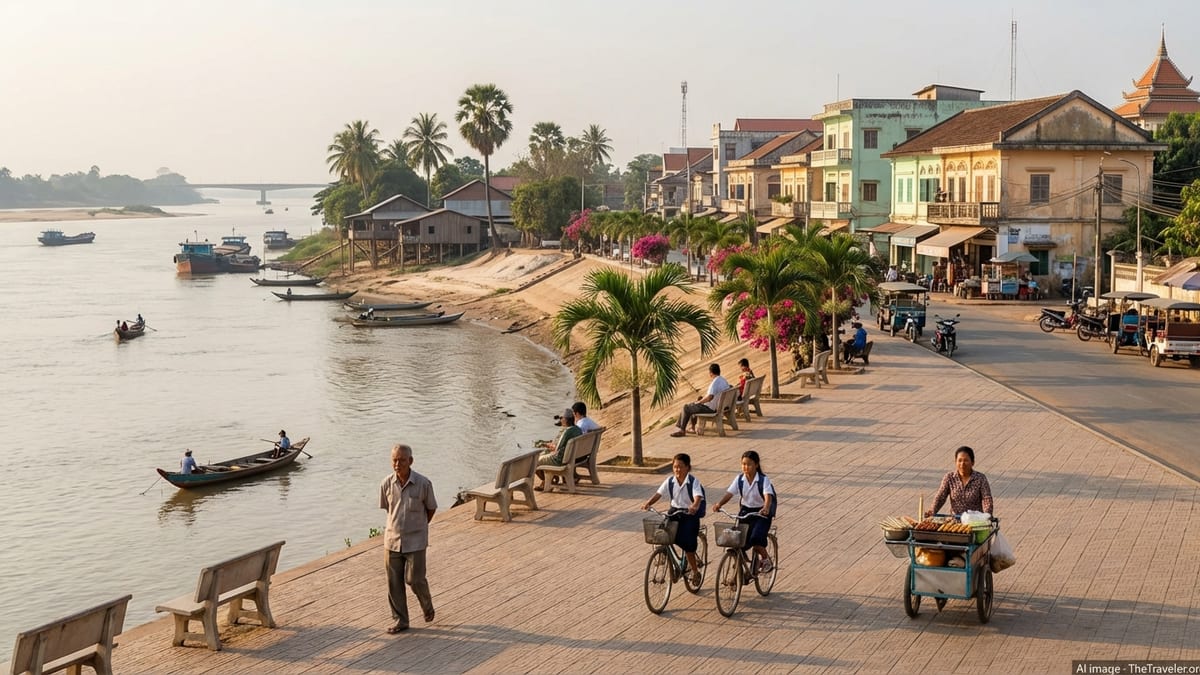
The town’s defining public space is its riverfront park, stretching from near the Japanese-built Kizuna Bridge along the curve of the Mekong. A broad promenade runs parallel to the water, shaded by palms and dotted with benches. Sculptures and somewhat eccentric statues appear at intervals, giving the park a quietly whimsical character.
From first light, locals arrive to walk, jog, or practice stretching exercises by the river. Later in the day, families gather on the lawns, children ride bicycles, and food vendors set up carts selling grilled meats, fried noodles, iced coffee, and sticky rice treats. At sunset, the sky turns pastel over the water, and the promenade becomes a lively social corridor.
Spending time here is as essential as any temple visit. It offers a safe, easy environment to observe local life, taste casual street food, and acclimatize to the rhythm of the town. Early morning and dusk are the most atmospheric times, with relatively cooler temperatures.
Crossing the Kizuna Bridge
Opened in 2001, the Kizuna Bridge was the first bridge to span the Mekong within Cambodia, linking the country’s eastern and western regions by road. For locals, it transformed trade and travel. For visitors, it provides a vantage point over the river and a sense of the Mekong’s scale.
You can cross by tuk-tuk, car, bicycle, or even on foot if you are comfortable with some traffic and tropical heat. The views from mid-span reach back toward Kampong Cham’s riverfront and out over floating houses, sandbars, and cultivated fields. Crossing at sunrise or sunset can be particularly striking, with fishermen heading onto or back from the water.
The bridge sits at the northern edge of town, easily reached from the central market area. It is practical to combine a crossing with a visit to villages on the far bank or as part of a longer journey deeper into eastern Cambodia.
The Seasonal Bamboo Bridge to Koh Paen
One of Kampong Cham’s most distinctive sights in the dry season is the bamboo bridge that traditionally connects the town with Koh Paen (Koh Pen) Island. Locals rebuild this long, flexible structure each year when water levels fall, driving thousands of bamboo poles into the riverbed to create a roadway strong enough for motorbikes, bicycles, and pedestrians.
Riding or walking across can feel both thrilling and slightly unnerving, as the bamboo flexes and creaks under your feet or tires. The crossing usually involves a small toll, which helps cover the cost of construction and maintenance. When the monsoon returns and the river rises, the bridge is dismantled, and boats resume their role as the primary means of reaching the island.
Because local authorities and river conditions can change from year to year, check in town whether the bamboo bridge is operating during your visit. Even if the bridge is not in place, boat trips to Koh Paen still offer access to the island’s quiet roads and farmland.
Island and Countryside: Cycling and Village Life
Kampong Cham’s compact urban area quickly gives way to a rural landscape of rice paddies, sugar palms, and small villages. Spending time in the countryside helps balance temple visits and river walks, giving a fuller sense of how people live and work along this stretch of the Mekong. Bicycles and tuk-tuks are the most flexible ways to explore, with islands and ecotourism villages particularly appealing.
Cycling Around Koh Paen Island
Koh Paen is a long, narrow island set in the Mekong directly opposite town. Once you cross via the seasonal bamboo bridge or by boat, you enter a very different world of sandy tracks, stilted wooden houses, and fields of vegetables, tobacco, and seasonal crops. The island is flat and relatively quiet, making it ideal for leisurely cycling.
Renting a bicycle in town and spending half a day looping through Koh Paen allows frequent stops to watch farmers at work, children playing, and monks moving between small pagodas. Chickens, cows, and dogs wander freely, and simple wooden bridges cross minor canals. You may be invited to stop for a drink or to practice a few words of Khmer with curious residents.
Bring water, sunscreen, and a hat, as shade can be limited on some sections of the island. If you are uncomfortable cycling alone, guesthouses and local guides can often arrange escorted rides that include cultural explanations and visits to specific households or farms.
Cheung Kok Ecotourism Village
Cheung Kok, sometimes referred to by the name of the supporting association, is a community-based tourism village just outside Kampong Cham town. Established as a partnership between local families and development organizations, it aims to give visitors insight into rural Cambodian life while generating supplemental income for residents.
In Cheung Kok, homes double as small workshops where villagers weave silk or cotton scarves, make palm sugar, or produce simple crafts. Visitors can join in everyday activities such as rice planting or harvesting (depending on season), cooking local dishes, or learning how traditional stilt houses are built and maintained. Overnight homestays are sometimes available for those who want a deeper immersion.
Spending time here provides a more structured way to engage with rural life than wandering alone, particularly if you prefer to support organized community initiatives. It is wise to inquire in town or with your accommodation about current programs, what is included, and how payments are shared with participating families.
Rubber Plantations and Agricultural Landscapes
Kampong Cham province has long been a center of Cambodia’s rubber industry, with large plantations established during the French colonial period and still operating today. Visiting a rubber plantation offers a window into a lesser-known side of the rural economy, where workers tap latex from neatly lined rows of trees and processing plants convert it into sheets and blocks for export.
Some plantations near the provincial capital allow visitors to walk or drive through the groves, seeing the characteristic cuts on tree trunks and the cups used to collect latex. In certain cases, small entrance fees give access to basic processing facilities where you can watch raw latex being transformed into finished product. Mornings are generally the best time to see active work before the heat of the day builds.
In addition to rubber, the countryside around Kampong Cham is rich with seasonal crops and orchards. Even without a formal tour, casual rides or drives through rural roads reveal cassava fields, banana groves, and vegetable plots irrigated from the Mekong and its channels.
Colonial Echoes and Urban Wanderings
While Kampong Cham’s river and temples often take center stage, the town itself rewards slow, unhurried exploration. Wide boulevards, low-rise shop houses, and surviving colonial buildings tell the story of a port that once played a pivotal role in regional trade. Today, the scale is modest, but the architectural details and street scenes remain engaging for visitors who enjoy walking rather than being driven everywhere.
French Watchtower on the Mekong
Across the river from the main town, a tall, auburn-colored tower rises above the flat landscape. Commonly called the French lighthouse, it was in fact built as a watchtower in the early 20th century to monitor traffic on the Mekong and protect nearby rubber estates. From a distance, it appears slender and somewhat weathered, a reminder of another era.
Climbing the internal stairs, where permitted, leads to a small viewing platform overlooking the river and the town’s riverfront park. The vantage point makes clear why the French chose this location: it commands extensive views of shipping lanes and adjacent farmland. Today, the tower serves mainly as a local landmark and informal viewpoint rather than a formal museum.
Access arrangements can vary, so it is sensible to check with a local guide or driver about whether the tower is currently open to visitors. Even seen from the riverbank or a passing boat, however, it contributes to the town’s distinctive skyline.
Streetscapes and Everyday Markets
In central Kampong Cham, streets near the river and main market hold a scattering of colonial villas, administrative buildings, and shop houses. Time and climate have taken their toll, but shutters, balconies, and decorative plasterwork still evoke the early 20th century. Many buildings have been adapted to local needs, housing small businesses, government offices, or family homes.
The central market and surrounding side streets are among the best places to observe daily commerce. Before mid-morning, stalls overflow with vegetables, fruits, fish, and prepared foods, while sellers call out prices and bargain with regulars. By midday, the pace slows and some vendors pack up, leaving behind a quieter warren of gold shops, tailors, and hardware stalls.
Walking these streets helps you understand Kampong Cham not as a set of attractions, but as a lived-in town adjusting to changing economic and climatic realities. As always, ask before photographing people at close range and be mindful of space in narrow aisles.
Experiencing Local Culture, Food, and Festivals
Beyond sightseeing, Kampong Cham rewards travelers who make time for meals, performances, and seasonal celebrations. The food scene is straightforward but satisfying, with market stalls, street carts, and small restaurants serving a range of Cambodian staples. Depending on when you visit, major Buddhist holidays and river-focused festivals may transform the atmosphere along the waterfront and at major pagodas.
Sampling Mekong River Cuisine
The Mekong supplies much of the protein eaten in Kampong Cham, and many dishes highlight freshwater fish grilled, souped, or fermented. At riverfront stalls and in small eateries, you may find whole fish grilled over charcoal and served with herbs and dipping sauces, bowls of noodle soup enriched with fish or pork, and crunchy snacks such as fried river shrimp or small fish.
Morning markets are excellent places to try simple breakfasts like rice porridge, noodle soup with herbs and lime, or freshly made rice cakes. In the evening, mobile carts set up near the river park, offering skewers, sugarcane juice pressed to order, and desserts made from sticky rice, coconut, and seasonal fruits. Vegetarian options are increasingly available, though flexibility with fish sauce and broths may be required.
As with all street food, choose busy stalls with high turnover, observe basic hygiene, and bring small denomination cash. Bottled or filtered water is widely available and advisable if your stomach is sensitive.
Apsara Dance and Temple Ceremonies
While Kampong Cham does not have the nightly dance performances common in major tourist centers, traditional Khmer dance and music still appear at local festivals, temple gatherings, and occasional special events. Apsara dance, with its detailed hand movements and elaborate costumes, is most often seen during major Buddhist holidays or community celebrations.
If you are interested in seeing live performance, ask your guesthouse or a local guide whether any events are scheduled during your stay. Even without formal shows, temple visits frequently coincide with chanting, drumming, or informal musical practice by laypeople and monks. Respectful listening from the sidelines is welcome, provided you avoid interrupting rituals or blocking access for worshippers.
Festivals on the River and at the Pagodas
As in much of Cambodia, Kampong Cham’s calendar is shaped by Buddhist festivals and national holidays. Pchum Ben, the festival honoring ancestors, and Khmer New Year in April are particularly important, with many families traveling back to their home provinces, including Kampong Cham, for ceremonies and reunions. Pagodas become focal points of activity, with offerings, blessings, and communal meals.
Water-related festivals such as Bon Om Touk, the Cambodian Water Festival, take on special significance along the Mekong. Depending on the year and local arrangements, you may see boat races, illuminated floats, or riverfront gatherings. During major holidays, transport and accommodation can be busier, and some businesses close or operate with reduced hours, but the energy and sense of shared celebration can be memorable.
The Takeaway
Kampong Cham is not a place of blockbuster sights or choreographed tourist experiences. Its appeal lies in a quieter blend of timeworn temples, broad river views, and an unhurried daily life that still revolves around the Mekong and surrounding fields. From the weathered stones of Wat Nokor to the creaking planks of the seasonal bamboo bridge, from village homestays in Cheung Kok to sunset strolls along the riverfront park, the town invites you to slow down and look closely.
For travelers willing to trade some convenience for authenticity, Kampong Cham offers a deeply Cambodian experience that complements better-known destinations in the country. A couple of days here allow you to see a hilltop pagoda at dawn, share a market breakfast with locals, cycle between tobacco fields on Koh Paen, and watch families gather under the riverfront trees at dusk. It is in these overlapping scenes of temples, river walks, and local life that Kampong Cham leaves its lasting impression.
FAQ
Q1: How many days should I spend in Kampong Cham?
Most travelers find that one to two full days is enough to see the main temples, enjoy the riverfront, and visit at least one village or island. If you prefer a slower pace, three days allows extra time for cycling trips and relaxed exploration.
Q2: What is the best time of year to visit Kampong Cham?
The most comfortable period is typically from November to March, when temperatures are slightly cooler and rainfall is lower. This is also when the seasonal bamboo bridge to Koh Paen Island is most likely to be in place, though exact timing can vary with river levels.
Q3: Is Kampong Cham easy to reach from Phnom Penh?
Yes. Buses, minibuses, and taxis run regularly between Phnom Penh and Kampong Cham, with the journey usually taking around three to four hours, depending on traffic and road conditions. Many visitors also pass through the town when traveling between Phnom Penh and the northeast of Cambodia.
Q4: Do I need a guide to visit the temples and villages?
You can visit major sites such as Wat Nokor, Phnom Pros, Phnom Srey, and the riverside park independently using tuk-tuks or bicycles. However, hiring a local guide can add useful historical context, facilitate communication in villages, and help you navigate less-visited rural areas like Wat Moha Leap or Cheung Kok.
Q5: Is Kampong Cham suitable for cycling and walking?
The town center and riverfront are flat and reasonably compact, making them good for walking. Bicycles are a popular way to reach nearby villages, Koh Paen Island, and some temples. Traffic is generally lighter than in larger cities, though you should still ride cautiously and avoid the hottest hours of the day.
Q6: What should I wear when visiting temples in Kampong Cham?
Modest dress is expected. Both men and women should cover shoulders and knees, and avoid very tight or transparent clothing. You will be asked to remove shoes and hats before entering shrine buildings. A light scarf or shawl is useful for covering up when needed.
Q7: Is the bamboo bridge to Koh Paen Island always open?
No. The bridge is typically built during the dry season when Mekong water levels are lower, and it is dismantled before or during the monsoon when the river rises. Conditions and timing can change from year to year, so check locally upon arrival to see whether the bridge is in place. When it is not, small boats usually provide access to the island.
Q8: Are there ATMs and modern facilities in Kampong Cham?
The town has a limited but growing number of ATMs, basic pharmacies, small supermarkets, and mid-range guesthouses. It is wise to bring some cash in US dollars or Cambodian riel, especially if you plan to spend time in rural areas where card payments are rarely accepted.
Q9: Is Kampong Cham a good destination for families?
Yes, provided children are comfortable with heat and simple facilities. Kids often enjoy river walks, boat trips, cycling on quiet roads, and meeting animals in villages. Parents should take usual precautions around water, in traffic, and at busy markets, and carry sun protection and drinking water.
Q10: Can I combine Kampong Cham with other destinations in one trip?
Absolutely. Kampong Cham fits naturally into itineraries that include Phnom Penh, Kratie, and the northeastern provinces, or that loop through central Cambodia before heading to Siem Reap. Its central location and road connections make it a convenient, low-key stop that adds depth and variety to a broader journey through the country.