

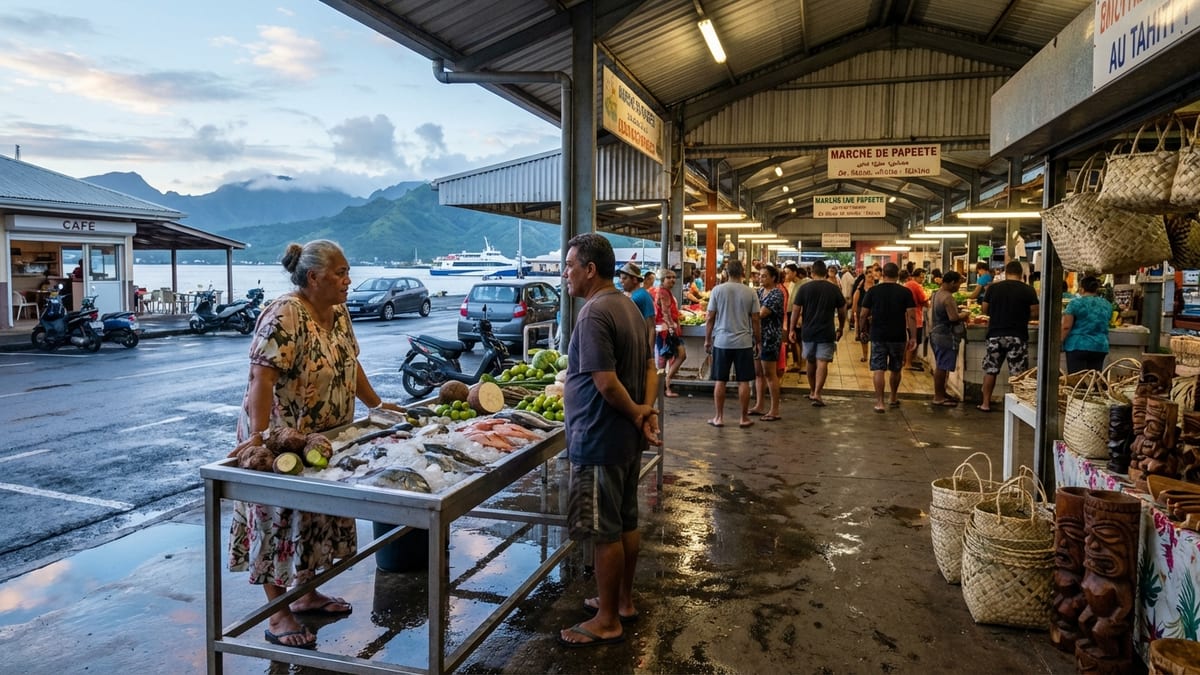
Tahiti has long been sold as a dreamscape of overwater bungalows and infinity pools, but the island’s real character waits well beyond resort walls. Venture into Papeete’s markets at dawn, hike into misty valleys, ride the swells with local surfers, and share fish straight from the lagoon with a Tahitian family, and you will discover a place that is vibrant, complex, and very much alive.
For travelers ready to look past postcard views and experience the island as more than a backdrop, Tahiti offers a rich mix of nature, culture, and everyday life that rewards curiosity at every turn.
Immerse Yourself in Papeete’s Everyday Life
Papeete, Tahiti’s compact capital, is often reduced to a transit point between the airport and resort launches, but it is the best entryway into real island life. The waterfront streets are busy with traffic, ferries, and schoolchildren, and the air smells of grilled fish, exhaust, and tiare blossoms all at once. Spend a full day here before decamping to the more secluded coasts and you will have a far deeper understanding of the country you are about to explore. From early-morning markets to late-night food trucks, Papeete is where Tahitians work, shop, protest, celebrate, and flirt.
The Papeete public market, Marché de Papeete, is still the social and commercial heart of the city. Open daily in 2026 with early-morning hours, it fills before sunrise with vendors selling reef fish, mountain-grown taro, bananas, and bundles of fragrant basil and mint. Later in the morning the upper level comes alive with pareos, woven baskets, wood carvings, and shell jewelry. Even if you are not shopping for souvenirs, wandering the aisles is a crash course in Tahitian tastes and aesthetics: the bold floral prints, the shaped pandanus leaves, the intricate mother-of-pearl inlays. Visit on a Sunday morning if you can, when families crowd the stalls to stock up and local specialties such as roasted pork and firi firi coconut donuts appear in great quantities.
Beyond the market, Papeete’s streets reveal more of the island’s modern personality. Political posters, graffiti, and large-scale murals speak to ongoing debates about autonomy, the legacy of nuclear testing, and the role of tourism. Cafes mix local snacks with espresso culture, and in small bars you might hear a ukulele trio segue into reggae or French pop. Do as locals do: buy a cup of freshly cut pineapple from a street stand, walk the waterfront promenade, and linger on a bench to watch ferries slide back and forth to Moorea as rush hour swells and recedes.
As night falls, head to the waterfront roulottes, the famous food trucks that gather near the main square. Plastic tables and smoky grills replace the daytime bustle, and office workers sit alongside backpackers and families. Here you can try Chinese-Tahitian staples, fresh sashimi and poisson cru, or hearty steaks and crepes. It is inexpensive by Tahiti standards and it is one of the most democratic dining scenes on the island, a world away from white-tablecloth resort restaurants.
Hike into Tahiti’s Wild Interior
Seen from the air, Tahiti’s coastline looks like a narrow rim around a huge green crown. That interior is a dramatic world of steep ridges, knife-edge peaks, and waterfall-cut valleys that most visitors never see. Exploring it requires a bit of effort and planning, but the payoff is immense: cool air scented with ginger and wet earth, the roar of unseen cascades, and views that make the resorts seem like tiny outposts on the edge of a sprawling volcanic fortress.
One of the most accessible introductions to inland Tahiti is the hike into Fautaua Valley to Cascade de Loti, a waterfall that plunges more than 300 meters into a deep gorge. The trail begins a short drive from Papeete and usually takes two to three hours round-trip for reasonably fit hikers. The route involves river crossings and can be muddy after rain, so proper footwear and caution are essential, but the experience of standing at the base of the falls with mist on your face feels worlds away from manicured beaches. A small permit is often required from the Papeete town hall, which has the added benefit of limiting crowds.
Stronger hikers can tackle more demanding routes such as the ascent to Mount Aorai, Tahiti’s third-highest peak at 2,066 meters. This full-day or overnight trek is not to be underestimated. It climbs along exposed ridges with rope-assisted sections and requires stable weather and good preparation. Those who complete it are rewarded with sweeping views over the island’s jagged interior and out across the ocean to Moorea. Other trails, such as the Mahinarama route above Mahina or the rugged Tuauru Valley, traverse lush forest, river gorges, and high plateaus with panoramic viewpoints, giving a sense of just how wild the island remains away from the coast.
If solo trekking feels daunting, numerous local guides and outfitters based in Papeete and its suburbs offer 4x4 excursions and guided hikes into the Papenoo valley and other interior areas. These trips often combine short walks with cultural explanations and stories about the land, which is deeply entwined with Tahitian identity. Guides point out medicinal plants, old terraces and stone structures, and sacred peaks associated with ancestral myths, turning a scenic excursion into a living history lesson.
Explore the Coasts and Villages of Tahiti Nui
Most resort guests rarely leave the immediate vicinity of their accommodation, but Tahiti Nui, the larger of the island’s two lobes, invites unhurried exploration by car or local bus. Circle the coastal road and you will move through a series of distinct micro-worlds: small fishing villages where dogs doze in the shade, roadside fruit stands, black-sand surf beaches, and quiet churchyards that fill with hymns on Sunday mornings.
The northern and western coasts are the most developed, but they still hold surprises beyond hotel zones. Small public beaches tucked between private properties give access to shore breaks used by local surfers and bodyboarders, who gather in the late afternoon when the light softens. In towns such as Punaauia you will find simple snack stands serving grilled fish plates and sandwiches, while further out, in places like Paea, the mood shifts to something more rural, with fewer buildings and more greenery between them.
On the east coast, where the trade winds blow more directly, the atmosphere is wilder. Waves hammer the reef, and the mountain slopes rise almost vertically behind the narrow ribbon of road and houses. Here you can stop at scenic points overlooking surf passes, visit small waterfalls close to the road, and take short detours into valleys that quickly close in with dense vegetation. Locals tend gardens and small plantations of bananas, papayas, and breadfruit; along the roadside you can buy bunches of still-green bananas or bags of prepared fruit and grilled snacks.
At almost any point along the way, it is worth pulling off the road and spending a few minutes on a small public beach or riverside. The aim is not to tick off big sights but to watch everyday life unfold: children practicing outrigger canoe strokes, elders gathered under a tree playing cards, teenagers posing for phone photos in the shallows. This gentle, observational travel is one of the most rewarding ways to experience Tahiti beyond curated resort activities.
Discover Tahitian Culture and History
To understand Tahiti beyond its visuals, it helps to engage with its deep cultural roots and complex history. The island was home to sophisticated Polynesian societies long before European contact, and it later became a flashpoint for missionary activity, colonial politics, and nuclear-era tensions. Many of the most interesting experiences today are those that reveal how Tahitians are reclaiming and reshaping their heritage.
In Punaauia, a short drive from the main tourist strip, the national ethnographic museum offers one of the clearest windows into this heritage. Established in the 1970s, it preserves traditional canoes, tools, sculptures, and tapa cloths, as well as exhibits on navigation, mythology, and daily life across the archipelagos. The museum sits on an important historical site associated with a former marae and early missionary presence, giving visitors a sense of how layers of belief and power overlap in this landscape. A walk around the grounds, where the lagoon sparkles beyond, makes it easy to imagine ancient voyaging canoes pulled up on the same shore.
Scattered across the island are restored marae, the stone temple complexes that served as central places of worship and ceremony in pre-Christian times. While some are modest and partially ruined, others have been carefully rehabilitated with carved tikis and fenced-off sacred sections. Visiting a marae with a knowledgeable guide, rather than just snapping a photograph in passing, can transform a pile of stones into a story of gods, chiefs, and rituals that once structured every aspect of society.
Contemporary culture is equally important. Dance troupes rehearse in public halls and school yards, blending traditional moves with modern choreography. Art galleries and studio spaces, especially in and around Papeete, showcase painters and sculptors whose work grapples with identity, environment, and the legacy of outside powers. Consider attending a local performance or community event if your visit coincides with one. Even if you do not follow every word, the drumming, chanting, and body language carry their own power.
Experience the Sea like a Local
While resort guests often encounter the ocean as a view or a controlled activity such as a short snorkel off a private dock, Tahitians live with the sea as a daily partner and sometimes adversary. To move beyond the passive postcard version, seek experiences that mirror local relationships with the water, whether that means paddling, fishing, surfing, or simply riding in small open boats along the reef.
On the south coast, near the villages that fringe the famous pass of Teahupo’o, you can join boat tours that venture into the lagoon to see the legendary surf break and the wild coastline beyond the end of the road. Small local companies operate shared and private lagoon excursions that typically last a half or full day. Aboard low-slung boats, you travel through turquoise channels to untouched stretches of coast known as Fenua Aihere and Te Pari, where there are no roads and the forest descends almost directly into the sea. There is time for snorkeling among vibrant coral, drifting over bommies where fish congregate, and swimming in clear, shallow coves far from the bustle of town.
Surf-oriented taxi boats carry spectators and photographers out to the wave at Teahupo’o when conditions are right. For safety reasons, only very experienced surfers tackle this break, but watching from a boat offers a different understanding of both the ocean’s power and the community’s relationship with the surf. On major swell days, a flotilla of craft gathers just inside the channel, and the atmosphere is part sporting event, part neighborhood gathering, with shouted commentary and shared snacks passing between boats.
Elsewhere on the island, you can take part in more low-key marine activities that resemble everyday life. Look for opportunities to join a traditional outrigger canoe session with local clubs, either as a short introductory paddle at dawn or as part of a more structured outing. Fishing charters that cater to residents as well as visitors tend to focus less on trophies and more on filling the cooler, giving a genuine sense of how many families still supplement their meals with what they pull from the sea. Snorkeling from public beaches or local boats, instead of only resort platforms, also shows you how Tahitians use the lagoon as a multi-purpose space for subsistence, play, and quiet contemplation.
Connect through Food and Local Flavors
Resort dining often tries to be all things to all travelers, offering polished versions of both international and Polynesian dishes. To taste Tahiti in a more authentic way, you will need to follow your nose out into the community. Markets, roadside stands, family-run snacks, and church fundraisers all serve as informal restaurants where recipes are passed down and adapted according to what is in season and what the sea has provided.
Start in the markets and small grocers, where you will see the building blocks of local cuisine. Look for piles of taro, breadfruit, cassava, and yams, all starchy staples that form the basis of many dishes. Baskets of limes, chili peppers, and tomatoes hint at bright, acidic sauces, while fresh coconut cream ties everything together. Chat with vendors about how they cook certain items; many are happy to explain how long to roast breadfruit in a ground oven or how to marinate fish properly for poisson cru.
Street food and simple snack bars, sometimes little more than a window in a cement wall, offer generous portions at relatively modest prices. Chinese influence is strong, so chow mein and stir-fried dishes appear everywhere, often with a Tahitian twist in the choice of vegetables and sauces. Grab a plate of raw tuna in coconut milk, grilled mahi-mahi, or chicken marinated in ginger and soy, then eat at a plastic table under the shade of a tree while scooters buzz past. In the evenings, the roulotte scene in Papeete is a must, but similar mobile kitchens set up in other towns and near beaches on weekends.
For a deeper connection, consider seeking out cultural or community meals, especially if you are traveling during festivals or on weekends. Churches, schools, and associations often organize fundraising feasts where food is served buffet-style on long tables, and visitors are usually welcome if they approach respectfully and pay the posted contribution. This is one of the few ways to experience an ahimaa, the traditional earth oven, where meats and root vegetables are slow-cooked in hot stones and wrapped in banana leaves. Sharing space at a long table with locals while opening banana-leaf packets and dipping into shared bowls of sauce is an experience no resort restaurant can match.
The Takeaway
Tahiti’s resorts offer comfort and beauty, but they are only a narrow frame around a far larger picture. Beyond the manicured gardens and private decks, the island is a living place where people rise before dawn to sell fish at the market, hike into cloud-draped valleys, paddle canoes through passes, argue about politics, and teach their children dances that predate any hotel on the reef. Travelers who are willing to trade a day of poolside lounging for a dawn walk through Papeete or a muddy hike into the interior discover that the island is not just somewhere to be looked at, but somewhere to be engaged with.
Exploring Tahiti beyond its resorts also means embracing a slower, less scripted style of travel. Buses may not run on exact schedules, weather can disrupt plans at the last minute, and many of the most memorable interactions will not appear in any brochure. Yet it is in that space of uncertainty and openness that Tahiti reveals its true soul. Step outside the resort gates with curiosity and humility, and you will return not just with pictures of turquoise water, but with stories that tie you to the land and people in a more meaningful way.
FAQ
Q1. Is it safe to explore Tahiti beyond the resorts on my own?
For most travelers, exploring Tahiti independently is safe, especially during daylight hours. Use common sense as you would anywhere: keep valuables out of sight, avoid walking alone late at night in unfamiliar areas, and check local advice before heading onto remote trails or into strong surf zones.
Q2. Do I need a car to see the island outside my resort?
Renting a car gives you the most flexibility to circle the island, visit villages, and stop at viewpoints or small beaches. Public buses operate along the main coastal road but schedules can be irregular, especially in the evening and on Sundays, so a car or organized tour is recommended if you want to explore widely.
Q3. Can beginners hike safely in Tahiti’s interior?
Yes, there are moderate hikes suitable for reasonably fit beginners, such as shorter valley walks and certain waterfall trails. However, the terrain is steep and can become slippery after rain, so choose routes that match your ability, wear proper shoes, and consider hiring a local guide for more challenging or remote paths.
Q4. How can I find authentic local food outside the resorts?
Look for public markets, small snack bars called “snacks,” and evening food trucks, especially in Papeete and larger towns. Asking hotel staff or local drivers where they like to eat is often the quickest route to simple, genuine places that serve generous plates at fair prices.
Q5. Is it respectful for visitors to attend community events or church services?
Visitors are generally welcome at public events and many church services, provided they dress modestly, arrive on time, and behave respectfully. Avoid taking intrusive photos, follow the lead of locals, and consider making a small donation if a collection is taken or if food is included.
Q6. Do I need to speak French or Tahitian to get around?
French is widely spoken and Tahitian is common in informal settings, but people working in tourism often speak at least some English. Learning a few basic words in Tahitian, such as greetings and thanks, is appreciated and can open doors to warmer interactions.
Q7. What is the best time of year to explore beyond the resorts?
The drier months, generally from May to October, tend to offer more stable weather for hiking and coastal exploration, with slightly cooler temperatures. The wetter months can still be rewarding but may bring heavy showers that affect trails and outdoor activities, so flexibility is important.
Q8. How can I visit the Teahupo’o area without surfing?
You can reach the village area by road on Tahiti Iti and then join local boat tours that visit the wave, nearby lagoon, and the roadless Fenua Aihere and Te Pari coastline. Many operators welcome non-surfers and focus on scenery, snorkeling, and cultural insights rather than riding waves.
Q9. Are there cultural rules I should know when visiting marae and other sacred sites?
Dress modestly, avoid loud behavior, and refrain from climbing on stone structures or touching carvings. If in doubt, ask a guide or local person how to behave appropriately. Treat these sites as you would temples or churches elsewhere, with quiet respect.
Q10. How can I support local communities while exploring beyond the resorts?
Choose locally owned guesthouses, guides, and restaurants whenever possible, buy crafts directly from artisans at markets, and be mindful of environmental impact by sticking to marked trails and not disturbing wildlife. Paying fair prices and showing genuine interest in people’s work helps ensure tourism benefits reach beyond the resort gates.