

More news on this day
As demand surges on routes between North America and Asia-Pacific, airlines are racing to upgrade cabins, creating a new pecking order for travelers seeking premium comfort across the Pacific in 2026.
Get the latest news straight to your inbox!
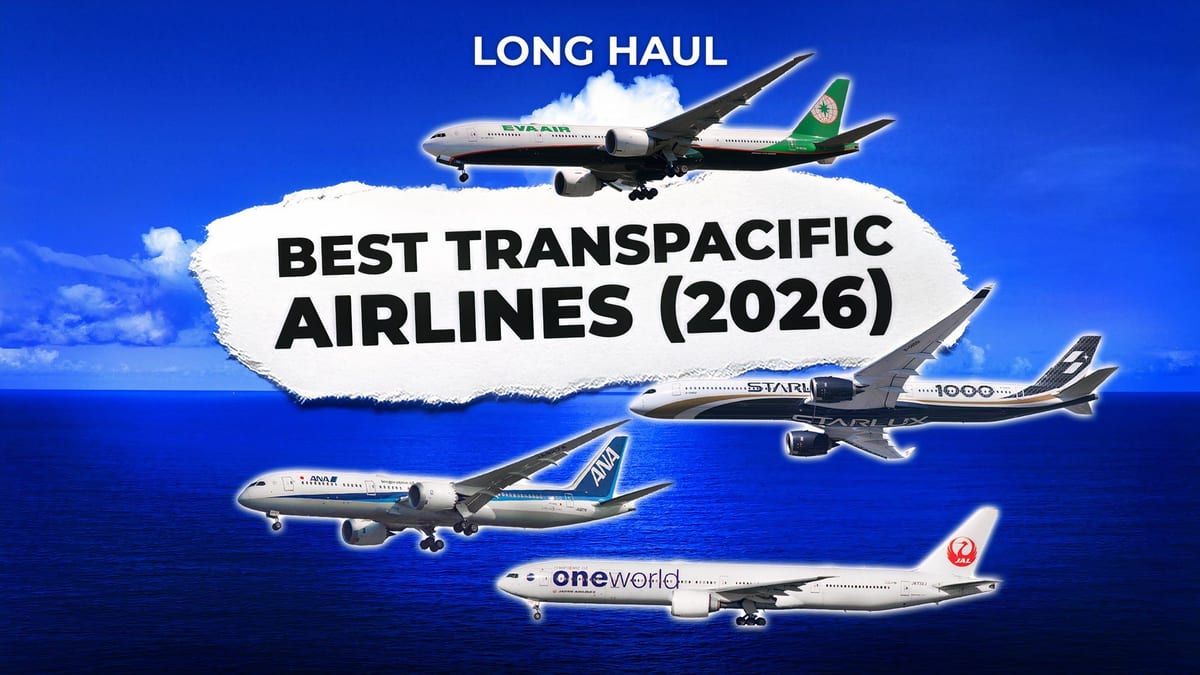
Image by Simple Flying
Premium Comfort Becomes a Key Battleground
Industry data and recent rankings indicate that transpacific airlines are investing heavily in premium economy and business cabins as post-pandemic travel stabilizes and high-yield demand returns. Skytrax awards, independent review platforms and specialist travel media consistently highlight Asian full-service carriers as leaders in seat comfort, onboard service and overall long-haul experience on these routes.
Singapore Airlines, All Nippon Airways (ANA), Japan Airlines (JAL), Cathay Pacific, EVA Air and Taiwan’s China Airlines feature repeatedly in global rankings, with strong showings for both business and premium economy products. Singapore Airlines retained its Skytrax title as one of the world’s top carriers in 2024, while Cathay Pacific and ANA continue to appear near the top of business-class league tables, underscoring their focus on long-haul comfort rather than ultra-dense configurations.
Alongside cabin hardware, airlines are repositioning their premium cabins as a middle ground between traditional economy and business class. Enhanced meal services, upgraded bedding, noise-canceling headphones and more generous luggage allowances are now standard expectations on many transpacific premium economy offerings, blurring the lines between cabin classes and reshaping what travelers consider “worth the upgrade.”
Pricing dynamics add another dimension. Reports from travel publications show that premium economy fares on major North America to Asia routes often undercut business class by thousands of dollars, yet still deliver significantly more comfort than standard economy. This gap has turned premium economy into a strategic product for both passengers and airlines, especially on flights that routinely exceed 10 hours.
Japan Airlines and ANA: Quiet Leaders in Premium Economy
In the premium economy segment, Japanese carriers have consolidated a reputation for meticulous comfort. Japan Airlines’ premium economy was recognized in 2024 as the world’s best in its class at the Skytrax World Airline Awards, with travel industry coverage pointing to generous legroom, large personal screens, quality headphones and small but meaningful amenities such as slippers and upgraded dining service. Recent analyses by business-travel outlets highlight that these cabins often feel close to an older-generation business class, particularly on widebody aircraft deployed on transpacific routes.
ANA has followed a similar path, refining its premium economy seats on aircraft such as the Boeing 777-300ER and Boeing 787 family used heavily on U.S. to Japan services. Long-haul reviews describe a consistent 38 inches of seat pitch, substantial recline, leg and footrests and high-resolution entertainment screens that rival those in many flagship business cabins from a decade ago. The airline’s emphasis on quiet, orderly cabins and attentive service resonates with travelers seeking a calmer experience without the price tag of a business-class suite.
Both carriers are using upcoming aircraft deliveries to keep that competitive edge. Industry reports note that JAL’s latest-generation widebodies, including new Airbus A350 variants, are being scheduled on high-demand routes such as Los Angeles to Tokyo, bringing refreshed premium economy and business products to some of the most competitive transpacific city pairs. Analysts suggest that these rollouts will further anchor Tokyo’s position as a premium hub for North America–Asia connections.
For travelers, the practical takeaway is that Japanese airlines often deliver exceptional “middle cabin” value. On many peak-season dates, published fares show that premium economy on JAL or ANA can cost only a modest premium over flexible economy tickets on U.S. carriers, while providing a notably more spacious and quiet environment on overnight sectors.
Singapore Airlines, Cathay Pacific and EVA Air: Flagship Comfort Across the Pacific
Singapore Airlines remains a benchmark for premium long-haul travel, with Skytrax once again ranking it among the top global airlines in 2024. Its transpacific services linking cities such as Los Angeles, San Francisco and Seattle with Southeast Asia are equipped with lie-flat business seats, refined soft product and a premium economy cabin that has been progressively upgraded. Aviation analysts point to Singapore’s focus on cabin design and service detail as a reason it continues to command higher average fares while maintaining strong load factors on long sectors.
Cathay Pacific, based in Hong Kong, has re-entered the top tier of global rankings after its long rebuild. Recent Skytrax results and industry commentary place it back in the top three worldwide, with particular praise for long-haul comfort and the airline’s premium cabin consistency. Cathay’s premium economy offers an expansive 40-inch seat pitch on Airbus A350 aircraft, along with curated menus and upgraded tableware, features that reviewers say can make the product feel close to an earlier-generation business class on overnight transpacific flights.
EVA Air, a pioneer of premium economy on transpacific routes since the early 1990s, continues to be highlighted by reviewers for its “Elite” and “Premium Economy” offerings. Publicly available information and enthusiast reviews often describe EVA’s premium economy as among the most spacious in the Pacific market, with supportive seating, generous recline and catering standards that have earned separate recognition in global awards focused on this cabin. The carrier’s network from North America to Taipei and onward into Southeast and Northeast Asia gives travelers multiple routing options without sacrificing comfort.
Taiwan’s other major carrier, China Airlines, has also been gaining attention. In late 2024, it received multiple APEX awards, including recognition for overall cabin service and inflight food and beverage, with travel reports highlighting upgraded amenity kits and high-quality headphones in premium cabins on transoceanic routes. Together, the Taiwanese and Hong Kong carriers offer a cluster of premium-focused options that appeal to travelers who prioritize soft-product refinement alongside hard-seat comfort.
United, Delta and Emerging Hybrid Players Raise Their Game
On the U.S. side of the Pacific, the big three carriers are investing in premium products to defend market share on lucrative Asia routes. United Airlines has signaled a major step up with its “Elevated” interior for upcoming Boeing 787-9 deliveries, which will feature new Polaris business suites, refreshed Premium Plus seats with privacy features and upgraded entertainment systems. Company statements and industry coverage describe a cabin layout with a higher proportion of premium seats, aimed at capturing demand on routes such as San Francisco to Taipei and Tokyo, some of the busiest U.S.–Asia corridors.
Delta Air Lines and American Airlines continue to expand and refine their premium economy cabins, marketed as Premium Select and Premium Economy respectively, on transpacific fleets. Reports from business-travel media comparing premium economy products note that Delta, American and United now price these cabins at levels that can undercut some Asian competitors, particularly on shoulder-season dates, while still offering wider seats, additional legroom and enhanced service compared with standard economy. The result is a more competitive landscape where North American carriers can increasingly match or exceed comfort expectations on specific aircraft types and routes.
Newer and hybrid carriers are also entering the contest. South Korea’s Air Premia, which operates a two-class configuration built around an expansive premium economy product branded “Premia 42,” has been drawing attention from analysts and frequent flyers. Public fleet information shows that its Boeing 787-9 aircraft feature a 2-3-2 premium economy layout with 42 inches of pitch, a figure that surpasses many legacy competitors’ offerings in the same cabin. For travelers departing from West Coast gateways, these emerging players add alternative paths to Asia with a strong comfort-to-price ratio.
Travel forums and consumer reviews reflect that the gap between traditional full-service carriers and newer hybrids is narrowing, particularly in the middle cabins. While the very highest-end business suites remain concentrated among established flag carriers, the competition in premium economy and “quasi-business” offerings is intensifying as more airlines seek to differentiate themselves on long Pacific crossings.
How Travelers Are Redefining Value on Transpacific Flights
Passenger behavior is evolving alongside these product changes. Published fare comparisons and booking data discussed in industry reports suggest that travelers on transpacific routes are increasingly willing to pay more for comfort, but are also highly sensitive to relative value between cabin classes and carriers. A growing number of consumers appear to treat premium economy, rather than business class, as the realistic upgrade target for long-haul travel, particularly for leisure trips and small-business budgets.
This shift has clear consequences for airline strategy. Premium economy cabins are growing in size relative to traditional business cabins on some new aircraft, and carriers that historically emphasized low-cost economy seats are exploring expanded “comfort” tiers to remain competitive. Analysts tracking capacity changes note that, on several U.S.–Asia routes, the share of seats classified as premium has risen, even when overall capacity remains flat.
For travelers choosing among the best transpacific airlines, the new premium comfort hierarchy is less about a single “best” carrier and more about matching individual preferences to specific products. Japanese airlines such as JAL and ANA lead in refined, consistently spacious premium economy cabins; Singapore Airlines, Cathay Pacific and EVA Air set the pace in holistic long-haul comfort; and U.S. majors like United and Delta are closing the gap with refreshed cabins and competitive mid-tier pricing. Hybrid entrants, notably Air Premia, are demonstrating that generous seat pitch and modern aircraft can redefine expectations at lower price points.
In 2026, premium comfort across the Pacific is no longer a niche perk. It has become a core part of the competitive landscape, reshaping how airlines design cabins and how passengers decide which carrier will carry them through one of the longest stretches of sky in commercial aviation.