

Lisbon is a city defined by its skyline. Red-tiled roofs spilling toward the Tagus River, the castle on its hill, and the long arc of the 25 de Abril Bridge all combine into a view that travelers remember long after they leave.
To truly understand Lisbon, you have to see it from above, and that means seeking out its miradouros, the terrace-like viewpoints that crown the city’s hills. Among them all, Miradouro da Senhora do Monte is consistently singled out as the place where Lisbon’s vast, sunlit panorama feels at its most complete and most emotional.
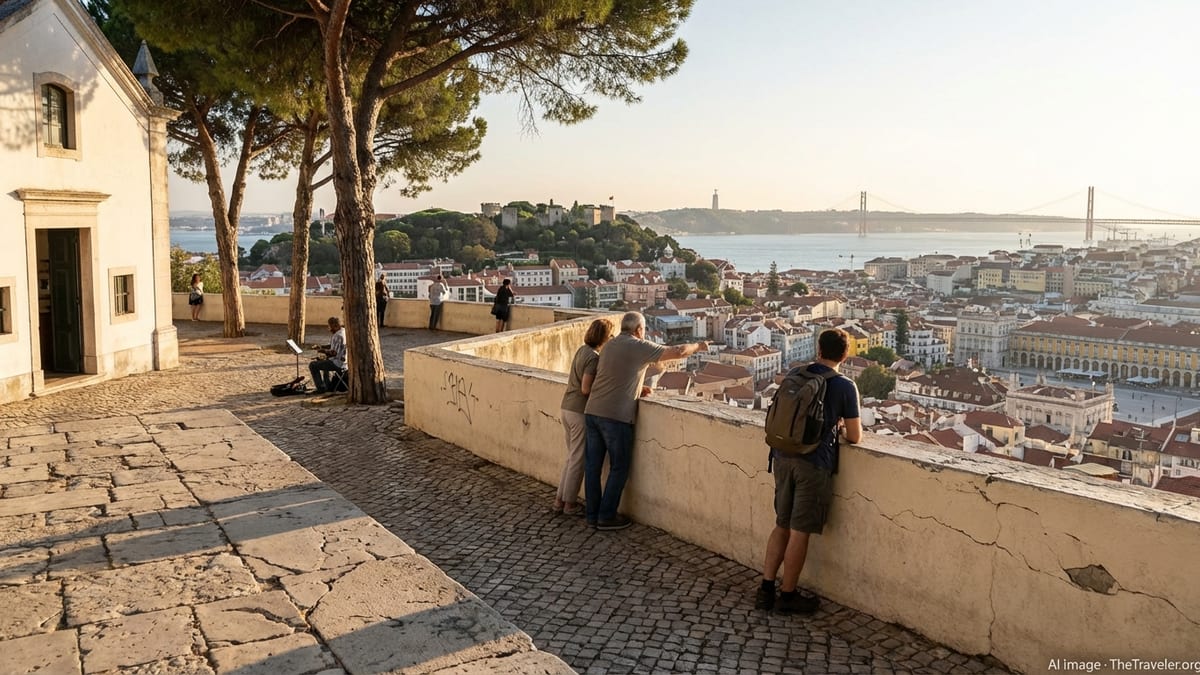
Lisbon, the City of Miradouros
Lisbon’s geography is destiny. Built across seven hills, the Portuguese capital naturally lends itself to viewpoints that capture shifting angles of light and layers of history. Over time, these high points evolved into formal spaces known as miradouros, where locals and visitors pause between tram rides and steep staircases to catch their breath and orient themselves against the city’s landmarks. Benches, small gardens, kiosks, and sculptures turned simple lookouts into social spaces.
Today, the city’s miradouros are as much a part of Lisbon’s identity as its azulejo tiles and yellow trams. Miradouro de São Pedro de Alcântara in Bairro Alto offers a manicured terrace overlooking downtown. Santa Luzia and Portas do Sol serve up classic postcard views of the Alfama district, with whitewashed churches and the river glinting beyond. Miradouro da Graça, perched near a historic convent, offers a shaded terrace and a mellow neighborhood feel. Each has its own personality, its own soundtrack, and its own time of day when it shines.
Yet when you ask guides, travel writers, and Lisbon residents which viewpoint best encapsulates the city in a single sweep, Miradouro da Senhora do Monte is mentioned again and again. It is the highest of Lisbon’s official miradouros, a fact that becomes obvious the moment you step onto its terrace and the entire city seems to unfurl beneath you. Where other viewpoints are about a particular angle, Senhora do Monte is about the whole picture.
Part of the appeal is that reaching a miradouro in Lisbon still feels like a small achievement. You ride an old tram, or you climb narrow streets, or you weave between low houses and laundry lines. The rise is gradual until suddenly the city opens. At Senhora do Monte, that sense of arrival is amplified by both the altitude and the silence that seems to fall when people catch sight of the view for the first time.
Where to Find Miradouro da Senhora do Monte and How to Reach It
Miradouro da Senhora do Monte sits above the Graça neighborhood, northeast of Lisbon’s historic center. The terrace occupies a space near a small white chapel dedicated to Our Lady of the Hill, from which the viewpoint takes its name. From below, you might not immediately see the viewpoint itself, but you can spot the hillside crowned with trees and hear the gentle murmur of people gathered at the top.
Reaching the viewpoint is part of the experience. Many visitors arrive on the famed Tram 28, which climbs through some of Lisbon’s oldest quarters on its route toward Graça. From its nearest stops, there is still a short uphill walk through residential streets, with views already widening at each intersection. Others opt for tuk-tuks or guided tours, which often include Senhora do Monte as a highlight stop on a circuit of the city’s hills. For those who prefer to explore on foot, a gradual climb from Martim Moniz or Alfama brings you through a mix of steep stairways and winding lanes, revealing everyday life in between the postcard moments.
The ascent can be demanding, particularly on hot summer days, but the payoff is immediate. As you step onto the terrace at Senhora do Monte, you are standing on one of Lisbon’s highest accessible points. The city, which may have felt maze-like at street level, suddenly appears ordered and legible. You can trace tram lines, follow the route of the river, and understand how districts such as Baixa, Alfama, Mouraria, and Graça connect to one another.
Despite its popularity, the space retains a certain calm. Compared to some riverfront viewpoints or terraces closer to nightlife districts, Senhora do Monte feels more residential and slightly removed, a place where the city’s soundtrack is softened. That sense of distance is important. It allows visitors to experience Lisbon not as a series of close-up details but as a living, breathing whole.
The View: Why This Panorama Feels Different
What sets Miradouro da Senhora do Monte apart is the sheer scope of what you can see. From the terrace, the eye travels effortlessly from the castle on its neighboring hill across the rooftops of Baixa, out to the Tagus, and along the line of the 25 de Abril Bridge, often compared to its North American cousins for its red color and suspension design. On clear days, you can distinguish ships on the river and even hills on the far bank. It is a view that invites long, unhurried observation rather than a quick snapshot.
Looking slightly to one side, Castelo de São Jorge dominates the skyline, its medieval walls clearly visible from this vantage point. Below, the grid-like order of the Pombaline downtown stretches toward the water, its grand squares and avenues laid out after the great earthquake of the 18th century. From above, the reconstruction plan that shaped modern Lisbon is legible in a way that it is not at street level. The rooftops reveal patterns of color and height, while newer structures stand out against the city’s predominantly low rise fabric.
Turn your gaze further along the horizon and the 25 de Abril Bridge comes into view, spanning the Tagus toward Almada. The bridge, along with the silhouette of the Cristo Rei statue in the distance, anchors the panorama and reminds you of Lisbon’s Atlantic identity. South of the castle, the winding streets of Alfama are visible as a dense textured patchwork, while to the north and east the city rises again into other residential hills. Gentle changes in light throughout the day shift the mood of the view, but the essential sense of openness remains.
Many viewpoints in Lisbon frame a specific scene: a church façade, a cluster of rooftops, a particular curve in the river. Senhora do Monte offers all of that and then some. The impression is one of scale. You feel the size of the city without losing a sense of human detail. From one spot, you can read the story of Lisbon’s topography, its reconstruction after disaster, and its evolution into a modern capital that still acknowledges its layered past.
Atmosphere and Character: Serenity Above the City
Unlike some of Lisbon’s more central miradouros, which can take on a festive or even crowded character during peak seasons, Miradouro da Senhora do Monte often feels contemplative. It is certainly popular, and at sunset it can be busy, but the terrace itself is relatively spacious and the overall tone leans toward quiet admiration rather than constant movement. People linger on benches or along the low walls, talking softly, pointing out landmarks, or simply standing silently as the light changes.
The small chapel, modest and whitewashed, contributes to this restrained atmosphere. It anchors the terrace and speaks to an older, devotional relationship with the hill. Even if you never step inside, its presence gives the space a reflective quality. The trees that dot the viewpoint offer shade in summer and create pockets of intimacy where couples, families, and solo travelers can sit apart from the main cluster of visitors. Street musicians do appear, but performances are often acoustic and low-key rather than overpowering.
This mix of serenity and accessibility is part of why many locals recommend Senhora do Monte for visitors who want to experience a viewpoint without the constant bustle associated with nightlife areas. You are high enough above the streets to feel removed from the city’s noise, yet close enough to hear a distant tram bell, a burst of laughter, or the echo of church bells marking the hour. The city feels present but not intrusive.
At different times of day, the atmosphere shifts gently. Morning can be remarkably calm, with soft light and fewer people, making it ideal for photography or quiet reflection. Midday brings a brighter, crisper view, though the summer sun can be intense. Late afternoon and early evening, especially in spring and autumn, strike a balance between visibility and mood, as the sky takes on warm tones that soften the city’s edges. After dark, the panorama transforms into a tapestry of lights, with avenues and squares glowing like constellations below.
Sunset Magic: Why Evening Light Elevates the Experience
Ask almost anyone who has spent time at Miradouro da Senhora do Monte and they will likely mention sunset. While the viewpoint is rewarding at any hour, dusk seems to unlock something special. The sun dips behind the western hills, bathing the castle, rooftops, and river in gold, then in pink, then in deepening blue. Shadows lengthen across the city, and details that were sharp in midday light become silhouettes, striking against the sky.
From Senhora do Monte, you enjoy an uninterrupted perspective of this daily performance. The angle allows you to watch the play of color across multiple layers of the city at once. As the sun lowers, reflections dance on the Tagus and the windows of buildings catch the last light, creating a subtle shimmer. On clear evenings, the sky behind the 25 de Abril Bridge turns into a gradient backdrop that photographers and casual visitors alike find compelling.
Practical considerations make sunset at this miradouro particularly attractive. Because of the height and openness of the terrace, there is room for people to spread out without feeling overly compressed, even when it is busy. Those who arrive early can secure a bench, while others often sit on the low walls or find a spot under the trees. The mix of locals, visitors, small groups, and solo travelers creates a shared yet unhurried moment that feels distinct from the high-energy scenes unfolding down in Bairro Alto or along the waterfront at the same hour.
As daylight fades into night, the city’s lights switch on almost imperceptibly at first, then all at once. The avenues of Baixa glow in straight lines, castle walls are illuminated, and car headlights trace the outlines of major roads like moving threads of light. For many, this transition from day to night at Senhora do Monte becomes one of the defining memories of Lisbon, not just a pretty backdrop for photos but a moment when the city’s rhythm becomes visible.
Comparing Senhora do Monte to Other Lisbon Viewpoints
Lisbon’s miradouros are not interchangeable. Each one offers a slightly different composition, mood, and sense of place. Understanding why Miradouro da Senhora do Monte stands out requires considering it alongside a few of the city’s other renowned viewpoints.
Miradouro de São Pedro de Alcântara, for example, sits in the Bairro Alto district and is known for its landscaped gardens, symmetrical layout, and direct alignment with the castle across the valley. It is particularly atmospheric in the evening, with nearby bars and restaurants ensuring a constant flow of people. This viewpoint offers a classic, balanced composition of downtown Lisbon and the castle, but it is closer to nightlife and feels more like an urban terrace than a quiet high point removed from the city.
In Alfama, Miradouro de Santa Luzia and Portas do Sol are arguably the most photographed viewpoints in Lisbon. Their charm lies as much in the foreground as in the view: pergolas draped in bougainvillea, tile panels depicting historical scenes, palm trees, and nearby churches. From here, you look out over a tumbling sea of rooftops and church towers toward the river. These locations feel intimate and romantic, but their platforms are smaller and can feel crowded at peak times, particularly when cruise passengers or tour groups arrive in waves.
Miradouro da Graça, a short walk downhill from Senhora do Monte, offers a slightly lower vantage point and a more overtly social atmosphere, with a café terrace, shade trees, and live music often part of the experience. It is beloved for its balance of local life and sweeping views. Yet when it comes to reading the entire city at a glance, the extra elevation of Senhora do Monte matters. From there, you can see not only the castle and downtown but also a wider stretch of the river and distant neighborhoods.
In essence, Miradouro da Senhora do Monte is less about charming foreground elements and more about raw, expansive panorama. Where other viewpoints may win points for romance, street life, or accessibility, Senhora do Monte claims the title for overall perspective. If you only have time for one high vantage point in Lisbon, this is the one that tells you the most about the city’s form and setting.
Planning Your Visit: Practical Tips for Travelers
A visit to Miradouro da Senhora do Monte is simple to arrange, but a bit of planning helps you make the most of it. The viewpoint is free to access and typically open throughout the day, making it easy to slot into any itinerary. Many travelers choose to combine it with a walk through Graça, Mouraria, or Alfama, using the viewpoint as either a starting point for a downhill wander or a rewarding finale after exploring the city’s older quarters.
Footwear matters here. The climb involves cobbled streets and, depending on your route, some steep stretches. Comfortable shoes are strongly recommended, especially if you plan to continue walking afterward. In summer, the hill can feel particularly warm in the afternoon, so carrying water and arriving slightly earlier or later in the day can make the experience more pleasant. The terrace does offer some shaded areas under trees, but the best panoramic spots are more exposed to the elements.
If sunset is your goal, arriving early is advisable. On clear evenings during peak season, the viewpoint attracts a steady flow of people who all have the same idea. Giving yourself extra time not only improves your chances of finding a comfortable vantage point but also lets you see the view evolve from late afternoon into dusk. For photographers, this extended window offers multiple lighting scenarios, from bright cityscapes to the pastel hues of golden hour and the blue hour that follows.
Respect for the residential nature of the surrounding area is important. Noise regulations and local sensitivities mean that travelers are encouraged to keep music volume low, dispose of any trash properly, and avoid blocking narrow access streets with parked vehicles or large groups. Many visitors appreciate that Senhora do Monte still feels calm compared to busier downtown spots, and maintaining that atmosphere depends in part on how thoughtfully people use the space.
Experiencing the Neighborhood Beyond the Viewpoint
While it is tempting to treat Miradouro da Senhora do Monte as a single-objective stop, the viewpoint is intertwined with the character of the Graça neighborhood and the nearby district of Mouraria. Spending time in the streets that lead to and from the terrace enriches the experience and adds context to what you see from above.
Graça combines a village-like feel with some of the best views in the city. Pastel-colored buildings, small grocery shops, and traditional cafés line the streets. Locals gather at bakeries and corner bars, and visitors share sidewalk tables without overwhelming the area’s everyday rhythm. Descending from Senhora do Monte toward Graça’s main square allows you to dip into this atmosphere before continuing downhill toward the more familiar tourist circuits.
To the west, Mouraria offers another layer of history. Considered one of the birthplaces of fado, Portugal’s iconic music genre, the neighborhood has long been home to a mix of communities. Its narrow alleys, small plazas, and cobbled steps tell a different story from the grand squares of Baixa or the scenic terraces of Alfama. Walking through Mouraria after having viewed it from above at Senhora do Monte can be particularly striking, as you connect the panorama with the intimate details at street level.
By framing your visit in this way, Miradouro da Senhora do Monte becomes more than a high point for taking photos. It becomes a gateway into two of Lisbon’s most characteristic and historically rich quarters. What you see from the terrace is immediately reinforced by what you smell, hear, and taste in the streets below, from the clang of tram bells to the aroma of grilled sardines or freshly baked bread drifting out from a local kitchen.
The Takeaway
Lisbon offers no shortage of spectacular viewpoints, each with its own story and style, but Miradouro da Senhora do Monte occupies a special place among them. It is the highest of the city’s official miradouros, and that extra elevation translates directly into a view that is both broad and deeply revealing. From this terrace beside a modest chapel, you can see the castle, the Pombaline downtown, the folds of Alfama and Mouraria, the sweep of the Tagus, and the 25 de Abril Bridge all at once.
What makes Senhora do Monte stand out is not only what you see but how it feels. The atmosphere tends toward quiet appreciation rather than constant spectacle. The surrounding neighborhood retains a residential, lived-in character that grounds the experience. Sunrise brings calm and clarity, midday offers sharp definition, sunset bathes the city in gold, and night reveals a metropolis of light. At every hour, the viewpoint provides a chance to step back and understand Lisbon as a whole rather than as isolated moments.
For travelers deciding how to allocate limited time, this miradouro is a compelling priority. Where some viewpoints specialize in romance, others in nightlife, and still others in easy access, Miradouro da Senhora do Monte delivers the most complete panorama without losing its sense of serenity. It is a place to arrive, to pause, and to let the city itself tell you its story from above. Whether you stay ten minutes or an hour, the image of Lisbon seen from this hill has a way of staying with you long after you descend its cobbled streets.
FAQ
Q1. Where exactly is Miradouro da Senhora do Monte located in Lisbon?
Miradouro da Senhora do Monte is situated above the Graça neighborhood, northeast of Lisbon’s historic center. It occupies a terrace space beside a small chapel dedicated to Our Lady of the Hill, on one of the city’s highest accessible points.
Q2. How difficult is the walk up to Miradouro da Senhora do Monte?
The walk involves ascending cobbled streets and some steep sections, which can be challenging for those with limited mobility or on very hot days. However, the climb is manageable for most visitors wearing comfortable shoes, and public transport or tuk-tuks can shorten the steepest part of the route.
Q3. What is the best time of day to visit Miradouro da Senhora do Monte?
While the viewpoint is beautiful at any time, late afternoon through sunset is especially popular, as the light softens and the city glows in warm tones. Early morning, on the other hand, offers a quieter experience and crisp, clear views with fewer people.
Q4. Is there an entrance fee to access Miradouro da Senhora do Monte?
No, access to Miradouro da Senhora do Monte is free. Like most of Lisbon’s miradouros, it is a public space, and visitors are welcome throughout the day without any admission charge.
Q5. Can I reach Miradouro da Senhora do Monte by public transport?
Yes. Many visitors take Tram 28 or local buses that pass through or near the Graça area, then walk the remaining distance uphill. The final approach is on foot, but using public transport significantly shortens the climb.
Q6. How does Miradouro da Senhora do Monte compare to Miradouro da Graça?
Miradouro da Graça sits slightly lower and has a more overtly social atmosphere, with a café terrace and frequent live music. Miradouro da Senhora do Monte, just a short walk uphill, offers a higher, more expansive view and generally feels quieter and more contemplative.
Q7. Is Miradouro da Senhora do Monte suitable for families with children?
Yes, families often visit, and children tend to enjoy the open space and the sweeping views. Parents should keep an eye on younger children near low walls and edges, but the terrace overall is reasonably spacious and easy to navigate.
Q8. Are there facilities such as cafés or restrooms at the viewpoint?
Offerings can vary over time, but you can usually find small kiosks or vendors nearby selling drinks and snacks, especially at busier times of day. For more extensive facilities and dining options, the nearby streets of Graça provide cafés, bakeries, and restaurants.
Q9. Is Miradouro da Senhora do Monte safe to visit in the evening?
The viewpoint is generally considered safe, and many people visit for sunset and stay into the early evening. As in any city, it is wise to stay aware of your surroundings, keep valuables secure, and follow local advice, but the area is a regular stop on tours and a familiar vantage point for residents.
Q10. How much time should I plan to spend at Miradouro da Senhora do Monte?
Many travelers spend between 30 minutes and an hour at the viewpoint, allowing time to enjoy the panorama from different angles and watch the changing light. If you combine your visit with a walk through Graça or Mouraria, you may want to allocate a full morning or afternoon.