

Big Thicket National Preserve is one of those places that quietly rewrites what you think you know about Texas. Instead of a single, sweeping landscape, it protects a patchwork of forests, bayous, bogs, and savannahs that collide in surprising ways.
For travelers, that mosaic translates into hiking through cypress sloughs before lunch, paddling a tea-colored river in the afternoon, and watching fireflies blink on over a longleaf pine savannah by evening. Understanding the preserve’s trail system, habitats, and low-key but rewarding activities will help you design a trip that reveals why this corner of Southeast Texas is considered a global biodiversity hotspot.
Getting Oriented: What Makes Big Thicket Unique
Big Thicket National Preserve lies north and northeast of Beaumont in Southeast Texas, spread across a series of non-contiguous units that follow rivers, creeks, and long ridges of forest. Rather than a single entrance gate and loop road, the preserve is a network of protected tracts that you access from different highways and backroads. That unusual layout reflects the region’s natural history. Here, influences from the Eastern hardwood forests, Gulf Coast wetlands, Southwest deserts, and Central Texas prairies all meet and overlap, creating an environment that early travelers described simply as “the thicket.”
Today, the National Park Service manages Big Thicket primarily to protect its rich variety of habitats and species. Botanists have documented more than a thousand species of flowering plants and ferns, including at least 20 orchids and four kinds of carnivorous plants. The preserve sits within the North American Coastal Plain, recognized as a global biodiversity hotspot, and its mosaic of pine uplands, hardwood bottomlands, baygalls, and savannahs provides shelter for everything from alligators to warblers. For visitors, this biological richness is not just a scientific curiosity. It shapes the experience on every trail, where a slight change in elevation or soil can change the forest around you.
Unlike many national parks focused on overlooks and scenic drives, Big Thicket is intentionally low-key. You come here to walk, paddle, and listen. There are no ski lifts, lodges, or crowded boardwalks to famous viewpoints. Instead, you find modest trailheads tucked under pines, quiet canoe launches on stained rivers, and small information panels explaining why the grass under your boots is just as important as the trees overhead. That sense of discovery is part of the preserve’s appeal and also why advance planning makes such a difference.
Habitats in the Thicket: From Longleaf Pine to Baygall
The single most important thing to know about Big Thicket’s landscapes is that small changes matter. A rise of just a foot or two can turn a wet flatwood into a slightly drier upland, and each subtle shift favors different plants and wildlife. Understanding the major habitat types helps you choose trails that match what you are hoping to see, whether that is carnivorous plants, towering pines, or shadowy sloughs.
On higher, sandier ground you encounter longleaf pine uplands and pine savannahs. These open woodlands are defined by scattered longleaf and loblolly pines with a sunlit understory of grasses, sedges, and wildflowers. Fire is essential here. Park ecologists use prescribed burns every few years to keep the overstory open and prevent hardwoods from shading out the herb layer. In places where fire has been reintroduced, such as the Solo Tract near the visitor center, the result is a more vibrant carpet of grasses and blooming plants, which in turn supports insects, birds, and reptiles that depend on a patchwork of sun and shade.
Move downslope or closer to a stream and the scene changes quickly to hardwood-dominated flatwoods and floodplain forests. Sweetgum, oaks, tupelo, water hickory, and bald cypress start to dominate, with dwarf palmetto forming dense thickets in the understory. These bottomland forests are periodically flooded, especially along the Neches River and Village Creek, and their soggy soils create ideal conditions for amphibians, warblers, and a tangle of vines that lend the thicket its name. Woodpeckers tap on snags, while barred owls and prothonotary warblers favor the quieter backwaters.
In localized pockets you encounter baygalls and bogs, where acidic, nutrient-poor water pools under evergreen shrubs and hardwoods. These are some of the most distinctive habitats in the preserve. The wet, sandy soils and high acidity favor sphagnum mosses and specialized plants that have learned to draw nutrients from insects rather than the soil. Here you find Big Thicket’s carnivorous plants: pale pitcher plants standing like small fluted vases, diminutive sundews shining with sticky “dew,” and delicate butterworts and bladderworts. Trails that cross these areas, such as the Sundew and Pitcher Plant trails, are some of the most memorable short walks in the preserve.
Signature Trails and Where They Lead
Big Thicket offers more than 30 miles of official hiking trails, many of them short to moderate loops that explore a single unit. Because trailheads are spread over a wide area, most visitors pick several hikes that highlight different environments rather than trying to “do it all” from one base. The following overview focuses on some of the most accessible and rewarding options for first-time travelers.
Near the visitor center, the Kirby Nature Trail is one of the classic introductions to the preserve. Winding through hardwoods and cypress sloughs, it showcases the wetter side of Big Thicket, crossing bridges over blackwater streams and passing buttressed cypress trees. Interpretive panels help you understand how periodic flooding shapes this forest and why certain species thrive here. The loop format allows you to shorten or extend your walk depending on the heat and your schedule.
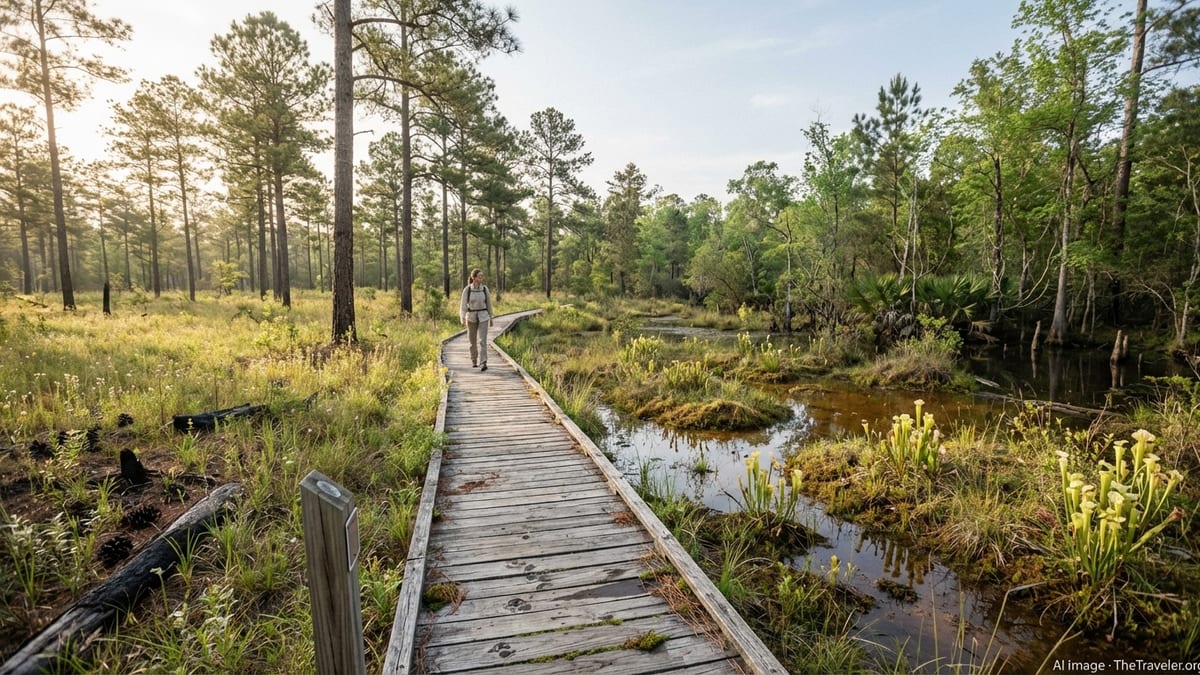
To experience the longleaf pine savannah and carnivorous plants, point your car toward the Hickory Creek Savannah Unit and the Sundew Trail. This one-mile loop includes boardwalk sections over a pitcher plant bog and a pipeline right-of-way that, despite its industrial origin, now offers ideal open habitat for sundews. These tiny plants, often no bigger than a coin, glisten with sticky droplets that trap small insects. Pale pitcher plants are taller, easier to spot, and add splashes of green and yellow to the bog in spring and summer. The trailhead has a covered picnic area, useful when the midday sun bears down.
Elsewhere in the preserve, the Turkey Creek, Big Sandy Creek, Beech Creek, and Menard Creek Corridor units host additional trails that range from short strolls to more immersive hikes. Some routes follow sandy creeks through mixed pine and hardwood forest, while others traverse low ridges and dips where you can see habitat transitions within a mile or two. The preserve’s trail system is not extensive by Western national park standards, but that limitation is a strength. With a handful of carefully chosen walks, you can see a surprising variety of landscapes without rushing from one epic viewpoint to another.
Carnivorous Plants and Botanical Highlights
One of the reasons Big Thicket captures the imagination of botanists and casual visitors alike is the presence of carnivorous plants. Four of the five carnivorous plant types found in North America occur here: pitcher plants, sundews, bladderworts, and butterworts. They are not everywhere, and you need to know where to look, but with a bit of patience many travelers will find at least one of these species during a visit in the growing season.
Pitcher plants are perhaps the most conspicuous. Pale pitcher plants rise from the wet savannah like clusters of narrow tubes, each filled with fluid. Insects are drawn in by color and nectar, then slip on a waxy interior and tumble into the trap where they are digested. Trails such as the Pitcher Plant Trail and portions of the Sundew Trail pass through established bogs where these plants are relatively common. Late spring and summer are typically the best times to see them in full growth, though seasonal conditions vary from year to year.
Sundews are smaller and reward close observation. These plants form low rosettes dotted with tentacle-like stalks tipped with glistening droplets that resemble dew. The droplets are sticky and sweet, luring small insects that become ensnared. As the captured insect struggles, the leaf slowly curls around it, and digestive enzymes do the rest. Visitors often find sundews along damp, open stretches of the Sundew Trail’s boardwalk and the adjacent right-of-way, where sun reaches the saturated soil.
Butterworts and bladderworts are more elusive, though no less fascinating. Butterworts grow on moist ground, using sticky, taco-shaped leaves to trap tiny insects. Bladderworts live in shallow, acidic waters like bog lakes and sloughs, where small bladders on their submerged leaves act like vacuum traps. When a passing water flea or other small creature touches trigger hairs, the bladder snaps open and sucks in both water and prey. Spotting these species usually requires a trained eye, but knowing they are present underscores the ecological complexity of even the smallest patches of standing water in Big Thicket.
On the Water: Paddling Big Thicket’s Creeks and Rivers
While the trails offer an intimate view of Big Thicket’s forests and savannahs, the preserve truly comes into its own when you get on the water. Creeks, bayous, and rivers wind through the units, creating long corridors of protected riparian forest. For paddlers, these waterways are a chance to slip into a quieter world and see the thicket from underneath its canopy, with overhanging branches, cypress knees, and sandbars that double as resting spots and overnight camps.
The National Park Service highlights three official Texas Paddling Trails within or along the preserve, each offering a clearly defined route with put-in and take-out points. These routes cater to a range of skill levels, from beginners looking for a half-day float on gentle current to more experienced paddlers planning an all-day river trip. Beyond the designated trails, many miles of navigable waterways flow through the preserve’s units, so it is wise to study maps and current conditions before committing to a particular section.
Village Creek and the Neches River are the primary paddling destinations. Their tea-colored waters flow past sandbars, wooded banks, and occasional clearings where wildlife comes to drink. In quieter reaches, you may see river otters, turtles, wading birds, and migratory songbirds flitting between the trees. Backcountry camping is permitted on sandbars along sections of Village Creek and the Neches River, subject to free permits obtained from the visitor center. This combination of paddling and primitive camping lets you experience the preserve after day visitors have left, with starlight reflecting off the water and the sounds of owls and insects filling the night.
Ranger-led paddle trips, offered periodically, are an excellent option for travelers new to moving water or unfamiliar with the area’s natural history. On these outings, park staff or volunteers provide canoes, safety gear, and a running commentary on the geology, plants, and animals you encounter. For independent paddlers, private outfitters and nearby state parks rent kayaks and canoes, though rental boats from state parks generally must be used on-site rather than transported into the preserve. Big Thicket itself does not operate a rental service, so advance arrangements are essential if you do not have your own gear.
Essential Safety, Seasons, and Practical Planning
Big Thicket’s subtropical climate and low-lying terrain shape both the best times to visit and the precautions you need to take year-round. Summers in Southeast Texas are hot and humid, often with high heat indexes that can make even short hikes taxing by midday. Spring and fall offer more comfortable temperatures, along with wildflower displays and active birdlife. Winter can be mild and pleasant for hiking, though periods of rain and high water occasionally limit paddling and access to lower trails.
For both hikers and paddlers, water and weather awareness are critical. On the water, sudden changes in rainfall upstream can alter conditions quickly, turning friendly creeks into swift, debris-laden channels or dropping water levels to the point where you are dragging your boat over exposed limbs and sandbars. The Park Service emphasizes checking water levels and forecasts before committing to a trip, wearing a properly fitted life jacket at all times, and leaving a float plan with someone you trust. Heat, hypothermia, and unexpected overnight stays are all real possibilities if things go wrong on the river.
On land, prepare for heat, insects, and potentially muddy or flooded segments of trail. Even short loops can feel strenuous in summer if you are not accustomed to the humidity. Carry more water than you think you will need, as streams and creeks are not safe drinking sources without proper treatment. Lightweight, breathable clothing, sun protection, and insect repellent are year-round essentials. Ticks and mosquitoes are part of the environment, particularly in wetter habitats, so long sleeves and pants can be as important as bug spray.
Fire and drought also play roles in Big Thicket’s story. The preserve uses prescribed burns to maintain longleaf pine savannahs and other fire-dependent communities, and those operations can temporarily close specific trails or units. At the same time, regional drought conditions can elevate wildfire risk across East Texas, leading to burn bans and, in some years, active fires in surrounding forests. Before your trip, check for current alerts, closures, and burn restrictions issued by the preserve and state agencies. Planning with these realities in mind ensures that you can enjoy the thicket safely while giving land managers the flexibility they need to protect it.
Wildlife Watching, Birding, and Quiet Recreation
Beyond hiking and paddling, much of Big Thicket’s appeal lies in quiet observation. The preserve functions as a crucial refuge for birds, amphibians, reptiles, and small mammals in a region where forests have been fragmented by logging and development. Patient travelers who move slowly and listen carefully often find the most memorable encounters, whether that is a barred owl calling in midafternoon or a chorus of frogs booming from a hidden slough at dusk.
Birders will find the preserve particularly rewarding, especially during spring and fall migration when warblers, tanagers, and other songbirds funnel through the forests. Open pine savannahs attract species that favor scattered trees and grassy understories, while bottomland hardwoods and baygalls harbor woodpeckers, owls, and a mix of resident and migratory species. The park’s ongoing efforts to restore longleaf pine habitat also support species of conservation concern that depend on open, fire-maintained forests.
Herpetologists and casual reptile enthusiasts alike recognize Big Thicket as a stronghold for amphibians and reptiles characteristic of Gulf Coast wetlands. Turtles bask on logs in creeks and bayous, alligators occupy some of the warmer backwaters, and a variety of snakes inhabit both uplands and lowlands. While encounters with venomous species are possible, most will avoid humans when given the chance. Staying on trails, wearing sturdy footwear, and watching where you place your hands and feet are simple measures that make shared use of the habitat safe for both visitors and wildlife.
For many travelers, the preserve’s greatest luxury is a sense of unhurried time. Fishing along the Neches or a nearby creek, picnicking at a shaded table near the Sundew Trail, or simply sitting on a sandbar with your feet in the water all fit the spirit of the place. There are no grand lodges or major restaurants inside the preserve. Instead, you base yourself in nearby towns, then come into the units each day to hike, paddle, or watch birds before returning to local cafés and motels. That rhythm makes Big Thicket an appealing long-weekend destination, especially for travelers from Houston and other parts of Texas who want a break from the city without the logistics of a far-flung trip.
The Takeaway
Big Thicket National Preserve is not a park of single, iconic scenes. It is a place where the details matter: a narrow boardwalk threading through a pitcher plant bog, the sound of water sliding past cypress knees, the way a longleaf pine savannah opens around you after miles of denser forest. Trails, waterways, and a scattered geography invite you to slow down and explore one unit at a time, learning the differences between upland pine ridges, baygall thickets, and the dark ribbons of river that sew them together.
For travelers, that means the best trips are built around curiosity rather than checklists. Choose a few trails that highlight contrasting habitats, schedule at least one day on the water, and allow spare hours for birding, wildflower photography, or simply sitting still. Prepare thoughtfully for heat, insects, and changing water levels, and check for seasonal burns or closures before you go. In return, Big Thicket offers a rare opportunity to see how much ecological variety can fit into a seemingly modest patch of forest and water.
Whether you are a paddler looking for quiet blackwater creeks, a hiker who prefers short but meaningful trails, or a naturalist drawn to carnivorous plants and longleaf pines, the thicket rewards repeat visits. Each season brings new colors, new calls from the canopy, and small changes in the understory that hint at the dynamic processes shaping this landscape. If you are willing to look closely, Big Thicket National Preserve is a place that keeps explaining itself, one trail, habitat, and activity at a time.
FAQ
Q1. Where is Big Thicket National Preserve located?
Big Thicket National Preserve is in Southeast Texas, north and northeast of Beaumont. It consists of multiple separate units rather than one continuous park, spread across Hardin and surrounding counties along the Neches River, Village Creek, and several smaller waterways.
Q2. What are the best trails for first-time visitors?
First-time visitors often start with the Kirby Nature Trail near the visitor center for an introduction to bottomland hardwoods and cypress sloughs, then add the Sundew Trail in the Hickory Creek Savannah Unit to see longleaf pine savannah and carnivorous plants. From there, you can choose additional short hikes in units like Turkey Creek or Big Sandy Creek to experience different forest types.
Q3. When is the best time of year to visit?
Spring and fall are generally the most comfortable times to visit, with warm but moderate temperatures and active wildlife. Wildflowers and carnivorous plants are often showy in late spring and early summer, while fall can bring clearer skies and fewer insects. Summer can be very hot and humid, and winter conditions vary from mild and pleasant to cool and rainy.
Q4. Can I see carnivorous plants year-round?
Carnivorous plants such as pitcher plants and sundews are most visible and colorful during the growing season, typically from late winter or early spring through summer, depending on conditions. In cooler months, some species die back or become less conspicuous. Visiting in spring or early summer gives you the best chance to see vibrant bog communities from boardwalks on trails like the Sundew and Pitcher Plant trails.
Q5. Do I need a permit to hike or paddle in the preserve?
You do not need a permit for regular day hiking or day paddling. However, free permits are required for backcountry camping on river sandbars and for certain other overnight activities. You can obtain camping permits from the preserve’s visitor center. Always check current regulations, as rules can change with management needs and seasonal conditions.
Q6. Are there canoe and kayak rentals available?
The preserve itself does not rent boats for independent use, though it does provide canoes for some ranger-led paddle trips. Independent travelers typically rent kayaks or canoes from private outfitters in nearby communities or from nearby state parks, using the boats on those parks’ waters. If you plan to paddle within the preserve and do not have your own boat, contact local outfitters in advance to confirm rental options and shuttle services.
Q7. What wildlife should I watch for, and are there safety concerns?
Big Thicket is home to a wide range of wildlife, including deer, otters, alligators, turtles, snakes, and many bird species. Most animals avoid humans when given space. Safety considerations include respecting alligators by keeping your distance, watching your step for snakes, and protecting yourself from insects such as ticks and mosquitoes. Staying on trails, avoiding feeding wildlife, and observing from a distance are basic but effective safety practices.
Q8. How should I prepare for the climate and conditions?
Plan for heat and humidity, especially from late spring through early fall. Bring plenty of water, wear lightweight and breathable clothing, and use sun protection. Insect repellent, long sleeves, and long pants help with ticks and mosquitoes. Trails can be muddy or partially flooded after heavy rains, so closed-toe footwear with good traction is recommended. For paddling, always wear a life jacket and check water levels and weather forecasts ahead of time.
Q9. Is Big Thicket suitable for families and new hikers?
Yes. Many of the preserve’s trails are short loops with gentle grades, ideal for families and new hikers. Boardwalks on routes like the Sundew Trail provide accessible viewing of sensitive habitats, and ranger-led walks or paddle trips can be especially engaging for children. As with any outdoor trip, adjust distance and difficulty to your group’s abilities and be conservative in hot or wet conditions.
Q10. Where can I stay and find services while visiting?
There are no lodges or campgrounds operated by the preserve itself, aside from primitive riverbank camping with permits. Most visitors stay in nearby towns such as Kountze, Lumberton, or Beaumont, where you will find motels, restaurants, fuel, and groceries. From these bases, you can drive to different preserve units for day hikes, paddling trips, and wildlife watching, then return to town each evening.