

More news on this day
Bihar is preparing a significant expansion of its international air network, with plans for direct flights from Patna and Gaya to Nepal, Thailand and Singapore as part of a broader strategy to position the state as a stronger gateway for Buddhist circuits and regional tourism.
Get the latest news straight to your inbox!
New Routes Put Bihar Back on the International Aviation Map
Publicly available information shows that the Bihar government has cleared a policy framework to encourage airlines to start or expand international services from Patna’s Jay Prakash Narayan Airport and Gaya Airport, the state’s existing international gateway. The focus is on connecting Bihar directly with key regional hubs, including Kathmandu in Nepal, Bangkok in Thailand and Singapore, routes that are expected to support both tourism and migrant travel.
Reports from regional media indicate that international flights linking Patna to Kathmandu and Gaya to Bangkok, Singapore and other destinations are planned in phases over the next one to two years, aligned with upgrades to airport infrastructure and terminal capacity. In several cases, these routes are described as resumption or scaling up of earlier seasonal or charter-style operations, now being formalised as more regular commercial services.
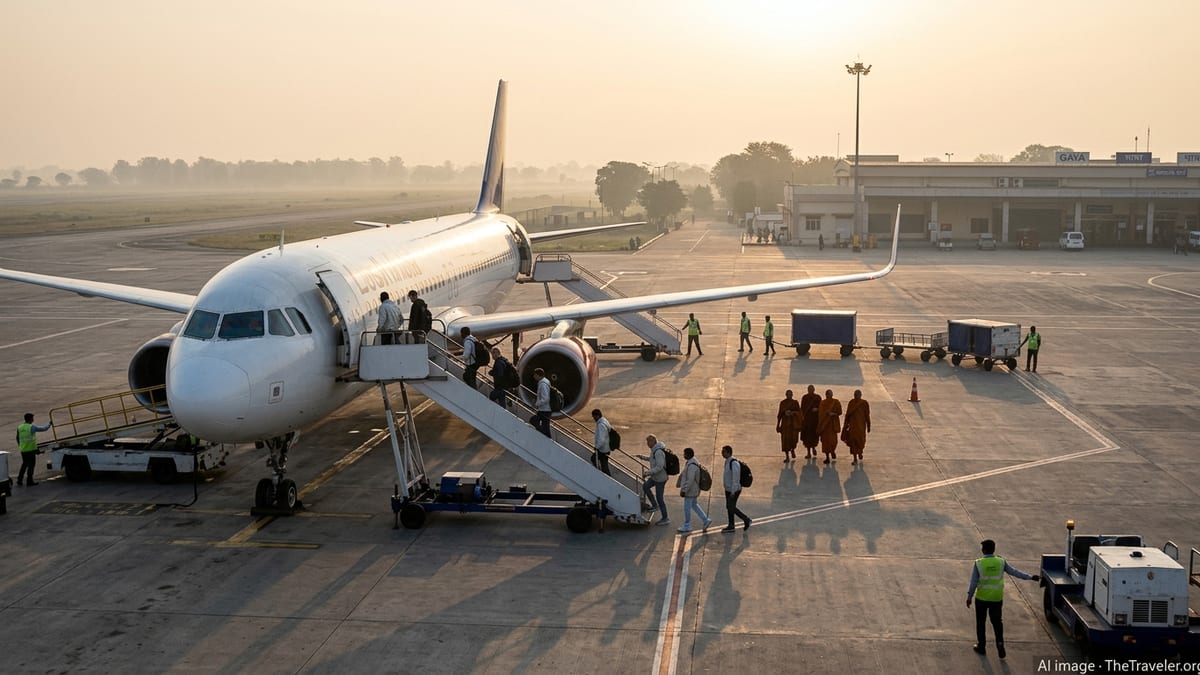
At Gaya, which already handles seasonal international traffic tied largely to Buddhist pilgrimage, new schedules ahead of the 2025–26 tourist season are expected to increase the frequency of flights from Thailand and open more consistent connectivity to Southeast Asia. Local coverage of aviation developments has highlighted recent Bangkok–Gaya operations bringing groups of foreign visitors directly to Bodh Gaya, underlining demand that state planners hope to tap more systematically.
In Patna, the launch of a modern terminal and related airside improvements is being framed as the trigger for the first regular international departures in decades. Plans referencing direct links to Kathmandu, Bangkok and Singapore place the city on course to regain its role as an international node, which currently depends almost entirely on connections through Delhi, Kolkata and other Indian hubs.
Policy Push: Incentives and Cheaper Fuel for Airlines
According to published coverage of recent Bihar cabinet decisions, the state has adopted a targeted incentive scheme to make new international routes commercially viable in their initial years. The framework includes viability gap funding, with financial support reportedly in the range commonly cited as 5 to 10 lakh rupees per round trip flight on specified international sectors from Patna and Gaya.
Media reports also highlight changes to state-level taxes on aviation turbine fuel at eligible airports, with reductions designed to lower operating costs and make short- and medium-haul international flights more attractive to carriers. These fiscal adjustments mirror strategies used by several other Indian states to secure new services to Gulf, Southeast Asian and South Asian destinations.
The incentive policy is structured around clearly defined routes, with Gaya–Bangkok, Gaya–Singapore and proposed Patna–Kathmandu flights often cited as priority corridors. The combination of direct financial support and more competitive fuel pricing is intended to offset initial demand risk, especially outside the peak pilgrimage and holiday travel windows.
Industry observers following the region note that this approach aligns with a wider national pattern in which state governments compete to attract new international links by sharing start-up risks with airlines, particularly on routes that support tourism zones or large overseas worker communities.
Tourism Impact: Faster Access to the Buddhist Circuit
The planned links to Nepal, Thailand and Singapore are particularly significant for religious and cultural tourism. Gaya Airport serves Bodh Gaya, one of the most important Buddhist pilgrimage sites, and is already a seasonal magnet for visitors from across East and Southeast Asia. Direct flights from Bangkok and other Southeast Asian hubs are expected to shorten journeys for pilgrims who currently route through Delhi, Kolkata or other Indian cities before connecting onward by domestic flight or rail.
For tourists coming from or via Singapore, new non-stop services to Bihar would offer an additional gateway to the broader Buddhist circuit that includes Bodh Gaya, Rajgir, Nalanda and sites in neighbouring Uttar Pradesh. Travel industry commentary suggests that easier access could help international tour operators package Bihar more competitively with other regional religious and heritage destinations.
Connectivity with Kathmandu is equally strategic. Nepal is both a source market for visitors to the Buddhist sites of Bihar and a popular outbound destination for Indian travellers seeking mountain tourism and short-haul holidays. Direct flights between Patna and Kathmandu would reduce travel times and simplify itineraries, particularly for religious travellers tracing routes between Lumbini, Bodh Gaya and other historic locations.
State tourism materials already emphasise infrastructure investments in and around major heritage sites, including improved road links and accommodation. Against that backdrop, additional international seats into Gaya and, potentially, Patna are viewed in travel sector analysis as a critical missing piece to translate heritage assets into higher-value, year-round tourism flows.
Infrastructure Upgrades at Patna and Gaya Airports
The aviation push is tied closely to ongoing construction and expansion projects at Bihar’s key airports. At Patna, the new terminal complex has been presented by airport authorities and central agencies as a long-awaited solution to congestion and capacity challenges at one of India’s most space-constrained airports. Once fully operational, the facility is expected to handle significantly higher passenger volumes and offer the processing capabilities required for regular international operations.
Coverage of the project notes improved check-in, security and baggage systems, along with upgraded boarding gates and apron space suitable for narrow-body aircraft typically used on regional international routes to Kathmandu, Bangkok and Singapore. The overall package is designed to support both domestic growth and the addition of cross-border services.
Gaya Airport, already designated as an international airport, has been the focus of multiple upgrades in recent years, including work on terminal facilities and airside infrastructure to better manage peak pilgrimage traffic. Tourism-related documents and media reports describe Gaya as the primary air gateway for Bodh Gaya and surrounding heritage sites, with the potential to function more consistently as an international arrival point beyond the traditional winter charter season.
Further north, plans for additional airports and expansions, including discussions around greenfield or enlarged facilities in other parts of Bihar, are being framed as part of a longer-term aviation strategy. While many of these projects remain at various planning stages, their mention in public documents underlines a broader ambition to spread air connectivity beyond the current Patna–Gaya axis.
What Travellers Can Expect as New Flights Roll Out
For travellers, the most immediate change once services begin will be the ability to fly directly between Bihar and key regional gateways without transiting through other major Indian cities. This is expected to reduce total journey times for many itineraries linking Bodh Gaya with Southeast Asia or connecting Patna with Kathmandu and onward Himalayan destinations.
Prospective passengers can anticipate that inaugural flights on these routes may initially follow limited or seasonal schedules as airlines test demand and align operations with peak tourism periods. Industry experience from other emerging international routes in India suggests that frequency and capacity often build gradually as routes mature and awareness grows among travellers and tour operators.
Travel analysts note that competition among carriers, if more than one airline enters a given route, could influence fares and connectivity options over time. For now, publicly available information points primarily to a policy-driven opening in which state incentives and infrastructure improvements are used to draw airlines into markets that have shown strong potential through charter traffic and indirect travel patterns.
As Bihar strengthens its aviation links to Nepal, Thailand and Singapore, the state is positioning itself not only as a gateway to key Buddhist and heritage sites, but also as a more integrated participant in the wider regional travel network of South and Southeast Asia.