

More news on this day
Toronto’s downtown Billy Bishop Airport flipped a crucial switch on March 10 as U.S. border preclearance formally opened, instantly reshaping Porter Airlines’ links to New York and Boston and promising a faster, more tourism-friendly corridor between the cities.
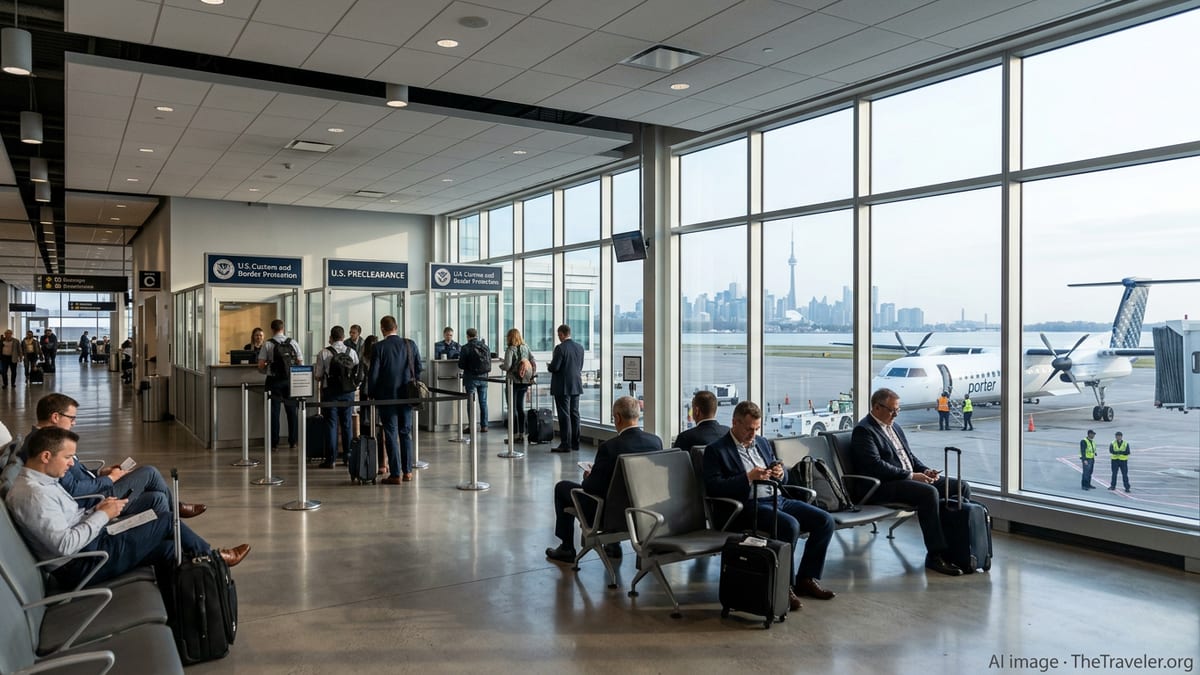
Preclearance Turns Billy Bishop into a Downtown US Gateway
The new U.S. Customs and Border Protection facility at Billy Bishop allows passengers to clear immigration, customs and agriculture checks in Toronto before boarding, arriving in the United States as domestic travelers. For transborder routes that already trade heavily on convenience and short travel times, it is a structural shift that reduces uncertainty at arrival and tightens onward connections.
Billy Bishop becomes the ninth Canadian airport with U.S. preclearance, but its setting on Toronto’s waterfront, a short ferry or pedestrian tunnel ride from the financial core, gives the program an outsized impact. Business travelers who previously had to factor in long queues at U.S. Federal Inspection Stations can now leave downtown offices later and step directly into city centers such as Manhattan and Boston with fewer bottlenecks.
The airport authority is funding the facility through a dedicated per-passenger user fee on U.S.-bound travelers, while removing traditional arrival inspection charges that are baked into fares at many U.S. airports. Officials describe it as a cost-neutral move for most passengers that delivers a clear upgrade in predictability and comfort.
The change aligns Billy Bishop with Toronto Pearson and other major Canadian hubs that already offer preclearance, but with a scale and intimacy designed to preserve the island airport’s reputation for quick processing and compact walking distances.
Porter Builds on New York and Boston Strengths
Porter Airlines, the dominant carrier at Billy Bishop and the airport’s sole cross-border operator for nearly two decades, quickly positioned the preclearance opening as a competitive advantage on its New York and Boston routes. The airline operates multiple daily flights linking downtown Toronto with New York area airports and Boston Logan, serving a mix of corporate travelers, visiting friends and relatives traffic, and short-break tourists.
By clearing U.S. formalities before departure, Porter passengers on these routes now touch down in New York and Boston as domestic arrivals. That can cut as much as an hour from door-to-door journeys in peak periods, particularly at large hubs where inbound international passengers often face extended waits at immigration and customs.
Porter executives have argued for years that preclearance would unlock additional demand from travelers who value time savings more than marginal fare differences. With the system now live, the airline is expected to refine schedules on key business routes, encouraging morning and evening departures that sync with financial market hours and weekend waves that appeal to leisure visitors.
The airline is also expanding its U.S. footprint from downtown Toronto with new destinations and schedule adjustments, signaling that preclearance has given it confidence to deepen its cross-border strategy from Billy Bishop rather than shift growth entirely to larger hubs.
Tourism Boards Eye Stronger New York–Toronto City Pair
Tourism officials in Toronto and New York are seizing on the preclearance milestone to market a smoother, more city-centered travel experience between the two urban hubs. Both cities rely heavily on short-stay visitors who come for culture, dining, sports and events, and who are especially sensitive to the friction of international travel.
For New Yorkers, downtown-to-downtown itineraries now look more appealing: a subway or commuter train to the airport in New York, a precleared flight, and a short hop by shuttle, streetcar or on foot into downtown Toronto hotels. The simplified arrival process is expected to encourage more last-minute weekend trips and short midweek breaks tied to concerts, theater and festivals.
Destination marketers in Toronto are highlighting the combined effect of preclearance and the airport’s waterfront location, pitching itineraries that take travelers from a morning meeting in Manhattan’s financial district to an afternoon walk along Toronto’s Harbourfront or a game in the city’s sports district with minimal downtime in transit.
Industry analysts say the smoother experience could also drive more group and incentive travel between the two cities, with event planners now able to build tighter schedules without as much buffer for border delays on arrival in the United States.
Boston Benefits From Tighter Business and Leisure Links
Boston, another cornerstone of Porter’s U.S. network from Billy Bishop, is set to gain in similar ways from the new preclearance regime. The route connects downtown Toronto with New England’s primary gateway, Boston Logan International Airport, a hub for both corporate travel and academic ties given the region’s concentration of universities and research institutions.
With passengers arriving as domestic travelers, connections in Boston to other U.S. cities become less risky, particularly in tight 45 to 60 minute transfer windows that previously deterred some travelers from booking through tickets. Tourists heading onward to New England’s coastal destinations or ski towns also face a simpler path, picking up luggage and continuing on without an extra security or immigration layer.
Boston tourism officials are expected to use the development to promote more two-city trips that pair the city with Toronto, positioning them as complementary waterfront destinations with strong arts, sports and culinary scenes. Marketing efforts are likely to stress the “no customs on arrival” message for visitors who may have been put off by international travel complexities.
The improved reliability on the Toronto–Boston corridor arrives as both cities emphasize sustainable, urban-centered tourism, encouraging visitors to rely on transit, walking and cycling once they arrive rather than renting cars for short stays.
Competition and Capacity Poised to Grow
The activation of preclearance at Billy Bishop is also reshaping the competitive landscape on Toronto–U.S. routes. Rival airlines are adding or planning new transborder services from the island airport to major U.S. cities, including New York and Boston, directly challenging Porter on key business and leisure corridors.
More carriers and frequencies from a constrained downtown airport suggest competition for premium time slots and a renewed focus on punctuality, onboard service and loyalty perks. Travelers stand to benefit from a broader choice of departure times and fare levels, while tourism authorities anticipate a larger overall pool of visitors as capacity grows.
Airport officials say the preclearance facility was designed with future expansion in mind, balancing tighter security and border controls with passenger comfort. They argue that by handling U.S. formalities in Toronto, Billy Bishop can support more departures without adding to congestion at already crowded U.S. arrival facilities.
As routes ramp up and traveler behavior adapts to the new reality of downtown-to-downtown precleared flying, the Toronto–New York and Toronto–Boston corridors are expected to emerge as test cases for how much a smoother border can stimulate tourism and business links between closely connected cross-border city pairs.