

More news on this day
Biman Bangladesh Airlines is rebalancing its Boeing 787 Dreamliner network between Dhaka, Rome and Toronto, a move that is subtly reshaping how travelers connect between Southern Europe and North America via Bangladesh.
Get the latest news straight to your inbox!
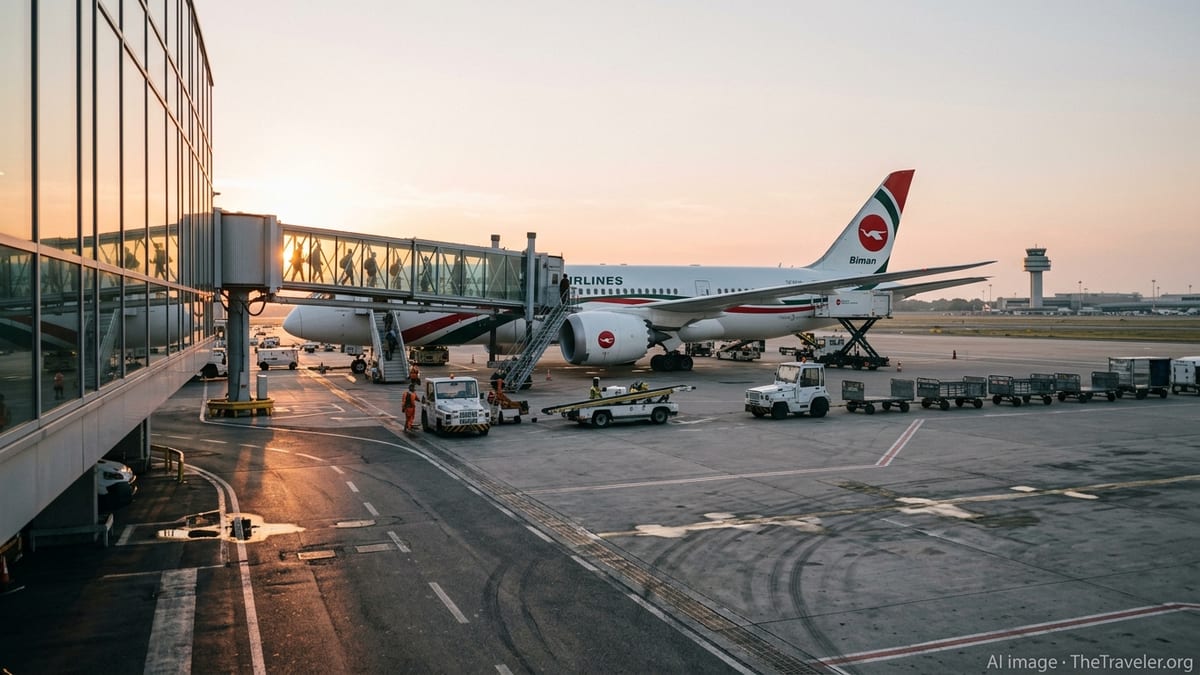
Dreamliner Network Realigned Between Dhaka, Rome and Toronto
Publicly available schedules show that Biman Bangladesh Airlines is consolidating its long-haul operations around its Boeing 787 Dreamliner fleet, with Rome and Toronto emerging as pivotal points in the carrier’s westbound network. Rome Fiumicino has returned to the map as a key European gateway, while Toronto Pearson continues to anchor Biman’s presence in North America.
Industry schedule data and specialist route coverage indicate that Biman resumed nonstop Dhaka to Rome service in March 2024 using Boeing 787-8 aircraft on a three-times-weekly basis, restoring an Italy connection that had been dormant for nearly a decade. The Dreamliner deployment places Rome alongside London and Istanbul as major European touchpoints for the airline.
On the other side of the Atlantic, Biman’s Toronto route has been progressively built up since its launch with Boeing 787 jets, including additional frequencies introduced for peak seasons. Adjustments since 2024 suggest the carrier is seeking a more coherent long-haul pattern, with Dhaka–Rome–Toronto timings calibrated to facilitate same-day or overnight connectivity across the three cities.
Taken together, these network shifts show Biman using its Dreamliner fleet to carve out a niche bridging South Asia, Southern Europe and Eastern Canada, even as the airline continues to refine aircraft rotations and departure times in response to operational and geopolitical pressures.
Rome Returns as a Strategic European Gateway
The reinstatement of Rome Fiumicino in 2024 marked a notable turn in Biman’s long-haul strategy. Aviation news outlets reported that the Dhaka–Rome service, dropped in 2016, was brought back with Boeing 787-8 Dreamliners and a three-times-weekly schedule, targeting both point-to-point demand and onward connections within Europe.
Italian-language aviation coverage highlights that the route quickly became a flagship long-haul operation for the airline in the Schengen zone, sitting alongside its established presence in London and its technical stop operations in Istanbul. The use of modern widebody aircraft has allowed Biman to promote quieter cabins, improved fuel efficiency and competitive flight times between Bangladesh and Southern Europe.
Rome’s position within the airline’s broader network is reinforced by Biman’s decision to maintain Dreamliner operations on the route, including selective upgauging to the larger 787-9 variant on specific dates in 2024. This pattern underlines a strategy of flexing capacity into Rome in line with seasonal peaks, migrant-worker flows and leisure demand from Italy’s Bangladeshi diaspora.
Operational reports have also shown that the Rome–Dhaka sector, like many long-haul services, is sensitive to technical and engineering issues, with occasional disruptions linked to Dreamliner maintenance events. Even so, the persistence of the service and the choice of Rome as a European gateway point to its importance within Biman’s evolving intercontinental footprint.
Toronto Strengthens as Biman’s North American Anchor
Toronto Pearson has simultaneously emerged as Biman’s main bridge into North America. Historical coverage indicates that Dhaka–Toronto flights, operated by Boeing 787 aircraft, were introduced as part of a broader air services framework between Bangladesh and Canada and have since been fine-tuned through schedule and frequency changes.
Local business media in Bangladesh reported that additional weekly frequencies were layered into the Dhaka–Toronto–Dhaka pattern from late 2024, giving travelers more options for both direct travel and onward North American connections via Canadian partners. These moves effectively solidified Toronto as Biman’s long-haul anchor in the western hemisphere.
Subsequent schedule bulletins have documented further timing shifts on the Toronto axis, including earlier departures from Dhaka during specific periods. Publicly available statements attribute some of these changes to airspace considerations, as Biman has at times routed its Toronto and Rome flights to avoid certain regions, lengthening flight times and requiring timetable adjustments.
The end result has been a dynamic but gradually more coherent Toronto operation, with the Dreamliner fleet at its core. Travelers from Bangladesh and the broader South Asian region are increasingly using Toronto as a gateway to the Canadian interior and, via connections, to parts of the United States, while passengers from Canada gain improved one-stop access to Rome and onward to Dhaka.
Airspace Rerouting and the Rome–Toronto Travel Corridor
Biman’s route planning between Dhaka, Rome and Toronto has been influenced not only by commercial demand but also by shifting overflight patterns. In 2025, multiple Bangladesh-based outlets reported that Biman temporarily revised schedules on its Toronto, Rome and London flights as the airline avoided Pakistani airspace amid heightened regional tensions.
Those adjustments, which included earlier departures on the Dhaka–Toronto and Dhaka–Rome services during a defined May 2025 window, effectively recharted parts of the airline’s long-haul network. Longer routings and altered departure times reshaped how connections could be made between Rome and Toronto via Dhaka, requiring travelers to adapt their itineraries while maintaining overall connectivity.
Although those emergency measures were time-limited, they underscored the vulnerability of South Asia–Europe–North America corridors to geopolitical shifts. They also highlighted the flexibility of the Dreamliner platform, whose fuel efficiency and range can help offset some of the operational impact of detours, even as carriers work to protect schedules and minimize knock-on delays.
For passengers moving between Rome and Toronto, the net effect of these changes has been a reminder that the corridor is part of a larger, interdependent network stretching across Eurasia. Biman’s ability to pivot its Dreamliner operations and adjust timings has become a critical factor in preserving reliable travel links between Italy, Bangladesh and Canada during periods of uncertainty.
Implications for Travelers and Competing Hubs
The alignment of Rome and Toronto within Biman’s Dreamliner network has wider implications for global travel flows. By threading Dhaka into a Rome–Toronto axis, the airline is offering an alternative to more established routings via Gulf hubs or Western European megahubs, particularly for travelers originating in Bangladesh and neighboring regions.
For Europe-origin passengers, the Rome link opens additional one-stop options into Bangladesh and select points in South and Southeast Asia that connect over Dhaka. For Canada-based travelers, the Toronto service provides a direct bridge into Bangladesh with potential access to onward regional destinations, all operated by a consistent widebody product.
At the same time, the corridor faces competition from carriers in the Gulf, Europe and North America that also operate 787s and other new-generation aircraft between similar city pairs. Analysts following the South Asia long-haul market note that Biman’s success on these routes will depend on its ability to maintain schedule reliability, competitive pricing and fleet availability while managing seasonal demand peaks such as Hajj traffic.
As schedules continue to evolve, the Rome–Toronto connection via Dhaka demonstrates how a mid-sized national airline can use a focused Dreamliner fleet to reconfigure traditional travel paths. Even incremental timetable and routing shifts are influencing how passengers think about crossing between Southern Europe and Eastern Canada, with Biman’s network choices reshaping the map of global travel links in subtle but significant ways.