

More news on this day
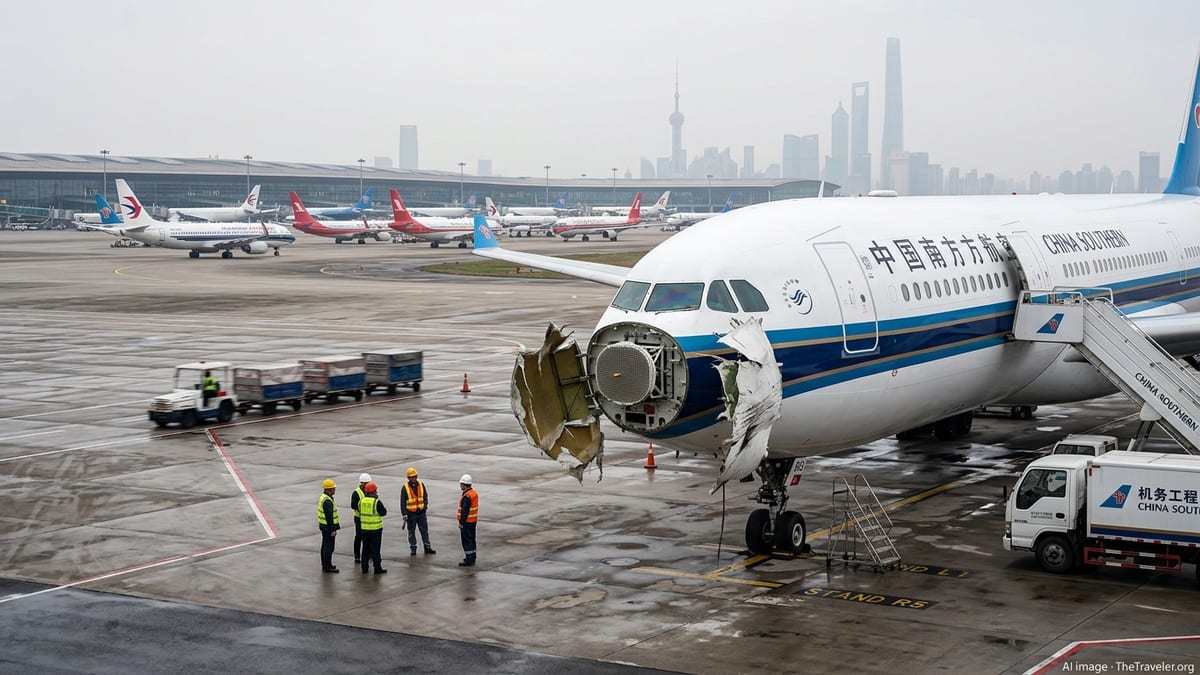
Travelers across China faced delays and diversions after China Southern Airlines flight CZ3554 from Shanghai to Shenzhen was forced to return to Shanghai Hongqiao following a dramatic bird strike that ripped away much of the aircraft’s nose section shortly after takeoff.
Get the latest news straight to your inbox!
What Happened on Flight CZ3554
Publicly available flight-tracking data and photos shared on aviation forums indicate that China Southern flight CZ3554, operated by an Airbus A330, departed Shanghai Hongqiao Airport on the morning of March 21 and was bound for Shenzhen. Shortly after takeoff, the aircraft appears to have collided with a large bird, resulting in extensive damage to the front of the jet.
Images circulating on social media show the A330 on the ground with most of its white composite radome missing. The exposed weather radar dish and supporting structures at the nose are clearly visible, with fragments of the radome hanging from the hinge in front of the cockpit windows.
Data from online flight-tracking platforms suggest that the crew leveled off at a relatively low altitude, entered a holding pattern near Shanghai, and then returned to Hongqiao within a short period of time. Reports indicate that the landing was uneventful and that the aircraft vacated the runway under its own power.
There were no immediate reports of injuries. The scale of the structural damage at the nose, however, has drawn widespread attention from aviation observers and travelers, who have described the incident as one of the more visually striking examples of a bird strike in recent years.
Impact on Passengers and Airport Operations
The sudden return of CZ3554 added to an already busy morning at Shanghai Hongqiao, where traffic peaks with frequent departures on popular domestic routes. The diversion required runway and gate adjustments, with the damaged Airbus A330 occupying an aircraft stand while inspections and initial assessments were carried out.
Travel-focused social media accounts and passenger reports describe a period of uncertainty at the gate as customers waited for information on onward travel to Shenzhen. Some passengers were reportedly rebooked on later China Southern services or transferred to other carriers, while others faced extended waits in terminal areas as airline and airport staff reorganized schedules.
The disruption rippled beyond a single flight. An aircraft heavily damaged at the nose is unlikely to return to service quickly, so the incident effectively removed a widebody jet from China Southern’s rotation. This can trigger knock-on delays and equipment swaps on other routes, particularly on busy domestic corridors where aircraft utilization is high.
Travelers connecting onward from Shenzhen or relying on tight schedules in southern China faced missed meetings and rearranged plans, highlighting how even a single wildlife strike can cascade into broader travel chaos during peak periods.
Why Bird Strikes Remain a Serious Travel Hazard
Bird strikes are a long-recognized hazard in aviation, but most encounters are relatively minor, involving small birds and causing little more than inspection delays. Global safety data published by aviation regulators show that the vast majority of bird strikes do not result in accidents or serious damage to modern airliners.
In this case, early images and descriptions suggest that a large bird or flock likely hit the radome with substantial force. The radome, made of lightweight composite materials designed to be transparent to radar signals, is not a structural part of the fuselage, but losing it can affect aerodynamics and expose sensitive radar equipment at the nose.
The combination of high speed during climb and the mass of the bird can produce enough kinetic energy to shatter the radome. While commercial aircraft are designed with significant safety margins, unexpected damage at the front of the aircraft demands caution. A return to the departure airport, as seen with CZ3554, aligns with standard risk management when crews encounter structural damage or suspect system issues.
Airports in rapidly urbanizing regions face particular challenges as expanding cities, landfills, wetlands and agricultural areas can attract bird populations close to flight paths. Wildlife management teams increasingly rely on a mix of habitat modification, sound deterrents, radar-based bird detection and coordinated airfield inspections to reduce the risk, but incidents cannot be eliminated entirely.
What Travelers on China Southern and Other Carriers Should Expect
For passengers booked on China Southern in the coming days, the removal of an Airbus A330 from service for inspection and repair may lead to schedule reshuffles. Operators often reposition aircraft or substitute different models to cover affected routes, which can change seat layouts, cabin classes and even baggage allowances on short notice.
Travelers transiting Shanghai, Guangzhou or Shenzhen should expect the possibility of minor delays while airlines absorb the impact. Checking flight status frequently on official airline channels and arriving at the airport with extra time is advisable during periods when fleets are under unusual strain.
For those nervous about flying, it is important to note that publicly available safety statistics consistently show that bird strikes rarely compromise the overall safety of flight. Modern aircraft are tested to withstand impacts, and flight crews receive recurrent training on handling wildlife encounters, engine anomalies and damaged instrumentation.
However, wildlife events often lead to longer ground times, inspections and potential aircraft substitutions. That can mean squeezed connections, missed last flights of the day and overnight stays near hubs, particularly for travelers on complex itineraries across China and beyond.
Practical Tips to Navigate Disruptions After a Bird Strike
When a major incident like the CZ3554 bird strike affects an aircraft and schedule, being proactive can help minimize disruption. As soon as a delay or diversion appears on departure boards, passengers can check their booking on the airline’s official website or app to see whether rebooking options are offered.
Travelers on tight connections may wish to contact customer service channels to secure earlier alternatives, as the most convenient seats on later flights typically disappear quickly after a high-profile disruption. Keeping boarding passes, receipts and any written notices from airline or airport staff can also be useful if travelers seek compensation or expense reimbursement where regulations or airline policies permit.
For future trips, booking slightly longer connection windows, particularly when changing planes at busy hubs in regions with heavy bird activity, can reduce the risk of missed onward flights. Travel insurance that explicitly covers missed connections and extended delays can add another layer of protection in the rare cases when wildlife strikes or other unforeseen events trigger substantial schedule changes.
As investigations into the CZ3554 incident progress and repairs to the damaged A330 are assessed, travelers can expect airlines and airports in China to review bird control measures and operational procedures. For passengers on the ground, the immediate effect is mainly inconvenience and delays, but the underlying safety systems that prompt swift returns and thorough inspections are exactly what keep modern air travel statistically very safe, even when nature intervenes.