

More news on this day
China Southern Airlines flight CZ3554 from Shanghai Hongqiao to Shenzhen made an emergency return shortly after takeoff after a suspected bird strike tore away most of the Airbus A330’s nose radome, leaving dramatic images of the aircraft’s exposed weather radar circulating across aviation forums and social media.
Get the latest news straight to your inbox!
Mid-Air Incident Shortly After Departure From Shanghai Hongqiao
Publicly available flight-tracking data indicates that flight CZ3554, operated by a China Southern Airbus A330 registered B-1062, departed Shanghai Hongqiao International Airport on March 21 for the short domestic hop to Shenzhen. Within minutes of takeoff, the twin-aisle jet stopped its climb and turned back toward Shanghai, completing a relatively tight circuit before landing.
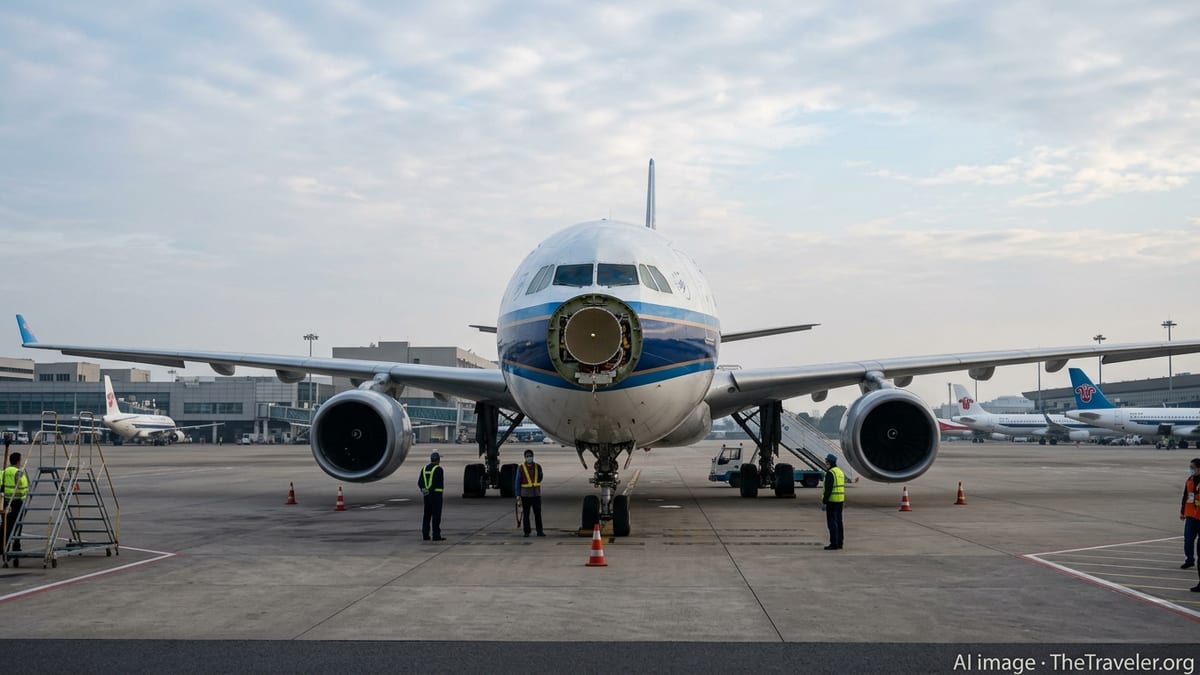
Images shared by aviation enthusiasts appear to show the aircraft on the ground with its nose radome largely missing, exposing the circular weather radar dish and internal structures at the front of the fuselage. The damage has been widely linked to a bird strike that occurred shortly after departure, although the precise moment of impact has not been independently verified.
Reports indicate the crew halted the climb and requested a return to Hongqiao soon after the anomaly was detected. Flight-tracking plots show a relatively short airborne time, consistent with a quick decision to divert back to the departure airport rather than continue toward Shenzhen.
There have been no reports of injuries among passengers or crew, and available information suggests the landing back in Shanghai was controlled and uneventful, despite the highly visible structural damage at the front of the aircraft.
Radome Torn Away, Weather Radar Left Exposed
The photographs that have driven global attention to the incident focus on the missing radome, the streamlined composite nose cone that covers the aircraft’s weather radar. In this case, most of the radome appears to have detached, leaving only fragments near the hinge line and along the lower fuselage, with the radar antenna itself still mounted in place.
Aviation specialists commenting in public forums note that the radome is designed primarily for aerodynamics and to allow radar signals to pass through, rather than as a heavy structural component. As a result, it is relatively thin, and substantial impacts or strong aerodynamic loads can cause it to fail or separate. Observers have speculated that an initial bird strike may have compromised or lifted the radome, and the high-speed airflow during climb then tore it away.
Close-up images circulating online suggest minor damage around the nose structure and possible marking on cockpit windows, but there are no clear indications of deep structural harm to the fuselage or radar assembly. The apparent survival of the radar dish itself has been highlighted by some aviation commentators as evidence that the primary impact energy was absorbed by the radome skin.
While the visual effect of a missing nose cone is dramatic, the incident underscores how certain exterior components can be sacrificed to protect more critical systems and maintain overall aircraft integrity, enabling a safe return to the airport.
Passenger Experience and Operational Disruption
For passengers on CZ3554, the most immediate impact appears to have been the interruption of their journey and a likely period of uncertainty as the aircraft returned to Shanghai. Public posts referencing the flight describe a short cruise followed by descent and a return to Hongqiao, without major onboard disruption being reported.
Operationally, the loss of an Airbus A330 hull to unscheduled maintenance is significant for China Southern, particularly on busy domestic corridors such as Shanghai to Shenzhen. The aircraft involved is expected to remain grounded while inspections, repairs, and regulatory checks are completed, which may affect future rotations and schedules.
Travelers with upcoming bookings on similar routes may experience aircraft substitutions or minor timetable changes as the airline adjusts its fleet plan. Based on patterns in previous technical incidents, some services could be consolidated or reassigned to different aircraft types while the A330 undergoes nose-structure repairs and component replacement.
For those directly affected by the return of CZ3554, rebooking on later flights from Shanghai to Shenzhen is likely to have been the primary resolution, with passengers either continuing the same day or being moved to alternative services depending on availability.
Bird Strikes and Nose Damage in Commercial Aviation
Bird strikes are a long-recognized risk in commercial aviation, particularly during takeoff and landing when aircraft operate at lower altitudes near airports. In most cases, such encounters result in localized damage, engine inspection requirements, or precautionary returns, rather than large structural losses like an entire radome segment.
The severity of the damage on the China Southern A330 has prompted wider discussion among aviation observers about how unusual it is to see a radome almost completely removed. Public commentary from pilots and engineers on aviation forums suggests that a combination of impact and airflow likely contributed, with some pointing out that if the nose cone is partially opened or unlatched, aerodynamic forces at speed can rapidly peel it away.
Despite the striking imagery, current data on commercial safety performance continues to show that such events remain rare. Large airlines operating modern fleets, including China Southern, typically maintain extensive bird-strike mitigation measures at home bases and major hubs, working with airport operators and local authorities on wildlife control and monitoring programs.
The CZ3554 episode will likely be analyzed alongside previous nose-damage events involving other carriers to better understand how radome design, inspection procedures, and departure checks can further reduce the risk of similar failures in the future.
Ongoing Inspections and Implications for Travelers
Following an incident of this nature, the affected aircraft usually undergoes a multi-stage evaluation, starting with initial inspections at the airport and continuing with more detailed structural assessments at a maintenance facility. For the Airbus A330 involved in CZ3554, this process is expected to focus on the forward fuselage, radar system, cockpit windows, and electrical routing near the nose.
Regulators and the airline’s engineering teams are likely to review maintenance logs, recent nose-radome work, and bird-control conditions at Shanghai Hongqiao around the time of the event. Any findings may be incorporated into updated inspection intervals or procedural refinements, both for this specific aircraft and potentially across parts of the fleet if deemed relevant.
For travelers, the immediate takeaway is that the flight returned safely and there have been no publicly reported injuries, reflecting robust design standards and crew training. However, passengers planning near-term trips on domestic Chinese trunk routes may wish to monitor booking platforms and airline notifications closely, as fleet reshuffles following high-profile technical incidents can ripple through schedules for several days.
The incident also serves as a reminder that, while extremely rare, wildlife encounters can still affect air travel even at highly developed airports, and that decision-making by flight crews to return promptly plays a critical role in maintaining safety and minimizing risk for those on board.