

More news on this day
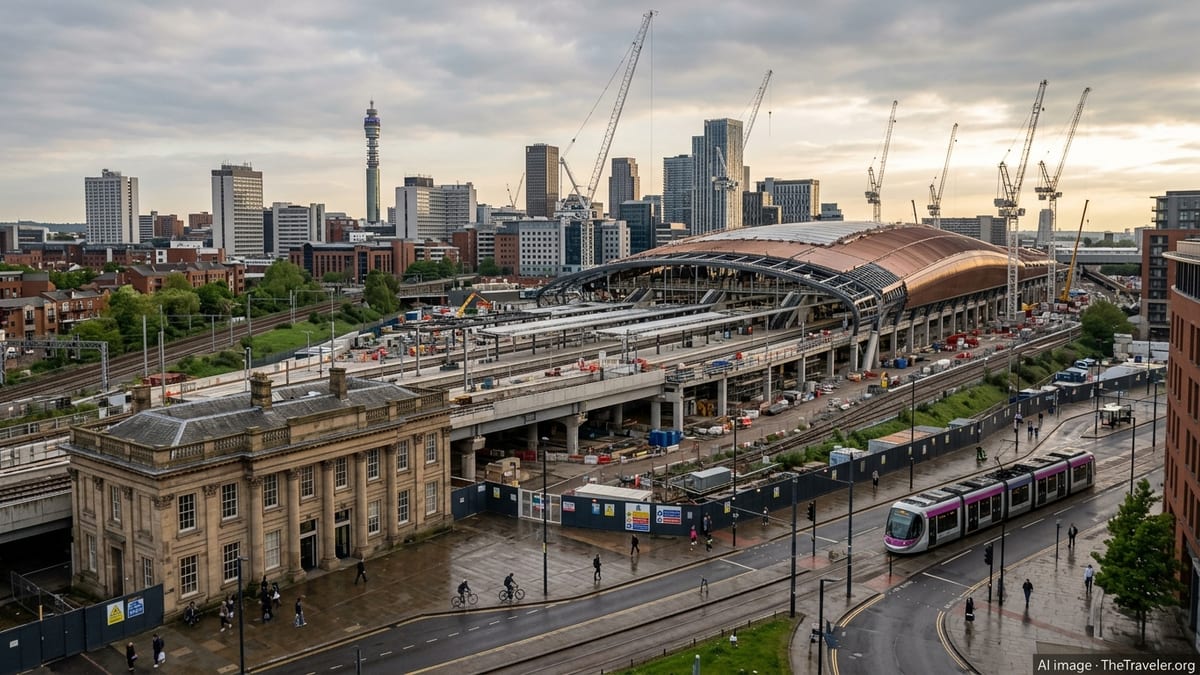
Birmingham’s new £460 million Curzon Street high speed rail station is emerging as the centrepiece of the reshaped HS2 project, with construction advancing on a landmark hub that is expected to anchor faster, cleaner rail travel between London and the West Midlands by around 2030.
Get the latest news straight to your inbox!
A Landmark High-Speed Terminus for a Scaled-Back HS2
The Curzon Street project is designed as the main high-speed terminus for the London to West Midlands section of HS2, after the cancellation of the northern phases left the route focused on links between London Euston and Birmingham. Publicly available information describes the Birmingham station as a key gateway for the redefined network, concentrating long-distance high-speed services in the heart of the city.
The investment in the station itself is widely reported at around £460 million, forming part of a much larger programme of civil works and rail infrastructure in central Birmingham. While the broader HS2 scheme has faced rising costs and political scrutiny, Curzon Street has remained one of its most advanced components, with site preparation and foundation works progressing despite national debate over the project’s future direction.
Early project assumptions had trains running between London and Birmingham sometime between 2029 and 2033. More recent coverage indicates that these dates are no longer considered achievable, and that opening could slip into the early to mid 2030s. Even so, many reports continue to reference 2030 as a working horizon for Curzon Street to be substantially complete and ready to serve as a high-speed hub, subject to wider programme decisions.
The decision to proceed with a large, seven-platform station despite a reduced HS2 network has drawn attention. Analysis highlighted by national media and public audits suggests only three platforms would be required on day one for the curtailed route, prompting questions about capacity planning and long-term expansion scenarios.
Architecture Inspired by Rail Heritage and City Streets
The design for the new Curzon Street station is led by Grimshaw Architects with engineering partners WSP and Arcadis, building on planning consent first granted by Birmingham City Council in 2020. The concept references the historic 1838 Curzon Street station building, which is being preserved and integrated into the new complex, reconnecting the city with one of the earliest chapters in British railway history.
Architectural material released by HS2 depicts a series of sweeping arches and elevated concourses spanning the high-speed platforms, intended to frame views across the city skyline and towards nearby districts such as Digbeth. The scheme has been repeatedly refined, with an emphasis on simplifying complex elements and managing costs while retaining a distinctive civic presence.
Recent design updates approved in 2025 replaced an earlier timber-lined roof concept with copper-coloured aluminium cladding, a move reported as balancing visual impact, fire safety and long-term maintenance with tighter budget controls. Planning documents and design summaries describe a focus on durability, modular construction and efficient use of structural materials.
The station concourse is planned to operate as an open, permeable public space rather than a closed-off transport box. Visualisations show generous glazing, high ceilings and a layout that aligns directly with surrounding streets, reflecting a broader push in UK station design to treat rail terminals as urban gateways and everyday civic rooms.
Net-Zero Operations and Low-Carbon Construction Goals
Curzon Street has been promoted by HS2 as one of the most environmentally focused rail stations in the United Kingdom. Project documentation states that the station is designed to be net zero in operation, using a combination of on-site energy generation, efficient building systems and careful management of embodied carbon in materials.
HS2’s own updates report that detailed design changes have delivered an estimated 55 percent reduction in whole-life carbon compared with earlier iterations, achieved through leaner structural solutions, reduced material volumes and lower-carbon alternatives. This approach aligns with national climate targets and with the broader argument that high-speed rail can provide a lower-emission alternative to domestic flights and motorways.
The station roof and platform canopies are expected to host extensive solar arrays, covering several thousand square metres. These photovoltaic panels are intended to supply a significant share of the station’s electricity demand, supplemented by highly efficient heating, cooling and ventilation systems controlled through smart building management.
Water-use reduction is another key element, with published design information highlighting rainwater capture and reuse for non-potable needs such as toilet flushing and landscape irrigation. Together with extensive planting in the public realm, these features are framed as part of a long-term climate resilience strategy for central Birmingham.
Transforming a Former Industrial Fringe into a New City Quarter
The Curzon Street station site occupies land that was long characterised by rail yards, light industry and fragmented streets on the eastern edge of Birmingham city centre. Local planning documents describe the new station as a catalyst for transforming this underused area into an expanded core, stitching together the city centre, Eastside, the Knowledge Quarter and Digbeth’s creative and residential districts.
Plans for the station forecourt, often referred to as Station Square, envisage a broad pedestrian plaza with trees, seating, and step-free connections to surrounding streets. The aim is to create a high-quality urban space that functions as much as a local meeting point and thoroughfare as a gateway for high-speed passengers.
Design material indicates that new walking and cycling routes will pass under and around the station viaducts, connecting to universities, colleges and cultural venues nearby. This mirrors a wider West Midlands strategy that seeks to use major transport investments to support denser, mixed-use neighbourhoods rather than car-oriented sprawl.
Local economic studies linked to the wider Birmingham Curzon HS2 Masterplan anticipate that the station and its surroundings could attract significant private-sector development in offices, hotels, housing and education facilities over the next decade. While the overall HS2 network has been scaled back, city planners continue to frame Curzon Street as a once-in-a-generation chance to reshape the eastern side of the centre.
Connectivity with Metro, Classic Rail and Wider UK Travel
A central objective of the Curzon Street scheme is tight integration with existing public transport. Transport for West Midlands strategy documents show the West Midlands Metro extension running alongside and beneath the station, linking the high-speed platforms directly to the city’s tram network and to key destinations such as New Street, Snow Hill and the Jewellery Quarter.
The station is also designed to sit within walking distance of Birmingham Moor Street, one of the city’s main conventional rail hubs. Plans call for upgraded pedestrian routes between the two termini, creating an interchange between HS2 services and regional and intercity trains towards the West Midlands, the Cotswolds and London Marylebone.
Bus routes and coach services are expected to be reorganised around Curzon Street as construction advances, with dedicated pick-up and drop-off areas beneath the viaducts and on adjacent streets. Local transport plans emphasise step-free access, cycle parking and limited private car access, reflecting ambitions to prioritise active and shared travel modes in the city core.
In the wider national context, Curzon Street is set to complement the planned Birmingham Interchange station near the airport and the NEC, which will serve as a parkway stop on the same HS2 line. Together, these two West Midlands stations are intended to improve access to the region for long-distance rail travellers, potentially shortening journey times, relieving pressure on existing mainlines and reinforcing Birmingham’s role as a central node in the UK’s rail network over the next decade.