

More news on this day
A historic blizzard sweeping across New York, Boston and the wider I-95 corridor has paralyzed air and ground transport, forcing major Gulf carriers Emirates and Etihad to cancel or rethink long-haul schedules into the northeastern United States and leaving thousands of transatlantic travelers scrambling to rebook.
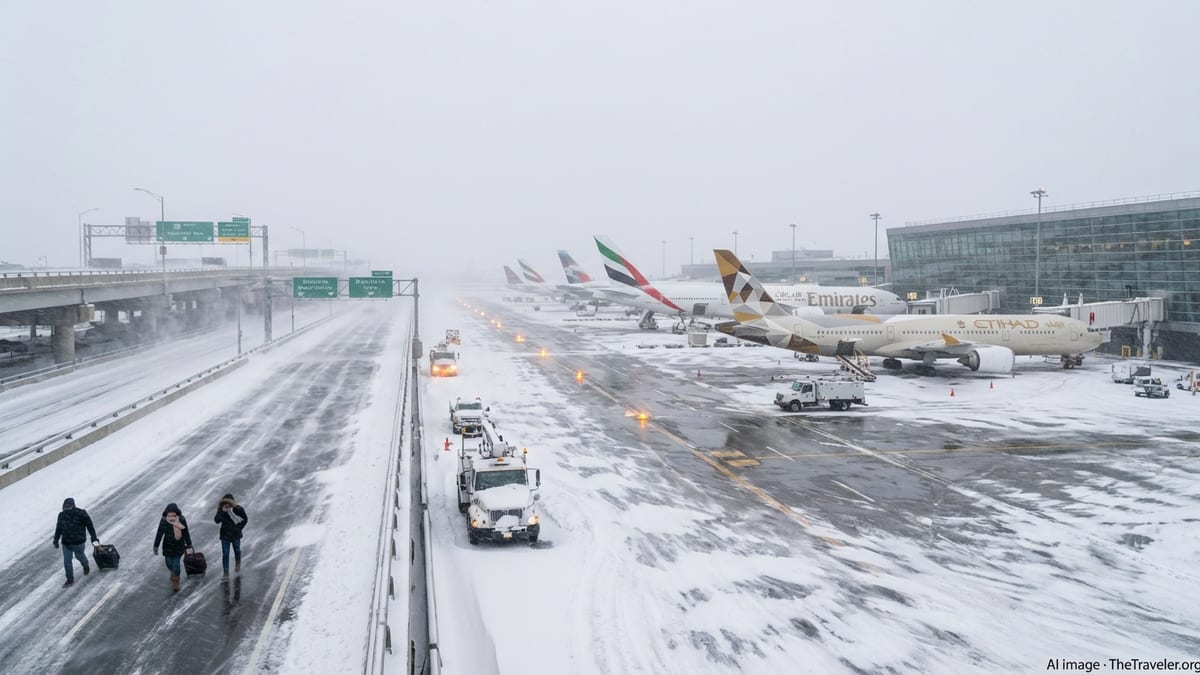
Blizzard of 2026 Freezes the Northeast’s Air and Ground Networks
The strongest nor’easter in a decade roared up the Eastern Seaboard on February 23, 2026, dumping one to three feet of snow from Maryland to Maine and knocking out power to hundreds of thousands of customers. Key cities along the I-95 corridor, including New York and Boston, declared states of emergency as whiteout conditions, hurricane-force gusts and deep snowdrifts brought normal life to a standstill.
Airports that anchor transatlantic and transcontinental travel have been especially hard hit. Nearly all departures from New York’s major gateways – John F. Kennedy, LaGuardia and Newark Liberty – were canceled on Monday, while Boston Logan saw the vast majority of its schedule wiped out as runways closed periodically for plowing and de-icing. Flight-tracking data showed more than 5,000 flights canceled in a single day across the United States, with New York and Boston at the epicenter.
On the ground, travel bans for non-essential vehicles were imposed in parts of New York, New Jersey, Rhode Island and Massachusetts, with stretches of I-95 effectively shut down. Rail and bus operators curtailed or suspended services, compounding the challenge for air passengers trying to reach or leave northeastern airports once flights eventually resume.
Although the storm’s most intense phase is expected to pass within 24 to 36 hours, aviation officials warn that the recovery will take days as airlines reposition aircraft and crews, clear backlogs and wait for airport operations and access roads to return to safe capacity.
Emirates and Etihad Trim New York and Boston Schedules
Among the long-haul carriers most affected are Emirates and Etihad, which rely on New York and Boston as key North American gateways from Dubai and Abu Dhabi. As blizzard conditions intensified on February 23, both airlines began proactively canceling or consolidating services in and out of the region to avoid aircraft being trapped on the ground and crews running out of legal duty hours.
Etihad has canceled multiple rotations between Abu Dhabi and New York JFK, as well as its Abu Dhabi–Boston service, across February 23 and 24. Affected flight numbers include core daily departures such as EY001 and EY002 between Abu Dhabi and New York, along with EY007 and EY008 linking Abu Dhabi and Boston. The airline has warned that additional changes remain possible should airport restrictions extend beyond the initial storm window.
Emirates, which operates several daily services between Dubai and New York JFK and serves the wider northeast via codeshare connections, has also scrubbed select flights and is placing passengers onto later departures where seats permit. Both airlines are emphasizing safety and regulatory compliance, noting that strong crosswinds, low visibility and limited runway availability leave little margin for safe long-haul arrivals into the region.
For travelers, the practical impact is a sharp reduction in nonstop options between the Gulf and the northeastern United States for at least two days, with knock-on effects for those connecting onward to Canada, the U.S. domestic network or Caribbean destinations through New York and Boston hubs.
What Gulf-Based and European Travelers Should Do Right Now
For passengers currently in Dubai, Abu Dhabi or European hubs holding tickets to New York, Boston or other northeastern cities over the next several days, the most urgent step is to verify the precise status of your flight before leaving for the airport. Schedules are changing by the hour as airports update their capacity limits and airlines adapt to evolving runway and taxiway conditions.
Emirates and Etihad are both offering flexible rebooking options for customers scheduled to travel during the storm window. In practice, this typically means passengers can move to another date within a defined period without change fees, though fare differences may still apply. Agents are prioritizing those whose flights have been canceled outright, so travelers seeking voluntary date changes should be prepared for longer call-center and airport wait times.
Transatlantic travelers with tight onward connections, such as same-day links from New York to smaller U.S. cities, should assume that “legal” minimum connection times may not be realistic for several days. Where possible, rebook itineraries to include longer layovers or overnight stops, especially if your inbound long-haul sector is among the first to operate after the storm when congestion at immigration, baggage claim and security will be at its worst.
Those already in the United States and planning to return to the Gulf should also monitor their departure airports closely. Even after skies clear, it can take time for full long-haul schedules to resume, and westbound flights may be consolidated or retimed as aircraft and crew are repositioned. Reasonable travel insurance policies with trip interruption coverage may help recover additional accommodation and subsistence costs incurred during extended delays.
Rerouting Options Beyond New York and Boston
With New York and Boston capacity constrained, some travelers may be able to reroute through alternative U.S. or Canadian gateways less affected by the storm. On the East Coast, airports farther south along the I-95 corridor, such as Washington Dulles or Charlotte, may recover more quickly from the blizzard, though they too have experienced disruptions and limited spare capacity for additional long-haul passengers.
For Gulf passengers connecting via European hubs, one strategy is to retime travel to arrive in the Northeast later in the week, when runway conditions, de-icing queues and ground access are expected to improve. Another is to swap final destinations from storm-hit airports to more southerly or inland options and complete the last leg by domestic flight once the system fully clears. This approach works best for flexible itineraries and travelers comfortable with multi-hop journeys.
Some corporate travel managers are advising their teams to avoid the Northeast entirely for the next several days, routing via Midwest hubs such as Chicago or Detroit where feasible, then backtracking to East Coast destinations after the worst of the operational backlog has passed. While this can add distance and time, it may improve reliability for mission-critical trips that cannot be postponed.
However, given the scale of the Blizzard of 2026 and the nationwide ripple effects already visible in the flight network, travelers should keep expectations realistic. Seats on alternative routings are limited, fares for last-minute inventory are elevated, and same-day fixes may not always be possible, especially for families or large groups traveling together.
Practical Tips for Navigating the Days Ahead
For those who must travel despite the storm’s aftermath, preparation is essential. Build redundancy into your plans by allowing extra time at every stage of the journey, from reaching the airport on potentially narrowed or icy roads to clearing security alongside bigger-than-usual crowds. Keep digital and printed copies of your itineraries, ticket numbers and airline contacts in case mobile networks or apps become unreliable during peak rebooking periods.
Pack as though an unplanned overnight stay is possible even on what appears to be a straightforward same-day itinerary. Essential medications, chargers, warm clothing and basic toiletries should go in your carry-on, not in checked baggage that may be delayed or misrouted as airlines work through mounting backlogs. Families with young children may wish to add snacks and small entertainment items to reduce stress during long waits.
Travelers unfamiliar with winter operations in the northeastern United States should also be prepared for extensive de-icing procedures that can add significant time between boarding and takeoff. This is normal and safety-critical, and it may occur even after the sun returns if residual snow, ice or freezing moisture is present on aircraft surfaces or taxiways.
Finally, flexibility remains the traveler’s most valuable asset. With New York, Boston and the broader I-95 belt still digging out from a once-in-years blizzard, airlines, airports and transport authorities are working under exceptional strain. Being willing to adjust dates, accept alternative routings or split groups across flights can significantly increase your odds of getting where you need to go as the transatlantic system gradually recovers.