

More news on this day
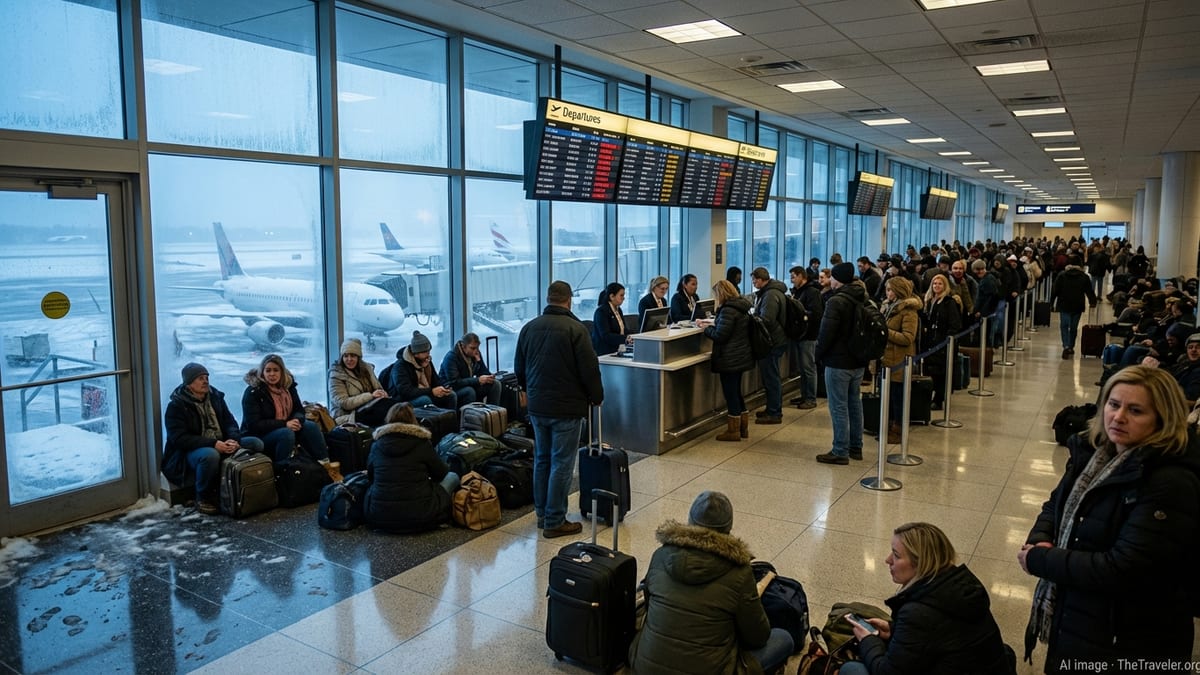
Hundreds of travelers were left stranded across the United States on Monday as Dallas–Fort Worth recorded 119 new flight cancellations and 128 delays amid a powerful winter storm, while blizzard warnings and emergency declarations in the Northeast triggered thousands more disruptions for United, Spirit, JetBlue, Frontier and other carriers from Boston to Philadelphia and Newark.
Winter Storm Hernando Turns Northeast Corridor Into No-Fly Zone
A rapidly deepening winter storm, widely referred to by forecasters and airlines as Winter Storm Hernando, effectively shut down much of the U.S. Northeast aviation network on February 23, 2026. Flight-tracking data showed more than 5,300 flights canceled nationwide by Monday morning, on top of thousands of weekend disruptions as snow, high winds and whiteout conditions swept across the region.
Major coastal hubs including Boston Logan, New York’s JFK and LaGuardia, Newark Liberty and Philadelphia International saw cancellation rates approaching or exceeding 90 percent of scheduled operations. Airlines preemptively grounded departures as blizzard warnings stretched from the mid Atlantic through New England, with meteorologists reporting snowfall rates of up to 2 to 3 inches per hour and gusts near 70 miles per hour in exposed coastal areas.
By early Monday, close to 40 million people were under blizzard warnings and tens of millions more under winter storm advisories, prompting governors and mayors to declare states of emergency and issue travel restrictions. Aviation authorities warned that the storm’s impacts on aircraft and crew positioning would ripple well beyond the immediate blizzard zone for days.
Dallas–Fort Worth Disruptions Ripple Across National Networks
While the brunt of the storm’s snowfall targeted the Northeast, its sprawling footprint and associated cold front also disrupted operations at Dallas–Fort Worth International Airport, one of the nation’s most critical connecting hubs. By midmorning, the airport had logged at least 119 new cancellations and 128 delays, according to operational tallies, as airlines adjusted schedules in anticipation of further weather deterioration and downstream constraints.
Carriers at Dallas–Fort Worth faced a complex operational puzzle. Some flights were scrubbed due to icy conditions and low visibility in North Texas, while others were canceled or delayed because their aircraft and crews were stranded at shuttered Northeast airports. With American Airlines and its regional partners using Dallas–Fort Worth as a key transfer point, disruptions there quickly cascaded into missed connections for travelers heading to or from the storm-battered East Coast.
Passengers on transcontinental and international itineraries also felt the impact, as long-haul services requiring precise aircraft rotations encountered gaps in fleet availability. Even travelers flying between relatively unaffected regions such as the Mountain West and West Coast encountered delays when their schedules passed through Dallas–Fort Worth at any point in the day.
Boston, Newark and Philadelphia Bear the Brunt of Cancellations
Among East Coast airports, Boston Logan, Newark Liberty and Philadelphia International emerged as some of the hardest-hit hubs. At Boston Logan alone, several hundred flights were canceled and well over a hundred delayed as Hernando’s strongest bands swept across coastal New England, combining heavy snow with gale-force winds and periods of near-zero visibility on the airfield.
Newark, a primary hub for United Airlines, reported the grounding of more than 80 percent of its daily schedule as crosswinds exceeded safe operational thresholds for takeoffs and landings on multiple runways. Philadelphia, a key base for American Airlines and a growing focus city for several low-cost carriers, saw hundreds of flights canceled as plows struggled to keep ahead of rapidly accumulating snow and drifting.
With these three airports sitting on some of the country’s densest domestic and transatlantic corridors, the operational freeze produced a knock-on effect across dozens of secondary airports. Flights into smaller Northeastern and Mid-Atlantic cities, many of them operated by regional affiliates, were canceled preemptively once it became clear that the mainline hubs feeding them would remain paralyzed through much of Monday.
United, JetBlue, Spirit, Frontier and Others Struggle to Maintain Schedules
Airlines with a heavy presence in the Northeast bore the brunt of the storm’s aviation fallout. JetBlue, which relies on Boston and New York as core hubs, canceled the vast majority of its operations for the day, including many of its shuttle-style services along the Interstate 95 corridor. United, with its major hub at Newark and a significant schedule at Washington-area airports, also recorded large-scale cancellations and delays as the storm’s footprint expanded.
Ultra-low-cost carriers Spirit and Frontier faced their own challenges as point-to-point networks collided with closed hubs and stranded aircraft. While these airlines do not operate the same banked hub structures as legacy carriers, their relatively lean fleets and tight aircraft utilization meant that the loss of even a handful of flights in the Northeast produced outsized network disruptions. Routes connecting Florida and other Sun Belt destinations to Boston, Newark and Philadelphia were particularly affected as travelers sought to return from winter getaways.
Legacy stalwarts Delta and American also issued widespread travel waivers and scaled back schedules, even on routes where conditions remained marginally flyable. Executives and operations managers framed the move as a safety-first decision, emphasizing that crews must be able to divert or hold as needed without risking fuel constraints or airfield gridlock at already saturated diversion airports.
Emergency Declarations, Travel Bans and "Impossible" Road Conditions
On the ground, conditions mirrored the turmoil in the skies. Governors in several Northeastern states, including New York, New Jersey, Pennsylvania and Massachusetts, declared states of emergency as Hernando intensified on Sunday night and into Monday. Local officials issued travel bans or strong advisories against non-essential road use across swaths of the region, citing what the National Weather Service described as “impossible travel conditions” in some zones.
In New York City, officials closed schools and curtailed some public transit services, while warning residents to remain indoors during the height of the storm. Similar measures were announced in Boston, where authorities urged drivers to keep vehicles off major arteries to allow plows and emergency vehicles to operate. Coastal communities from New Jersey through Cape Cod faced the added threat of coastal flooding as strong onshore winds coincided with high tides.
These moves, while aimed at public safety, compounded challenges for travelers attempting to reach or depart from airports. Many passengers who had not yet received formal cancellation notices found it impossible to safely get to the terminal, and ride-hailing and public transport services were either suspended or severely curtailed at peak storm periods.
Thousands of Travelers Stranded, From Hubs to Regional Gateways
Across the country, airport concourses transformed into ad hoc waiting rooms as travelers faced extended delays or abrupt cancellations. At Dallas–Fort Worth, some passengers woke to find their morning departures scrubbed overnight, leaving them to line up at customer service desks that quickly snaked through multiple gate areas. Families attempting to connect to Boston, Newark or Philadelphia were among the first to be told that alternative flights might not be available for days.
In the Northeast, where airports had effectively ceased flying, many passengers never made it to the terminals at all. Those already stuck at hubs like Boston Logan, Newark Liberty and Philadelphia International reported full gate areas, limited food service options and difficulty securing last-minute hotel rooms as nearby accommodations filled with displaced travelers and crews. Airport staff set out cots and blankets in some concourses, recalling similar scenes from previous historic storms.
Regional airports in the Midwest and South also saw rising numbers of stranded passengers as connecting flights to the Northeast vanished from departure boards. Even cities far from the snowfield, such as Atlanta, Orlando and Chicago, dealt with crowds of travelers trying to rebook itineraries that had relied on now-frozen hubs. Airline agents advised many passengers to accept refunds or travel credits and replan trips entirely once operations stabilize.
Airlines Roll Out Waivers, Rebooking Windows and Fee Flexibility
As it became clear that Hernando would produce several consecutive days of severe disruption, airlines moved to expand winter-weather waiver programs. United extended its “Northeast Winter Weather” waiver to cover a broad set of airports including Newark, Boston, Philadelphia and major Washington-area fields, allowing affected passengers to rebook new itineraries within specific travel windows without change fees or fare differences, provided they remained in the same cabin.
JetBlue offered similarly flexible policies for customers traveling through its New York and Boston networks, waiving both change and cancellation fees and, in some cases, fare differences for those willing to shift trips later into the week. Spirit and Frontier reminded customers that longer delays or cancellations on their flights could qualify them for refunds instead of credits, in line with company policies highlighted in pre-storm travel advisories.
Industry analysts noted that such waivers have become a standard tool in managing large-scale weather events, encouraging passengers to voluntarily move off peak storm dates and reducing the likelihood of overcrowded terminals. However, the sheer scale of Hernando’s impact, combined with prior winter weather in late January, meant that spare seats on alternative flights were limited, particularly on peak business and leisure routes along the East Coast.
Operational Recovery Could Stretch Well Beyond the Storm
Even as forecasters predicted that snowfall would ease across much of the Northeast by late Monday, aviation experts cautioned that a full return to normal schedules would lag behind the weather by several days. Crews displaced from their scheduled rotations by duty-time limits, aircraft parked out of position at unaffected airports, and continued deicing needs in cold air behind the storm all threatened to slow the recovery.
Air traffic control capacity presented another constraint. With multiple major centers managing reroutes around remaining snow bands and high winds, the Federal Aviation Administration coordinated closely with airlines to meter departures and arrivals into key hubs. Ground stops and flow-control programs remained possible at Boston, Newark and Philadelphia on Tuesday and beyond, even under improving skies.
Travel advisors and airline communications teams urged passengers with non-urgent travel plans to consider postponing trips or rebooking later in the week to help ease the load during the first wave of recovery operations. For those who must travel, officials recommended arriving at airports early, keeping carry-on bags light to speed boarding, and monitoring airline apps in real time for gate and schedule changes that could occur with little notice.
What Travelers Should Expect in the Coming Days
With the storm still in progress and recovery plans evolving, travelers across the United States were advised to brace for continued disruption. Even in regions spared the heaviest snowfall, flights may depart late or arrive out of sequence as airlines prioritize restoring core routes and repositioning aircraft and crews. Short-notice cancellations remain possible where residual icing, high winds or runway conditions fall below safety thresholds.
Experts say that passengers connecting through Dallas–Fort Worth, Boston, Newark, Philadelphia, New York or Washington-area airports should pay particular attention to itinerary changes and leave generous buffers for connections. Those booking new travel are being encouraged to consider nonstop options whenever possible to reduce exposure to cascading disruptions in multi-leg journeys.
For hundreds of travelers already impacted, the immediate focus is simply getting home. With Hernando joining a growing list of severe winter events in recent years, both airlines and passengers are once again being reminded that even the most carefully built travel plans can be upended in a matter of hours when a historic storm barrels across some of the country’s most critical aviation corridors.