

More news on this day
Los Angeles International Airport is grappling with a cascading wave of schedule chaos as a historic Northeast blizzard and wider operational strains trigger 110 delays and 42 cancellations involving JetBlue, American Airlines, United and Delta, disrupting long-haul and domestic links to New York, Chicago, London, Tokyo and other key U.S. cities.
Ripple Effects From a Northeast Blizzard Hit LAX
The latest round of disruption reaches Los Angeles from more than 2,000 miles away. A powerful winter storm that slammed the U.S. Northeast on February 23 and 24 has forced airlines to pare back schedules nationwide, grounding aircraft and leaving crews out of position. While New York and Boston have borne the brunt of the weather, the knock-on effects are now being felt at major West Coast gateways, including Los Angeles International Airport.
Data from flight-tracking and airport operations shows at least 42 cancellations and 110 delays tied to Los Angeles services across JetBlue, American Airlines, United Airlines and Delta Air Lines. Many of these flights are not directly weather-affected over Southern California skies but are linked to planes and crews scheduled to rotate through storm-hit hubs in New York, New Jersey, Boston and Philadelphia.
On Monday alone, nearly 150 flights were canceled at LAX as the nationwide disruption deepened, with further schedule adjustments spilling into Tuesday. Airport officials describe a patchwork of irregular operations, from early-morning departures leaving on time to late-afternoon transcontinental services pushed back for hours while airlines wait for inbound aircraft to arrive.
For travelers, the experience is uneven but increasingly tense. Some departures to the Midwest and East Coast have left close to schedule, while others to the same cities have been scrapped or delayed by several hours as carriers juggle gate space, maintenance windows and crew duty limits.
Major Carriers Struggle to Stabilize Networks
JetBlue has emerged as the most acutely affected airline, mirroring its struggles across the Northeast. With a dense network of flights into New York and Boston, the carrier continues to cancel a significant share of its schedule as it works through a backlog of disrupted operations. Many of the Los Angeles cancellations involve eastbound JetBlue services that depend on aircraft cycling through storm-battered hubs.
American Airlines, United Airlines and Delta Air Lines are also contending with extensive systemwide knock-ons. Each of the three legacy carriers has trimmed operations at their key East Coast and Midwest hubs, including New York, Chicago and Washington, in order to focus on safety and allow time to clear runways and deice aircraft. That means some westbound flights to Los Angeles are either heavily delayed leaving their origin, or canceled outright, which in turn erases the matching departure from California.
Carrier representatives say they are offering standard flexible rebooking policies, with change fees waived on many affected routes and dates. However, same-day availability has become scarce on popular transcontinental routes. Travelers hoping to reroute through alternative hubs such as Atlanta, Dallas or Denver are finding that backup options are filling quickly, especially for those connecting to onward long-haul flights.
Operational planners within the airlines expect the reset to take several days. Even as the storm system moves off the Atlantic coast and runway conditions improve in the Northeast, it will take time to reposition aircraft, rebuild crew rotations and absorb stranded passengers into future departures without overloading already busy flights.
Key Routes Affected: New York, Chicago, London and Tokyo
The most visibly affected routes for Los Angeles travelers are the high-demand corridors linking LAX with New York and Chicago. Transcontinental services to New York’s John F. Kennedy and LaGuardia airports, along with flights to Newark Liberty, have seen clusters of cancellations as those airports temporarily reduced operations or, at times, nearly shut down departures during the height of the blizzard.
Travel to Chicago, a crucial domestic hub for both American and United, has remained technically possible but unreliable. Even when O’Hare and Midway have stayed open, heavy snow and strong winds in the wider region have slowed arrivals and departures, lengthening turnaround times and creating missed connections for Los Angeles passengers relying on Chicago as a link to smaller Midwestern and East Coast cities.
The disruption is also reaching across the Atlantic and the Pacific. Some transatlantic flights between Los Angeles and London are experiencing rolling delays when inbound aircraft from storm-struck East Coast gateways arrive late into Heathrow. In several cases, long-haul services have been rescheduled or combined to help airlines consolidate capacity. On the Pacific side, select flights to Tokyo are being delayed as carriers rework global aircraft rotations that normally depend on a precise sequence of North American and transoceanic legs.
Beyond these marquee routes, a web of U.S. domestic connections is being tested, from Boston-bound leisure travelers returning from California holidays to business passengers trying to reach secondary cities via hubs in Dallas, Denver, Minneapolis and Houston. Even where the weather is calm, those journeys are vulnerable when a single disrupted transcontinental leg removes the aircraft or crew needed for the next sector.
Passengers Face Long Lines, Uncertainty and Limited Alternatives
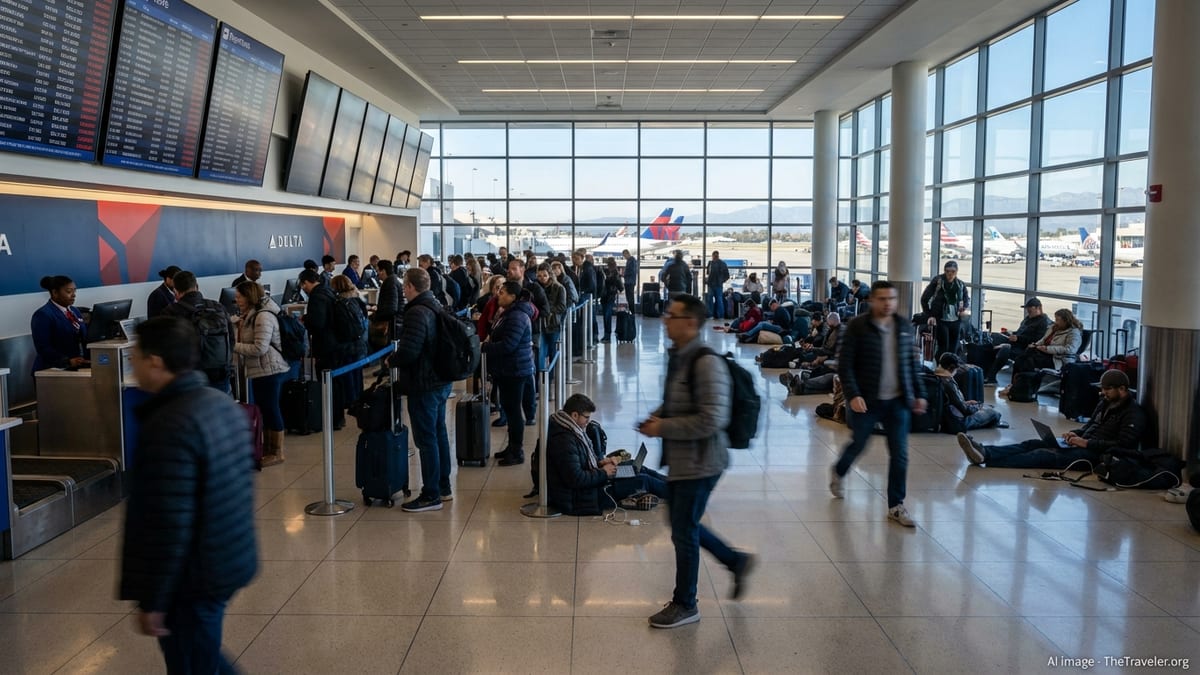
Inside LAX’s terminals, the human impact of the disruption is immediately visible. Departure boards are a patchwork of red “canceled” notices and lengthening estimated departure times, particularly on flights heading east and onward to Europe and Asia. Lines at check-in counters and customer service desks stretch down concourses as passengers seek new options, accommodation vouchers or details on when they can reasonably expect to depart.
Many travelers are juggling rapidly changing notifications from airline apps, text messages and public address announcements. Some have arrived at the airport to find their flight canceled only minutes before scheduled boarding, while others have sat on the tarmac waiting for updated departure times as airlines work through deicing and congestion issues at destination airports.
For those whose trips are time-sensitive, the limited alternatives are adding to the frustration. Seats on remaining flights to New York, Chicago, London and Tokyo are in high demand, often selling out even as airlines upgauge aircraft or add recovery services where possible. Overland alternatives are thin for West Coast travelers, with no practical rail substitute for coast-to-coast journeys and long-distance bus options offering only partial relief on shorter segments.
Airport staff are encouraging passengers to stay in close contact with their airlines, avoid arriving too early unless their flight is confirmed and allow additional time for security and boarding once a departure window is secured. Hotels near the airport are also reporting an uptick in last-minute bookings from stranded visitors forced to spend an extra night in Los Angeles.
What Los Angeles Travelers Should Expect Next
Forecasts indicate that the worst of the blizzard conditions in the Northeast will ease by late Tuesday, but aviation experts caution that the airline system will not snap back to normal immediately. For Los Angeles travelers, the coming 48 to 72 hours are likely to feature a mix of improving reliability and pockets of persistent disruption, especially on flights linked to New York, Boston and other storm-battered hubs.
Airlines are expected to continue adjusting schedules dynamically, canceling some flights in advance in order to protect the remainder of the network from further knock-on delays. This strategy may mean fewer last-minute surprises at the gate but could also result in reduced frequency on some routes until aircraft and crews are fully repositioned.
Travel advisers recommend that passengers check flight status repeatedly in the hours leading up to departure, keep boarding passes and travel documents easily accessible for potential rebooking, and consider carrying essential items in hand luggage in case of unexpected overnight stays. Those with flexibility are being urged to move travel to later in the week, when operations should be closer to normal and the backlog of stranded travelers has begun to clear.
For now, Los Angeles remains a crucial pressure point in a national aviation system under stress, serving both as a gateway for long-haul international journeys and as a key domestic hub. How quickly the current wave of 110 delays and 42 cancellations subsides will depend not on California’s blue skies, but on how fast airlines can dig out from a historic winter storm unfolding thousands of miles away.