

More news on this day
Spokane running icon Doug Kelley, a co-founder of the city’s famed Lilac Bloomsday Run, is stranded in Qatar after fast-escalating military strikes across the Persian Gulf shut down air routes and left thousands of travelers searching for a way home.
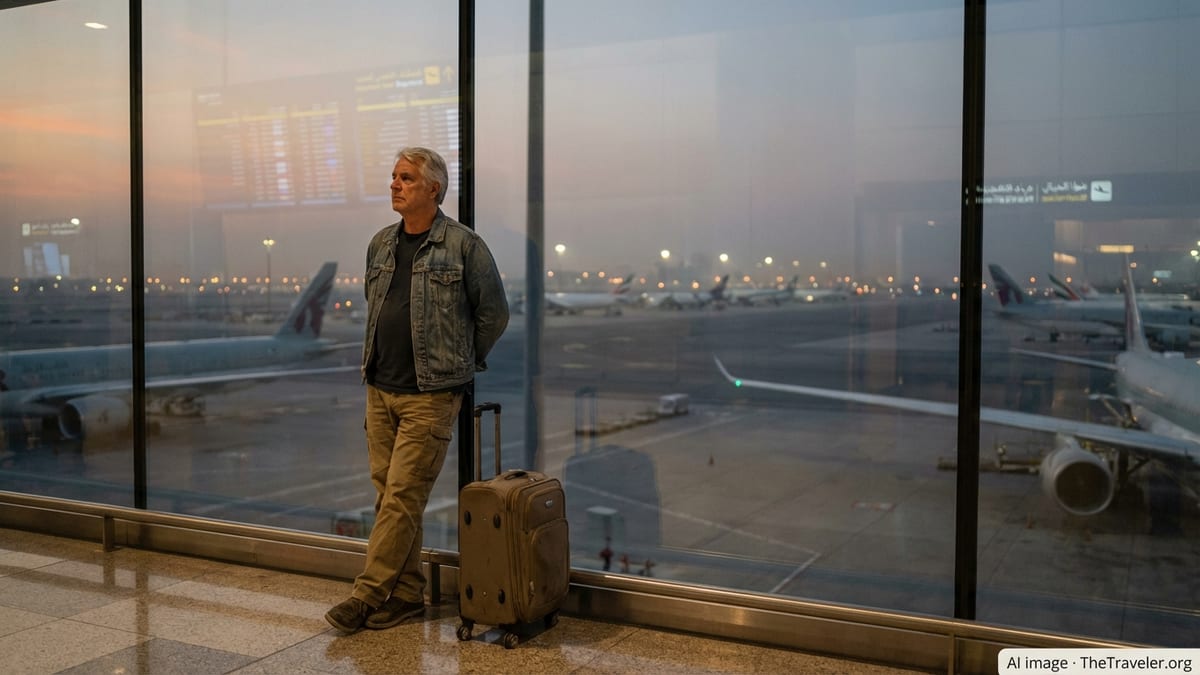
A Routine Layover Turns Into a Crisis Zone
Kelley, who helped organize the first Bloomsday in Spokane in the late 1970s and later served as its inaugural race director, was returning from a trip to Africa when events in the Middle East abruptly shifted around him. His itinerary routed him through Doha, Qatar, a busy global hub that suddenly found itself on the front line of a widening regional conflict.
Relaxing at a beach resort on the outskirts of the Qatari capital, Kelley first noticed something was wrong when an emergency alert flashed across his phone in Arabic. Unfamiliar with the language, he could not immediately decipher the warning. Within minutes, more alerts followed and the atmosphere along the waterfront shifted as security staff started moving visitors off the sand.
Unbeknown to Kelley at that moment, U.S. and Israeli forces had launched a major attack on Iran across the Persian Gulf. In response, Iranian forces fired missiles toward American interests in the region, including the vast Al Udeid Air Base located just outside Doha. The exchange sent shockwaves through regional aviation and jolted once-routine stopovers like Kelley’s into a landscape of uncertainty.
By the time Kelley hailed a cab back to his hotel, a new alert arrived in English, with a blunt instruction: shelter inside. As traffic thinned on the normally busy roads, his short ride back to central Doha became an unsettling window into a city bracing for potential escalation.
Missile Booms Over Doha and a City on Edge
From his hotel balcony, Kelley watched and listened as the night sky echoed with what he later described as a series of booms overhead. The rolling detonations continued for hours, punctuated by at least two explosions so close they rattled his room. Qatar’s Defense Ministry has since said its forces intercepted inbound missiles before they reached populated areas, while acknowledging that debris fell across parts of the country.
The seasoned traveler has experienced violence abroad before, including bombings in Paris and Kathmandu. Yet he told friends and family that the sensation of missiles streaking overhead felt different, more disorienting than past brushes with danger. In Doha, the conflict was not an abstract news item but a physical presence in the sky, audible and, at times, almost tangible.
As the evening wore on, the normally vibrant city grew quieter. Public spaces emptied, and visitors sought refuge in hotel rooms and lobbies, scrolling news alerts and messaging home. For Kelley, used to the celebratory roar of tens of thousands of runners surging through Spokane each May, the hush in Doha underscored just how quickly a familiar travel corridor could feel foreign and fragile.
Officials in Qatar have stressed that normal life continues, but residents and visitors alike are contending with sporadic disruptions, heightened security, and the psychological weight of living within reach of a volatile front line. For Americans in the city, the U.S. embassy’s message has been clear: stay sheltered, stock essential supplies, and keep a low profile until the situation stabilizes.
Grounded Flights and a Regionwide Travel Snarl
The same skies that carried missiles have largely emptied of commercial traffic. In the hours after Iran’s retaliation, major airlines canceled or rerouted flights across swaths of Middle Eastern airspace, including routes over Iran, Iraq, Kuwait, Israel, and Bahrain. Aviation authorities in Europe advised carriers to avoid the region until risks can be reassessed, further constricting the global network that typically funnels passengers through hubs like Doha, Dubai, and Abu Dhabi.
For Kelley, the immediate impact was stark. The Sunday morning flight he expected to carry him out of Qatar abruptly showed as canceled, even though he had yet to receive formal notice from the airline. With schedules in flux and neighboring routes disrupted, viable alternatives dwindled, leaving him and many others effectively marooned.
Travelers in Doha describe a limbo defined by partial information and rapidly shifting advisories. Airline counters and call centers are struggling to keep up as carriers juggle aircraft, crews, and safety assessments. Online maps that usually display a dense lattice of long-haul flights now show wide gaps over the northern Gulf, a visual reminder of how regional tensions can ripple through the global travel system.
U.S. officials are urging citizens across the region to monitor local media, conserve phone batteries, and plan for possible extended stays. For those like Kelley, whose journeys began as standard long-haul itineraries with a single connection, the path home has become an open question measured not in hours but potentially days or weeks.
From Spokane’s Streets to a Global Flashpoint
Back in Spokane, Kelley is best known as one of the architects of the Lilac Bloomsday Run, the 12-kilometer race that has grown into one of the largest road events in the United States. As a member of the Spokane Jaycees in the 1970s, he worked alongside Olympic marathoner Don Kardong to transform the idea of a community road race into a signature civic celebration.
Over the decades, Bloomsday has drawn tens of thousands of runners annually, helped cement Spokane’s reputation as a running town, and spawned a host of related traditions, from the iconic runners sculpture downtown to the stories of generations who have made the race a yearly ritual. Kelley’s years as race director in the early 1980s helped lay the organizational groundwork that allowed the event to grow while retaining its homespun spirit.
Family, friends, and fellow runners in Spokane are now watching news out of Doha with particular concern, following updates as Kelley navigates the overlapping worlds of crisis management and international air travel. For a community used to seeing him shepherd others safely through crowded streets and challenging hills, the reversal of roles feels striking.
Local running groups and Bloomsday veterans have shared notes of support, hoping the man who helped guide so many runners across a finish line will soon find a safe route back across continents. In an era when Spokane’s hometown race has long attracted participants from around the world, Kelley’s predicament underscores how intertwined local traditions and global events have become.
Waiting Out Uncertainty in a Changed Travel Landscape
For now, Kelley appears resigned to the likelihood that he will be in Doha longer than planned. He has joked about needing to buy more books to pass the time, even as he follows official guidance to shelter indoors, keep essentials on hand, and remain reachable. It is a mix of pragmatic preparation and gallows humor that seasoned travelers often adopt when forces far beyond their control reshape their itineraries.
Qatar’s hotels, accustomed to short stopovers and brisk business travel, are pivoting to host guests who no longer know their departure dates. Concierges and front-desk staff field questions about flight status and safety as frequently as they arrange taxis or restaurant reservations. Behind the scenes, airlines and embassies are weighing how to restart routes or organize assisted departures without exposing crews and passengers to unacceptable risk.
For travelers across the Middle East, the episode highlights the fragility of even the most established corridors. Doha, Dubai, and Abu Dhabi have built global reputations as efficient, reliable transit points connecting East and West. In the span of a day, geopolitical shocks turned those same hubs into holding points for thousands of people like Kelley, caught at the intersection of personal journeys and national strategies.
As Spokane prepares for another spring and another Bloomsday, the community’s attention is briefly fixed not on Doomsday Hill or finish-line clocks, but on a quiet hotel room a world away. There, one of the race’s original standard-bearers is waiting for the skies to clear and for the complex machinery of modern air travel to spin back into motion, so he can complete a journey home that suddenly carries far more weight than a simple connection on a long-haul ticket.