

More news on this day
Blue Flag Capital is preparing to expand its lifestyle hospitality portfolio in Summer 2026, with four new design-forward hotels expected to open under the Faraway banner and related concepts in high-profile leisure destinations.
Get the latest news straight to your inbox!
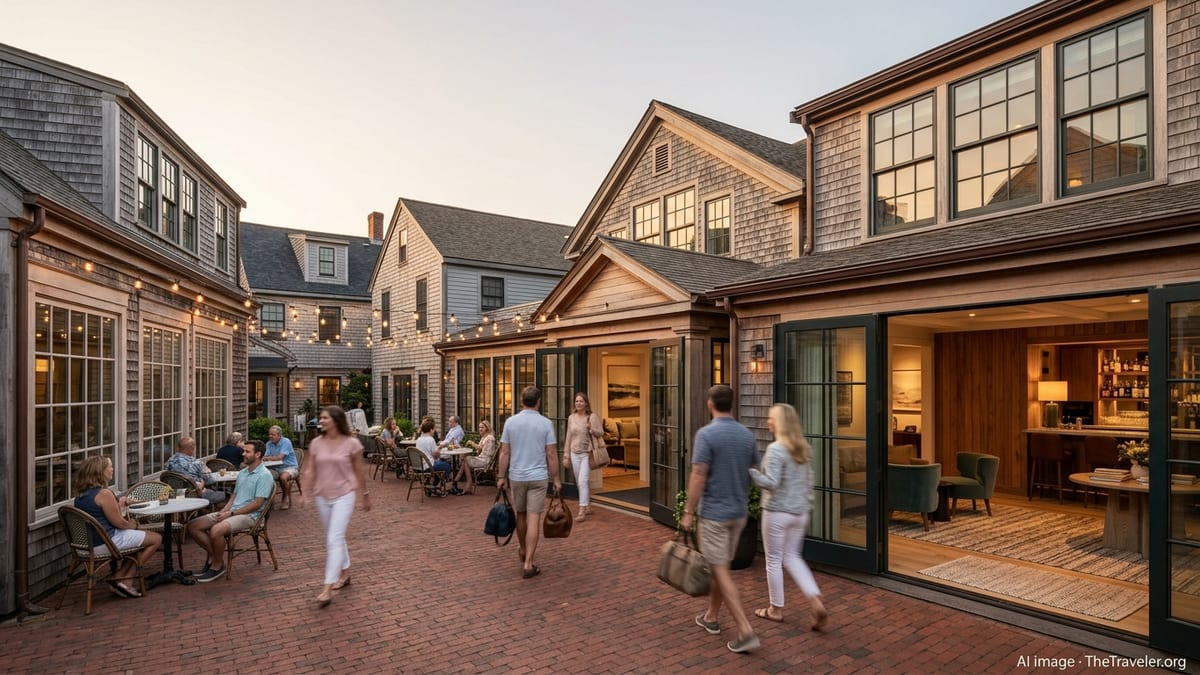
Expanding a Design-Led Hospitality Portfolio
Blue Flag Capital, the hospitality-focused real estate investment platform that traces its origins to Blue Flag Partners, has spent the past several years building a portfolio of boutique hotels that prioritize bold interiors, restored historic buildings, and walkable leisure locations in New England resort towns. Publicly available information on the company and its Faraway Hotels brand highlights projects in Nantucket, Martha’s Vineyard, and other coastal destinations, all emphasizing layered interiors, curated art, and an emphasis on social spaces over traditional resort formality.
Recent coverage of the company’s work describes a strategy centered on repositioning existing inns and small resorts into higher-yield lifestyle properties with strong design narratives. Properties such as Faraway Nantucket and Faraway Martha’s Vineyard, along with the reimagined Beachside Hotel on Nantucket, have been cited in travel media for blending historical architecture with contemporary design details and destination-specific storytelling. This pattern of adaptive reuse and design-forward repositioning forms the backdrop for the next phase of expansion scheduled for Summer 2026.
With new openings planned across multiple markets, Blue Flag Capital is poised to translate its New England playbook to a broader footprint. The four hotels scheduled to debut in 2026 are expected to deepen the company’s presence in established coastal enclaves while introducing the Faraway aesthetic and operating philosophy to new regions with strong seasonal and year-round demand.
Faraway Sag Harbor Anchors New York Expansion
One of the most closely watched projects in Blue Flag Capital’s pipeline is Faraway Sag Harbor, slated to open in Summer 2026. Industry development reports describe the hotel as part of a broader collaboration between Blue Flag Capital, its Faraway Hotels platform, and institutional real estate partners, bringing the boutique brand from New England into the Hamptons. The move aligns the company with one of the most competitive luxury leisure markets in the United States while maintaining its focus on intimate scale and strong design identity.
Published hospitality announcements outline Faraway Sag Harbor as a design-led property expected to blend the maritime character of the village with a more eclectic, globally inspired interior style. The project is positioned to tap into demand from travelers who prefer walkable, small-town environments over large resort compounds, while still expecting sophisticated food and beverage, social courtyards, and thoughtfully designed guest rooms.
Blue Flag Capital’s recent acquisitions and development activity around Sag Harbor suggest that the company views the East End of Long Island as a natural extension of its Nantucket and Martha’s Vineyard cluster. By establishing a Faraway-branded property in Sag Harbor, the group is effectively creating a coastal circuit for repeat guests who favor design-focused, mid-scale luxury hotels and seek similar experiences across different seaside destinations.
New England Beachside Concept Builds on Nantucket Success
Blue Flag Capital’s Summer 2026 slate also appears to lean into the momentum of its reimagined Beachside Hotel in Nantucket, which has been profiled as a family-friendly resort with a strong design point of view. That project transformed an existing property near Jetties Beach into a relaxed, residential-feeling retreat with outdoor gathering spaces, a pool scene geared to both adults and children, and interiors that depart from classic nautical clichés in favor of warmer textures and a broader coastal palette.
Based on the company’s recent portfolio moves and public commentary, industry observers expect at least one of the four forthcoming 2026 hotels to expand this family-forward beachside concept to another New England shoreline destination. Such a property would likely emphasize flexible room configurations, kid-friendly amenities layered with adult-focused programming, and an aesthetic that feels more like a modern beach house compound than a traditional resort.
If the new Beachside-branded or beach-inspired hotel follows the model established on Nantucket, travelers can anticipate outdoor firepits, lawn games, and casual dining concepts that encourage guests to linger on property between beach outings. The approach fits into a wider trend identified in hospitality analysis, in which boutique operators pursue experiential, design-rich family resorts in place of more standardized, chain-led offerings.
Design-Forward Adaptive Reuse in Historic Settings
Blue Flag Capital’s earlier projects provide a clear blueprint for how its 2026 openings may be executed. Faraway Nantucket, for example, brought together several historic buildings around a central courtyard and introduced maximalist interiors that intentionally broke from the island’s dominant blue-and-white, shiplap-heavy vernacular. Meanwhile, smaller properties such as Blue Iris on Nantucket and refreshed historic inns have showcased the company’s interest in honoring original architecture while layering in contemporary art, custom lighting, and tactile finishes.
Travel and design coverage of these hotels has emphasized details such as Murano glass chandeliers, Portuguese-inspired textiles, and color-forward guest room schemes, all deployed within preserved 19th-century structures. The overall effect is a tension between old and new, where restored envelopes house decidedly current interiors and public spaces designed for socializing rather than purely for sleeping.
Observers expect a similar design philosophy to guide at least two of the four hotels debuting in Summer 2026. Likely candidates include historic buildings in walkable village centers or legacy motels near beaches, which can be reconfigured into compound-style properties with multiple courtyards and pocket lounges. By pairing adaptive reuse with intensive interior design, Blue Flag Capital is able to command higher average daily rates while preserving the architectural fabric that draws visitors to these destinations.
National Footprint and Evolving Guest Demands
Although Blue Flag Capital’s earliest hospitality investments were concentrated in coastal New England, recent development reports and transaction records indicate a deliberate shift toward a broader national footprint. The planned 2026 openings, led by Faraway Sag Harbor and complemented by additional beach and village properties, place the company in conversations about next-generation boutique operators that scale without sacrificing a strong sense of place.
Market research referenced in hospitality analyses suggests that travelers are increasingly seeking hotels that blend the service and comfort levels associated with luxury brands with the character and intimacy of independent inns. Blue Flag Capital’s strategy of under-100-key properties, outward-facing public spaces, and destination-specific design appears tailored to that demand, especially in secondary leisure markets where large-format luxury development is constrained by zoning, land availability, or community preference.
The four design-forward hotels slated for Summer 2026 are positioned to act as a litmus test for how far the Faraway and related concepts can stretch geographically while maintaining the idiosyncratic style that has defined them in Nantucket and Martha’s Vineyard. If successful, the openings could accelerate further growth into additional coastal regions and potentially select urban neighborhoods, reinforcing Blue Flag Capital’s role as a specialist in experiential, design-centric hospitality real estate.