

Blyde River Canyon is one of those rare landscapes that feels both cinematic and intimate. Stretching along the northern Drakensberg escarpment in South Africa’s Mpumalanga province, it is widely described as one of the largest canyons in the world, and arguably the largest green canyon because of its dense subtropical foliage.
Here, sheer cliffs rise roughly 800 meters above the Blyde River and the Blyderivierspoort Dam, viewpoints look down over a vast Lowveld plain, and iconic rock formations like the Three Rondavels punctuate a horizon of layered sandstone and mist.
This guide explains what to expect from a visit, how to plan your time along the famed Panorama Route, and how to experience the canyon from the rim, the water and the trails.
Understanding Blyde River Canyon and the Panorama Route
The Blyde River Canyon forms the heart of the Blyde River Canyon Nature Reserve, a protected area of roughly 260 square kilometers straddling the escarpment edge between the Highveld and the Lowveld. The canyon itself runs for about 26 to 30 kilometers, tracing the path of the Blyde River as it cuts through ancient quartzite and sandstone before feeding the dam at its lower end. Unlike the bare rock of many other great gorges, this is a canyon draped in green. Forested slopes, ferns, cycads and pockets of indigenous montane forest cling to near-vertical cliffs, especially in the wetter summer months.
Most travelers encounter Blyde River Canyon as part of the Panorama Route, a loop of scenic viewpoints, waterfalls and small towns that starts near the forestry and tourism hub of Graskop and arcs north past God’s Window, Bourke’s Luck Potholes and the Three Rondavels. The key driving artery is the R532 regional road, which runs north from Sabie and Graskop past many of the major viewpoints along the canyon’s western rim. A short spur road, the R534, loops off to access God’s Window and other lookout points before reconnecting with the main route. This ease of access makes the canyon one of South Africa’s most visited natural attractions, frequently combined with a safari in nearby Kruger National Park.
Although it is marketed as one of the world’s largest canyons, visitors are often more struck by its depth and drama than by statistics. At several viewpoints you look down almost a vertical kilometer to the river or reservoir below. The vistas change constantly as you drive: one moment you are on a misty cliff edge at God’s Window staring out over lowland plains; a short drive later you are at Bourke’s Luck Potholes peering into cylindrical rock pools carved by swirling water; further north, the canyon suddenly opens into a huge amphitheater dominated by the Three Rondavels rock towers.
This variety is what makes Blyde River Canyon such a satisfying destination. Even if you only have a day, you can assemble a rich experience that blends roadside viewpoints, short walks, geological curiosities, river scenery and, if time allows, a boat cruise down on the water. With more time, you can base yourself at one of the resorts or lodges close to the canyon and explore hiking trails, waterfalls and nearby historic towns like Pilgrim’s Rest.
When to Visit and What Weather to Expect
Blyde River Canyon is technically a year-round destination, but the experience changes markedly with the seasons. The region has a summer rainfall climate, with hot, sometimes humid conditions and frequent afternoon thunderstorms from roughly November to March. During this time, the canyon is at its greenest; the vegetation is lush, waterfalls are full and the landscape photographs as a tapestry of saturated greens and red rocks. The trade-off is that views can be obscured by low cloud and mist, particularly at higher viewpoints like God’s Window, and trails may be slippery after heavy rain.
The cooler, drier months from about May to September are widely regarded as the most comfortable time for hiking and driving the Panorama Route. Daytime temperatures are mild, often around 20 degrees Celsius, with much lower humidity. Skies tend to be clearer, which means better visibility from the viewpoints and more reliable photographic conditions. Winter mornings and evenings can be chilly on the escarpment, so you will want layers, but by midday the sun is usually warm. Several hiking and trekking resources, as well as regional tourism boards, emphasize June to August as an especially rewarding period for panoramic views.
Shoulder months like April, September and October can offer a pleasing compromise. In early spring, new foliage adds vibrant greens to the landscape without the full intensity of summer storms. This can be an excellent time for landscape photography, with softer light and often dramatic, cloud-filled skies without continuous rain. October and November see rising temperatures and the start of the rainy season; waterfalls swell and birdlife becomes more active, appealing to nature enthusiasts who do not mind occasional showers.
Whichever month you choose, it is worth remembering that the escarpment’s microclimate changes quickly. A clear view at one lookout can coincide with thick mist at another just a few kilometers away. Morning visits often have the best odds for clear skies, especially at the highest viewpoints. Pack a light rain jacket even in winter, as cold fronts can bring drizzle and wind. In summer, thunderstorms typically build in the afternoon, often accompanied by spectacular cloud formations that add drama to the canyon’s already imposing cliffs.
Getting There and Navigating the Area
Most visitors approach Blyde River Canyon from Johannesburg or Pretoria, driving or joining a tour on a route that also takes in Kruger National Park. The drive from Johannesburg to the canyon region, via the N4 to Mbombela (formerly Nelspruit) and then through Sabie and Graskop, takes roughly five to six hours under normal conditions. Rental cars are readily available in Johannesburg, Pretoria and at Kruger Mpumalanga International Airport near Mbombela, giving independent travelers flexibility to set their own pace along the Panorama Route.
The towns of Sabie and Graskop function as practical bases and gateways. Sabie, a former forestry town, lies to the south of the canyon and is surrounded by waterfalls and plantation forests. Graskop, a short drive north of Sabie, sits close to several headline viewpoints and has a growing range of guesthouses, eateries and roadside stalls. From Graskop, the R532 heads north to Bourke’s Luck Potholes and the Three Rondavels view site, while the R534 loops east and then north to God’s Window and other lookouts before rejoining the main road. Signage is generally clear, though having offline maps or a GPS-based app is helpful if you plan to explore side roads and lesser-known waterfalls.
The Blyde River Canyon Nature Reserve is managed by provincial conservation authorities, and separate entrance fees are charged at many individual attractions and view sites rather than at a single main gate. At popular spots you will find formal parking areas, simple visitor facilities and pay points where staff collect a per-person or per-vehicle fee. Fees are modest by international standards but vary for South African residents and foreign visitors, and you should expect them to change periodically. It is sensible to bring sufficient cash, as smaller sites and some activity operators may not accept cards or may have intermittent connectivity.
Several commercial resorts and activity centers sit close to the canyon. On the upper rim, resorts and lodges offer direct access to hiking trails and viewpoints. At the lower end, near the Blyderivierspoort Dam, operators run scenic boat cruises into the canyon, departing from a jetty accessed through a provincial gate with its own conservation fee. These facilities are generally reached on tarred or good gravel roads, but conditions can deteriorate after heavy rain, so allow extra time and ask locally about current road surfaces if you are driving a low-clearance vehicle.
Iconic Viewpoints and Geological Highlights
One of the defining pleasures of Blyde River Canyon is the sequence of viewpoints that reveal different facets of the landscape. Many travelers structure their day as a slow drive from Graskop northwards, stopping at a handful of highlights and tailoring the pace to the weather and crowds. Early starts are helpful not only for avoiding tour buses but also for catching the canyon while the light is still soft and the air clear.
God’s Window, accessed off the R534 not far from Graskop, is the most famous stop. From the parking area, a short, sometimes steep path leads to several viewing platforms perched on the lip of the escarpment. On a clear day, you can see far across the Lowveld, sometimes as far as the Kruger plains and the hazy line of the Lebombo Mountains on the horizon. The altitude here exceeds 1,700 meters, so clouds often roll in; patience can pay off as mist lifts to reveal patchwork forests and distant farmland thousands of meters below. The surrounding montane forest, draped in ferns and moss, hints at how much rainfall the escarpment intercepts.
Further north, Bourke’s Luck Potholes mark the dramatic confluence of the Treur and Blyde Rivers. Over millennia, swirling currents loaded with sand and stones have carved a series of cylindrical potholes and sculpted channels into the red and yellow bedrock. Today, walkways and footbridges let visitors peer directly down into these polished formations, where dark pools of water collect between honey-colored rock walls. It is a compact site, but one that rewards lingering to appreciate the patterns in the rock, the sound of the water and the way sunlight reflects off the pools. Short walking trails branch out to quieter viewpoints along the river.
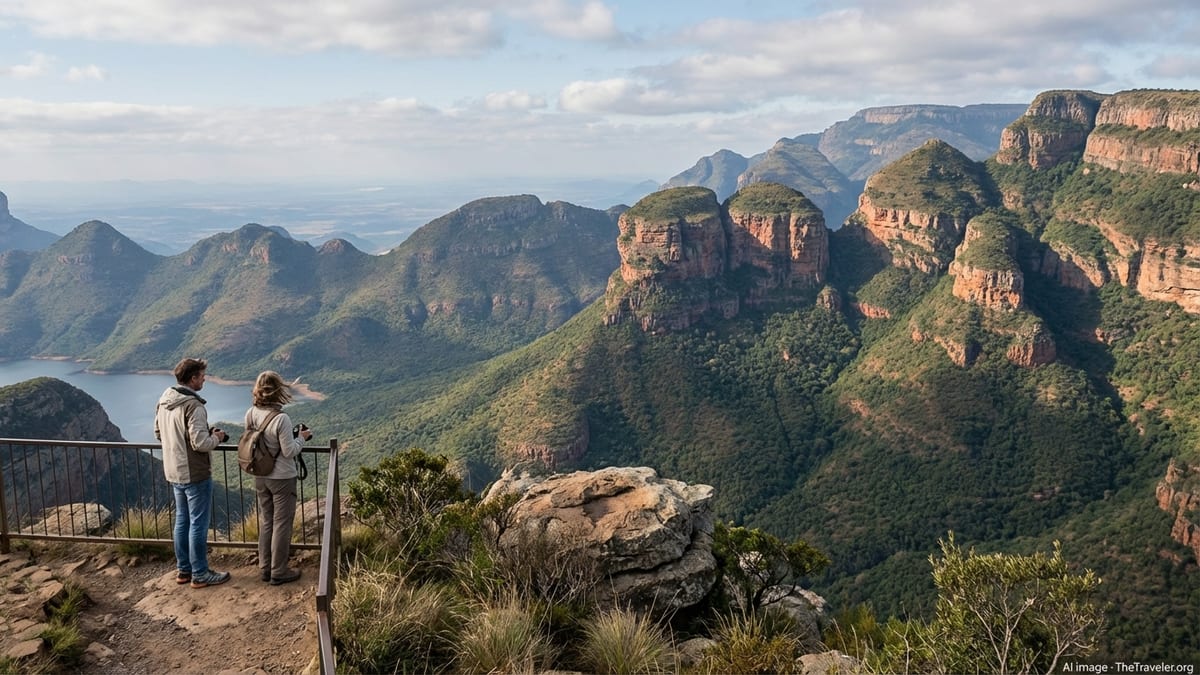
The Three Rondavels viewpoint, near the northern end of the commonly visited section of the canyon, offers the archetypal postcard vista. Here the canyon opens into an immense amphitheater dominated by three rounded rock buttresses that resemble traditional African roundhouses, hence their name. The formations, also referred to by local names as a chief and his three wives, rise above a wide bend in the reservoir, with distant peaks forming a sawtooth skyline beyond. From the fenced viewpoint, you look down into an 800-meter-deep gorge where the river gleams far below and vultures sometimes ride thermals along the cliffs. The scale is hard to capture on camera; being present on a still day, with only the wind and distant birds for company, is one of the defining Blyde experiences.
Experiencing the Canyon: Hiking, Boat Trips and Other Activities
Many visitors are content to tour Blyde River Canyon from their car, stepping out at viewpoints and returning to nearby accommodation by afternoon. For those who want to immerse themselves more deeply, the reserve offers a variety of hiking, boating and adventure options. Trails range from short, family-friendly walks to demanding overnight hikes, often threading through indigenous forest, grassland and rocky outcrops with frequent glimpses of the gorge.
Short interpretive trails start from several official picnic and view sites within the reserve, including at Bourke’s Luck Potholes and some of the rim viewpoints. These paths are typically well signposted and suitable for anyone with moderate fitness, though they can be steep in places and exposed to the sun. Longer day hikes, such as sections of canyon rim trails and routes descending closer to the river in designated areas, are usually accessed via resorts or conservation offices where permits are required. Conditions can change due to weather or maintenance, so it is important to check locally for up-to-date information on trail status and difficulty before setting out.
One of the most rewarding ways to appreciate the canyon’s scale is from the water. At the Blyderivierspoort Dam, near the lower end of the canyon, licensed operators run guided boat cruises that glide between towering cliffs and past waterfalls trickling over the rock face into the reservoir. Typical cruises last around 90 minutes and highlight the canyon’s geology, birdlife and plant communities. You may spot hippos wallowing near the shoreline, crocodiles basking on rocks and an array of birds including fish eagles and, more rarely, raptors like the Taita falcon. Cruises run several times a day and are strongly weather dependent; wind and storms can lead to cancellations or delays, so flexible planning is advisable.
Beyond hiking and boating, the wider Panorama Route region offers waterfall-hopping, zip lines, canyon swings, cultural visits and scenic drives to historic mining settlements. The town of Graskop has an adventure lift experience that descends into a forested gorge, while nearby Sabie is ringed by waterfalls such as Lone Creek, Bridal Veil and Mac Mac Falls. Many travelers combine a day of viewpoints and gentle walks at Blyde River Canyon with more adrenaline-focused activities elsewhere along the route, or with wildlife viewing in Kruger just a couple of hours’ drive to the east.
Wildlife, Ecology and Conservation
While Blyde River Canyon is best known for its scenery, the reserve also shelters a rich mosaic of plant and animal life. The steep gradient from escarpment to Lowveld, combined with varied geology and microclimates, creates multiple habitats in a relatively compact area. On the rim, grasslands and patches of Afromontane forest host ferns, mosses and tall trees that thrive in the misty conditions. Lower down, riverine forests, thickets and woodland cloak the canyon walls and riverbanks, interspersed with cliffs and rocky ledges.
Mammal sightings within the canyon itself tend to be occasional rather than guaranteed, especially compared with the nearby big-game reserves. However, species such as baboons, vervet monkeys, small antelope and rock hyrax are commonly seen along the roads and trails. Around the reservoir and rivers, you may encounter hippos and crocodiles, particularly from a boat. At dawn and dusk, bushbuck and other antelope can sometimes be glimpsed in the fringes of woodland. Travelers interested in big game typically focus their wildlife expectations on Kruger National Park or private reserves and treat Blyde River Canyon primarily as a scenic and hiking destination.
Birdlife is a major draw for many visitors. The cliffs and crags are home to raptors, including Verreaux’s eagles, peregrine falcons and sometimes rarer species that favor high escarpment habitat. The forested gullies host turacos, parrots and a variety of smaller birds, while the river and dam attract kingfishers, herons and fish eagles. Boat cruises often include informal birding commentary, and serious birdwatchers are advised to bring binoculars and a field guide. The interplay between birds riding thermals along the canyon walls and the changing light over the cliffs can be a highlight even for casual observers.
Conservation management in the reserve focuses on controlling invasive plant species, preventing soil erosion and balancing tourism access with environmental protection. Visitors can contribute by staying on marked paths, refraining from picking plants or disturbing wildlife, and taking all litter out with them. Fires are strictly controlled and generally only permitted in designated braai or picnic areas, where facilities are provided. Respecting fences and barriers at viewpoints is also crucial; they are designed not only for safety but to limit trampling of fragile vegetation along the rim.
Practicalities: Fees, Safety and Responsible Travel
Visiting Blyde River Canyon Nature Reserve involves a patchwork of small entrance fees collected at specific attractions, rather than a single consolidated park fee. At sites such as God’s Window, Bourke’s Luck Potholes and the Three Rondavels viewpoint, expect to pay a per-person fee or a fee that covers both entry and parking. At the dam, conservation fees are collected separately for those joining boat cruises. Rates often differ for South African residents and international visitors and are periodically updated, so current details should be confirmed with local tourism offices or directly at the gates.
In terms of safety, the reserve and main viewpoints are generally considered secure during daylight hours, particularly where there is a staff presence at gates and parking areas. As with any busy tourist region, petty theft from unattended vehicles can occur, so you should avoid leaving valuables visible in your car and make use of accommodation safes where available. Walking on marked trails in small groups or with a guide is recommended, especially on more remote routes. Mobile reception can be patchy in parts of the canyon, so do not rely solely on your phone for navigation or emergency contact.
Environmental conditions pose a more significant risk than crime for most visitors. The combination of altitude, strong sun and sometimes steep, uneven paths means that dehydration and sunburn are real possibilities, even on cooler days. Carry sufficient drinking water, wear a hat and sunscreen, and use footwear with good grip. In summer, thunderstorms can bring sudden lightning and heavy downpours; if dark clouds start to build or thunder is audible, it is wise to avoid exposed viewpoints and open ground. Trails near the river can be slippery after rain, and swimming is only advisable in designated areas under local guidance, as currents and submerged hazards can be deceptive.
Responsible travel here also encompasses sensitivity to local communities and culture. Parts of the land adjacent to the canyon are owned or co-managed by local communities, and several activity operators work in partnership with them. Choosing locally based guides, staying in community-linked lodges and buying crafts directly from artisans at roadside markets can help ensure that tourism revenue supports livelihoods in the area. A polite greeting, respectful photography (especially when people are in the frame) and a willingness to engage with local stories enrich the experience for both visitors and hosts.
The Takeaway
Blyde River Canyon rewards both the hurried day tripper and the traveler who lingers. Its scale is undeniable, but what stays with many visitors is the interplay of textures and moods: the way morning mist pools in the gorge and then burns off to reveal layered cliffs; the sound of water echoing through rock at Bourke’s Luck Potholes; the improbable symmetry of the Three Rondavels framed against a distant mountain wall. Add to that the straightforward access from Johannesburg and Kruger, and it becomes clear why this corner of Mpumalanga sits near the top of many South African itineraries.
Planning a visit is chiefly about timing and pacing. Give yourself at least a full day to drive the main viewpoints, and more if you want to add a hike or a boat cruise. Aim for the drier months if you prioritize clear views and comfortable walking, or embrace the summer rains if a greener, more dramatic canyon appeals. Respect the environment, support local operators and keep an eye on the sky as much as the map. In return, Blyde River Canyon will reveal a landscape that feels ancient, resilient and quietly exhilarating.
FAQ
Q1: How many days do I need to properly visit Blyde River Canyon?
Most travelers can see the main viewpoints and enjoy a relaxed pace in one full day, but two to three days allow time for a boat cruise, short hikes and visits to nearby waterfalls and towns along the Panorama Route.
Q2: What is the best time of year to visit the canyon?
The cooler, drier months from May to September generally offer the clearest views and most comfortable hiking conditions, while the summer rainy season from November to March brings lusher vegetation and fuller waterfalls but more cloud and afternoon storms.
Q3: Do I need a 4x4 vehicle to explore the area?
No, the main roads and viewpoints along the Panorama Route are accessible by standard two-wheel-drive vehicles, although a higher-clearance car can be more comfortable on some gravel access roads, especially after heavy rain.
Q4: Are there entrance fees for Blyde River Canyon?
Yes, entrance fees are typically charged at individual sites such as God’s Window, Bourke’s Luck Potholes, the Three Rondavels viewpoint and the dam area; the amounts vary and may differ for local residents and international visitors.
Q5: Can I hike inside the canyon without a guide?
Short, well-marked trails at official viewpoints and picnic sites can usually be walked independently by fit visitors, but longer or more remote routes often require permits and are safer and more informative with a local guide.
Q6: Is swimming allowed in the Blyde River or the dam?
Swimming is generally restricted to designated areas, as currents, changing water levels and submerged rocks can be hazardous; check locally for any safe swimming spots and always follow posted signage and official guidance.
Q7: Are there accommodations close to the canyon?
Yes, there are several lodges, resorts, guesthouses and self-catering options in and around Graskop, Sabie and near the canyon rim and dam, catering to a range of budgets and travel styles.
Q8: How crowded does Blyde River Canyon get?
The most popular viewpoints can become busy during weekends, public holidays and school vacations, but visiting early in the morning, traveling outside peak holiday periods and exploring lesser-known stops can provide a more tranquil experience.
Q9: Is it safe to visit Blyde River Canyon with children?
Yes, families regularly visit the canyon, but close supervision is essential near cliff edges, on steep paths and around water; choosing shorter walks, established viewpoints and guided activities helps keep visits child friendly.
Q10: Can I combine a visit to Blyde River Canyon with a Kruger National Park safari?
Absolutely; many itineraries include one or two days on the Panorama Route and at Blyde River Canyon before or after a safari in Kruger, as the driving distance between the canyon region and Kruger’s western gates is only a few hours.